


Visual Paradigm (VP) has evolved far beyond a simple diagramming application. Today, it is a robust Application Lifecycle Management (ALM) and enterprise architecture platform. By bridging the gap between high-level design, iterative development, and emerging technologies, Visual Paradigm provides a unified environment for modern software engineering.
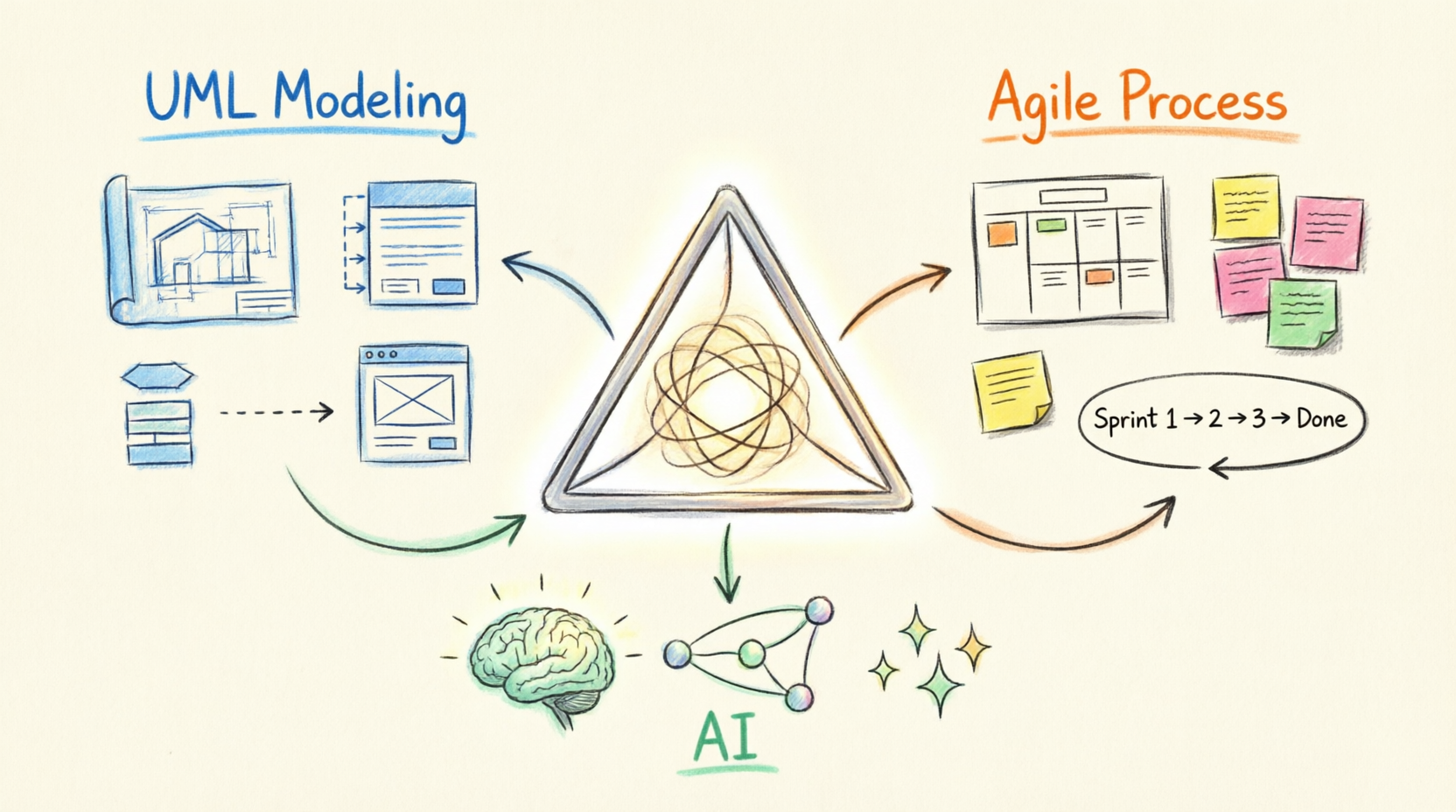
This comprehensive guide explores how Visual Paradigm tooling empowers teams across three critical domains: UML Modeling, Agile Processes, and Artificial Intelligence (AI).
Part 1: Mastering UML Modeling with Visual Paradigm
At its core, Visual Paradigm is a powerhouse for the Unified Modeling Language (UML). It supports the full spectrum of UML 2.5 diagrams, transforming abstract ideas into concrete, executable blueprints.
Key Concepts
-
Model-Driven Development (MDD): The practice of creating models that serve as the primary artifact of development, from which code and documentation are generated.
-
Round-Trip Engineering: The ability to generate code from UML models (Forward Engineering) and update UML models based on changes made in the source code (Reverse Engineering).
-
Diagram Interchange & Traceability: Linking elements across different diagrams (e.g., linking a class in a Class Diagram to an object in a Sequence Diagram) to maintain architectural consistency.
Examples in Practice
-
Designing a Microservices Architecture: An architect uses a Component Diagram to map out the boundaries of the Payment, Inventory, and User microservices. They then use a Deployment Diagram to map these components to Kubernetes pods and cloud infrastructure.
-
Forward Engineering to Code: A developer creates a detailed Class Diagram for a new
OrderProcessingmodule, defining attributes, methods, and relationships. With a single click, Visual Paradigm generates the boilerplate Java, C#, or Python code, complete with interfaces and dependency injection frameworks (like Spring Boot). -
Reverse Engineering Legacy Code: A team inherits a massive, undocumented C++ codebase. They use VP’s Reverse Engineering feature to automatically generate a comprehensive Class Diagram, allowing them to understand the existing architecture before refactoring.
💡 Pro-Tip: Use the Wireframe & UI Modeling tools in VP alongside your UML diagrams. You can link a UI mockup directly to a Use Case diagram, ensuring the frontend design aligns with backend business logic.
Part 2: Streamlining the Agile Process
Agile methodologies thrive on adaptability, but they often suffer from a lack of architectural visibility. Visual Paradigm integrates Agile management directly into the modeling environment through its Agilest module, ensuring that design and development remain synchronized.
Key Concepts
-
Agilest (Agile Management): VP’s built-in Agile tool that supports Scrum, Kanban, and SAFe (Scaled Agile Framework) directly alongside your UML models.
-
Living Documentation: Because models and code are synchronized, and Agile artifacts are linked to these models, your documentation updates automatically as the project evolves.
-
End-to-End Traceability: The ability to trace a line from a high-level business requirement down to a specific line of code or database schema.
Examples in Practice
-
From User Story to Sequence Diagram:
-
A Product Owner creates a User Story in the Agilest Kanban board: “As a customer, I want to track my order in real-time.”
-
The developer opens this story and creates a Sequence Diagram showing the interaction between the Mobile App, API Gateway, and Tracking Service.
-
The diagram is automatically linked to the User Story. When the sprint is reviewed, stakeholders can see both the Agile progress and the technical design in one place.
-
-
Sprint Planning with Impact Analysis: During sprint planning, a team realizes they need to change the database schema. Using VP’s Impact Analysis tool, they can instantly see which UML models, Agile user stories, and test cases will be affected by this change, allowing for accurate sprint estimation.
-
Definition of Done (DoD) Automation: VP can be configured so that a User Story in Agilest cannot be moved to “Done” until the linked UML models are updated and the corresponding code has passed automated CI/CD pipeline checks.
Part 3: Integrating Artificial Intelligence (AI)
As of 2026, AI is no longer just a subject to be modeled; it is an active participant in the modeling process. Visual Paradigm supports AI in two distinct ways: AI-Assisted Modeling (using AI to build models) and Modeling AI Systems (designing AI/ML architectures).
Key Concepts
-
Generative AI for Modeling (VP AI): Leveraging Large Language Models (LLMs) to generate UML diagrams, code snippets, and documentation from natural language prompts.
-
Ontology and Knowledge Graph Modeling: Using UML extensions and specialized data modeling tools to design the semantic structures required for AI and machine learning.
-
Data Flow & Pipeline Modeling: Utilizing Data Flow Diagrams (DFD) and specialized ML pipeline diagrams to map out data ingestion, training, and inference processes.
Examples in Practice
-
AI-Assisted Diagram Generation: A business analyst is in a meeting and needs to capture a complex process quickly. They type a prompt into VP AI: “Generate a sequence diagram for a user resetting their password via email OTP, including error handling for expired tokens.” VP instantly generates the editable UML diagram, which the analyst then refines.
-
Designing an ML Pipeline: A data architect uses Visual Paradigm to design a Machine Learning recommendation engine. They use a Data Flow Diagram (DFD) to map the flow of user clickstream data from Kafka into a data lake, through a Spark training cluster, and out to a Redis inference cache.
-
Ontology Modeling for NLP: For a Natural Language Processing (NLP) project, an engineer uses VP’s ontology tools to define classes, properties, and relationships (e.g.,
Customer,hasSentiment,ProductReview). This semantic model is then exported to OWL/RDF formats to train the AI’s knowledge graph.
💡 Pro-Tip: Use VP AI to generate unit tests. By selecting a Class Diagram or a block of generated code, you can prompt the AI to generate comprehensive JUnit or PyTest test cases based on the modeled business rules.
Part 4: The Synergy: UML + Agile + AI in Action
The true power of Visual Paradigm is realized when these three pillars intersect. Here is a real-world scenario of how a modern tech team uses the unified VP ecosystem.
The Scenario: A team is building an AI-powered fraud detection system for a banking app.
-
Agile Initiation: The team sets up a Scrum board in Agilest. They define Epics (“Identity Verification”, “Transaction Scoring”) and break them down into User Stories.
-
AI-Assisted Design: To save time, the lead architect uses VP AI to generate an initial Component Diagram of the fraud detection microservices based on the Epic descriptions.
-
UML Refinement: The architect refines the AI-generated diagram, adding specific State Machine Diagrams to model the lifecycle of a “Flagged Transaction” (e.g., Pending -> Under Review -> Approved/Rejected).
-
Agile Execution & Traceability: Developers pull User Stories from the Agile board. They use Forward Engineering to generate the Java/Spring Boot code from the refined Class Diagrams. Every piece of code is tagged with the User Story ID.
-
Continuous Feedback: As the AI model is trained and the code is updated, the team uses Reverse Engineering to keep the UML models in sync. The Agile board automatically reflects the completion of technical tasks, providing the Product Owner with a real-time, visually backed view of project health.
Conclusion
Visual Paradigm is much more than a tool for drawing boxes and arrows. It is a comprehensive ecosystem that brings order to complexity.
-
By leveraging UML, teams ensure architectural integrity and automate code generation.
-
By integrating Agile (Agilest), teams maintain flexibility, traceability, and alignment with business goals.
-
By embracing AI, teams accelerate the design process and possess the specialized tooling required to architect the next generation of intelligent applications.
For organizations looking to mature their software delivery pipelines, adopting Visual Paradigm as a central ALM hub provides the visibility, automation, and intelligence required to succeed in the modern software landscape.
Related posts:
 Mastering UML Component Diagrams with Visual Paradigm: A Modern Guide
 Beyond Notes: My Hands-On Review of Visual Paradigm OpenDocs as a Unified Knowledge Hub
 Bridging Knowledge Silos: Seamlessly Publish OpenDocs Content to WordPress
 Create Stunning Interactive Documentation: A Complete Guide to Flipbooks, Bookshelves, and WordPress Integration with Visual Paradigm OpenDocs