


The BPMN (Business Process Model and Notation) Working Group is responsible for the ongoing maintenance and evolution of the BPMN standard. A critical function of this group is to vote on proposed changes, clarifications, and new features. Given the global distribution of the working group members and the complexity of the proposals, the voting process cannot be conducted in a single, synchronous meeting.
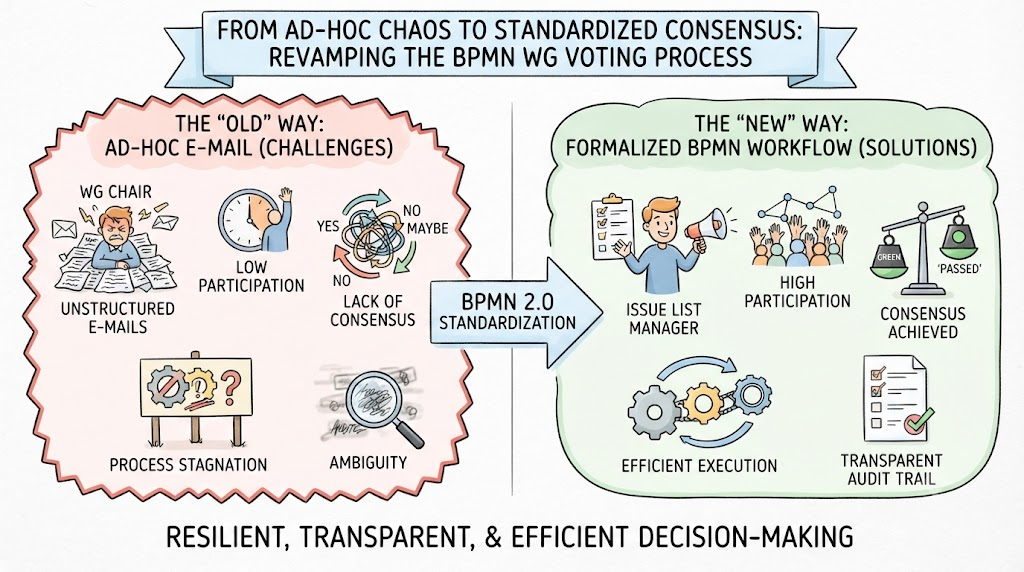
Historically, the group relied on an ad-hoc e-mail voting process. However, this process suffered from several critical issues:
-
Low Participation: Often, a quorum was not reached because members missed e-mail calls for vote or failed to participate in discussions.
-
Lack of Consensus: Complex issues often failed to achieve a clear majority in the first round, leading to prolonged e-mail threads that went in circles.
-
Process Stagnation: When consensus or participation failed, the process would sometimes stall, requiring manual intervention by the Working Group Chair to restart or reset the discussion.
-
Ambiguity: There was no clear audit trail of who was warned about low participation or why a particular decision was ultimately made.
To address these challenges, the Working Group decided to formalize and standardize their e-mail voting process using BPMN 2.0. The goal was to create a resilient, transparent, and efficient model that could handle these complex, multi-party scenarios without requiring constant manual oversight by the Chair.
The BPMN Solution
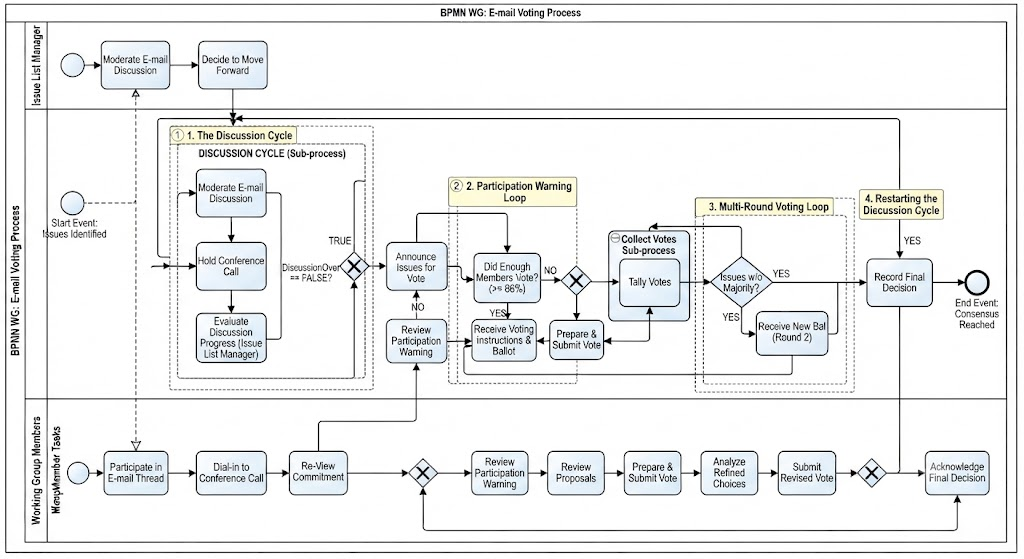
The resulting process, visualized in the diagram (image_3.png), is a sophisticated collaboration model that clearly separates responsibilities between the Issue List Manager (the process administrator) and the Working Group Members (the voters). The model is structured to handle the entire lifecycle of an issue, from identification to final consensus, with specific, automated safeguards (loops) to handle common process failures.
Detailed Process Analysis
The process is initiated by a Start Event: Issues Identified. The flow is then structured into four key phases, which correspond to the numbered loops in the diagram.
-
Phase 1: The Discussion Cycle (Sub-process)
-
Role: Issue List Manager.
-
Activities: The Manager initiates a discussion by moderating e-mail threads and holding conference calls. This is crucial for complex topics where a simple up/down vote is insufficient.
-
Loop Mechanism: At the end of this sub-process, the Manager performs the task “Evaluate Discussion Progress (Issue List Manager)”. This task sets the variable
DiscussionOver == TRUEorFALSE. -
Resilience: If the discussion is deemed incomplete or new issues are raised, the process loops back to the beginning of the “Moderate E-mail Discussion” activity. This prevents the process from prematurely moving to a vote before the issue is mature.
-
-
Phase 2: The Participation Warning Loop
-
Role: Issue List Manager and Working Group Members.
-
Activities: Once the discussion is over, the Manager initiates a vote by performing the task “Announce Issues for Vote”.
-
Loop Mechanism: The process then waits for members to vote. The critical step is the gateway “Did Enough Members Vote? (>= 86%)”. This requires a high quorum (86%) to ensure a legitimate result.
-
Resilience (The Warning System): If the quorum is not met (“NO”), the process follows a specific exception path.
-
Members who have not voted receive a “Review Participation Warning” task.
-
Simultaneously, the Manager’s pool triggers a task to “Review Participation Warning”, ensuring transparency.
-
This flow loops back to the “Announce Issues for Vote” task. Crucially, this loop can only happen once. The Members’ pool shows a “Re-View Commitment” task, followed by a gateway. This ensures that if a member fails to vote after being warned, their vote is recorded as an abstention in the next cycle, preventing endless loops of warnings. This loop is a key feature for enforcing accountability.
-
-
-
Phase 3: The Multi-Round Voting Loop
-
Role: Issue List Manager and Working Group Members.
-
Activities: If a quorum is met, the votes are collected and tallied within the “Collect Votes Sub-process”.
-
Loop Mechanism: After tallying, the gateway “Issues w/o Majority?” checks if the proposals have achieved the necessary support.
-
Resilience (Refining Choices): If an issue lacks a majority, the process enters a refinement loop. The Manager’s pool shows the task “Analyze Refined Choices” (often based on the initial vote’s feedback) and the members are asked to “Submit Revised Vote”. This allows the group to narrow down options (e.g., from five options to the top two) and re-vote, rather than simply failing the issue. This loop is designed to resolve complex preference issues without restarting the entire discussion.
-
-
Phase 4: Restarting the Discussion Cycle
-
Role: Issue List Manager.
-
Activities: This is the ultimate exception path for intransigent issues.
-
Loop Mechanism: After the “Multi-Round Voting Loop” is exhausted, the gateway “Failed 2 Voting Cycles?” checks if the issue has failed to achieve consensus after two full rounds of voting.
-
Resilience (The Full Reset): If the answer is “YES”, the process flow is reset, not ended. A message flow connects this gateway back to the start of the “1. The Discussion Cycle” sub-process. This forces the group to go back to the drawing board, re-frame the problem, and begin the discussion phase all over again with fresh context. This prevents the process from terminating in an “unresolved” state and provides a clear, documented path for escalation.
-
Detailed Explanation of the BPMN E-mail Voting Process
The provided BPMN diagram represents a structured, collaborative workflow designed to resolve issues within the BPMN working group. The model is defined as a collaboration between two primary participants, or “Pools”: the Issue List Manager and the Working Group Members.
The process flow is governed by four distinct, complex loops that ensure the group reaches a consensus or manages participation issues effectively.
1. The Discussion Cycle Internal Loop
The process begins with the “Discussion Cycle” sub-process, which is the primary activity for managing new issues.
-
Mechanism: Within this sub-process, the Issue List Manager executes the “Evaluate Discussion Progress” task.
-
Logic: This task updates a
DiscussionOvervariable to either TRUE or FALSE. -
Loop Action: If the variable is set to FALSE, the sub-process triggers a loop, requiring the entire cycle of e-mail moderation and conference calls to repeat until the discussion is considered complete.
2. The Participation Warning Loop
This loop acts as a safeguard against low voter turnout toward the end of the voting phase.
-
Mechanism: The process reaches a decision point asking, “Did Enough Members Vote?”. Approval requires a two-thirds majority of voting members.
-
Loop Action: If the response is NO, the system checks if the members have already received a warning. If not, the process loops back to the “Announce Issues for Vote” task to initiate a second voting cycle with an attached warning.
3. The Multi-Round Voting Loop
When the first vote fails to reach a majority, this loop provides a mechanism to refine the choices available to members.
-
Mechanism: If there are “Issues w/o Majority?” after the initial vote, a sub-process executes to narrow down the potential solutions to the two most popular options.
-
Loop Action: Voters are then requested to change their votes based on the refined options, and the flow loops back to the “Collect Votes” sub-process for a second, more focused round.
4. Restarting the Discussion Cycle
This is the final, ultimate loop for when the voting process fails to produce a resolution after multiple attempts.
-
Mechanism: If the multi-round voting loop has been exhausted without a successful consensus, the process checks if two failed voting cycles have occurred.
-
Loop Action: Rather than terminating, the process resets entirely, looping back to the initial “Discussion Cycle” sub-process to restart the discussion phase.
Summary of Key BPMN Concepts Used
-
Collaboration Pools: The diagram separates the responsibilities between the Issue List Manager (who orchestrates the process) and the Working Group Members (who participate in discussions and voting).
-
Synchronization: The model uses these four loops to synchronize activities across parallel paths, such as timers, e-mail moderation, and conference calls, ensuring the manager maintains a clear view of the issue’s status.
-
Resilience: By using these loops, the process handles “unusual” business scenarios where consensus might be elusive or participation is insufficient, preventing the process from stalling in an incomplete state.
Conclusion
The formalization of this process using BPMN has transformed the BPMN Working Group’s operations. The model, with its explicit roles, clear message flows, and four distinct exception loops, provides a robust framework for global collaboration.
By embedding these loops directly into the process definition, the group has achieved:
-
Increased Participation: The automated warning loop ensures that quorum is rarely missed.
-
Higher Quality Decisions: The multi-round voting loop allows for the resolution of complex, multi-option issues.
-
Efficiency: The process no longer stalls; it either progresses to consensus or automatically reverts to a previous, more appropriate stage (like discussion).
-
Transparency and Auditability: Every action, from sending a warning to resetting a cycle, is part of the formal process model, providing a clear audit trail for all decisions.
The case study demonstrates how BPMN can be used not just for modeling operational workflows, but for structuring and governing complex, consensus-driven collaboration activities.
