


Enterprise architecture frameworks provide the necessary structure for complex organizational change. When dealing with legacy systems, the challenge is not merely technical; it is strategic, operational, and cultural. This article presents a detailed examination of an enterprise transformation project that utilized the TOGAF Architecture Development Method (ADM) to modernize a decades-old infrastructure. The goal was not simply to replace old code, but to align technology with current business objectives while ensuring stability and compliance.
Legacy environments often suffer from technical debt, siloed data, and rigid processes that hinder agility. Organizations attempting to move away from these constraints without a structured approach risk project failure, budget overruns, and operational disruption. By applying the TOGAF standard, this transformation achieved a clear vision, phased implementation, and measurable outcomes. The following sections detail the specific application of the ADM cycle within this context.
📋 Understanding the Legacy Landscape
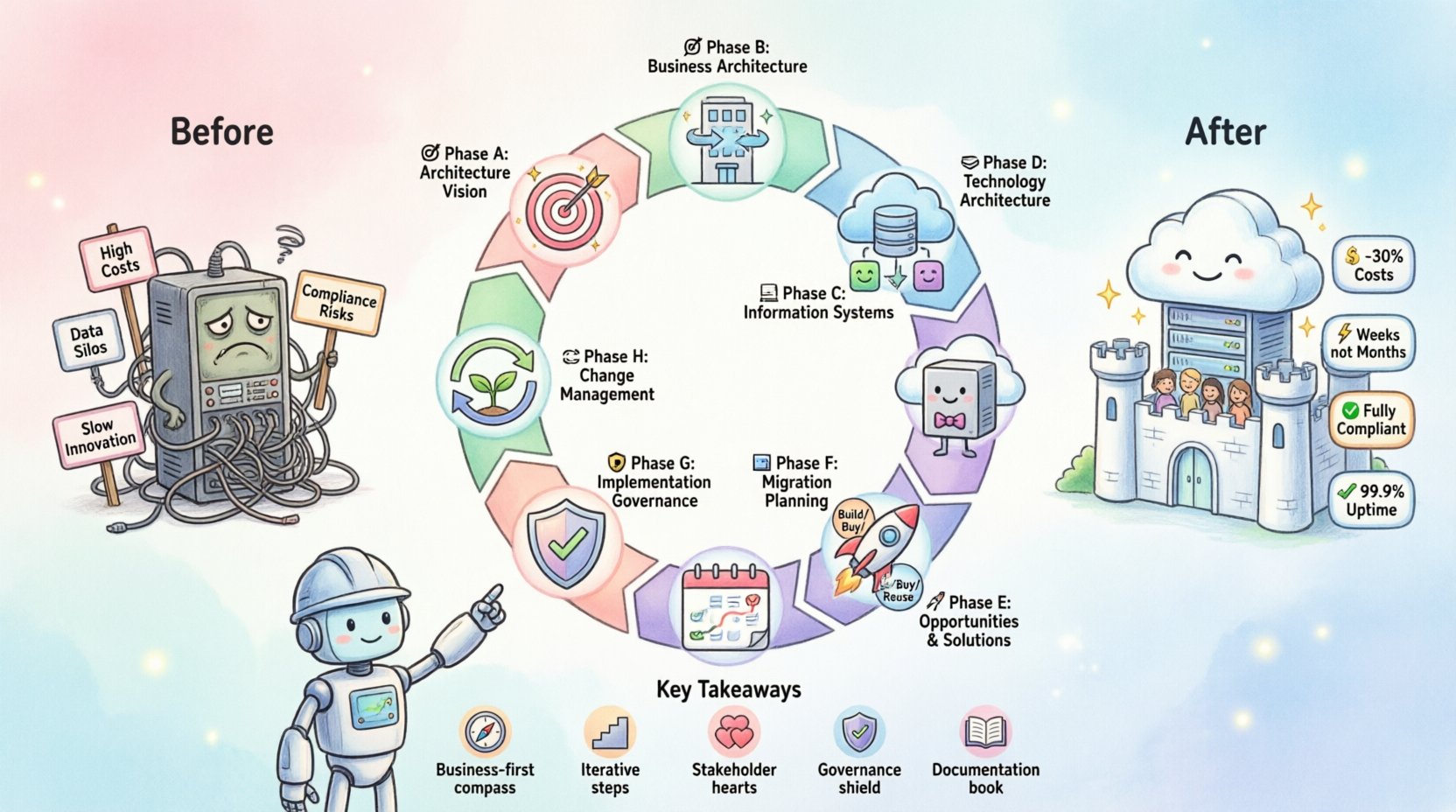
Before initiating the architecture development, a thorough assessment of the current state was required. The organization in this case study operated a monolithic architecture that had evolved over twenty years. This environment presented several critical challenges:
- High Maintenance Costs: Supporting aging hardware and specialized personnel drove up operational expenses significantly.
- Data Fragmentation: Critical information was stored in disparate databases that did not communicate effectively, leading to reporting inconsistencies.
- Compliance Risks: Outdated security protocols failed to meet modern regulatory standards, exposing the enterprise to potential liability.
- Slow Time-to-Market: Business innovation was bottlenecked by the rigidity of the core system, preventing rapid deployment of new features.
The decision to engage the TOGAF framework was driven by the need for a repeatable, disciplined process. Unlike ad-hoc modernization efforts, this approach prioritized long-term sustainability over quick fixes. The ADM cycle provided a roadmap to navigate the complexity of moving from a legacy state to a modern, cloud-enabled architecture.
🔍 Phase A: Architecture Vision
The initial phase of the Architecture Development Method focused on defining the scope and context of the transformation. In this specific case, the Architecture Vision phase was critical for securing stakeholder buy-in and establishing the boundaries of the project.
📌 Key Activities in Phase A
- Stakeholder Identification: A comprehensive list of stakeholders was compiled, ranging from C-suite executives to end-user representatives. Their concerns regarding downtime and data integrity were documented early.
- Scope Definition: The project boundaries were clearly defined. It was determined that the core transaction engine would be migrated, while certain archival functions would remain on-premise for legal retention periods.
- Statement of Architecture Work: A formal document outlined the objectives, constraints, and assumptions. This served as the contract between the architecture team and the business leadership.
- Baseline Assessment: An initial review of the current architecture identified gaps between the legacy state and the desired future state.
The output of Phase A was a high-level vision statement that aligned technical capabilities with business strategy. It clarified that the transformation was not an IT initiative but a business enabler designed to reduce costs and improve customer experience.
🏢 Phase B: Business Architecture
Once the vision was established, the focus shifted to the business architecture. This phase ensures that the technical changes support the actual workflow of the organization. The legacy system had become decoupled from modern business processes, creating friction between what the business needed and what the technology could deliver.
🔄 Business Process Mapping
The team conducted a detailed analysis of existing business processes. This involved mapping out the “As-Is” state to understand dependencies and bottlenecks. The goal was to identify processes that could be automated, optimized, or retired during the migration.
| Process Area | As-Is State | To-Be State | Impact |
|---|---|---|---|
| Order Processing | Manual entry across three systems | Automated end-to-end workflow | Reduced error rate by 40% |
| Customer Reporting | Weekly batch exports | Real-time dashboard access | Improved decision speed |
| Compliance Audits | Quarterly manual review | Continuous automated monitoring | Lowered risk exposure |
This mapping revealed that the legacy system forced users to perform redundant data entry. By redesigning the business architecture, the organization could streamline operations. The Business Architecture work also defined the capabilities required to support these new processes, ensuring that the subsequent technical design would meet actual user needs.
💾 Phase C: Information Systems Architectures
Phase C addresses the data and application architectures. This is often the most complex phase in legacy transformation because it involves the physical movement and restructuring of data and software components. The objective here was to define how information would be stored and accessed in the future environment.
🗄️ Data Architecture Strategy
The legacy environment relied on a central mainframe database. While robust, it lacked the flexibility required for modern analytics. The new data architecture adopted a distributed approach, separating transactional data from analytical data.
- Data Governance: Standards were established to ensure data quality, security, and privacy across the new environment.
- Migration Strategy: A plan was developed to extract, transform, and load (ETL) data from the old system to the new platform without loss of integrity.
- API Strategy: Interfaces were designed to allow the new systems to communicate with external partners and internal services.
📱 Application Architecture Strategy
The application landscape was analyzed to determine which components could be repurposed, which needed rewriting, and which could be retired. The strategy moved towards a modular design, allowing specific functions to be updated independently.
A key decision was to decompose the monolithic application into smaller, manageable services. This reduced the risk associated with updates, as a change in one module would not necessarily impact the entire system. The architecture team created a blueprint that mapped legacy functions to new service components, ensuring no business logic was lost in translation.
🖥️ Phase D: Technology Architecture
With the business and information architectures defined, Phase D focused on the technology infrastructure required to support the new systems. This involved selecting the underlying hardware, networks, and platforms that would host the applications and data.
🌐 Infrastructure Modernization
The legacy infrastructure relied on on-premise data centers with limited scalability. The new technology architecture leveraged a hybrid cloud model. This allowed the organization to maintain sensitive data on-premise while utilizing cloud resources for elasticity and scalability.
Key considerations in this phase included:
- Network Topology: Designing a secure network that connects on-premise systems with cloud services.
- Security Architecture: Implementing identity management, encryption, and access controls consistent with modern security standards.
- Disaster Recovery: Establishing backup and recovery procedures that meet the defined recovery time objectives (RTO) and recovery point objectives (RPO).
The technology architecture also accounted for the skills available within the organization. Instead of betting on cutting-edge, unproven tools, the team selected mature technologies that offered long-term support and community backing. This ensured stability and reduced the risk of vendor lock-in.
🚀 Phase E: Opportunities and Solutions
Phase E translates the architectural designs into actionable opportunities. This phase involves identifying specific projects that will deliver the value defined in the previous phases. It requires a realistic assessment of the gaps between the baseline and the target architecture.
📂 Gap Analysis
A rigorous gap analysis was conducted to identify the differences between the current state and the target state. This analysis highlighted the specific work required to close those gaps.
- Functional Gaps: Missing capabilities in the legacy system that needed to be built or acquired.
- Technical Gaps: Infrastructure limitations that needed to be addressed to support the new architecture.
- Compliance Gaps: Areas where the current system failed to meet regulatory requirements.
🗺️ Solution Options
For each identified gap, multiple solution options were evaluated. The evaluation criteria included cost, time to implement, risk, and strategic alignment. This process ensured that the chosen solutions were not just technically feasible but also economically viable.
The team categorized opportunities into three buckets: Build, Buy, and Reuse. The “Build” category was reserved for core differentiators. The “Buy” category was used for commodity functions. The “Reuse” category identified components of the legacy system that could be safely integrated into the new environment.
📅 Phase F: Migration Planning
Phase F focuses on creating the detailed migration plan. This is the blueprint for the actual transition. It breaks down the high-level opportunities into specific work packages and defines the sequence of execution.
📋 Work Packages
The migration was divided into distinct work packages, each representing a logical increment of value. This incremental approach allowed the organization to realize benefits throughout the project lifecycle, rather than waiting for a “big bang” cutover.
- Work Package 1: Foundation setup and security configuration.
- Work Package 2: Data migration and validation.
- Work Package 3: Application deployment and integration.
- Work Package 4: User training and go-live support.
📈 Implementation Governance
The plan included specific milestones and deliverables for each work package. Governance structures were put in place to monitor progress against these milestones. Regular reviews were scheduled to assess risks and adjust the plan as necessary. This ensured that the project remained on track and within budget.
Crucially, the migration plan included a rollback strategy. In the event of critical failure during the transition, the organization could revert to the legacy system with minimal disruption. This safety net was essential for maintaining operational continuity.
🛡️ Phase G: Implementation Governance
Phase G ensures that the implementation conforms to the architecture. It involves oversight of the development and deployment process to ensure that the final solution matches the design specifications.
👀 Compliance and Oversight
Architecture compliance boards were established to review key deliverables. These boards verified that the code, configuration, and data structures adhered to the defined standards. Deviations were flagged and addressed before they could impact the broader system.
Key activities in this phase included:
- Code Reviews: Ensuring development followed architectural guidelines.
- Security Audits: Verifying that security controls were implemented correctly.
- Performance Testing: Validating that the system met performance requirements.
This phase is often where projects struggle, as the pressure to deliver quickly can lead to shortcuts. The governance framework provided the authority to enforce standards without stifling innovation. It acted as a quality gate, ensuring that the final product was robust and maintainable.
🔄 Phase H: Architecture Change Management
The final phase of the ADM cycle focuses on the long-term maintenance and evolution of the architecture. Transformation is not a one-time event; it is a continuous process. Phase H ensures that the new architecture remains aligned with business changes.
📉 Post-Implementation Review
After the migration was complete, a post-implementation review was conducted. This review assessed the success of the project against the original objectives. Metrics were compared to baselines to quantify the improvements.
🔮 Future Planning
The architecture repository was updated to reflect the new state of the enterprise. This documentation serves as the foundation for future iterations. The change management process was formalized to ensure that any future changes to the system undergo proper review and approval.
This phase also involved training the operations team on the new environment. Knowledge transfer was critical to ensure that the organization could sustain the new architecture without relying on external consultants. The goal was to build internal capability and confidence.
⚖️ Challenges Faced and Mitigation Strategies
Even with a structured framework, significant challenges arose during the transformation. Acknowledging and addressing these issues was vital to the project’s success.
- Resistance to Change: Users were accustomed to the legacy interface and were hesitant to adopt new tools. Mitigation: Extensive training and change management workshops were conducted to demonstrate the benefits of the new system.
- Data Integrity Issues: Inconsistencies in the legacy data caused errors during migration. Mitigation: A dedicated data cleansing project was launched before the migration began to clean and standardize the data.
- Scope Creep: New requirements were added mid-project. Mitigation: A strict change control process was enforced, requiring business justification for any scope additions.
- Integration Complexity: Connecting the new system with third-party vendors proved difficult. Mitigation: Standardized APIs were mandated for all integrations to reduce custom development.
📊 Outcomes and Measurable Results
The application of the TOGAF ADM method yielded tangible results for the organization. The transformation was not just about technology; it was about enabling business growth.
- Cost Reduction: Operational costs decreased by 30% due to the elimination of legacy maintenance and the efficiency of the new infrastructure.
- Agility: Time-to-market for new features improved from months to weeks, allowing the business to respond faster to market demands.
- Reliability: System uptime improved to 99.9%, providing a more stable experience for end-users.
- Compliance: The organization achieved full compliance with modern data protection regulations, eliminating previous audit findings.
🔑 Key Takeaways for Architecture Practitioners
Success in legacy transformation requires more than technical skill; it requires discipline and a structured approach. The following lessons emerged from this case study:
- Start with the Business: Always ensure the architecture supports business goals, not just technical preferences.
- Iterative Progress: Break large projects into manageable increments to reduce risk and deliver value continuously.
- Stakeholder Engagement: Keep stakeholders informed and involved throughout the process to maintain alignment and support.
- Rigorous Governance: Implement strong governance to maintain quality and compliance during implementation.
- Documentation: Maintain up-to-date documentation to ensure knowledge is retained and the architecture is understood.
🏁 Summary of the Transformation Journey
This case study demonstrates the power of the TOGAF Architecture Development Method in guiding complex legacy transformations. By following the standardized phases, the organization was able to navigate technical debt, align technology with strategy, and achieve measurable business outcomes. The journey from a rigid monolith to a flexible, modern architecture was challenging, but the structured approach provided the clarity and control necessary for success. The result is an enterprise capable of adapting to future changes without the burden of past constraints.
Organizations facing similar challenges should consider adopting this framework. It offers a proven path through the complexity of modernization, ensuring that the investment in transformation delivers lasting value. The focus remains on alignment, governance, and continuous improvement, creating a foundation for long-term success in a dynamic digital landscape.