
The Modern BPM Ecosystem: Architecting with BPMN, CMMN, and DMN
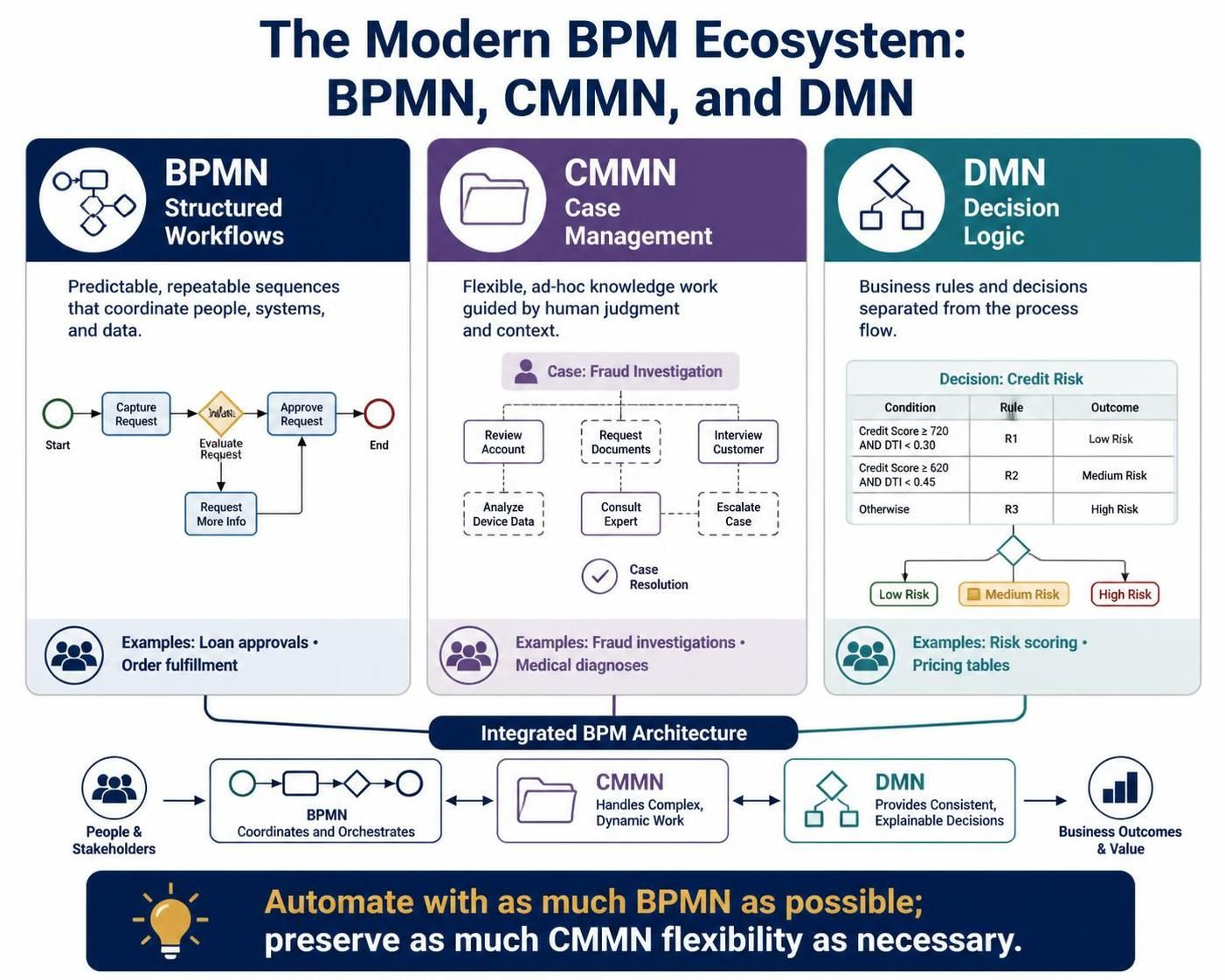
In the realm of modern Business Process Management (BPM), relying on a single modeling standard is rarely sufficient for complex enterprise challenges. Instead, organizations leverage a “Standards Trio”—BPMN, CMMN, and DMN—to create robust, adaptive architectures. This tutorial explores how these three standards work together to handle the full spectrum of business work, from rigid automation to human-centric decision-making.
1. BPMN: The Backbone of Structured Work
BPMN (Business Process Model and Notation) serves as the cornerstone for modeling structured workflows. It is designed for predictable, repeatable sequences where the path of execution is largely determined by the process design rather than human whim.
Key Characteristics:
- Focus: Structured Workflows.
- Best Used For: Predictable, repeatable sequences.
- Core Mechanism: It coordinates people, systems, and data through a strict flow of events, gateways, and activities.
In our ecosystem, BPMN acts as the “Orchestrator.” It defines the high-level path of a process. For example, in a loan approval process, BPMN dictates the strict sequence: Capture Request → Evaluate Request → Approve Request → End.
@startuml
start
:Capture Request;
:Evaluate Request;
:Approve Request;
stop
@enduml
2. CMMN: The Engine of Case Management
While BPMN handles the predictable, many business scenarios are “unstructured.” These are knowledge-work scenarios driven by human discretion, such as fraud investigations or medical diagnoses. This is where CMMN (Case Management Model and Notation) comes into play.
Key Characteristics:
- Focus: Case Management.
- Best Used For: Unstructured, ad-hoc work.
- Core Mechanism: It relies on human judgment and context. Unlike BPMN’s strict “flow,” CMMN uses “Milestones” and “Plannable Items” to allow the process to evolve dynamically.
Imagine a Fraud Investigation case. The investigator doesn’t follow a fixed script. They might decide to “Review Account” and “Request Documents” one day, and “Interview Customer” the next. CMMN allows this flexibility while ensuring all necessary steps (like “Analyze Device Data”) are eventually completed before the “Case Resolution” milestone is hit.
3. DMN: The Brain of Decision Logic
Complex decision logic embedded within a process flow can make a BPMN diagram unreadable. DMN (Decision Model and Notation) solves this by separating the decision logic from the process flow.
Key Characteristics:
- Focus: Decision Logic.
- Best Used For: Rule-based decisions.
- Core Mechanism: It uses Decision Tables to map inputs (Conditions) to outputs (Outcomes) clearly.
In the context of the “Credit Risk” decision, DMN allows business analysts to define rules like “If Credit Score ≥ 720 AND DTI < 0.30, then Low Risk." This logic is defined once in a DMN diagram and can be called by multiple BPMN processes, ensuring consistency and explainability.
table
    Condition | Rule | Outcome
    Credit Score >= 720 AND DTI < 0.30 | R1 | Low Risk
    Credit Score >= 620 AND DTI < 0.45 | R2 | Medium Risk
    Otherwise | R3 | High Risk
4. The Integrated BPM Architecture
The true power of this ecosystem lies in integration. The "Integrated BPM Architecture" shown in the diagram illustrates how these standards interact to deliver value:
- People & Stakeholders initiate the process.
- BPMN coordinates and orchestrates the overall flow, automating routine steps.
- CMMN handles complex, dynamic work where human intervention is required (e.g., the fraud investigation case).
- DMN provides consistent, explainable decisions (e.g., the credit risk scoring) to support the orchestration.
- The result is optimized Business Outcomes & Value.
Conclusion
By utilizing Visual Paradigm's AI-assisted tooling alongside these standards, you can build systems that are not just diagrams, but living architectures. BPMN provides the structure, CMMN provides the flexibility, and DMN provides the intelligence.