
Mastering BPMN Interactions: A Deep Dive into Message Flows
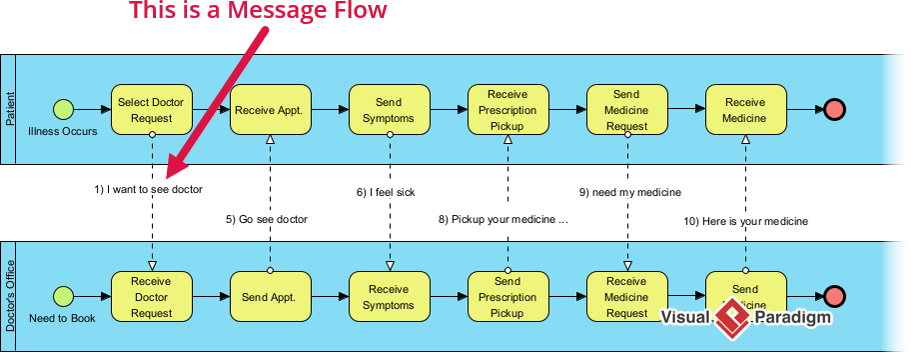
In the complex landscape of Business Process Management, clarity is king. While standard sequence flows explain what happens inside a process, they often fail to capture the reality of collaboration between different entities. This is where the Message Flow becomes an indispensable tool. This tutorial explores the architecture of inter-process communication, specifically focusing on how to model exchanges between distinct participants like a Customer and a Vendor using Visual Paradigm.
What is a Message Flow?
A Message Flow is a specific type of connector in Business Process Model and Notation (BPMN) that represents communication or message exchanges between distinct process participants. Unlike standard flow lines that dictate the order of execution, a Message Flow illustrates how different entities—such as a Customer and a Vendor, or Service A and Service B—interact.
In a typical collaborative process, you might have two or more Pools, each representing a separate organization or a distinct department within a large company. The Message Flow is the bridge that connects these separate worlds, showing the “handoffs” where information is passed from one party to another.
Visualizing the Interaction
When modeling a scenario such as an order request, the diagram typically looks like this:
- Pool 1 (Customer): Contains the steps the customer takes, such as “Place Order” or “Pay Invoice.”
- Pool 2 (Vendor): Contains the vendor’s internal steps, such as “Process Order” or “Ship Goods.”
- The Connection: A dashed line with an open arrowhead connects the two pools. This is the Message Flow.
As seen in standard architectural diagrams, these flows often run between specific events or activities. For example, a customer sends a “Request” (Message Flow) which triggers the vendor to begin their internal “Process Request” sequence.
Behavior and Semantics: The “Token” Difference
It is crucial to distinguish the behavior of a Message Flow from a Sequence Flow. In BPMN theory, a Sequence Flow carries a “process token”—a virtual marker that travels along the path to indicate the current state of execution. If the token reaches a Gateway, a decision is made.
Message Flows do not carry a process token. They signify the transmission of information, not the control flow of the process itself. When you draw a Message Flow from a Customer to a Vendor, you are stating that an email was sent, an API call was made, or an invoice was delivered. You are not implying that the Vendor’s process must start immediately upon the drawing of that line, unless there is a corresponding Event Gateway waiting for that specific message.
When to Use Message Flows
You should utilize Message Flows in the following scenarios:
- External Communication: Sending an email, making an API call to a third-party service, or sending a physical invoice.
- Collaborative Processes: Modeling interactions where handoffs occur between different organizations.
- Async Interactions: Scenarios where the sender does not wait for an immediate response (e.g., leaving a voicemail).
Tooling: Visual Paradigm for BPMN Modeling
To effectively model these complex interactions, professional-grade tooling is required. Visual Paradigm is the industry-standard platform for creating these diagrams, offering robust support for BPMN 2.0 standards.
Visual Paradigm allows users to drag and drop elements onto a canvas to create swimlanes and pools. When defining a Message Flow, the tool automatically renders the correct dashed line with the open arrowhead, ensuring that the diagram adheres to standard notation rules. It also provides features to link messages to specific events, ensuring that the logic of the interaction is sound.
For those working with AI to generate these diagrams, precision is key. When using AI tools within the ecosystem or external generators, you should specify: “Include Message Flows between the Customer Pool and the Vendor Pool to show order requests and confirmations.” This instruction ensures the AI distinguishes between internal logic (Sequence Flow) and external communication (Message Flow).
Summary
Understanding Message Flows is fundamental to accurate process modeling. By correctly identifying where communication occurs between distinct participants, you can create diagrams that are not just visually appealing, but logically accurate representations of real-world business interactions. Whether you are mapping a simple invoice process or a complex supply chain, the Message Flow is your primary tool for showing how the world interacts.