


Enterprise architecture is often viewed as a static discipline, a set of diagrams stored in a repository that no one reads. This perception is incorrect. Effective enterprise architecture is dynamic, strategic, and deeply connected to business value. As an Architecture Lead, your role is not just to draw boxes, but to orchestrate the alignment of technology, data, and business processes. The TOGAF framework provides a structured approach to achieve this alignment.
Starting a TOGAF practice can feel overwhelming. The documentation is extensive, the terminology is dense, and the implementation requires significant organizational buy-in. This guide provides a practical roadmap. It is designed for leaders who need to operationalize TOGAF without getting lost in theory. We will cover the core components, the Architecture Development Method, governance structures, and the human elements required for success.
🧱 Understanding the TOGAF Framework Core
Before implementing any framework, you must understand what it is and what it is not. TOGAF stands for The Open Group Architecture Framework. It is not a prescriptive set of rules but a flexible methodology. It allows you to tailor the approach to your specific organizational needs.
Here are the fundamental pillars you need to grasp:
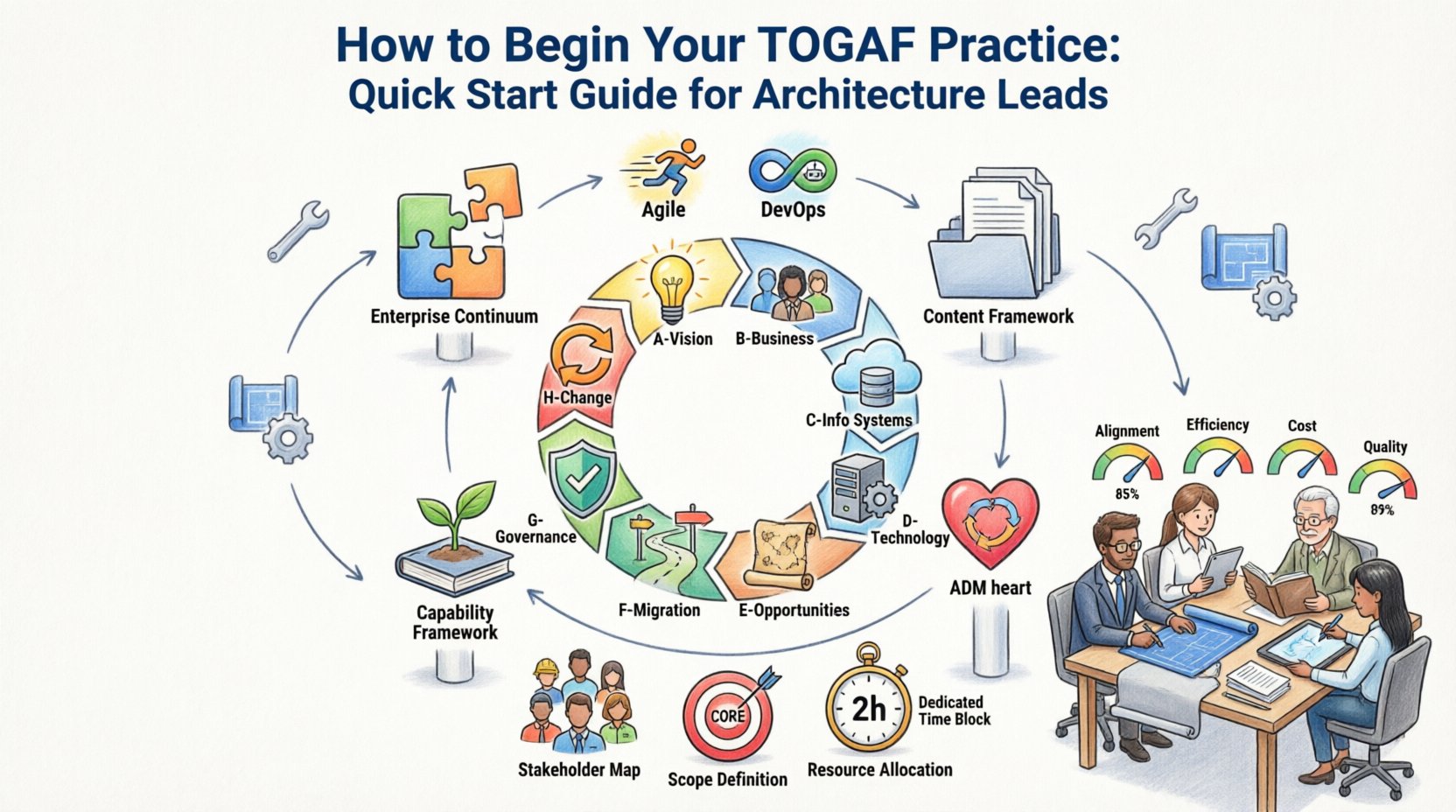
- The Architecture Development Method (ADM): This is the cyclical process used to develop an architecture. It is the heart of TOGAF.
- The Enterprise Continuum: A mechanism for classifying and organizing architectural assets. It helps you reuse existing solutions rather than building from scratch.
- The Architecture Content Framework: A structured way to define and organize architectural artifacts. This includes models, diagrams, and specifications.
- The Architecture Capability Framework: This guides you on how to build the organizational capability to sustain architecture work over time.
When you begin your practice, avoid trying to adopt every component immediately. Focus on the ADM first. It provides the workflow. The other components support the workflow but are not the workflow itself.
📋 Preparing for Implementation: Readiness Assessment
Jumping straight into the ADM without preparation is a common failure point. You need to assess the readiness of the organization. This involves understanding the current state of your technology landscape, the maturity of your processes, and the culture of the people involved.
1. Stakeholder Analysis
Architecture is a social activity. You must identify who cares about the outcome. Create a stakeholder map that includes:
- Executives: They provide budget and strategic direction.
- Business Unit Leaders: They define the requirements and pain points.
- Technical Teams: They build the solutions and need clear specifications.
- Compliance Officers: They ensure regulatory adherence.
Engage these groups early. Ask them what their biggest challenges are. If you solve their problems, you gain support. If you impose a framework without understanding their needs, you will face resistance.
2. Defining the Scope
Do not attempt to model the entire enterprise in the first cycle. Start with a specific domain. This could be a specific business unit, a critical application portfolio, or a transformation initiative. A focused scope allows you to demonstrate value quickly.
Scope Criteria Checklist:
- Is there a clear business driver?
- Are the stakeholders available?
- Is the timeline realistic?
- Does the scope align with strategic goals?
3. Resource Allocation
Architecture work requires time. Developers and architects need dedicated hours to perform architecture tasks. If they are 100% allocated to delivery tasks, architecture will be neglected. You must negotiate dedicated time for architecture activities.
🔄 The Architecture Development Method (ADM) Explained
The ADM is a cycle. It is not a linear process where you finish one phase and move to the next forever. It is iterative. You can enter the cycle at different points depending on the business need. Below is a breakdown of the phases and what an Architecture Lead should focus on in each.
| Phase | Focus Area | Key Deliverables |
|---|---|---|
| Phase A | Architecture Vision | Statement of Architecture Work, Architecture Vision Document |
| Phase B | Business Architecture | Business Scenarios, Business Process Models, Organization Maps |
| Phase C | Information Systems Architectures | Data Architecture, Application Architecture |
| Phase D | Technology Architecture | Technology Standards, Infrastructure Diagrams |
| Phase E | Opportunities & Solutions | Implementation Migration Plan, Gap Analysis |
| Phase F | Migration Planning | Implementation Plan, Risk Assessment |
| Phase G | Implementation Governance | Compliance Assessment, Architecture Compliance Review |
| Phase H | Architecture Change Management | Architecture Change Request, Updated Baseline |
Phase A: Architecture Vision
This phase sets the stage. You define the scope, constraints, and assumptions. You create the Architecture Vision document. This document should be concise and compelling. It explains why you are doing this work. It connects the technical initiative to business outcomes. Without this, the project is just IT work, not architecture work.
Phases B, C, and D: The Core Architectures
These phases define the target state. You are designing the Business, Information Systems, and Technology architectures. The goal is to ensure they are aligned. For example, if the Business Architecture requires real-time customer interaction, the Technology Architecture must support low latency. The Information Systems Architecture must ensure data is available and consistent.
Key Activities:
- Conduct Gap Analysis: Compare the Baseline Architecture (current state) with the Target Architecture (future state).
- Identify Building Blocks: Determine which components can be reused and which must be built new.
- Define Standards: Establish technical standards that will guide the implementation teams.
Phases E, F, and G: Planning and Governance
Design is useless without execution. Phase E identifies the opportunities to implement the changes. Phase F creates the plan to move from the current state to the target state. Phase G ensures that the implementation follows the architectural blueprint. This is where the Architecture Board plays a critical role.
Phase H: Change Management
Change is constant. The architecture is never truly finished. Phase H monitors the environment for changes that impact the architecture. It triggers a new cycle of the ADM if necessary. This ensures the architecture remains relevant.
⚖️ Governance and Architecture Boards
Governance ensures that the architecture is actually followed. Without governance, you have a nice document that sits on a shelf. You need a mechanism to review projects and ensure they align with the architectural strategy.
The Architecture Board
This is the governing body responsible for architecture decisions. It should include representatives from business, IT, security, and compliance. Their responsibilities include:
- Reviewing and approving major architectural changes.
- Resolving conflicts between different architecture domains.
- Ensuring compliance with standards and regulations.
- Managing the Architecture Repository.
As an Architecture Lead, you chair or facilitate these meetings. Prepare clear agendas. Bring data to support your decisions. Do not make decisions based on opinion alone.
Compliance Reviews
Implement a lightweight compliance process. You do not need to audit every line of code. Focus on critical milestones. Check if the solution aligns with the standards defined in Phases B, C, and D. If deviations are found, document them and assess the risk. Sometimes, deviation is necessary for speed, but it must be acknowledged and managed.
🏛️ Building the Architecture Capability
TOGAF is not just about the framework; it is about the people and the processes. You need to build a sustainable capability. This means creating a team that can operate the framework over the long term.
Skills and Competencies
An Architecture Lead needs a diverse skill set. You need to balance technical depth with business acumen. Here are the core competencies required:
- Strategic Thinking: Ability to see the big picture and anticipate future trends.
- Communication: Ability to explain complex concepts to non-technical stakeholders.
- Facilitation: Ability to run workshops and gather requirements from diverse groups.
- Technical Knowledge: Understanding of platforms, data, security, and integration patterns.
Training and Certification
Invest in training for your team. TOGAF certification is a recognized standard. It provides a common vocabulary. When everyone speaks the same language, communication becomes easier. However, do not rely on certification alone. Practical experience is more valuable.
Encourage your team to specialize. Have experts in Business Architecture, Data Architecture, and Technology Architecture. This specialization allows for deeper analysis in each domain.
The Architecture Repository
You need a place to store your work. This is the Architecture Repository. It should contain:
- Architectural Models
- Standards and Guidelines
- Reference Models
- Lessons Learned
Make this repository accessible. If your team cannot find the documentation, they will not use it. Integrate the repository into your existing workflow. Do not create a separate silo of information.
🚧 Common Pitfalls and Best Practices
Even with a solid plan, things can go wrong. Understanding common pitfalls can help you avoid them. Here are the challenges most Architecture Leads face and how to navigate them.
1. Analysis Paralysis
Trying to model everything before making a decision leads to delays. The perfect is the enemy of the good. Focus on the critical decisions first. You can refine the details later. Iterate quickly.
2. Lack of Executive Support
If leadership does not see the value, the initiative will stall. You must translate technical benefits into business value. Instead of saying “we need a better data model,” say “we will reduce data errors and improve reporting speed.” Speak the language of the business.
3. Over-Engineering
Creating complex architectures for simple problems is a waste of resources. Keep it simple. Use the simplest solution that meets the requirements. Complexity should only be introduced when it adds value.
4. Ignoring the Human Element
Change management is often overlooked. People resist change. Explain the benefits to them. Involve them in the design process. When people feel ownership of the solution, they are more likely to support it.
📈 Measuring Success
How do you know if your TOGAF practice is working? You need metrics. However, avoid vanity metrics like “number of diagrams created.” Focus on outcomes.
Key Performance Indicators (KPIs):
- Alignment: Percentage of projects aligned with the strategic architecture.
- Efficiency: Reduction in time to market for new capabilities.
- Cost: Reduction in redundant systems and maintenance costs.
- Quality: Reduction in post-deployment defects related to architecture.
Review these metrics regularly. Use them to adjust your approach. If alignment is low, review your governance process. If efficiency is low, review your development lifecycle.
🌱 Continuous Improvement
TOGAF is a living framework. It evolves. The industry evolves. Your practice must evolve with them. Schedule regular reviews of your architecture processes. Ask your team what is working and what is not. Solicit feedback from stakeholders.
Adopt a mindset of continuous improvement. This means being willing to discard practices that no longer serve a purpose. It means learning from failures. It means staying curious about new technologies and methodologies.
🔧 Integrating with Agile and DevOps
Modern organizations often use Agile or DevOps methodologies. There is a misconception that TOGAF is too heavy for Agile. This is not true. You can integrate TOGAF with Agile practices.
Integration Strategies:
- Iterative ADM: Treat each sprint as a mini-ADM cycle.
- Architectural Runway: Build the foundational architecture in advance so teams can move fast later.
- Collaborative Design: Involve developers in the architecture design process.
- Lightweight Governance: Reduce the overhead of compliance reviews.
The goal is to enable speed without sacrificing structure. The framework should facilitate the work, not hinder it.
🛠️ Final Thoughts on Execution
Starting a TOGAF practice is a journey. It requires patience and persistence. You will encounter resistance. You will face budget cuts. You will have to make tough decisions. But if you stay focused on the value you provide to the business, you will succeed.
Remember that the framework is a tool. It is not the destination. The destination is a more efficient, agile, and aligned organization. Use TOGAF to get there. Keep your documentation lean. Keep your communication clear. Keep your team motivated.
Your role as an Architecture Lead is pivotal. You bridge the gap between strategy and execution. You translate business needs into technical reality. By following this guide, you are setting the foundation for a robust and sustainable architecture practice. Start small, prove value, and scale gradually. The path to enterprise excellence is built one decision at a time.