
Architecting Secure AI Enterprise Solutions with Visual Paradigm’s Four-Pillar Model
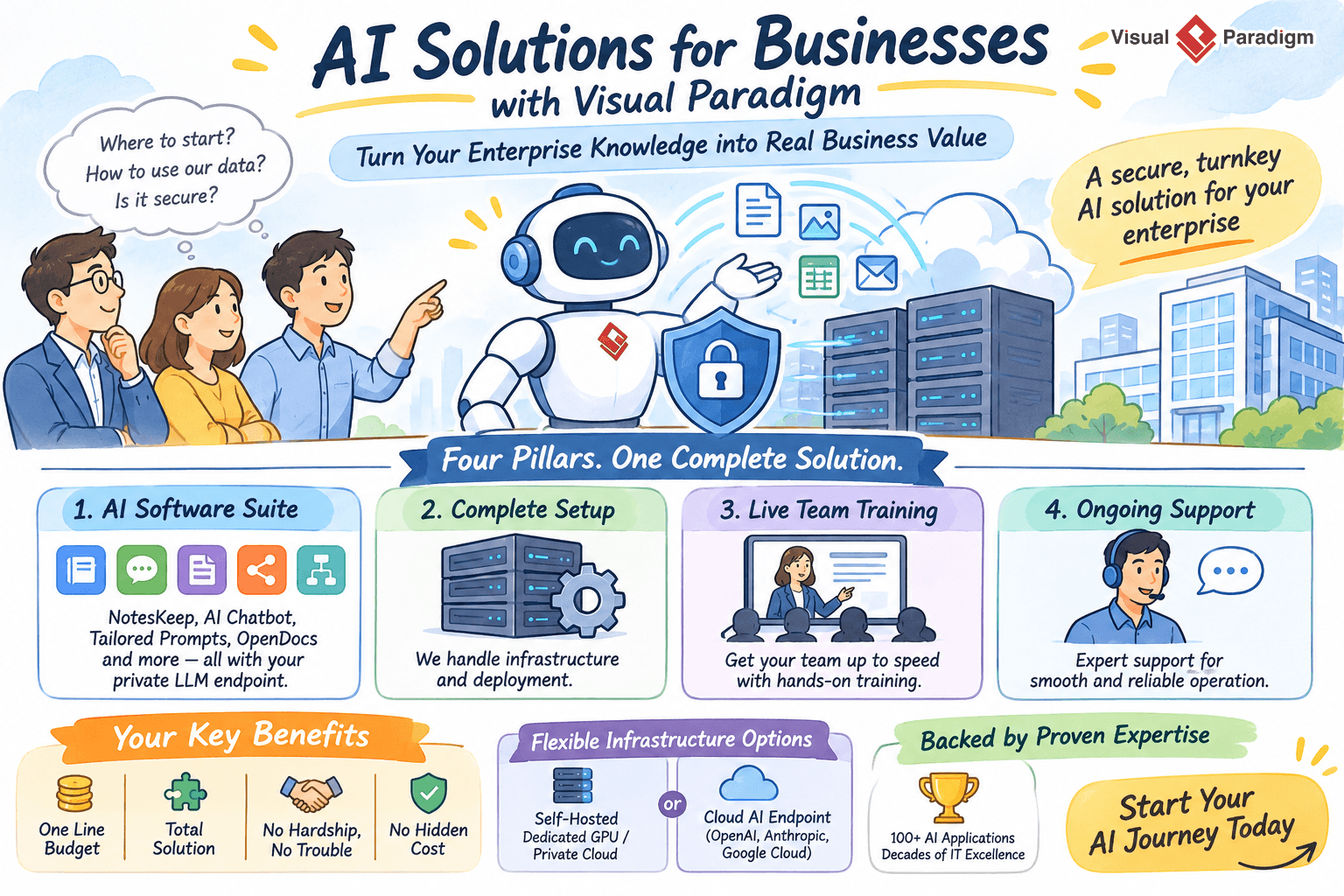
In the rapidly evolving landscape of Generative AI, organizations often face a critical dilemma: how to harness the power of Large Language Models (LLMs) without compromising data privacy or overwhelming internal IT resources. Visual Paradigm addresses this challenge not merely as a software vendor, but as a comprehensive architectural partner. Their approach moves beyond simple tool acquisition to a holistic “Four-Pillar” system designed to integrate AI securely into the enterprise fabric.
The Four Pillars of the Integrated AI Solution
Visual Paradigm’s solution is structured around four distinct but interconnected pillars. This architecture ensures that the transition to AI is not just a technology upgrade, but a streamlined operational shift.
1. The Integrated AI Software Suite
The foundation of this ecosystem is the software suite itself. Rather than disparate tools, this suite offers a unified engagement layer. Key components include:
- Visual Paradigm NotesKeep: A tool for managing corporate assets and casual notes, ensuring context is preserved.
- AI Chatbot & Knowledge Analysis: Advanced interfaces that answer queries based on your private data, acting as the primary user interface for the AI.
- Tailored AI Prompts: Mechanisms for precise document generation, such as creating technical product specifications.
- Visual Paradigm OpenDocs: A publishing and sharing module for disseminating AI-generated content.
- Visual Paradigm Online: A robust diagram editing tool that likely serves as the source of truth for system architecture.
Crucially, all these tools bind directly to your private LLM endpoint. This architectural choice ensures that data never leaves your control during processing.
2. Done-For-You Infrastructure & Endpoint Setup
One of the most significant friction points in enterprise AI adoption is the complexity of setting up the infrastructure. Visual Paradigm’s second pillar removes this barrier by handling the environment configuration. This includes:
- Endpoint binding.
- Tool deployment.
- Ensuring the team can start working immediately without technical friction.
3. Hands-On Live Online Team Training
Technology is only as good as the people using it. This pillar focuses on the human element through interactive sessions. The training covers:
- Tool navigation.
- Knowledge uploading strategies.
- Custom prompt engineering.
4. Dedicated Technical Advisory & Ongoing Support
Finally, the solution is sustained by a team of experienced representatives backed by the broader Visual Paradigm technical team. This ensures that systems run smoothly and efficiently over the long term.
Flexible Infrastructure Architecture: Option A vs. Option B
A critical component of the Visual Paradigm solution is its flexibility regarding where the AI processing occurs. The architecture supports two distinct deployment models, allowing organizations to choose based on their security and latency requirements.
Option A: Self-Hosted Dedicated GPU / Private Cloud
This model is designed for maximum privacy. The AI models are hosted on hardware within the organization’s control or a dedicated private cloud instance (e.g., AWS EC2 GPU). This ensures that sensitive enterprise data remains entirely within the private perimeter.
Option B: Cloud AI Endpoint Connection
For organizations seeking rapid deployment or specific model capabilities, this option routes traffic through direct API token providers. This architecture leverages the power of major cloud providers while maintaining the integration layer of Visual Paradigm.
Technical Comparison: VP Solution vs. Standard Products
When comparing the Visual Paradigm solution to standard commercial off-the-shelf (COTS) products, the architectural difference is profound. Standard products often treat AI as a “bolt-on” feature, whereas Visual Paradigm treats it as a core system component.
Standard Product Architecture:
  User -> SaaS Interface -> Public API -> External LLM
  (Data leaves the organization immediately)

Visual Paradigm Enterprise Architecture:
  User -> VP Suite -> Private Endpoint / API Gateway -> LLM
  (Data governance is maintained; endpoint binding ensures control)
Proven Expertise: The “100+ Applications” Benchmark
Why trust this architecture? Visual Paradigm’s credibility stems from their own internal implementation. They are not newcomers experimenting with hype; they are veterans who have successfully integrated advanced AI across more than 100 applications within their own ecosystem.
This “dogfooding” (using your own product) experience translates into:
- Secure Configuration: Decades of experience in configuring endpoints securely.
- Model Training: Deep understanding of how to train models for specific enterprise contexts.
- Architectural Integrity: Systems designed to respect enterprise data governance.
Conclusion: The Path to One-Line Budgeting
The Visual Paradigm AI solution offers a “One Line Budget” model, encompassing software, setup, training, and support. This contrasts with the “patchwork vendor management” typical of enterprise IT, where an organization might buy separate contracts for infrastructure, software, and consulting.
By choosing this integrated solution, businesses gain a clear path to AI transformation. Whether starting with a departmental pilot or launching a full enterprise deployment, the architecture provides the security, flexibility, and support necessary for success.