
Mastering the VP Unified Platform: Outcome-Driven Modeling for Enterprise
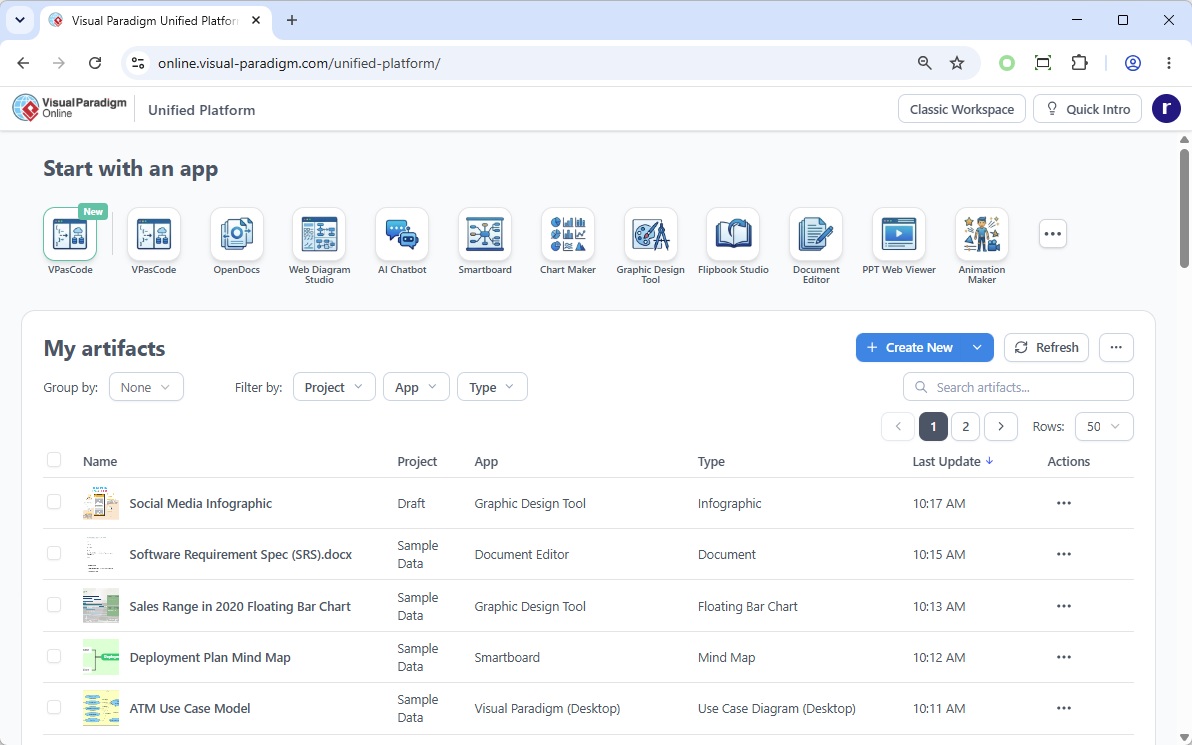
The landscape of software engineering and systems design has shifted from isolated desktop tools to integrated, cloud-native environments. The Visual Paradigm Unified Platform represents this evolution, moving away from the traditional “open an application, then open a file” paradigm. Instead, it introduces an outcome-oriented workflow where the artifact—the final deliverable—is the starting point.
This tutorial explores the core architecture of the Unified Platform, analyzing the dashboard, the centralized artifact hub, and the application launcher. We will examine how these components function together to streamline complex modeling tasks, from business analysis to software architecture.
1. The Central Entry Point: The Dashboard
The dashboard acts as the command center for the platform. Unlike legacy systems that require navigating deep directory trees to find a specific tool, the dashboard aggregates recent work, shared projects, and critical resources into a single view.
Key features of this entry point include:
- Unified Access: It provides immediate visibility into desktop projects and online artifacts, bridging the gap between offline work and cloud collaboration.
- Drive-like Storage: Users can access project folders that function similarly to cloud drives, ensuring that documents, diagrams, and plans are stored in a logical hierarchy.
- AI Integration: The dashboard serves as the gateway to AI tools, allowing users to leverage automated assistance directly from the start of their workflow.
2. The Unified Drive: A Hub for Artifacts
Perhaps the most significant architectural shift in the Unified Platform is the introduction of the Unified Drive or artifact hub. This centralized space treats all project resources as a cohesive body of work rather than a collection of unrelated files.
In a traditional setup, a software architecture diagram, a requirements document, and a product roadmap might exist in separate folders or even different software suites. The Unified Drive recontextualizes these assets:
- Integration of Visual and Textual Assets: The hub accommodates Visual Paradigm Desktop diagrams, online diagrams, wireframes, and strategy canvases alongside standard documents and presentations.
- Contextual Connectivity: By treating these items as parts of the same project, the platform ensures that technical and non-technical deliverables remain connected. For instance, a “Software Architecture Diagram” can be linked directly to its corresponding “Requirements Document” within the same project structure.
- Agile and Strategy Alignment: The system supports Agile-planning materials and business-analysis artifacts, allowing teams to manage the full lifecycle of a project from high-level strategy to low-level technical details.
3. The Application Launcher: Outcome Over Tool
The Unified Platform serves as a centralized launcher for over 100 specialized web applications. This vast ecosystem covers diverse domains including:
- Visual Modeling: UML, BPMN, and flowcharts.
- Enterprise Architecture: TOGAF and business capability mapping.
- Software Development: Database design and code generation.
- Project Management: Gantt charts, roadmaps, and Kanban boards.
The design philosophy here is “Outcome-Oriented Creation.” When a user needs to produce a specific outcome—such as a Class Diagram or a Presentation—they do not need to memorize which specific executable or web app handles that task. They simply select the artifact type they need, and the platform launches the appropriate application behind the scenes.
4. The Create Menu: Streamlined Workflow
The Create function is designed to reduce the cognitive load associated with navigating complex menus. By categorizing creation commands by output rather than by application, the platform accelerates the modeling process.
Users can initiate artifacts such as:
- UML Diagrams: Including Use Case, Class, and Sequence diagrams.
- Business Analysis: User story maps and strategy canvases.
- Visual Communication: Wireframes, mind maps, and presentations.
Conclusion
The Visual Paradigm Unified Platform represents a mature approach to systems engineering software. By unifying storage, application access, and project management, it empowers teams to focus on the actual deliverables—the diagrams, the code, and the plans—rather than the mechanics of file management. Whether you are a business analyst mapping out a strategy canvas or a software architect designing a database schema, the platform’s centralized architecture ensures that your tools adapt to your needs, not the other way around.