


Project management is often described as the art of balancing time, cost, and scope. However, the most critical variable that is rarely discussed in textbooks is integrity. Every project manager faces moments where the clock is ticking, stakeholders are pressing for results, and the ethical path feels like the slowest route. These are the gray areas. They are not black and white, but they are the crucible where professional reputation is forged or fractured.
When deadlines clash with integrity, the decision you make does not just affect the project timeline; it affects your career, your team’s morale, and the trust of your organization. This guide explores how to navigate these complex ethical dilemmas with authority and clarity.
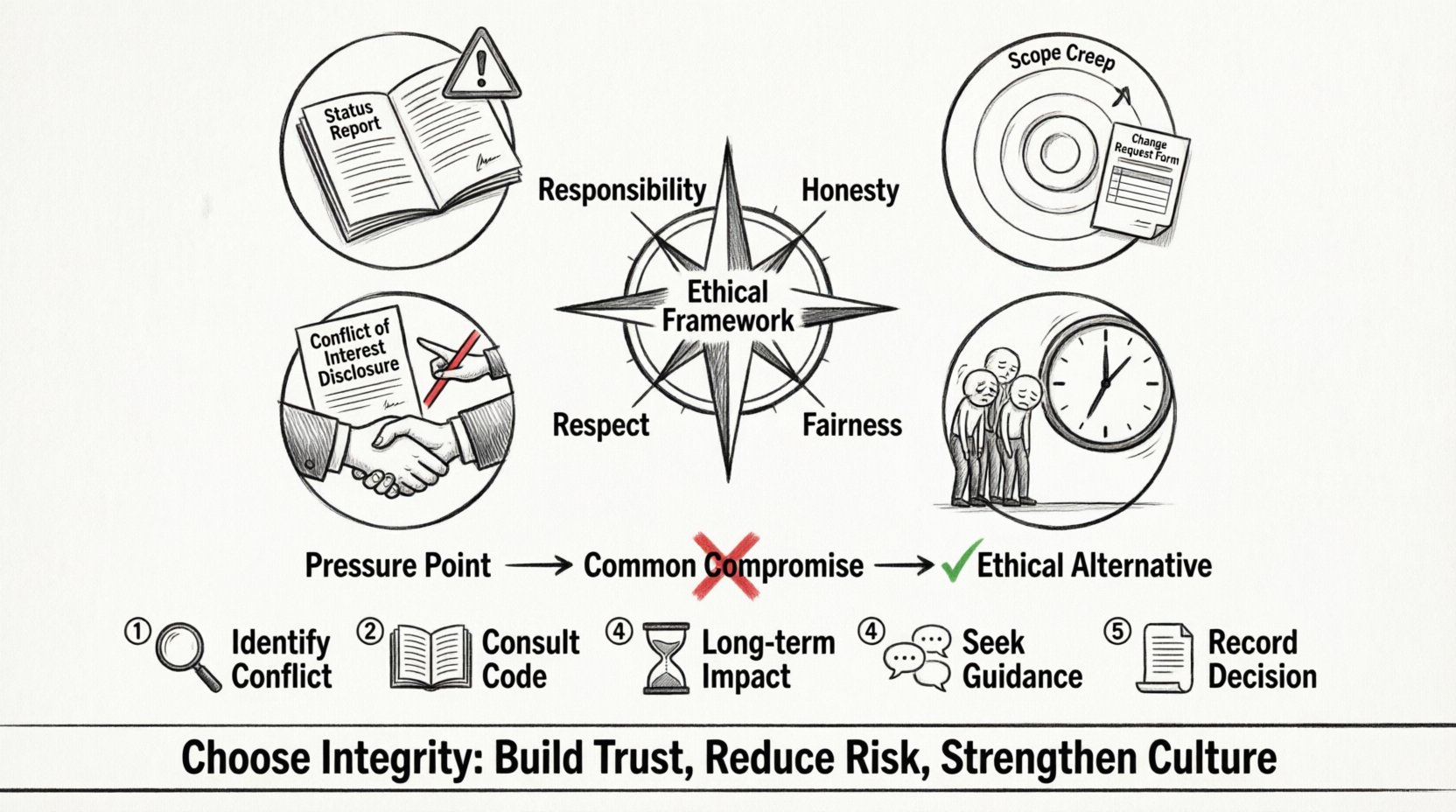
🧭 Understanding the Ethical Framework
Before diving into specific scenarios, it is essential to establish a baseline for what constitutes ethical behavior in project management. Most professional bodies, such as the Project Management Institute (PMI), have codes of conduct that emphasize four values:
- Responsibility: You are accountable for your actions and decisions.
- Honesty: You communicate truthfully and do not mislead stakeholders.
- Respect: You treat everyone involved with dignity and fairness.
- Fairness: You make decisions impartially and do not give undue advantage to any party.
Integrity in this context means adhering to these values even when no one is watching. It is the difference between saying something because you have to and saying it because it is true. When deadlines loom, the pressure to cut corners increases. The temptation to report “green” status on a “red” project is high. The temptation to hide resource constraints is higher. Understanding the weight of these values helps ground your decision-making process.
⚖️ Common Gray Areas in Project Delivery
Gray areas exist because business environments are complex. There is rarely a single right answer, but there are wrong ones. Below are the most common scenarios where deadlines threaten ethical standards.
1. Status Reporting and Transparency
One of the most frequent ethical challenges involves status reporting. Stakeholders want to know the health of the project. If a project is significantly behind schedule, admitting this can lead to blame, budget cuts, or loss of confidence. Conversely, reporting a false “on track” status creates a false sense of security.
- The Dilemma: Do you report the risk now, knowing it might cause alarm, or do you wait until you have a mitigation plan?
- The Ethical Path: Report the risk immediately but frame it with a proposed solution. Transparency builds trust; surprises destroy it.
2. Scope Creep and Change Management
Stakeholders often ask for “just one small thing” that does not fit the original scope. Saying yes preserves the relationship but risks the deadline. Saying no protects the timeline but risks the relationship.
- The Dilemma: Accepting work without formal approval to keep the client happy.
- The Ethical Path: Document every change request. Explain the impact on the timeline and budget clearly. Do not accept work that compromises the project’s viability without a formal agreement.
3. Resource Allocation and Burnout
When deadlines are tight, the urge to overwork the team is strong. Pushing a team to work overtime for weeks to meet a milestone can achieve the goal, but it sacrifices long-term health and productivity.
- The Dilemma: Hitting the deadline at the cost of team well-being.
- The Ethical Path: Protect the team. If overtime is required, it must be compensated or followed by recovery time. Chronic overwork is a form of exploitation that leads to turnover and errors.
4. Vendor and Procurement Integrity
Choosing vendors often involves discretion. A vendor might offer an incentive to speed up the process or secure a contract. This can appear as a conflict of interest.
- The Dilemma: Selecting a vendor based on a personal benefit rather than value.
- The Ethical Path: Select based on merit, cost, and capability. Disclose any potential conflicts of interest to your organization immediately.
📊 Decision Matrix: Ethical Dilemmas vs. Actions
To help visualize how to handle these situations, consider the following matrix. It outlines the pressure point, the common compromise, and the ethical alternative.
| Scenario | The Compromise | The Ethical Alternative |
|---|---|---|
| Project is at risk of missing a deadline | Hide the delay until the last minute | Communicate the delay immediately with a revised plan |
| Team is exhausted and quality is dropping | Force overtime to finish on time | Negotiate a timeline extension or reduce scope |
| Stakeholder wants a feature not in the contract | Build it informally to please them | Submit a formal change request with impact analysis |
| Vendor offers a personal gift for priority | Accept the gift and prioritize the vendor | Decline the gift and maintain objective selection |
| Team member makes a mistake that affects the timeline | Blame the team member to save the project | Investigate the root cause and support the team |
🧠 The Cost of Compromise
It is easy to think that bending the rules once will not hurt. However, the cost of ethical compromise is often cumulative. It manifests in three main areas: reputation, risk, and culture.
1. Reputation and Trust
Trust is the currency of project management. Once you lie about a status update, that lie follows you. Stakeholders will begin to question every future update you provide. If they feel you are managing the narrative rather than the facts, they will micromanage you. This increases overhead and reduces your effectiveness.
2. Project Risk
When you cut corners to meet a deadline, you are introducing technical debt or quality issues. These issues do not disappear; they surface later, often at a higher cost to fix. A project delivered late but with integrity is recoverable. A project delivered on time with hidden defects is a liability.
3. Organizational Culture
As a project manager, you set the tone. If you prioritize speed over ethics, your team will learn that speed is more important than quality. This trickles down to how they treat clients, vendors, and each other. A culture of shortcuts is difficult to reverse once established.
🛠️ A Framework for Decision Making
When you find yourself in a gray area, do not rely on gut feeling alone. Use a structured approach to evaluate your options. This framework helps remove emotion from the equation.
Step 1: Identify the Conflict
Clearly define what is being compromised. Is it the budget? The quality? The timeline? The well-being of the team? Naming the conflict helps you understand the stakes.
Step 2: Consult the Code of Conduct
Refer to your professional code of ethics. Does the proposed action violate a core value? If the action requires you to lie to a stakeholder, it likely violates the value of honesty.
Step 3: Evaluate the Long-Term Impact
Ask yourself: Will I be proud of this decision in five years? Will the stakeholder be proud of the outcome? If the answer is no, you should not proceed. Short-term gains rarely justify long-term reputational damage.
Step 4: Seek Guidance
Do not make high-stakes ethical decisions in isolation. Speak to a mentor, a peer, or a compliance officer. Getting a second opinion can reveal blind spots and provide support for your decision.
Step 5: Document the Decision
Write down why you made the choice. Document the risks you communicated and the alternatives you rejected. This documentation protects you if the project fails and you are held accountable.
🗣️ Communication Strategies for Difficult Conversations
Integrity often requires delivering bad news. This is the hardest part of the job. You must communicate the reality without sounding defeatist. Here are strategies to handle these conversations effectively.
- Lead with Facts: Start with the data. Do not lead with emotion or apology. State the current status objectively.
- Focus on Solutions: Do not just present the problem. Present the problem alongside three potential options for resolution.
- Own the Outcome: Use “I” statements. “I have identified a risk” is better than “There is a risk.” This shows accountability.
- Manage Expectations: Be clear about what can be delivered by the deadline. It is better to under-promise and over-deliver than to over-promise and fail.
Example Script:
“We have encountered a critical issue with the integration phase. This puts our original launch date at risk. I have analyzed the impact and identified two options: we can delay the launch by two weeks to ensure stability, or we can launch on time with a limited feature set. I recommend option one to ensure customer satisfaction. Please let me know which direction you prefer.”
🛡️ Protecting Your Team
Project managers are often the shield between their team and external pressure. When deadlines clash with integrity, the team is usually the one paying the price. They work late, they stress, and they burn out. Your role is to absorb the pressure from stakeholders so the team can focus on the work.
- Say No for Them: If a stakeholder asks for something unreasonable, you are the gatekeeper. Do not pass the pressure down to the team.
- Advocate for Resources: If the deadline is impossible, fight for more resources or a timeline extension. Do not let the team suffer for a planning failure.
- Recognize Effort: If overtime is necessary, ensure it is acknowledged and rewarded. Do not treat extra work as a baseline expectation.
🌱 The Long-Term Career Impact
Every project manager builds a portfolio. This portfolio is not just a list of completed projects; it is a list of relationships and reputations. When you choose integrity over a quick win, you build a brand as someone who is reliable and trustworthy.
Organizations value stability. A project manager who delivers honest updates, even when they are bad, is more valuable than one who hides problems until they explode. In the long run, the market rewards those who can be trusted with high-stakes decisions.
🔄 Continuous Improvement in Ethical Practice
Ethics is not a one-time lesson; it is a continuous practice. As projects become more complex and remote work becomes the norm, new ethical challenges will emerge. Data privacy, remote surveillance, and cross-cultural expectations are new frontiers.
- Stay Updated: Keep learning about industry standards and regulations.
- Reflect Regularly: After every project, review your decisions. Were there moments you wish you had handled differently?
- Build a Support Network: Connect with other professionals who value integrity. They will be your sounding board when you face difficult choices.
🏁 Final Thoughts on Integrity
Navigating the gray areas of project management requires courage. It is easier to lie than to tell the truth. It is easier to push the team than to ask for more time. But the cost of the easier path is high.
Integrity is not just about following rules; it is about doing the right thing when no one is forcing you to. When deadlines clash with integrity, the choice defines who you are as a professional. Choose the path that allows you to sleep well at night. Choose the path that builds lasting trust. Choose the path that honors the work you do.
The projects you manage will end. The teams will disband. The stakeholders will move on. But your reputation will remain. Ensure it is built on a foundation of honesty, responsibility, and respect.
Related posts:
 How Project Management Actually Works: A Definitive Overview for Intermediate Professionals
 The Hidden Cost of Chaos: Common Mistakes Stalling Your Project Management Career
 Agile vs. Waterfall: A Real-World Comparison for Senior Project Managers Deciding Frameworks
 5-Step Quick Start Guide to Structuring Any Project Management Initiative from Scratch