


The shift toward distributed work has fundamentally altered how organizations operate. Managing projects across different geographies, time zones, and home environments requires a distinct approach compared to traditional office settings. Effective remote project management is not merely about transferring existing processes online; it involves rethinking communication, accountability, and culture from the ground up. This guide explores the specific hurdles faced by distributed teams and provides actionable strategies to navigate them successfully. 🚀
🏗️ The Landscape of Distributed Work
Remote work is no longer a perk; it is a standard operational model for many industries. When teams are spread across multiple locations, the dynamics of coordination change significantly. Physical proximity often facilitated spontaneous collaboration and quick clarifications. In a virtual environment, every interaction must be intentional. Project managers must ensure that workflows remain transparent without relying on over-the-shoulder visibility. This shift demands a higher degree of documentation and a clear understanding of asynchronous workflows.
Success in this environment relies on building systems that support autonomy. Team members need to understand their objectives clearly enough to execute without constant supervision. This requires trust, which is earned through consistent delivery and open communication channels. The goal is to create an ecosystem where the location of the worker does not hinder the progress of the project.
🛑 Core Challenges in Remote Project Management
Identifying the friction points is the first step toward resolution. Remote project management introduces several unique variables that can derail timelines and morale if left unaddressed.
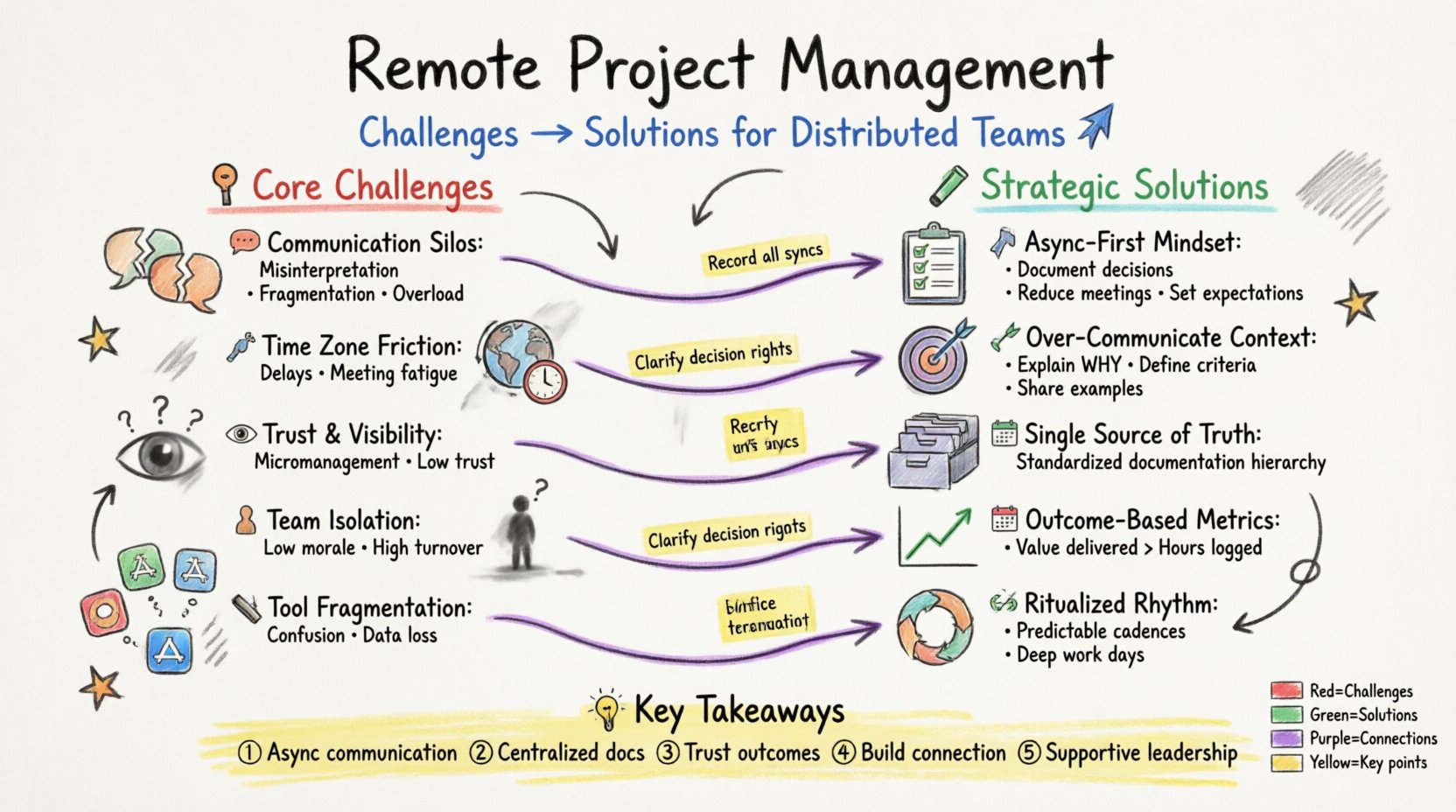
1. Communication Silos and Noise
In a physical office, information often flows through hallway conversations or quick desk visits. In remote settings, this informal layer disappears. Without a structured replacement, information gaps emerge. Teams may end up working in isolation, unaware of changes affecting their tasks. Furthermore, the sheer volume of digital messages can lead to fatigue. Important updates often get buried under notifications, leading to missed deadlines or duplicated efforts.
- Misinterpretation: Text lacks tone, leading to misunderstandings.
- Fragmentation: Conversations scattered across multiple platforms create confusion.
- Overload: Constant pinging reduces deep work time.
2. Time Zone Friction
When a team spans continents, the concept of a “workday” becomes fluid. Synchronous meetings often fall outside business hours for some participants. This can lead to burnout or resentment if the burden of odd hours is not shared fairly. It also delays decision-making. If a critical blocker needs approval, and the approver is asleep in another zone, the project stalls. Coordination becomes a logistical puzzle.
3. Trust and Visibility
Traditional management often relies on presence. Seeing someone at their desk implies they are working. In remote settings, this visual cue is gone. Managers may struggle to gauge productivity without resorting to surveillance, which damages trust. Conversely, team members may feel their efforts are invisible, leading to a lack of recognition. Establishing trust requires a shift from monitoring activity to evaluating outcomes.
4. Culture and Isolation
Company culture is often built on shared experiences and social interactions. Remote teams can struggle to build a sense of belonging. Isolation can lead to disengagement and higher turnover rates. Without deliberate effort to foster connection, the team may feel like a collection of individuals rather than a cohesive unit. This impacts collaboration and the willingness to go the extra mile.
📊 Challenge vs. Solution Matrix
Understanding the specific pairing of problems and remedies helps in creating a robust framework.
| Challenge | Impact | Strategic Solution |
|---|---|---|
| Communication Silos | Information gaps, duplicated work | Centralized documentation, defined communication channels |
| Time Zone Differences | Delays, meeting fatigue | Async-first workflows, rotating meeting times |
| Lack of Visibility | Micromanagement, low trust | Outcome-based metrics, transparent roadmaps |
| Team Isolation | Low morale, high turnover | Virtual social time, regular check-ins |
| Tool Fragmentation | Confusion, data loss | Consolidated tech stack, integration standards |
🛠️ Strategic Solutions for Distributed Teams
Addressing these challenges requires a multi-faceted approach. It involves changing processes, tools, and mindsets. The following strategies provide a foundation for resilient remote operations.
1. Adopt an Async-First Mindset
Asynchronous communication allows team members to work during their peak productivity hours without waiting for immediate responses. This reduces the pressure of instant availability. It also creates a written record of decisions, which is invaluable for reference later.
- Document Decisions: Every major decision should be recorded in a shared space. This prevents the “I thought you said…” scenario.
- Reduce Meeting Load: Replace status update meetings with written reports. Use meetings only for complex problem-solving or brainstorming.
- Set Response Expectations: Clearly define what requires an immediate response and what can wait 24 hours.
2. Over-Communicate Context
Without physical cues, context is easily lost. Project managers must provide more background information than they might in an office. When assigning a task, explain the “why” behind it, not just the “what”. This empowers team members to make better autonomous decisions.
- Explain the business impact of the task.
- Define the constraints and success criteria clearly.
- Provide examples or references to similar past work.
3. Standardize Documentation
A single source of truth is critical. When information is scattered, efficiency drops. Establish a hierarchy for where information lives. For example, high-level strategy goes in one place, technical specs in another, and meeting notes in a third. Everyone must know where to look for specific information.
4. Implement Outcome-Based Performance
Shift the focus from hours logged to value delivered. This aligns with the nature of remote work where output is more important than presence. Define clear Key Performance Indicators (KPIs) for projects and individuals. This removes ambiguity about what success looks like and reduces the need for constant check-ins.
5. Create a Ritualized Rhythm
Predictability helps teams function smoothly. Establish a rhythm for work. For instance, specific days for deep work, specific days for collaboration, and weekly cadences for planning. This helps team members plan their own schedules and manage their energy levels effectively.
🤝 Building Resilient Remote Processes
Processes are the backbone of any project. In a remote setting, they must be explicit and accessible.
Meeting Hygiene
Meetings are expensive. In a remote context, they require even more preparation to be worthwhile. Every meeting should have an agenda sent in advance. If there is no agenda, the meeting should be canceled. This respects everyone’s time and ensures that the discussion stays on track.
- Pre-work: Require reading materials before the call.
- Timeboxing: Set a strict end time for every call.
- Action Items: End every meeting with a clear list of next steps and owners.
Onboarding and Integration
Bringing a new member into a remote team requires more intention than an office setup. They cannot overhear conversations to learn the ropes. A structured onboarding process is essential.
- Assign a buddy or mentor for the first month.
- Create a comprehensive resource library for tools and policies.
- Schedule introductory calls with key stakeholders early on.
👔 Leadership in a Virtual Environment
Leadership styles must adapt to the virtual context. Command and control structures often fail in remote settings because they rely on visibility. Leaders need to be more supportive and less directive.
Empathy and Well-being
Remote work blurs the line between personal and professional life. Leaders should check in on the well-being of their team members, not just their output. Recognizing signs of burnout and encouraging boundaries is crucial. This builds loyalty and ensures long-term sustainability.
Conflict Resolution
Conflict is inevitable. In a remote setting, it can fester if not addressed quickly. Text-based arguments can escalate quickly due to the lack of tone. Leaders should move sensitive conversations to video calls when possible to read body language and de-escalate tension.
- Address issues privately, not in public channels.
- Focus on the behavior, not the person.
- Seek to understand the root cause before prescribing a solution.
📈 Measuring Success Without Micromanagement
How do you know the project is on track? Without a visual Kanban board on a wall, you need digital transparency.
Project Dashboards
Utilize dashboards that provide real-time visibility into project health. These should show progress against milestones, resource allocation, and potential risks. This allows stakeholders to see the status without needing to ask status update questions constantly.
Regular Retrospectives
At the end of every phase or sprint, hold a retrospective. This is a time to discuss what went well and what didn’t. It creates a feedback loop for continuous improvement. In remote teams, this is vital for catching process inefficiencies early.
- What barriers prevented us from working efficiently?
- What tools or processes need adjustment?
- How can we improve our communication next time?
🔮 Future-Proofing Remote Management
The landscape of work continues to evolve. Technologies like virtual reality and advanced AI are beginning to change how we collaborate. However, the core principles of clear communication, trust, and structured processes remain constant.
Adaptability
Be prepared to adjust your management style as the team grows or changes. What works for a small startup may not work for a large enterprise. Flexibility is a key trait for remote project managers.
Investment in Tools
While specific software names should be avoided, investing in a cohesive ecosystem is necessary. Ensure that your tools integrate well together to reduce context switching. A fragmented tech stack creates friction that slows down the entire team.
🌟 Final Thoughts on Distributed Success
Managing projects remotely is a complex endeavor that requires patience, discipline, and a willingness to learn. It is not about replicating the office at home; it is about creating a new way of working that leverages the benefits of flexibility while mitigating the risks of distance. By focusing on clear communication, documented processes, and outcome-based metrics, organizations can build teams that are resilient and high-performing regardless of location.
The journey toward effective remote project management is ongoing. It requires continuous refinement of strategies based on team feedback and changing circumstances. With the right approach, distributed work can offer a level of productivity and satisfaction that rivals or exceeds traditional models. The key lies in treating your team as partners in a shared mission, supported by robust systems and mutual respect. 🌱
As you implement these strategies, remember that consistency is your ally. Small, repeated actions build the culture and processes that sustain long-term success. Whether your team is fully remote, hybrid, or distributed across the globe, the principles of clarity, trust, and autonomy will guide you toward achieving your project goals.
📝 Key Takeaways
- Communication: Prioritize asynchronous methods to reduce fatigue and increase deep work time.
- Documentation: Maintain a single source of truth to prevent information silos.
- Trust: Measure performance by outcomes, not hours logged or visibility.
- Connection: Dedicate time to social interaction and team building to combat isolation.
- Leadership: Adapt styles to be more supportive and less directive in a virtual setting.
By adhering to these guidelines, you can navigate the complexities of remote project management and build a team that thrives in a distributed environment.
Related posts:
 How Project Management Actually Works: A Definitive Overview for Intermediate Professionals
 The Hidden Cost of Chaos: Common Mistakes Stalling Your Project Management Career
 Agile vs. Waterfall: A Real-World Comparison for Senior Project Managers Deciding Frameworks
 5-Step Quick Start Guide to Structuring Any Project Management Initiative from Scratch