


Growth is the primary objective for any organization striving for longevity and success. However, as a project management team expands from a handful of individuals to dozens or even hundreds, the dynamics of leadership shift fundamentally. The informal methods that worked when the team was small often become the very bottlenecks that stifle progress when the team grows. Managing larger teams requires a deliberate shift in strategy, moving from direct oversight to structural enablement. This guide explores the mechanics of scaling project management effectively.
When you scale, you are not just adding more people; you are adding more complexity, more communication channels, and more potential points of failure. The goal is to maintain the agility of a small startup while leveraging the resources of a large enterprise. Achieving this balance requires rigorous attention to process, clear communication frameworks, and a deep understanding of human dynamics. Below, we break down the essential steps to maintain control without micromanaging.
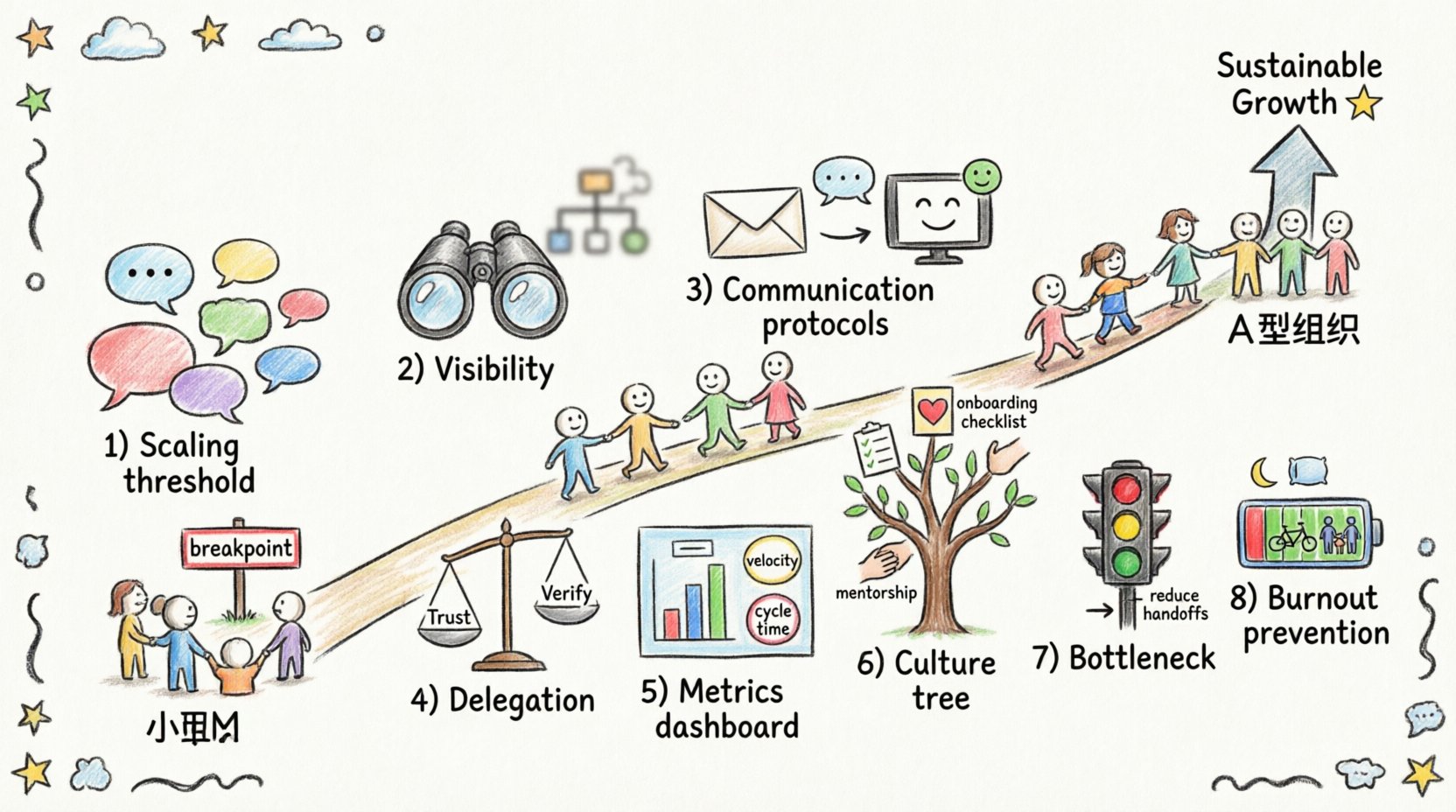
Understanding the Scaling Threshold 📈
Every team has a tipping point where informal communication breaks down. In a small group, you can know the status of every task through casual hallway conversations. As the team grows, this becomes impossible. The “scaling threshold” is reached when the number of communication channels exceeds the capacity of the team to process them efficiently.
- Identify the Breakpoint: Track how long it takes to make decisions as the team grows. If decision latency increases significantly, you have hit the threshold.
- Recognize Communication Overload: When meetings replace work, the structure is too heavy. When status updates are ignored, the structure is too light.
- Audit Current Processes: Review every workflow. If a step does not add value, remove it. Complexity should decrease as the team grows, not increase.
Scaling is not merely about hiring more project managers. It is about redesigning how work flows through the organization. You must transition from a leader who assigns tasks to a leader who designs the system that assigns tasks.
Restructuring for Visibility 👁️
Visibility is the currency of control. In a large team, you cannot see everything, but you can design the system so that the right things are always visible. This requires a shift in organizational structure.
Span of Control Models
The number of direct reports a manager can effectively supervise is limited. As you scale, you must decide on an appropriate span of control.
- Narrow Span: Fewer direct reports allow for closer mentorship but create more layers of management.
- Wide Span: More direct reports reduce hierarchy but require highly autonomous team members.
- Hybrid Approach: Use a mix depending on the maturity of the team and the complexity of the work.
The Role of Middle Management
When scaling, middle management becomes critical. They act as the bridge between strategic vision and tactical execution. Their role is to filter information, ensure alignment, and remove obstacles for the team members below them.
- Information Gatekeepers: They ensure that the team only receives necessary directives, preventing noise.
- Culture Carriers: They reinforce values and ensure consistency in how work is approached.
- Problem Solvers: They resolve issues before they escalate to senior leadership.
Structural Comparison
| Structure Type | Best For | Risk |
|---|---|---|
| Functional | Specialized skills, clear career paths | Silos, slower cross-team collaboration |
| Matrix | Resource sharing, project focus | Conflicting priorities, dual reporting lines |
| Network | Agility, external partnerships | Coordination overhead, less control |
| Flat | Small teams, rapid innovation | Management bottleneck, unclear hierarchy |
Communication Protocols for Scale 🗣️
Communication is the lifeblood of a project management system. When the team is small, ad-hoc communication works. When the team is large, ad-hoc communication creates chaos. You need defined protocols.
Asynchronous vs. Synchronous
Not all communication needs to happen in real-time. In fact, real-time communication is often the enemy of deep work.
- Asynchronous: Use documentation and updates for status reporting. This allows people to work on their own time.
- Synchronous: Reserve meetings for decision-making, brainstorming, and complex problem-solving.
- The 24-Hour Rule: If a question can be answered via documentation, ask the documentation first. Do not interrupt a colleague.
Information Hierarchy
Not all information is created equal. You must categorize communication based on urgency and audience.
- Strategic Level: High-level goals, budget changes, major risks. Shared with leadership.
- Tactical Level: Sprint goals, resource allocation, dependencies. Shared with team leads.
- Operational Level: Daily tasks, blockers, code reviews. Shared with individual contributors.
Delegating Authority Without Abandoning Oversight ⚖️
Micromanagement kills autonomy. However, total abandonment leads to drift. The art of scaling lies in delegating authority while maintaining accountability.
Decision-Making Frameworks
Define who has the final say on what. This prevents bottlenecks where everything waits for a single person.
- Consent-Based: Decisions can be made unless someone raises a valid objection.
- Consultative: The leader asks for advice but makes the final call.
- Delegated: The team member makes the decision and informs the leader.
Trust but Verify
You must trust your team to execute, but you need mechanisms to verify progress without hovering.
- Outcomes over Inputs: Judge based on what was delivered, not how many hours were spent.
- Milestone Checkpoints: Define specific points in the project where status must be reviewed.
- Automated Reporting: Use data to highlight anomalies rather than checking every detail manually.
Establishing Clear Metrics 📊
Without clear metrics, you cannot know if you are succeeding. In a large team, you cannot track every task. You must track the indicators that predict success.
Key Performance Indicators (KPIs)
Select metrics that align with business goals.
- Velocity: How much work is completed over time? Use this to predict future capacity.
- Cycle Time: How long does a task take from start to finish? Reducing this increases efficiency.
- Defect Rate: How often does work need to be redone? High rates indicate quality issues.
- Resource Utilization: Are people overworked or underutilized? Balance is key to sustainability.
Risk Management
As teams grow, the risk of failure compounds. You need a proactive approach to risk.
- Risk Registers: Maintain a living document of potential risks and mitigation strategies.
- Early Warning Systems: Define thresholds that trigger alerts (e.g., if budget is 10% over, flag it).
- Post-Mortems: After every major project, analyze what went wrong and update processes accordingly.
Preserving Culture During Growth 🌱
Culture is what remains when the processes fail. If you scale without preserving culture, you risk high turnover and low morale.
Onboarding and Integration
New members need to understand the “why” behind the work, not just the “what”.
- Structured Onboarding: Create a checklist for new hires to ensure they understand workflows.
- Mentorship Programs: Pair new members with experienced staff to accelerate learning.
- Knowledge Repositories: Ensure all processes are documented so knowledge is not lost when people leave.
Maintaining Psychological Safety
Team members must feel safe to speak up about problems without fear of retribution.
- Open Feedback Channels: Create safe spaces for honest feedback.
- Leadership Vulnerability: Leaders should admit mistakes to encourage others to do the same.
- Recognition: Celebrate wins publicly to reinforce positive behaviors.
Identifying Bottlenecks Early 🚦
Bottlenecks are natural in any system, but they become critical in large organizations. You need to spot them before they cause delays.
Flow Efficiency
Measure how much time work spends waiting versus being worked on.
- Wait Times: If a task sits in a “review” status for weeks, that is a bottleneck.
- Handoffs: Every time work passes from one person to another, efficiency drops. Reduce handoffs.
- Capacity Planning: Ensure the team has enough capacity to handle the workload without piling up.
Continuous Improvement
Scaling is not a destination; it is a continuous process of refinement.
- Regular Retrospectives: Hold meetings to discuss what is working and what is not.
- Experimentation: Encourage teams to try new workflows and measure the results.
- Feedback Loops: Ensure that insights from the front lines reach the decision-makers quickly.
The Human Element: Preventing Burnout 🔋
The biggest risk to scaling is the exhaustion of the people doing the work. A burned-out team cannot deliver quality results.
Workload Management
Ensure that work is distributed evenly and sustainably.
- Capacity Tracking: Know how many hours a person can realistically work per week.
- Rest Periods: Encourage time off to recharge.
- Work-Life Balance: Respect boundaries and avoid expecting availability outside of working hours.
Career Development
People stay when they see a future. Provide clear paths for growth.
- Skill Building: Offer training and opportunities to learn new skills.
- Internal Mobility: Allow people to move to different teams to keep work fresh.
- Recognition: Acknowledge contributions and progress regularly.
Final Thoughts on Sustainable Growth 🌟
Scaling project management is a complex challenge that requires balancing structure with flexibility. It demands that leaders let go of control in exchange for clarity. By implementing clear structures, robust communication protocols, and a focus on human well-being, you can lead large teams effectively. The journey is ongoing, and the strategies must evolve as the organization changes. Focus on building systems that work for the people, and the results will follow.