


Creating a schedule that actually works is one of the most critical skills in project management. Many teams struggle because they focus too much on the tools rather than the logic. A timeline should be a living document that guides execution, not a static chart that gathers dust. The goal is clarity and accountability. When you strip away the noise, you are left with the essential flow of work.
This guide outlines the systematic approach to constructing a timeline that withstands change and drives delivery. We will cover the foundational steps, the logic behind task sequencing, and the methods for keeping the plan accurate. You do not need complex software to achieve this. You need a clear strategy and a disciplined approach to planning.
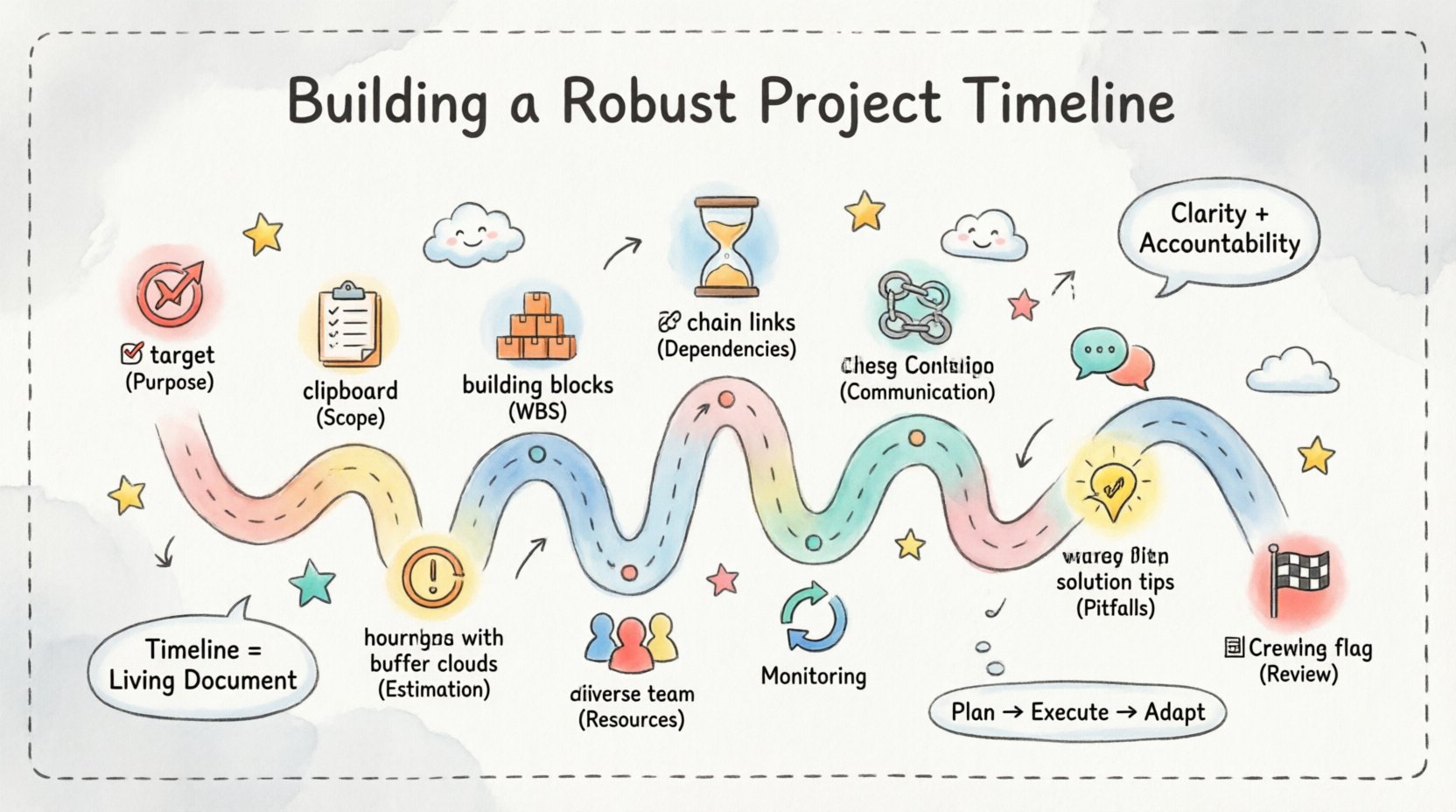
1. Understanding the Purpose of a Timeline 🎯
Before drawing a single line or assigning a date, you must understand what the timeline is meant to achieve. It serves several functions simultaneously:
- Communication: It shows stakeholders when to expect results.
- Coordination: It ensures different teams know when to hand off work.
- Tracking: It provides a baseline to measure progress against reality.
- Planning: It forces the team to think through the sequence of events before starting.
When a timeline becomes too detailed, it loses its value as a communication tool. When it is too vague, it fails as a planning tool. The sweet spot lies in the middle. You need enough detail to identify risks, but enough flexibility to absorb inevitable changes.
2. Defining Project Scope and Deliverables 📋
A timeline cannot exist in a vacuum. It must be built upon a clearly defined scope. If you do not know what you are building, you cannot estimate how long it will take. Start by listing the final deliverables. These are the tangible outputs that signal project completion.
Once you have the final outputs, work backward. What needs to happen immediately before the final delivery? What needs to happen before that? This backward planning technique helps you identify the necessary milestones.
Key steps for defining scope include:
- Document every deliverable explicitly.
- Set acceptance criteria for each item.
- Identify what is out of scope to prevent scope creep.
- Confirm these boundaries with key stakeholders.
Without this foundation, the timeline will drift. Teams will add work that was not planned, causing delays. A rigid scope definition protects the schedule from unnecessary expansion.
3. Creating a Work Breakdown Structure (WBS) 🧱
The Work Breakdown Structure is the backbone of your timeline. It breaks the project down into smaller, manageable pieces. You cannot schedule a project if you are scheduling abstract concepts. You must schedule specific actions.
Think of the WBS as a hierarchy. The top level is the project itself. The next level contains major phases or workstreams. The lowest level contains individual tasks. These tasks should be small enough to be estimated accurately but large enough to be meaningful.
Guidelines for effective task decomposition:
- Each task should be assignable to a single person or team.
- Each task should have a clear start and end point.
- Tasks should be measurable.
- Aim for a task duration of no more than two weeks for better control.
If a task takes a month, it is likely too large. It hides risks and makes progress tracking difficult. Breaking it into smaller chunks allows you to see if work is slipping early. This granularity is essential for a robust schedule.
4. Sequencing Tasks and Managing Dependencies 🔗
Order matters. Some work cannot begin until other work is finished. These relationships are known as dependencies. Identifying them correctly is the difference between a realistic plan and a fantasy.
There are four standard types of dependencies to consider:
- Finish-to-Start (FS): Task B cannot start until Task A is finished. This is the most common relationship.
- Start-to-Start (SS): Task B cannot start until Task A has started.
- Finish-to-Finish (FF): Task B cannot finish until Task A is finished.
- Start-to-Finish (SF): Task B cannot finish until Task A has started. This is rare.
When mapping these relationships, look for the Critical Path. This is the longest sequence of dependent tasks that determines the shortest possible project duration. If any task on the critical path is delayed, the entire project is delayed.
To manage dependencies effectively:
- Map all logical links between tasks.
- Identify which dependencies are mandatory (hard logic) vs. discretionary (soft logic).
- Review the critical path regularly.
- Minimize dependencies where possible to reduce risk.
5. Estimating Duration and Buffers ⏳
Estimating time is often the most difficult part of planning. People tend to be optimistic. They assume everything will go according to plan. Reality rarely aligns with optimism. You need to account for uncertainty.
Use historical data if available. Look at similar past projects to see how long tasks actually took. If you do not have history, use a range. Ask the team for a best-case, worst-case, and most likely scenario.
Including buffers is crucial for a robust timeline. A buffer is extra time added to protect the schedule from delays. There are two main types of buffers:
- Task Buffer: Extra time added to specific tasks that are high risk.
- Project Buffer: Extra time added at the end of the project to protect the final delivery date.
Do not hide buffers in individual task estimates. Keep them visible. This prevents the “student syndrome,” where people wait until the last minute to start because they feel they have extra time. If you manage buffers correctly, you can absorb shocks without missing deadlines.
6. Assigning Resources and Handling Constraints 👥
A schedule without resources is just a list of dates. You must assign who is doing the work. Resource allocation ensures you do not overbook your team. It also highlights when you need to hire or outsource.
Common resource constraints include:
- Availability: Team members may be on leave or working on other projects.
- Skills: Not everyone can do every task. Match skills to requirements.
- Equipment: Shared tools or environments may limit parallel work.
- Budget: Cost constraints may limit the number of resources you can use.
When assigning resources, look for conflicts. If two critical tasks require the same person at the same time, you have a problem. You must either split the task, change the schedule, or find another resource. Resource leveling is the process of smoothing out these conflicts to ensure a steady workflow.
7. Monitoring Progress and Updating the Plan 🔄
Once the project starts, the plan will change. Things will not go exactly as expected. The timeline must be updated to reflect reality. This is not a sign of failure; it is a sign of good management.
Establish a regular cadence for updates. Weekly reviews are standard. During these reviews, compare planned progress to actual progress. Calculate the variance.
Key actions during monitoring:
- Record actual start and finish dates for completed tasks.
- Update the percentage complete for ongoing tasks.
- Identify new risks that may impact the schedule.
- Adjust the remaining estimates based on actual performance.
If a task slips, analyze the impact. Does it affect the critical path? Does it delay a milestone? If it does, you need a recovery plan. This might involve crashing the schedule (adding resources) or fast-tracking (doing tasks in parallel).
8. Common Pitfalls to Avoid ⚠️
Even experienced planners make mistakes. Being aware of common errors helps you avoid them. Use the table below to identify potential issues in your planning process.
| Pitfall | Consequence | Solution |
|---|---|---|
| Ignoring Dependencies | Tasks start before prerequisites are ready. | Map all logical links before estimating. |
| Over-optimistic Estimates | Delays occur because time was not allocated for issues. | Add contingency buffers and review historical data. |
| Too Much Detail | The plan becomes unmanageable and difficult to update. | Keep high-level tasks for milestones and detailed tasks for execution. |
| No Change Control | Scope creep destroys the original schedule. | Formalize how changes are requested and approved. |
| Ignoring Resource Conflicts | Team members are double-booked and become bottlenecks. | Review resource allocation alongside task scheduling. |
9. Communication and Stakeholder Alignment 🗣️
A timeline is useless if stakeholders do not understand it. You must communicate the plan effectively. Different audiences need different levels of detail.
Executives care about milestones and critical dates. They do not need to see every single task. Team members need the specific tasks they are responsible for. Use the timeline to facilitate these conversations.
Best practices for communication:
- Share the timeline well in advance of the start date.
- Highlight any known risks or constraints clearly.
- Invite feedback on the schedule before finalizing it.
- Keep stakeholders informed of any significant changes.
When changes occur, explain the “why.” If a date slips, provide the reason and the new plan. Transparency builds trust. Hiding bad news usually makes the situation worse when it is eventually discovered.
10. Scaling the Timeline for Complex Projects 📈
As projects grow, a single timeline becomes unwieldy. You need a hierarchy of schedules. The master schedule shows the major phases and milestones. Sub-schedules break down specific workstreams. This allows you to manage complexity without losing the big picture.
Ensure all sub-schedules align with the master schedule. If a sub-schedule slips, the master schedule must reflect that. Integration is key. Regular synchronization meetings ensure that all parts of the project are moving in the same direction.
Key considerations for scaling:
- Define clear integration points between workstreams.
- Use a central repository for all schedule data.
- Assign a scheduler to manage the master plan.
- Automate status reporting where possible.
11. Reviewing and Closing the Timeline 🏁
The end of the project is a good time to review the timeline. Compare the planned dates to the actual dates. What went well? What went wrong? This post-project review is valuable for future planning.
Document the lessons learned regarding time estimation. Did tasks take longer than expected? Were dependencies missed? Use this data to improve your estimates on the next project. Continuous improvement is the only way to become more accurate over time.
Final thoughts on timeline management:
- Keep the plan simple and focused.
- Update it regularly to reflect reality.
- Communicate changes promptly.
- Learn from every project you complete.
A robust timeline is not about perfection. It is about having a reliable guide. It helps you navigate uncertainty and deliver value consistently. By following these steps, you can build a schedule that supports your team and meets your objectives.