


Reaching the intermediate stage of your project management career is a significant milestone. You have moved beyond the basics of task tracking and are now navigating the complexities of strategy, stakeholder influence, and team dynamics. However, with increased responsibility often comes a quiet anxiety. You have likely encountered moments where you hesitated to speak up, wondering if your experience is sufficient to handle the weight of a decision. This uncertainty is common, even among seasoned professionals.
This guide addresses the difficult questions that intermediate project managers hesitate to ask their mentors or peers. We will explore scenarios involving scope creep, team conflict, stakeholder management, and career progression. The goal is to provide clear, actionable guidance grounded in practical experience rather than theory.
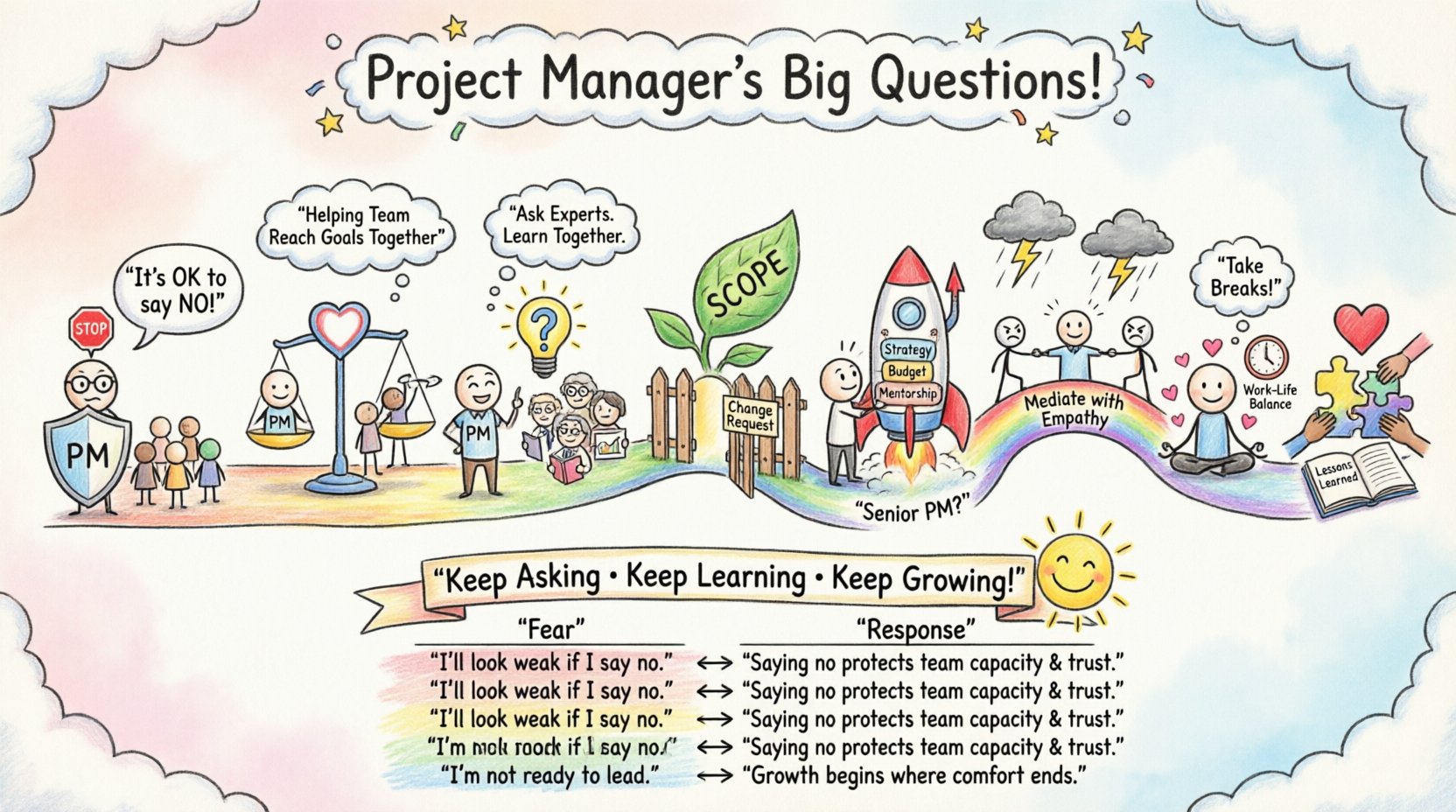
1. “Can I Actually Say No to a Stakeholder?” 🛑
One of the first major hurdles you face is the expectation that your role is to say “yes” to everything. When a senior executive or a key client requests a feature addition or a timeline shift, the immediate reaction is often compliance. However, blind agreement can lead to project failure, team burnout, and a loss of credibility.
Why This Question Matters
Saying no is not about being difficult. It is about protecting the project’s integrity and the team’s capacity. If you agree to every request without analysis, you dilute the focus of the project. Resources become stretched, quality suffers, and deadlines become impossible to meet.
How to Handle the Request
- Analyze the Impact: Before responding, assess what must change if you accept the new request. Does it require more budget? Does it delay another critical deliverable?
- Offer Alternatives: Instead of a flat refusal, propose a trade-off. “We can add this feature, but we will need to move the launch date by two weeks.”
- Document the Decision: Ensure that any agreement to change scope is recorded. This protects you and the team from future blame if the timeline slips.
- Use Data: Present historical data on how similar requests impacted previous projects. Facts often speak louder than opinions.
Remember, your value lies in your ability to guide the project to success, not in being a servant to every demand. A confident “no” backed by logic is better than a stressful “yes” that leads to failure.
2. “How Do I Influence a Team Without Direct Authority?” ⚖️
Intermediate project managers often lead cross-functional teams where they do not manage the people directly. These team members report to functional managers, not you. This creates a dynamic where you must drive results without the traditional leverage of hiring or firing.
The Challenge of Influence
Without direct authority, you cannot command. You must persuade. This requires building relationships and demonstrating value. If the team does not respect your judgment or trust your intent, they will not prioritize your requests.
Strategies for Building Influence
- Understand Their Goals: What motivates the team members? Is it learning, recognition, or stability? Align project tasks with their personal professional goals.
- Remove Roadblocks: Act as a shield for the team. If external noise is distracting them, handle it yourself. They will respect you for protecting their focus time.
- Communicate Clearly: Ambiguity causes friction. Ensure that every task has a clear owner and deadline. Make expectations transparent.
- Be Reliable: If you say you will follow up, do it. If you promise to resolve an issue, deliver. Trust is built on consistency over time.
Influence is an asset that grows with use. The more you help others succeed, the more they will support you when the project is on the line.
3. “What If I Don’t Know the Answer to a Critical Problem?” 🧠
There is a pervasive myth that a project manager must have all the answers. In reality, technical experts often have the solutions for specific problems. Admitting a gap in knowledge is not a sign of weakness; it is a sign of maturity.
Why Honesty is Vital
If you guess or provide incorrect information, you risk leading the team down the wrong path. This wastes time and resources. It is better to pause, gather information, and admit uncertainty than to pretend competence.
Steps to Take When Stumped
- Pause and Assess: Acknowledge that you need more information before committing to a path.
- Consult the Experts: Reach out to the subject matter experts within the team or the wider organization.
- Set a Timeline: Tell stakeholders when you will have a definitive answer. “I do not know the solution yet, but I will have an update by 2 PM tomorrow.”
- Facilitate Collaboration: Bring the right people together in a meeting to solve the issue collectively. This shifts the burden from you to the group.
Leadership is about navigating uncertainty, not eliminating it. By managing the process of finding the answer, you maintain control even when the solution is unclear.
4. “How Do I Manage Scope Creep Without Alienating Clients?” 📉
Scope creep is the silent killer of projects. It happens gradually as small, seemingly harmless requests accumulate. Eventually, the original scope is unrecognizable, and the project fails to deliver on time.
Recognizing the Signs
You might notice changes happening in informal chats rather than official channels. A client might ask for “just one small thing” during a weekly sync. These small additions are the beginning of scope creep.
Defending the Scope
- Formalize Changes: Require all changes to go through a formal change request process. This adds a slight friction that encourages clients to think before asking.
- Visualize the Cost: Show the team how the extra work impacts the timeline. Use a visual chart to demonstrate the delay.
- Revisit the Contract: Remind stakeholders of the original agreement. “This falls outside the initial agreement we signed off on.”
- Phased Delivery: If a request is valuable but out of scope, suggest adding it to the next phase. This validates the idea while protecting the current timeline.
Managing scope is about respect. You respect the client’s goals by ensuring the project succeeds, and you respect the team by not overloading them.
5. “Am I Ready to Move to Senior Project Manager?” 🚀
After managing several projects successfully, you might wonder if you have the skills to handle more strategic initiatives. The transition from intermediate to senior requires a shift in focus from execution to strategy.
Key Indicators of Readiness
- Strategic Alignment: Do you understand how your projects align with the broader business goals? Can you articulate this to leadership?
- Financial Acumen: Are you comfortable managing budgets, forecasting costs, and understanding ROI?
- Mentorship: Are you helping junior team members grow? A senior PM invests in the development of others.
- Risk Management: Can you identify risks before they become issues? Do you have mitigation plans in place?
How to Prepare
- Seek Feedback: Ask your manager and peers what skills you need to develop to reach the next level.
- Take on More Complexity: Volunteer for projects with higher visibility or greater risk.
- Learn Business Fundamentals: Study the industry you work in. Understand the market forces that drive your projects.
- Build Your Network: Connect with other senior professionals to learn from their experiences.
Career progression is not just about tenure. It is about demonstrating that you can handle the weight of higher-level responsibilities.
Common Fears vs. Professional Responses 📊
To help you internalize these concepts, here is a summary table of common fears and how to translate them into professional actions.
| Common Fear | Underlying Concern | Professional Response |
|---|---|---|
| “I might fail the project.” | Performance anxiety | Focus on risk mitigation and early warning signs. |
| “I don’t know the technical details.” | Imposter syndrome | Leverage the team’s expertise; manage the process, not the code. |
| “My team won’t listen to me.” | Lack of authority | Build trust through reliability and support. |
| “I have to say no to a boss.” | Conflict avoidance | Present data on impact and offer alternatives. |
| “I am not qualified for the promotion.” | Self-doubt | Document achievements and seek mentorship. |
6. “How Do I Handle Conflict Within the Team?” ⚔️
Conflict is inevitable when people with different backgrounds and priorities work together. As an intermediate PM, you will be the first to notice tension. Ignoring it allows it to fester, but intervening incorrectly can make it worse.
Types of Conflict
- Task Conflict: Disagreements about the work itself. This can be healthy if resolved constructively.
- Relationship Conflict: Personal friction between team members. This is usually toxic and needs immediate attention.
- Process Conflict: Disagreements about how the work should be done. This often stems from unclear roles.
Resolution Techniques
- Private Conversations: Talk to individuals separately before bringing them together. Understand their perspective.
- Focus on the Goal: Remind the team of the shared objective. “We both want this project to succeed.”
- Establish Ground Rules: Define how the team should communicate and make decisions moving forward.
- Mediate, Don’t Dictate: Guide them to a solution rather than imposing one. This builds ownership.
When handled well, conflict can lead to better ideas and stronger relationships. It forces the team to clarify their thinking and challenge assumptions.
7. “How Do I Balance My Own Well-being with Project Demands?” 🧘
Project management is a high-stress profession. The pressure to deliver can lead to burnout. Many intermediate PMs struggle to separate their work life from their personal life, constantly checking emails and worrying about status updates.
Signs of Burnout
- Chronic fatigue that rest does not fix.
- Increased cynicism or detachment from the work.
- Reduced sense of accomplishment.
- Physical symptoms like headaches or sleep issues.
Setting Boundaries
- Define Work Hours: Be clear about when you are available and when you are not.
- Delegate Tasks: You do not need to do everything yourself. Trust your team to handle operational tasks.
- Take Breaks: Step away from the desk regularly. A short walk can reset your focus.
- Seek Support: Talk to a mentor or manager if the workload becomes unmanageable.
Sustainability is key to longevity in this career. If you burn out, you cannot help the project. Your health is a critical resource.
8. “What If the Project Fails Despite My Best Efforts?” 💔
Even the best managers cannot guarantee success. Projects can fail due to market shifts, funding cuts, or technical impossibilities. Facing failure is one of the hardest emotional challenges.
How to Respond
- Own the Outcome: Do not blame the team or the stakeholders. Take responsibility for the management process.
- Conduct a Retrospective: Analyze what happened objectively. What went well? What went wrong?
- Document Lessons Learned: Write down the findings so the organization does not repeat the mistake.
- Reframe the Experience: View the failure as a learning opportunity. Every setback contains data for future success.
Resilience is not about avoiding failure; it is about how you recover from it. Your ability to navigate a post-mortem with grace will define your reputation more than a single success.
Moving Forward 🏁
The journey from intermediate to senior project management is paved with questions. It is not a straight line, and it is okay to feel unsure at times. The questions you fear asking are often the ones that will drive your growth the most.
By addressing scope creep, managing influence, handling conflict, and protecting your well-being, you build a foundation for long-term success. Remember that your role is to facilitate success, not to carry it alone. Use the team, the data, and your own experience to guide the way.
Keep asking questions. Keep learning. Keep delivering. The path forward is yours to shape.