


The landscape of work has shifted dramatically over the last decade. What was once a rigid structure of fixed schedules and physical presence has evolved into a fluid ecosystem of remote collaboration, artificial intelligence, and human-centric leadership. For project managers, this means the toolkit of the past is no longer sufficient. The discipline is maturing from a process of tracking tasks to a strategy of guiding value delivery.
We are witnessing a fundamental transformation. It is not merely about faster software or more meetings. It is about how we define success, how we support our teams, and how we navigate uncertainty. This guide explores the critical shifts defining the next era of project leadership.
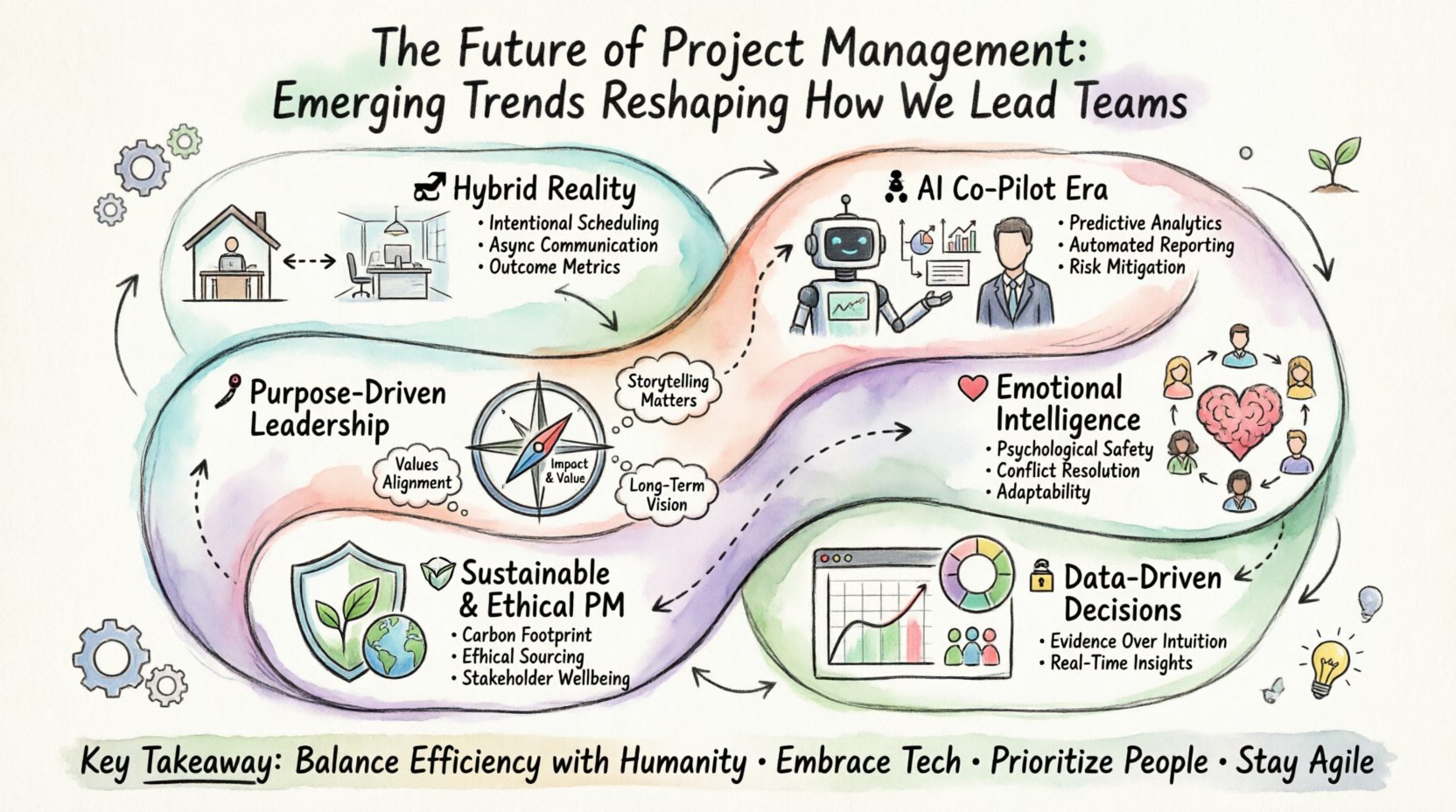
🌍 The Hybrid Reality: Redefining Presence and Productivity
The debate around remote versus in-office work has settled into a nuanced hybrid model. However, the implementation of this model remains a primary challenge for leaders. It is no longer sufficient to simply allow staff to work from home. The focus must shift to designing workflows that function regardless of location.
Effective hybrid management requires deliberate intention. Spontaneous collaboration in hallways no longer happens. Consequently, leaders must engineer opportunities for connection. This involves:
- Intentional Scheduling: Dedicating specific times for synchronous work and deep focus time.
- Asynchronous Communication: Prioritizing documentation over meetings to respect different time zones and work rhythms.
- Equity in Experience: Ensuring remote participants have the same access to information and decision-making power as those in the physical office.
- Outcome-Based Metrics: Shifting evaluation from hours logged to value delivered.
When teams feel connected and trusted, productivity naturally increases. The goal is to create a culture where the physical location is irrelevant to the quality of output.
🤖 AI and Automation: The Co-Pilot Era
Artificial Intelligence is not replacing project managers; it is augmenting their capabilities. The days of manual status updates and endless spreadsheet maintenance are fading. AI tools are now capable of analyzing historical data to predict risks, automate routine administrative tasks, and suggest resource allocations based on team capacity.
This shift allows leaders to focus on what humans do best: empathy, negotiation, and strategic thinking. Key areas of impact include:
- Predictive Analytics: Using past project data to forecast potential delays or budget overruns before they occur.
- Automated Reporting: Generating status reports instantly, freeing up time for stakeholder engagement.
- Resource Optimization: Algorithms that match team skills to project requirements more accurately than manual estimation.
- Risk Mitigation: Identifying patterns in communication that signal team friction or burnout.
However, the adoption of these technologies requires a careful ethical approach. Data privacy and the transparency of algorithmic decision-making are paramount. Leaders must understand the “why” behind AI suggestions to maintain trust within the team.
🧠 The Rise of Emotional Intelligence in Leadership
As technical tools become more sophisticated, the demand for soft skills has never been higher. In a world of distributed teams and automated processes, the human element becomes the differentiator. Emotional intelligence (EQ) is now a core competency for project leadership.
High EQ leaders excel at:
- Conflict Resolution: Navigating disagreements with empathy to find mutually beneficial solutions.
- Psychological Safety: Creating an environment where team members feel safe to admit mistakes or propose innovative ideas without fear of retribution.
- Adaptability: Managing their own reactions to change and modeling resilience for the team.
- Motivation: Understanding individual drivers and aligning project goals with personal growth.
Technical skills can be taught, but the ability to read a room, understand unspoken concerns, and foster a positive culture is intrinsic. This shift marks a move from “managing tasks” to “leading people.”
📊 Data-Driven Decision Making
Intuition still has its place, but the future of project management relies on evidence. Organizations are moving away from gut-feeling decisions toward data-backed strategies. This does not mean drowning in numbers, but rather interpreting the right signals to guide direction.
Key data points that are gaining prominence include:
- Velocity Trends: Tracking the speed of work over time to identify bottlenecks.
- Burn Rate Analysis: Monitoring financial spend against milestones in real-time.
- Team Health Scores: Aggregating feedback and engagement metrics to assess morale.
- Customer Value Flow: Measuring how quickly features or deliverables reach the end user.
Visualizing this data effectively is crucial. Dashboards should tell a story, highlighting progress and highlighting risks clearly. The leader acts as the translator, turning raw data into actionable insights for stakeholders.
🛡️ Sustainable and Ethical Project Management
Sustainability is no longer a buzzword; it is a requirement. Projects are being evaluated not just on cost and time, but on their environmental and social impact. This trend is driven by regulatory changes and a shift in consumer expectations.
Leaders must consider:
- Carbon Footprint: Minimizing travel and digital waste in project execution.
- Ethical Sourcing: Ensuring supply chains and vendor relationships align with ethical standards.
- Long-Term Viability: Designing solutions that are maintainable and do not create technical debt for the future.
- Stakeholder Wellbeing: Preventing burnout by enforcing reasonable workloads and respecting boundaries.
This approach ensures that success today does not compromise the ability to succeed tomorrow.
📊 Comparative Analysis of Traditional vs. Emerging Approaches
| Aspect | Traditional Approach | Emerging Approach |
|---|---|---|
| Focus | Output and Compliance | Outcome and Value |
| Communication | Synchronous Meetings | Asynchronous Documentation |
| Leadership Style | Command and Control | Servant and Coach |
| Risk Management | Reactive | Predictive and Proactive |
| Team Structure | Fixed Roles | Fluid and Cross-Functional |
| Success Metric | On Time, On Budget | Customer Satisfaction and Impact |
🔄 Adapting Methodologies for Complexity
While Agile and Waterfall are well-known, the future lies in hybrid methodologies that adapt to the specific context of the project. A “one size fits all” approach often fails in complex environments.
Principles for adapting methodologies include:
- Iterative Planning: Breaking down long-term goals into manageable sprints or phases that allow for feedback.
- Flexible Governance: Adjusting approval processes based on project risk and complexity.
- Continuous Improvement: Regular retrospectives to refine the process itself, not just the product.
- Stakeholder Inclusion: Involving end-users earlier in the process to validate assumptions.
This flexibility allows teams to respond to change without losing structural integrity. It balances the need for speed with the need for control.
🌱 Cultivating a Growth Mindset
Innovation requires a culture where failure is viewed as a learning opportunity rather than a punishable offense. Project managers play a pivotal role in fostering this mindset.
Strategies to build a growth culture:
- Post-Mortem Reviews: Conducting blameless analysis of what went wrong to extract lessons.
- Skill Development: Encouraging continuous learning through training and certification.
- Experimentation: Allowing small pilots to test new ideas before full-scale deployment.
- Recognition: Celebrating effort and learning, not just final results.
When teams feel safe to experiment, innovation flourishes. This leads to better solutions and a more resilient organization.
🤝 Collaboration Across Boundaries
Projects increasingly span multiple departments, organizations, and geographies. Silos are becoming a liability. The future of project management is collaborative by design.
Breaking down silos involves:
- Shared Goals: Aligning objectives across departments to ensure everyone pulls in the same direction.
- Integrated Tools: Using platforms that allow seamless information sharing across different teams.
- Open Communication: Encouraging direct communication between team members rather than routing everything through management.
- Trust Building: Investing time in building relationships with partners and stakeholders.
This interconnected approach reduces friction and accelerates delivery. It ensures that information flows freely, preventing bottlenecks caused by isolation.
🎯 The Shift from Process to Purpose
Teams are increasingly motivated by purpose. They want to know that their work matters. Project managers must articulate the “why” behind every initiative.
Connecting work to purpose involves:
- Storytelling: Framing project goals within the broader narrative of the organization.
- Impact Visualization: Showing how the output will benefit the end user or society.
- Values Alignment: Ensuring project decisions reflect the core values of the organization.
- Recognition: Acknowledging the contribution of individuals to the larger mission.
When people understand the impact of their work, engagement rises. This intrinsic motivation is a powerful driver of performance.
🛠️ Building Resilient Systems
Uncertainty is the new constant. Systems must be built to withstand shocks. This applies to both the project management infrastructure and the team dynamics.
Elements of resilience include:
- Redundancy: Having backup plans for critical resources and dependencies.
- Scalability: Ensuring processes can handle increased workload without breaking.
- Feedback Loops: Rapid mechanisms to detect and correct issues.
- Support Networks: Ensuring team members have access to mental health and professional support.
Resilience is not about avoiding problems, but about recovering quickly. This capability becomes a competitive advantage in volatile markets.
🔮 Looking Ahead: The Path Forward
The evolution of project management is ongoing. As technology advances and societal expectations shift, leaders must remain adaptable. The core principles of planning, executing, and monitoring remain, but the methods are changing.
Key takeaways for the modern leader:
- Embrace Technology: Leverage AI and automation to handle the mundane.
- Prioritize People: Invest in soft skills and team wellbeing.
- Focus on Value: Measure success by impact, not just output.
- Stay Agile: Be willing to pivot based on new information.
- Lead with Ethics: Ensure sustainability and fairness in all decisions.
The future belongs to those who can balance efficiency with humanity. It is a call to action for project managers to evolve their practices and lead with clarity and confidence.