


Running a project timeline is like walking a tightrope. One moment you are balancing perfectly, and the next, a gust of wind threatens to throw everything off course. As a junior coordinator, encountering a project delay is not a sign of failure; it is an inherent part of the workflow. The difference between a crisis and a manageable situation often lies in your response time and your ability to communicate clearly under pressure.
This guide is designed to help you navigate the complexities of a slipping schedule without panic. We will move through a structured process of assessment, communication, and recovery. By following these steps, you can maintain trust with stakeholders and guide your team back on track.
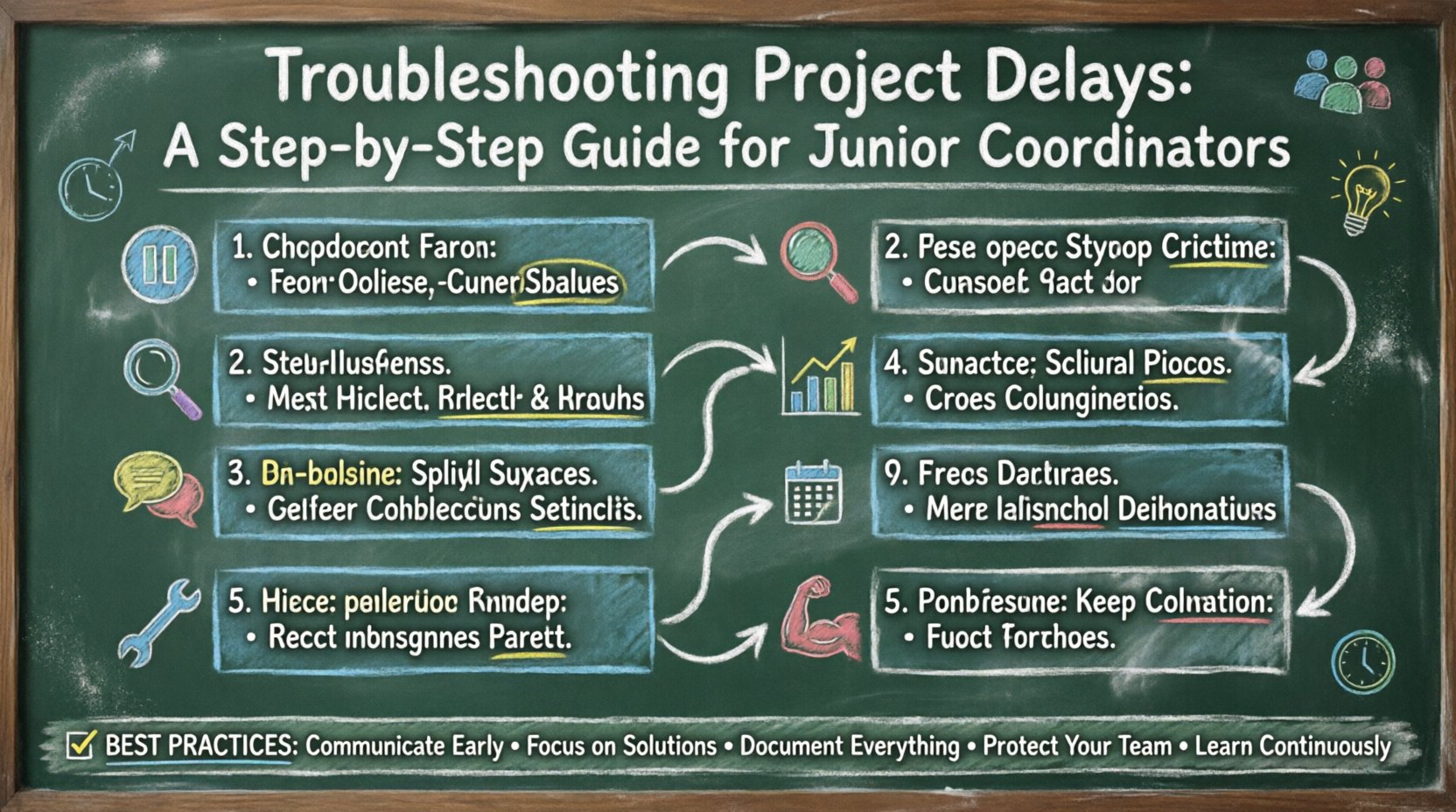
1. Immediate Triage: Stop the Bleeding ⏸️
The first instinct when you discover a delay is to rush. You might want to push the team to work faster or hide the issue to avoid blame. Both reactions are counterproductive. The priority now is to stabilize the situation.
- Pause and Verify: Before raising an alarm, confirm the data. Is the delay confirmed, or is it a perceived lag? Check the latest status reports and talk to the lead on the specific task.
- Assess the Impact: How does this delay affect the critical path? If a non-critical task is late, the overall delivery date might remain unchanged. If a critical milestone is missed, the timeline is at risk.
- Document the Deviation: Record the original date, the current status, and the new estimated completion date. This creates a paper trail that protects everyone involved.
- Notify Leadership Early: Do not wait for the deadline to pass. Inform your manager or the steering committee immediately. Transparency builds credibility.
When you communicate this news, avoid using language that suggests a lack of control. Instead of saying “I don’t know when this will be done,” say “We have identified a bottleneck and are implementing a recovery plan by [Date].” This shifts the narrative from uncertainty to action.
2. Root Cause Analysis: Understanding the “Why” 🔍
You cannot fix a problem you do not understand. Rushing into solutions without knowing the root cause often leads to recurring issues. You need to dig deeper than the surface symptom. A task is late because of a specific constraint, not just because “it took longer.”
Use a structured approach to identify the source of the delay. Common categories include:
- Resource Constraints: Was a key team member pulled away? Was there a lack of budget for tools?
- Scope Creep: Did stakeholders add new requirements mid-stream without adjusting the timeline?
- External Dependencies: Did a vendor delay their deliverable? Did a third-party API fail?
- Estimation Errors: Was the initial timeline overly optimistic? Did we underestimate the complexity?
- Technical Debt: Did we encounter unexpected bugs that required refactoring?
Once you have identified the category, apply the “5 Whys” technique. Ask “why” five times until you reach the fundamental issue. For example:
- Why is the design phase late? The designer is waiting on copy.
- Why is the designer waiting on copy? The marketing team hasn’t submitted it.
- Why hasn’t marketing submitted it? The content brief was unclear.
- Why was the brief unclear? Requirements changed during drafting.
- Why did requirements change? Stakeholders were not aligned on the initial vision.
In this scenario, the root cause is stakeholder alignment, not just the marketing team’s speed. Fixing the alignment process prevents future delays.
Common Delay Triggers
| Trigger Category | Typical Symptoms | Immediate Indicator |
|---|---|---|
| Resource Availability | Bottlenecks, idle time, burnout | Task status stuck on “In Progress” |
| Scope Changes | Feature creep, rework, confusion | New tickets added mid-sprint |
| External Dependencies | Waiting on approvals, vendor delays | Blocked status on multiple tasks |
| Technical Challenges | Unforeseen bugs, integration failures | QA rejections increasing |
3. Communication Strategy: Managing Expectations 🗣️
Delays are inevitable, but surprises are not. Your job is to manage expectations so that stakeholders are prepared for the shift. Communication must be frequent, honest, and solution-oriented.
Here is how to structure your updates:
- Frequency: Increase the cadence of updates. Move from weekly to daily stand-ups or status emails during the crisis period.
- Clarity: Use plain language. Avoid jargon that might confuse non-technical stakeholders. Explain the impact in business terms (e.g., “This delay affects the launch date,” not “The API latency is spiking.”).
- Options: Never present a problem without presenting options. Stakeholders prefer to choose a path rather than being told there is no path.
- Channel: Use the agreed-upon channel. Do not deliver bad news via a casual chat message. Schedule a brief call or send a formal email for significant timeline shifts.
Sample Communication Template:
Subject: Update on [Project Name] Timeline & Recovery Plan
Hi Team,
I am writing to inform you that we are currently tracking behind schedule on the [Specific Phase].
Current Status: The [Task Name] is delayed by approximately [Number] days.
Root Cause: This is due to [Brief Reason, e.g., unexpected technical complexity].
Recovery Options:
1. Extend the deadline to [Date].
2. Reduce scope by removing [Feature].
3. Add resources to accelerate [Task].Please let me know which option you prefer so we can proceed.
Best regards, [Your Name]
4. Resource Reallocation and Scope Adjustment 🛠️
Once you have communicated the issue, you need to take action to recover time. This often involves making difficult decisions about resources and scope.
Optimizing Resources
If the delay is due to capacity, you may need to shift focus. Consider the following:
- Re-prioritize: Identify tasks that can be deferred to a future phase without impacting the core launch.
- Swap Skills: Can a senior team member step in to unblock a junior member? Speed is often better than perfection at this stage.
- Overtime (Carefully): Asking the team to work extra hours is a short-term fix. Use it sparingly to avoid burnout, which will cause more delays later.
Scope Negotiation
Time is often fixed. If the deadline cannot move, the scope must change. This is where the concept of “Good, Fast, Cheap: Pick Two” applies.
- Identify Non-Essentials: Work with stakeholders to list features that are “Nice to Have” versus “Must Have.”
- Phased Delivery: Propose releasing the core product now and adding the extra features in a subsequent update.
- Formal Sign-off: Ensure any scope reduction is documented and signed off. This prevents scope creep from returning later.
5. Revised Timeline Creation 📅
Once you have adjusted the scope and resources, you need a new realistic schedule. Do not simply push every date forward by the same amount. You need to re-baseline the critical path.
Follow these steps to build the recovery plan:
- Map Dependencies: Ensure you understand which tasks block others. A delay in Task A might delay Task B, but Task C might run in parallel.
- Add Buffers: Introduce contingency time for high-risk tasks. If a task was estimated at 5 days, schedule 6 or 7 to account for minor hiccups.
- Set Checkpoints: Break the recovery plan into smaller milestones. This allows you to verify progress more frequently.
- Communicate the New Baseline: Share the revised schedule with everyone. Ensure they understand the new deadline is the new commitment.
Recovery Planning Checklist
| Checklist Item | Completion Status | Notes |
|---|---|---|
| Root cause documented | ☐ | |
| Stakeholders notified | ☐ | |
| Options presented | ☐ | |
| Scope adjusted (if needed) | ☐ | |
| Revised timeline approved | ☐ | |
| Team briefed on new plan | ☐ |
6. Monitoring and Cadence 📊
Once the plan is set, you must watch it closely. The risk during a recovery period is that the original problem resurfaces or a new one appears. You need to maintain a tighter grip on progress.
- Daily Stand-ups: Hold short meetings where team members only discuss blockers and daily progress. Keep it under 15 minutes.
- Visual Management: Use a physical or digital board to show task status. Make the flow of work visible to everyone.
- Early Warning Signals: Define what a “red flag” looks like. If a task is 20% behind schedule, it should trigger an alert.
- Focus on Completion: Celebrate small wins. Finishing a sub-task boosts morale and keeps momentum high.
It is crucial to maintain a calm demeanor. If you show anxiety, the team will mirror that. If you show confidence and control, the team will feel secure enough to focus on the work.
7. Post-Project Review: Lessons Learned 📝
After the dust settles and the project is delivered, you must analyze what happened. This is not about assigning blame; it is about improving the process for the next project.
Conduct a retrospective meeting with the team. Ask specific questions:
- What went well during the recovery?
- What processes slowed us down?
- Did we have the right tools and information?
- How can we estimate more accurately next time?
Document these findings in a central repository. This creates institutional knowledge. When you start your next project, you can reference this data to set more realistic timelines.
8. Emotional Resilience for Coordinators 💪
Managing delays takes a toll on your mental state. It is easy to feel responsible for every setback. Remember that you are a facilitator, not a magician. You cannot control every variable.
- Separate Self-Worth from Outcome: A delay is a project issue, not a personal failure.
- Focus on What You Control: You cannot control the vendor’s speed, but you can control how you communicate about it.
- Seek Support: Talk to your manager or peers. They have likely faced similar situations and can offer perspective.
- Take Breaks: Do not sacrifice sleep for work. A rested mind makes better decisions.
Summary of Best Practices ✅
Handling project delays requires a blend of technical skill and emotional intelligence. By following a structured approach, you transform a crisis into an opportunity to demonstrate reliability.
Key takeaways for every coordinator:
- Communicate early: Bad news travels fast; make sure you are the one delivering it.
- Focus on solutions: Always present options when presenting problems.
- Document everything: Keep a record of changes and decisions.
- Protect your team: Shield them from external pressure so they can focus on execution.
- Learn continuously: Use every delay as data to improve future estimates.
When you approach delays with a clear head and a solid plan, you establish yourself as a competent leader. Your ability to navigate turbulence is what defines your career, not just the perfect execution of a plan. Stay steady, stay transparent, and keep moving forward.