


Project management is often surrounded by a thick fog of jargon, theoretical frameworks, and promises of instant efficiency. We hear constant buzzwords suggesting that a specific methodology guarantees success or that a certain tool will fix broken processes. In reality, the landscape of delivering complex work is far more nuanced. It is not about finding a silver bullet; it is about understanding human behavior, resource constraints, and strategic alignment.
This guide cuts through the noise. We are here to examine the common misconceptions that derail projects and replace them with evidence-based practices that actually drive results. Whether you are leading a small team or managing enterprise-level initiatives, the principles of high performance remain consistent. Let us dismantle the hype and look at the mechanics of success.
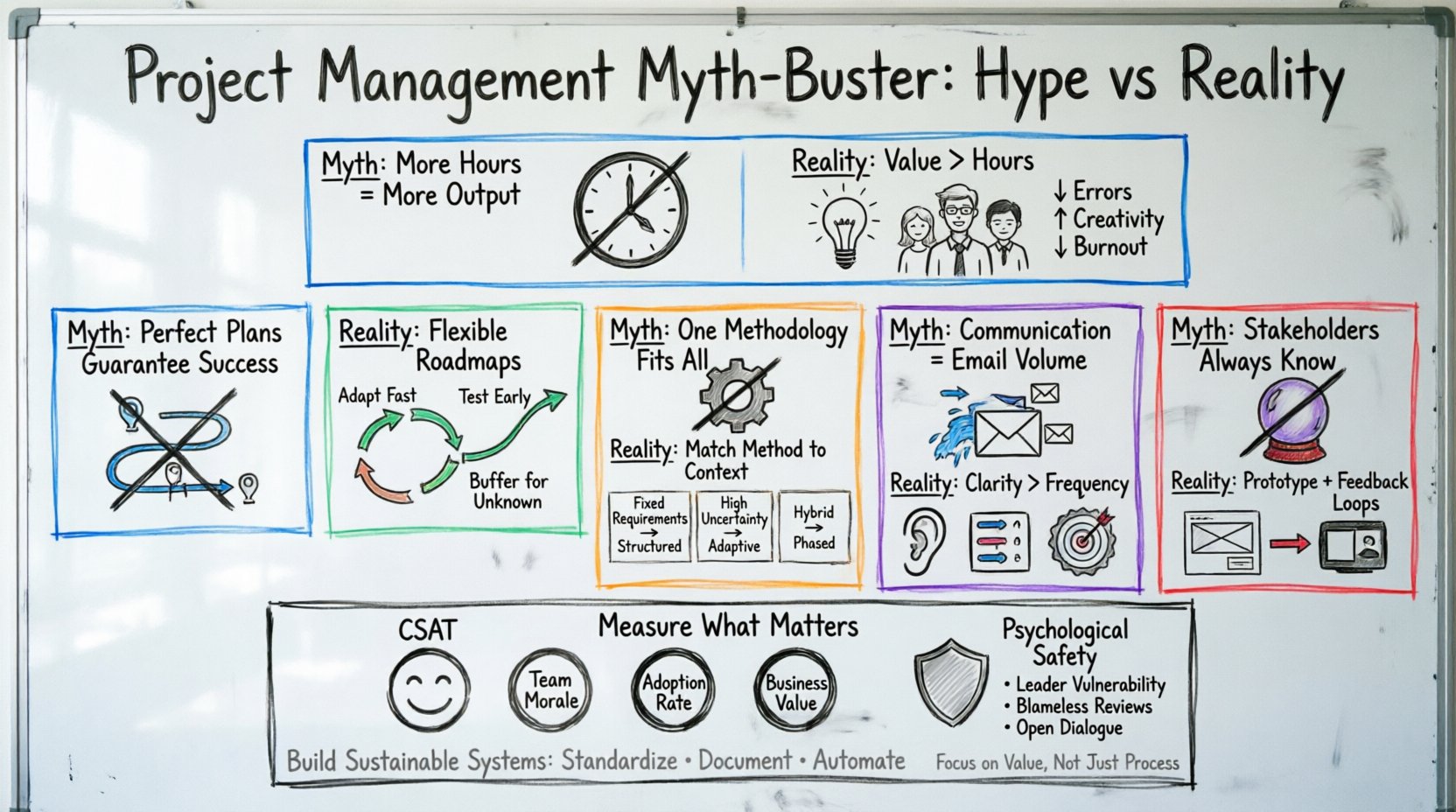
🧐 Myth 1: More Hours Equals More Output
The most persistent myth in the industry is the belief that productivity is a direct function of time spent. Many leaders equate late nights and weekends with dedication. They assume that if a team is working longer, they are achieving more. This logic is flawed and often counterproductive.
When teams are pushed to extend their hours, the law of diminishing returns kicks in rapidly. Cognitive fatigue sets in, leading to:
- Increased Error Rates: Tired eyes miss details. Code bugs, calculation errors, and missed requirements become more frequent.
- Reduced Creativity: Innovation requires mental space. Constant pressure to work shuts down the divergent thinking needed for problem-solving.
- Burnout and Turnover: Sustainable pace is the only pace that lasts. High turnover destroys institutional knowledge and inflates recruitment costs.
High-performing organizations focus on output and value delivery, not hours logged. They prioritize rest and recovery as essential components of the workflow. A rested team member makes better decisions in one hour than a fatigued team member does in three.
📅 Myth 2: Detailed Plans Guarantee Success
There is a strong desire for certainty in business. We want a roadmap that maps every step from start to finish. Consequently, many projects spend weeks or months creating detailed plans before a single task is executed. The belief is that if the plan is perfect, the outcome will be perfect.
This approach ignores the volatility of modern work environments. A plan created today may be obsolete next week due to market shifts, technology changes, or new stakeholder requirements. Rigid adherence to a plan that no longer fits reality is a recipe for failure.
Instead of detailed plans, successful teams create:
- Flexible Roadmaps: High-level goals with the ability to pivot based on feedback.
- Iterative Delivery: Breaking work into small chunks allows for early validation and course correction.
- Contingency Buffers: Realistic estimates that account for the unknown, rather than optimistic guesses.
The goal is not to predict the future perfectly, but to build a system that adapts to it quickly.
🔄 Myth 3: One Methodology Fits All
The industry often polarizes teams into camps. Some swear by strict, sequential processes, while others champion fluid, adaptive frameworks. The myth suggests that adopting a specific label (like Agile or Waterfall) automatically solves management problems. This is not the case.
Different projects have different needs. A construction project requires a sequential approach where you cannot build the roof before the foundation. A software product, however, benefits from iterative testing and release. Applying the wrong framework to the wrong context creates friction, not flow.
Consider the following comparison of contexts:
| Context Type | Primary Risk | Recommended Approach |
|---|---|---|
| Fixed Requirements (e.g., Compliance) | Risk of non-compliance | Structured, Predictive |
| High Uncertainty (e.g., R&D) | Building the wrong thing | Adaptive, Iterative |
| Hybrid Needs (e.g., Hardware + Software) | Integration delays | Hybrid, Phased |
The most effective leaders do not force a methodology onto their team. They select the approach that aligns with the specific constraints and goals of the project.
💬 Myth 4: Communication is Just Sending Emails
Many organizations mistake volume of communication for quality of communication. They send endless status updates, meeting invites, and bullet-pointed reports. The assumption is that if everyone receives the information, everyone understands it.
This creates “communication noise.” Important signals get lost in the background static. High-performing teams treat communication as a strategic asset, not an administrative chore.
Effective communication strategies include:
- Active Listening: Ensuring understanding before responding. Asking clarifying questions rather than assuming alignment.
- Right Channel: Using synchronous methods for complex discussions and asynchronous methods for updates. Not every topic needs a meeting.
- Transparency on Bad News: Creating a culture where delays and risks are reported immediately, allowing for mitigation rather than surprise.
If a project succeeds but the team is confused, the communication strategy has failed. Clarity trumps frequency.
👥 Myth 5: Stakeholders Always Know What They Want
Leadership often expects stakeholders to provide crystal-clear requirements at the outset. When they do not, teams are blamed for “ambiguity.” The reality is that stakeholders often do not know what they need until they see a prototype or a result.
Expecting perfect requirements upfront sets the project up for rework. Requirements evolve as understanding deepens. The myth of the “perfect brief” discourages the exploration phase where true value is discovered.
To manage this dynamic:
- Early Prototyping: Show, don’t just tell. Visualizing ideas helps stakeholders articulate their needs.
- Feedback Loops: Schedule regular checkpoints to validate direction before investing too much time in execution.
- Managing Expectations: Clearly define what is in scope and what is out of scope, but remain open to change within the budget and timeline constraints.
📊 Measuring Success Beyond Deadlines
Traditionally, project success is measured by the “Iron Triangle”: Time, Cost, and Scope. If you finish on time, on budget, and with all features, you have succeeded. This metric is insufficient for modern business.
A project can be delivered on time and on budget but fail to deliver value. The team might be exhausted, the product might not be used, or the market might have shifted. True high performance requires measuring the outcome, not just the output.
Consider adding these metrics to your dashboard:
- Customer Satisfaction (CSAT): Did the end-user benefit from the work?
- Team Morale: Is the team sustainable to work with long-term?
- Adoption Rate: Are people actually using the deliverable?
- Business Value Realized: Did the project achieve its strategic goal (e.g., revenue growth, efficiency)?
🛡️ The Human Element: Psychological Safety
Perhaps the most overlooked factor in project performance is psychological safety. This is the belief that one will not be punished or humiliated for speaking up with ideas, questions, concerns, or mistakes.
When fear is present, information is hidden. Problems are swept under the rug until they become crises. In a high-performing environment, mistakes are treated as learning opportunities. This encourages innovation and rapid problem-solving.
Building this culture requires:
- Leader Vulnerability: Admitting when you do not know something models humility.
- Blameless Post-Mortems: Focusing on process failures rather than individual culpability.
- Open Dialogue: Creating safe spaces for dissenting opinions during planning sessions.
🧱 Building Sustainable Systems
Reliance on heroics is a fragile strategy. Projects often succeed because one person works incredibly hard to compensate for systemic gaps. This is not scalable. It creates a single point of failure.
Sustainable project management relies on systems, not people. This means:
- Standardized Processes: Clear workflows that anyone can follow, reducing dependency on tribal knowledge.
- Documentation: Knowledge is captured and shared, not held in heads.
- Automation: Repetitive tasks are automated to free up human cognitive resources for strategic thinking.
🔍 Final Thoughts on Project Reality
Separating hype from reality requires a shift in mindset. It moves away from seeking the perfect tool or the rigid plan and towards building adaptable, human-centric systems. It acknowledges that uncertainty is inherent and manages it through transparency and iteration.
When you stop chasing the myth of control and start focusing on the reality of value, your projects become more resilient. Your teams become more engaged. Your outcomes become more valuable.
The path to high performance is not paved with shortcuts or buzzwords. It is built on a foundation of clear communication, realistic planning, and respect for the people doing the work. By challenging the common assumptions we hold about how work gets done, we create an environment where genuine progress can occur.
Focus on the substance of the work, not the appearance of the process. The results will speak for themselves.
Related posts:
 How Project Management Actually Works: A Definitive Overview for Intermediate Professionals
 The Hidden Cost of Chaos: Common Mistakes Stalling Your Project Management Career
 Agile vs. Waterfall: A Real-World Comparison for Senior Project Managers Deciding Frameworks
 5-Step Quick Start Guide to Structuring Any Project Management Initiative from Scratch