


The landscape of enterprise architecture is undergoing a profound transformation. Organizations are moving away from static, monolithic structures toward dynamic, distributed ecosystems. In this context, the TOGAF framework serves as a vital reference point, yet its application requires significant adaptation. This guide examines how to align the Architecture Development Method (ADM) with the demands of cloud-native infrastructure and artificial intelligence integration.
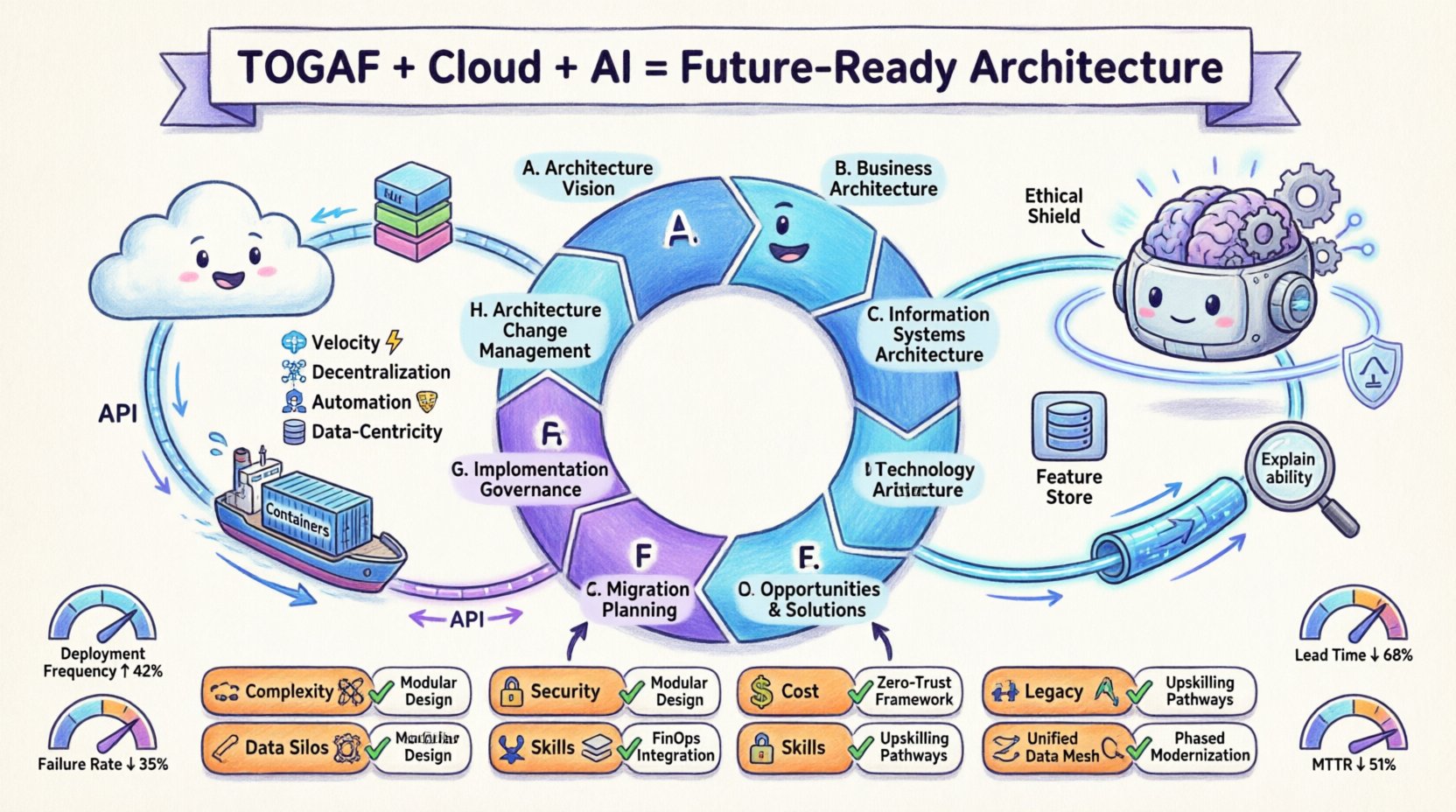
Understanding the Shift in Enterprise Architecture 🔄
Traditional enterprise architecture often focused on stability, predictability, and long-term planning cycles. Modern digital enterprises require agility, scalability, and continuous innovation. The integration of cloud-native principles and artificial intelligence changes the velocity at which architecture must evolve.
To remain relevant, the architecture framework must address:
- Velocity: The speed at which business value is delivered must accelerate.
- Decentralization: Decision-making power shifts from central IT to distributed teams.
- Automation: Infrastructure and governance processes must be automated to keep pace with deployment rates.
- Data-Centricity: Data is no longer just a byproduct; it is the core asset driving AI capabilities.
Adapting the framework involves preserving its core principles while modifying the implementation details to fit a fluid environment.
Cloud-Native Adaptation: Principles and Practices ☁️
Cloud-native architecture represents more than just hosting applications on remote servers. It involves designing systems that leverage the full potential of cloud computing models. This includes microservices, containers, and declarative APIs.
1. Redefining the Business Architecture 🏢
In a cloud-native environment, business processes are often modularized. The Business Architecture domain must map these modules to specific capabilities. This allows for greater flexibility in recombining functions without disrupting the entire system.
- Value Streams: Map value streams to identify where automation and cloud services can reduce latency.
- Organizational Units: Align teams with service boundaries rather than traditional departmental silos.
- Customer Journeys: Focus on the end-to-end experience, which often spans multiple cloud platforms.
2. Information Systems and Data Architecture 💾
Data architecture must support high availability and distributed processing. The traditional data warehouse model is often supplemented with data lakes and streaming platforms.
- API-First Strategy: Define interfaces before implementation to ensure interoperability between microservices.
- Data Governance: Implement governance policies that apply across distributed data stores.
- Security by Design: Embed security controls within the data pipeline rather than as an afterthought.
3. Technology Architecture 🛠️
The technology architecture must support the elasticity and resilience required by modern applications.
- Infrastructure as Code: Manage infrastructure through version-controlled scripts to ensure consistency.
- Container Orchestration: Utilize orchestration platforms to manage the lifecycle of containerized applications.
- Serverless Computing: Adopt serverless models for event-driven workloads to optimize cost and scaling.
Integrating Artificial Intelligence 🤖
Artificial intelligence is not merely a technology stack addition; it is a fundamental shift in how enterprises operate. AI capabilities influence decision-making, automation, and customer interaction.
1. AI as an Architectural Capability
Architecture must treat AI as a core capability rather than a project. This involves defining how models are trained, deployed, and monitored.
- Model Governance: Establish standards for model versioning, validation, and retirement.
- Training Data: Ensure data pipelines provide high-quality, labeled data for model training.
- Inference: Design systems to handle real-time inference requests with low latency.
2. Ethical Considerations and Compliance ⚖️
The use of AI introduces new risks regarding bias, privacy, and explainability. Architecture must embed compliance into the system design.
- Explainability: Design systems where AI decisions can be traced and explained to stakeholders.
- Privacy: Ensure personal data is handled according to regulatory requirements.
- Accountability: Define clear lines of responsibility for AI-driven outcomes.
3. Data Architecture for AI
AI requires vast amounts of data. The data architecture must support both batch processing and real-time streaming.
- Feature Stores: Centralize feature definitions to prevent inconsistencies across models.
- Data Lineage: Track the origin and transformation of data used in AI models.
- Metadata Management: Maintain metadata to describe data assets for discoverability.
Reimagining the Architecture Development Method (ADM) 🔄
The ADM cycle is the engine of the framework. To support modern needs, each phase requires specific adjustments.
Phase A: Architecture Vision 🎯
The vision must be agile. Instead of a static document, the vision should be a living set of principles that guide decision-making.
- Focus on business outcomes rather than specific technology stacks.
- Define guardrails rather than rigid constraints.
Phases B, C, and D: Business, Information, and Technology Architecture 🏗️
These phases should be iterative. Design systems in increments that can be tested and validated quickly.
- Iterative Design: Use prototypes to validate architectural decisions early.
- Modular Design: Break down complex systems into manageable components.
- Continuous Integration: Integrate architectural reviews into the CI/CD pipeline.
Phase E: Opportunities and Solutions 🚀
Migration strategies must account for the complexity of cloud-native environments.
- Lift and Shift: Move workloads quickly to cloud environments.
- Refactoring: Rewrite applications to be cloud-native for better scalability.
- Replacement: Substitute legacy systems with modern SaaS solutions.
Phase F: Migration Planning 📅
Planning must be flexible to accommodate changing requirements.
- Phased Rollouts: Deploy changes in stages to minimize risk.
- Rollback Plans: Prepare for scenarios where deployments fail.
- Stakeholder Communication: Keep stakeholders informed of progress and risks.
Phase G: Implementation Governance 🛡️
Governance must be automated where possible.
- Policy as Code: Define governance policies as executable code.
- Automated Compliance: Use tools to check compliance continuously.
- Architecture Decision Records: Document decisions to provide context for future changes.
Phase H: Architecture Change Management 🔄
Change management must be continuous. The architecture evolves alongside the business.
- Feedback Loops: Gather feedback from operations to inform architecture updates.
- Performance Metrics: Track key performance indicators to measure success.
- Review Cycles: Schedule regular reviews to assess alignment with business goals.
Governance in a Distributed Environment 🌐
Centralized governance often slows down innovation in cloud-native environments. A federated model is often more effective.
- Central Standards: Define core standards that must be followed across the enterprise.
- Local Autonomy: Allow teams to make decisions within defined boundaries.
- Shared Services: Provide shared services to reduce duplication and ensure consistency.
Skills and Culture Shift 🧠
Technical changes require cultural and skills adjustments. The workforce must adapt to new ways of working.
- DevOps Culture: Foster collaboration between development and operations.
- Continuous Learning: Encourage continuous learning to keep up with new technologies.
- Architecture Ownership: Empower teams to own their architectural decisions.
Challenges and Mitigation Strategies 🛑
Transitioning to a cloud-native and AI-driven architecture presents specific challenges. The following table outlines common issues and how to address them.
| Challenge | Impact | Mitigation Strategy |
|---|---|---|
| Complexity Management | Increased difficulty in tracking dependencies and state. | Implement comprehensive observability and automated documentation. |
| Security Risks | Expanded attack surface due to distributed systems. | Adopt zero-trust security models and automate security scanning. |
| Cost Control | Unpredictable spending due to elastic scaling. | Use cost management tools and enforce budget alerts. |
| Skills Gap | Lack of expertise in new technologies and practices. | Invest in training programs and hire specialized talent. |
| Data Silos | Fragmented data preventing effective AI integration. | Establish data mesh principles and centralized data governance. |
| Legacy Integration | Difficulty connecting old systems with new architectures. | Use API gateways and middleware for integration. |
Measuring Success and Performance 📊
To ensure the adaptation of the framework is effective, organizations must measure performance using relevant metrics.
- Deployment Frequency: How often are changes released?
- Lead Time for Changes: How long does it take from commit to production?
- Change Failure Rate: What percentage of deployments cause failure?
- Mean Time to Recovery: How quickly can the system recover from failure?
- Architecture Compliance: What percentage of projects adhere to architectural standards?
Future Trends and Considerations 🔮
The landscape continues to evolve. Several trends will shape the future of enterprise architecture.
- Edge Computing: Processing data closer to the source to reduce latency.
- Quantum Computing: Potential impact on cryptography and optimization problems.
- Blockchain: Use cases for distributed ledgers in supply chain and identity.
- Low-Code/No-Code: Democratization of application development.
Architects must remain vigilant and ready to adapt to these emerging technologies. The framework provides a stable foundation, but the implementation must be fluid.
Conclusion on Modernizing Enterprise Architecture 🚀
Adapting the framework for cloud-native and AI-driven enterprises is not about discarding established principles. It is about applying them in a way that supports speed, innovation, and resilience. By focusing on modular design, automated governance, and continuous learning, organizations can navigate the complexities of modern technology landscapes.
The path forward requires a balance between stability and agility. Architecture must enable business growth without becoming a bottleneck. Through careful planning and execution, the framework remains a powerful tool for guiding enterprise transformation.
Success depends on the willingness to evolve. Organizations that embrace these changes will be better positioned to compete in a rapidly changing market.