


Enterprise architecture operates at the intersection of business strategy and technical execution. Within the The Open Group Architecture Framework (TOGAF), the success of any architectural initiative hinges on one critical factor: the ability to engage stakeholders effectively. In complex enterprise environments, where systems, processes, and people intersect, ignoring stakeholder dynamics leads to architecture that fails to deliver value.
This guide explores practical, authoritative methods for managing stakeholder engagement throughout the Architecture Development Method (ADM). By aligning stakeholder needs with architectural decisions, organizations ensure their enterprise architecture remains relevant, supported, and actionable.
🔍 Understanding the Stakeholder Landscape
Before engaging, you must identify who holds influence and interest. In a TOGAF context, stakeholders are not merely people who need to be told about changes; they are entities with a vested interest in the outcome of the architecture.
Defining Architecture Stakeholders
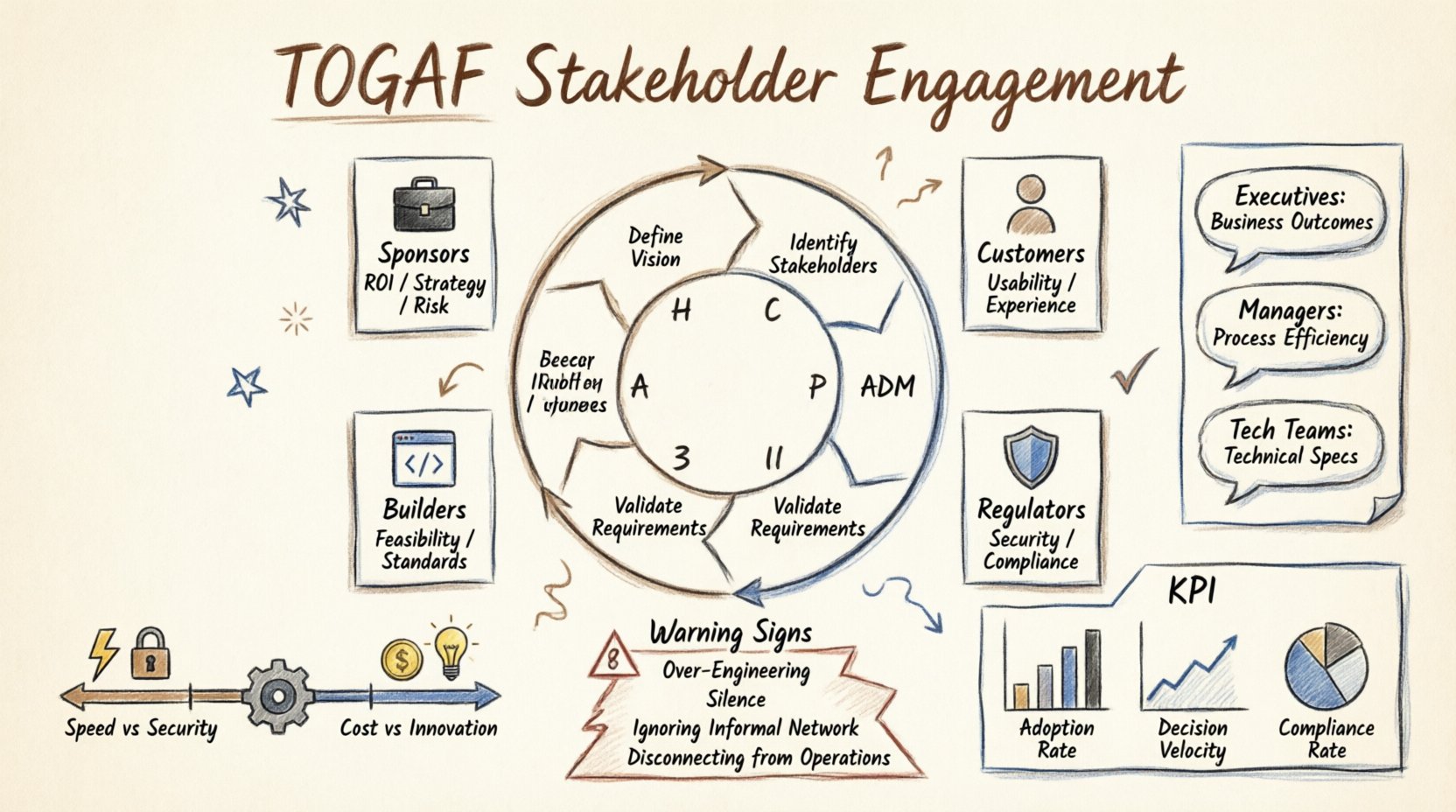
Stakeholders fall into several distinct categories. Each requires a specific approach to engagement. The following table outlines common roles and their primary concerns:
| Stakeholder Category | Typical Role | Primary Concerns | Engagement Focus |
|---|---|---|---|
| Sponsors | C-Level Executives, Board Members | ROI, Strategic Alignment, Risk | High-level summaries, Business Value |
| Customers | End Users, Clients | Usability, Experience, Functionality | Prototypes, User Stories |
| Builders | Developers, System Architects | Feasibility, Standards, Technical Debt | Technical Specifications, Models |
| Regulators | Compliance Officers, Auditors | Security, Legal, Standards | Compliance Reports, Audit Trails |
Identifying these groups is the first step. In complex environments, stakeholders often overlap. A CTO may be both a sponsor and a builder. Mapping these relationships reveals where power lies and where consensus must be built.
🔄 Integrating Engagement into the ADM Cycle
The TOGAF Architecture Development Method is iterative. Stakeholder engagement is not a one-time event at the start; it is woven into every phase. Treating engagement as a continuous loop ensures that the architecture evolves alongside business needs.
Phase A: Architecture Vision
This phase sets the scope. The goal here is to define the high-level goals and constraints. Engagement focuses on validating the vision against strategic intent.
- Identify Key Actors: Determine who has the authority to approve the charter.
- Validate Scope: Ensure the proposed architecture does not overreach or underdeliver.
- Secure Commitment: Obtain formal sign-off to proceed to detailed work.
Without clear vision approval, subsequent work risks being deemed out of scope later. Early engagement prevents costly rework.
Phase B, C, and D: Business, Information Systems, and Technology
These phases involve detailed modeling. Stakeholders here are primarily the builders and domain experts. The focus shifts to feasibility and technical constraints.
- Iterative Reviews: Present drafts of business capability maps and application portfolios for feedback.
- Gap Analysis: Collaborate with stakeholders to identify gaps between current and target states.
- Technical Standards: Engage IT leaders to ensure proposed technologies align with existing infrastructure.
During these phases, the risk of misalignment increases. Regular check-ins prevent the architecture from drifting into theoretical abstraction.
Phase E: Opportunities and Solutions
Here, the focus moves to implementation. Stakeholders involved are project managers and delivery teams. The engagement goal is to ensure the architecture is realizable within budget and time.
- Project Prioritization: Work with sponsors to rank initiatives based on value and risk.
- Sequencing: Define the order of implementation to minimize disruption.
- Migration Planning: Validate transition architectures with operations teams.
Phase F, G, and H: Migration, Implementation, and Change Management
These phases cover the actual rollout and governance. Stakeholders include operational staff and change management teams.
- Monitoring: Establish metrics to track adoption and performance.
- Compliance: Ensure implementation matches the architectural blueprint.
- Feedback Loops: Capture issues arising during deployment to update the architecture repository.
🗣️ Strategic Communication Techniques
Communication is the vehicle for engagement. Different stakeholders require different languages. A technical deep dive will lose a business sponsor, while a high-level summary will frustrate a lead architect. Tailoring the message is essential.
Tailoring the Message
Effective communication adapts to the audience’s level of technical literacy and interest.
- For Executives: Focus on business outcomes. Use financial metrics, risk reduction, and strategic alignment. Avoid technical jargon. Visuals should highlight trends and value.
- For Managers: Focus on process efficiency and resource allocation. Show how the architecture supports their specific department goals.
- For Technical Teams: Provide detailed specifications, interface definitions, and integration patterns. Allow for technical debate and refinement.
Communication Channels
Select the right medium for the message. Formal documents are necessary for governance, but informal sessions often yield better collaboration.
- Architecture Review Boards (ARB): Formal meetings for decision-making and compliance checks.
- Workshops: Collaborative sessions for design and problem-solving. Best for Phase B, C, and D.
- Newsletters and Portals: Maintain awareness of architectural decisions and standards across the enterprise.
- One-on-One Meetings: Crucial for sensitive discussions or building relationships with key influencers.
⚖️ Managing Conflicting Interests
In complex enterprises, stakeholders often have competing priorities. Marketing may want speed, while Security demands rigor. Finance may want cost cuts, while IT wants innovation. Managing these conflicts is a core responsibility of the architect.
Identifying Conflicts Early
Do not wait for conflicts to become crises. During the Vision phase, explicitly document trade-offs. Ask stakeholders to prioritize requirements when they contradict.
- Trade-off Analysis: Present options with clear pros and cons. Let stakeholders choose based on their priorities.
- Architecture Principles: Use established principles to adjudicate conflicts. If a principle states “Security First,” use it to guide decisions.
- Escalation Paths: Define who has the final say when consensus cannot be reached. This is often the CIO or a Steering Committee.
Building Consensus
Consensus does not mean everyone agrees 100%. It means everyone understands the decision and accepts it. Transparency is key.
- Document Rationale: Record why a decision was made. This prevents history from repeating itself.
- Inclusive Dialogue: Ensure all voices are heard before decisions are finalized. Even dissenting views add value by highlighting risks.
- Follow Through: Ensure decisions are implemented as agreed. Broken trust is difficult to rebuild.
🛡️ Establishing Governance and Decision Rights
Engagement without governance is merely discussion. Governance ensures that architectural decisions are adhered to and that the architecture supports the business over time.
Defining Decision Rights
Clearly define who approves what. Ambiguity in decision rights leads to bottlenecks or unauthorized changes.
- Scope of Authority: Specify which decisions require architectural approval and which do not.
- Review Triggers: Define the conditions that trigger an architecture review (e.g., budget threshold, new technology adoption).
- Expedited Paths: Create a process for urgent decisions to prevent delays, while maintaining necessary oversight.
Architecture Principles
Principles act as the rules of engagement. They provide a stable framework for decision-making even when personnel change.
- Business-Driven: Principles must support business goals.
- Stable: Principles should not change frequently. If they do, the rationale must be documented.
- Enforceable: There must be a mechanism to check compliance against principles.
📊 Measuring Engagement Success
How do you know if stakeholder engagement is working? Relying on intuition is insufficient. Use metrics to evaluate the health of your engagement efforts.
Key Performance Indicators
Track specific metrics to gauge effectiveness.
- Adoption Rate: Are stakeholders using the architecture artifacts?
- Decision Velocity: How long does it take to get architectural approval?
- Compliance Rate: How many projects adhere to the architecture standards?
- Feedback Quality: Is the feedback received during reviews actionable and constructive?
Continuous Improvement
Engagement strategies must evolve. Periodically review the engagement process itself.
- Surveys: Ask stakeholders about the usefulness of communications and meetings.
- Lessons Learned: After major projects, document what engagement tactics worked and what did not.
- Training: Provide training for stakeholders on how to use architecture tools and models effectively.
⚠️ Common Pitfalls in Architecture Governance
Even with best practices, pitfalls exist. Awareness helps you avoid them.
Pitfall 1: Over-Engineering
Creating complex models that stakeholders cannot understand or use. Keep models simple and relevant to the decision at hand.
Pitfall 2: Silence During the Process
Only engaging stakeholders when a decision is needed. This creates surprise and resistance. Engage them throughout the discovery and design phases.
Pitfall 3: Ignoring the Informal Network
Focusing only on formal roles. In many organizations, informal influencers hold significant power. Identify and engage these individuals to build broader support.
Pitfall 4: Disconnecting from Operations
Designing an architecture that looks good on paper but cannot be maintained. Involve operations teams early to ensure long-term viability.
🚀 Moving Forward
Stakeholder engagement in TOGAF is not a passive activity. It requires proactive planning, consistent communication, and a willingness to manage conflict. By integrating engagement into the ADM cycle and establishing clear governance, you create an architecture function that delivers tangible value.
Start by mapping your current stakeholders. Identify the gaps in your communication. Then, apply the techniques outlined above to build a stronger, more resilient enterprise architecture practice.
The complexity of the enterprise environment will not decrease. However, your ability to navigate it through effective engagement will increase. This is the path to sustainable architectural success.
Remember, architecture is a social process as much as a technical one. The models, diagrams, and documents are tools to facilitate understanding among people. Prioritize the people, and the technology will follow.