


Modern enterprises operate in an environment defined by volatility and rapid change. For a global organization spanning multiple continents, the complexity of IT infrastructure often mirrors the complexity of its business operations. When strategic goals shift, legacy systems frequently resist adaptation. This disconnect creates inefficiency, increased costs, and delayed time-to-market. This case study examines a global enterprise that successfully implemented the TOGAF Architecture Development Method (ADM) to bridge the gap between business strategy and technology execution.
The objective was not merely to update software but to realign the entire organizational structure around a unified architecture framework. By adopting TOGAF principles, the organization ensured that every technology decision supported a core business capability. The following sections detail the challenges faced, the implementation strategy, and the measurable outcomes achieved through disciplined architecture governance.
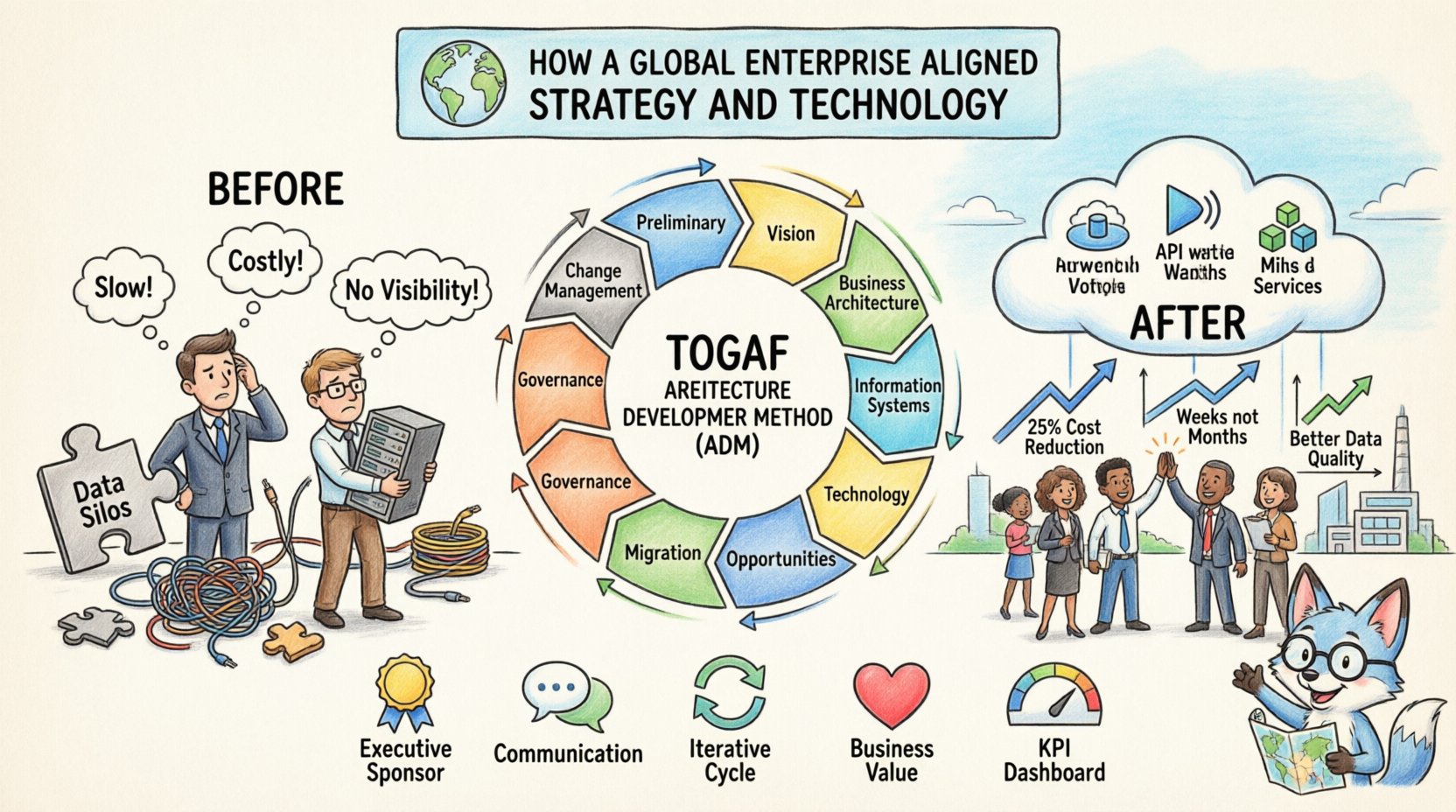
📉 The Challenge: Fragmentation and Misalignment
Before the initiative began, the enterprise operated with a decentralized approach to technology. Each regional division managed its own infrastructure, leading to significant redundancy. The organization faced several critical issues that threatened its long-term viability:
- Disconnected Systems: Customer data existed in silos across different platforms, making a 360-degree view impossible.
- High Maintenance Costs: Maintaining dozens of legacy applications drained budget resources that could have been allocated to innovation.
- Slow Response Times: Introducing new business capabilities required months of integration work due to rigid, monolithic structures.
- Lack of Visibility: Leadership could not accurately assess the technology landscape against strategic goals.
Without a standardized framework, decisions were made in isolation. The IT department built systems that did not fully support the business roadmap, while business units requested features that were technically unfeasible. The organization needed a common language to facilitate communication between technical teams and executive leadership. TOGAF provided that language.
🧩 Selecting the Framework: Why TOGAF?
Choosing the right architecture framework is a strategic decision in itself. The enterprise evaluated several methodologies but selected TOGAF for its proven adaptability and comprehensive scope. Key factors in this decision included:
- Industry Standard: TOGAF is widely recognized, ensuring that skills and resources are readily available.
- Scalability: The framework works effectively for large, distributed organizations.
- Iterative Process: The Architecture Development Method (ADM) allows for continuous refinement rather than a rigid, one-time design.
- Governance Focus: It includes robust mechanisms for compliance and change management.
The adoption of TOGAF was not treated as an IT project but as an enterprise transformation. Executive sponsorship was secured early to ensure that the architecture function had the authority to guide decision-making.
🏗️ Implementation: The TOGAF ADM Cycle
The core of the implementation relied on the Architecture Development Method (ADM). This iterative process guided the organization through the transformation. Below is a breakdown of how each phase was applied within the context of this global enterprise.
1. Preliminary Phase: Preparation
Before defining specific architectures, the team established the architecture capability. This involved defining the principles, standards, and templates that would govern all future work.
- Stakeholder Mapping: A comprehensive list of stakeholders was created to ensure all voices were heard.
- Principles Definition: Core principles such as “Data as an Asset” and “Interoperability First” were codified.
- Skills Assessment: The team identified gaps in internal skills and initiated training programs.
2. Phase A: Architecture Vision
This phase set the high-level direction. The architecture team worked with business leaders to define the scope and constraints of the transformation.
- Business Goals: The vision was aligned with the organization’s three-year strategic plan.
- Scope Definition: The project boundaries were clearly defined to prevent scope creep.
- Stakeholder Concerns: Specific concerns from different business units were documented and addressed in the vision statement.
3. Phase B: Business Architecture
The business architecture provided the blueprint for the enterprise’s structure, processes, and governance. This phase ensured that technology would support actual business needs.
- Capability Mapping: The team created maps of business capabilities to identify strengths and weaknesses.
- Process Modeling: Existing workflows were documented to identify inefficiencies and areas for automation.
- Organizational Structure: The relationship between business units and their technological support was clarified.
4. Phase C: Information Systems Architectures
With the business model defined, the focus shifted to data and applications. This phase addressed how information would flow across the enterprise.
- Data Architecture: A unified data model was established to break down silos. Data governance policies were drafted to ensure quality and security.
- Application Architecture: The application portfolio was analyzed. Redundant applications were identified for decommissioning.
- Integration Strategy: APIs and service-oriented architectures were planned to enable seamless connectivity.
5. Phase D: Technology Architecture
This phase defined the infrastructure required to support the applications and data. It covered hardware, software, and network capabilities.
- Infrastructure Standardization: The team moved towards a standardized cloud and on-premise mix to reduce complexity.
- Security Architecture: Security controls were integrated into the design phase rather than added as an afterthought.
- Performance Standards: Requirements for latency and throughput were defined to ensure user experience.
6. Phase E: Opportunities and Solutions
Once the target architectures were defined, the team identified the gaps between the current state and the desired state.
- Gap Analysis: Detailed comparisons highlighted missing capabilities and necessary upgrades.
- Solution Portfolio: Options for closing gaps were evaluated based on cost, risk, and time.
- Work Packages: Projects were grouped into logical work packages for manageable delivery.
7. Phase F: Migration Planning
Transitioning from the current state to the target state requires a detailed roadmap. This phase ensured that the migration was realistic and sustainable.
- Implementation Roadmap: A timeline was created with clear milestones and deliverables.
- Resource Allocation: Budget and personnel were assigned to specific work packages.
- Risk Management: Potential risks during migration were identified, and mitigation strategies were developed.
8. Phase G: Implementation Governance
During the execution phase, the architecture team monitored the projects to ensure they adhered to the defined standards.
- Compliance Audits: Regular checks ensured that delivered systems matched the architecture blueprints.
- Deviation Management: When deviations occurred, they were formally reviewed and approved by the Architecture Board.
- Quality Assurance: Technical quality was maintained through rigorous testing protocols.
9. Phase H: Architecture Change Management
Architecture is not static. As the business environment changes, the architecture must evolve. This phase established the mechanism for ongoing updates.
- Change Requests: A formal process was created for requesting changes to the architecture.
- Version Control: Architecture documents were versioned to track history and evolution.
- Feedback Loops: Lessons learned from implementation were fed back into the ADM cycle for future improvements.
📊 Governance and Structure
Successful implementation required a dedicated governance structure. The enterprise established an Architecture Board to oversee the framework’s application. This board included representatives from IT, business units, and security.
The board met regularly to review architecture artifacts and make decisions on significant changes. This ensured that technology decisions were aligned with business strategy at the highest level.
| Area | Before TOGAF | After TOGAF |
|---|---|---|
| Decision Making | Decentralized and ad-hoc | Centralized and governed |
| System Integration | Complex and manual | Standardized and automated |
| Cost Visibility | Obscured by silos | Transparent and tracked |
| Innovation Speed | Slow due to legacy debt | Accelerated via modular design |
| Compliance | Reactive | Proactive and embedded |
📈 Measurable Outcomes
After two years of rigorous application of the framework, the enterprise observed significant improvements. The alignment between strategy and technology resulted in tangible business value.
- Cost Reduction: By decommissioning redundant applications and standardizing infrastructure, operational costs decreased by 25%.
- Time-to-Market: The time required to deploy new business capabilities was reduced from months to weeks.
- Data Quality: Unified data models improved the accuracy of reporting and analytics.
- Agility: The organization could respond to market changes faster due to a flexible architecture.
- Employee Satisfaction: IT teams reported higher satisfaction due to reduced firefighting and clearer direction.
🧠 Lessons Learned
While the implementation was successful, several lessons emerged during the journey. These insights are valuable for other organizations considering a similar path.
- Executive Sponsorship is Critical: Without strong support from leadership, architectural initiatives often stall. The Architecture Board must have the authority to enforce standards.
- Communication is Key: Technical concepts must be translated into business value. Architects need strong communication skills to bridge the gap.
- Culture Change Takes Time: Shifting from a decentralized to a centralized mindset requires patience and persistent effort.
- Iterative Improvement: Do not aim for perfection in the first cycle. Start with high-value areas and refine the process over time.
- Focus on Business Value: Architecture should not be an end in itself. Every artifact must serve a clear business purpose.
🛡️ Sustaining the Framework
Implementing TOGAF is not a one-time event. It requires ongoing maintenance to remain relevant. The enterprise established a Center of Excellence (CoE) to support the architecture function.
This center provides training, resources, and mentorship to architects across the organization. It also maintains the repository of architecture assets, ensuring that knowledge is preserved and accessible.
Regular reviews of the architecture principles ensure they remain aligned with industry trends and business needs. This continuous improvement loop keeps the framework effective and valuable.
🔑 Key Takeaways for Architects
For architects looking to implement similar frameworks, the following points are essential:
- Start with the Business: Understand the business strategy before designing the technology.
- Engage Stakeholders Early: Involve all relevant parties in the visioning phase to build buy-in.
- Document Rigorously: Clear documentation prevents misinterpretation and aids in knowledge transfer.
- Be Pragmatic: Adapt the framework to fit the organization’s size and culture rather than forcing a rigid fit.
- Measure Success: Define KPIs to track the value delivered by the architecture function.
🚀 Final Thoughts
The journey to align strategy and technology is complex but achievable. By leveraging the structured approach of TOGAF, the global enterprise transformed its capabilities from fragmented to cohesive. The result was a technology landscape that actively enabled business growth rather than hindering it.
This case study demonstrates that architecture is not just about diagrams and models. It is about governance, communication, and strategic alignment. When executed correctly, it becomes a competitive advantage that drives long-term success.
Organizations facing similar challenges should consider adopting a recognized framework. The investment in architecture pays dividends in agility, cost efficiency, and strategic clarity. The path forward requires commitment, but the destination is a resilient and adaptable enterprise.