

For students entering the fields of Computer Science and Information Technology, understanding software development frameworks is as critical as mastering a programming language. Among the various methodologies available, Scrum stands out as the most widely adopted agile framework. This guide provides a comprehensive examination of the Scrum Guide, the official document that defines the rules of the game. Whether you are building your final year project or preparing for industry roles, grasping these concepts is essential.
Scrum is not merely a set of meetings or a checklist of tasks. It is an empirical process control framework. This means that knowledge comes from experience and making decisions based on what is observed. It focuses on delivering value incrementally and adapting to change quickly. This article breaks down the core components, roles, events, and artifacts defined in the current Scrum Guide.
Core Values of Scrum 🤝
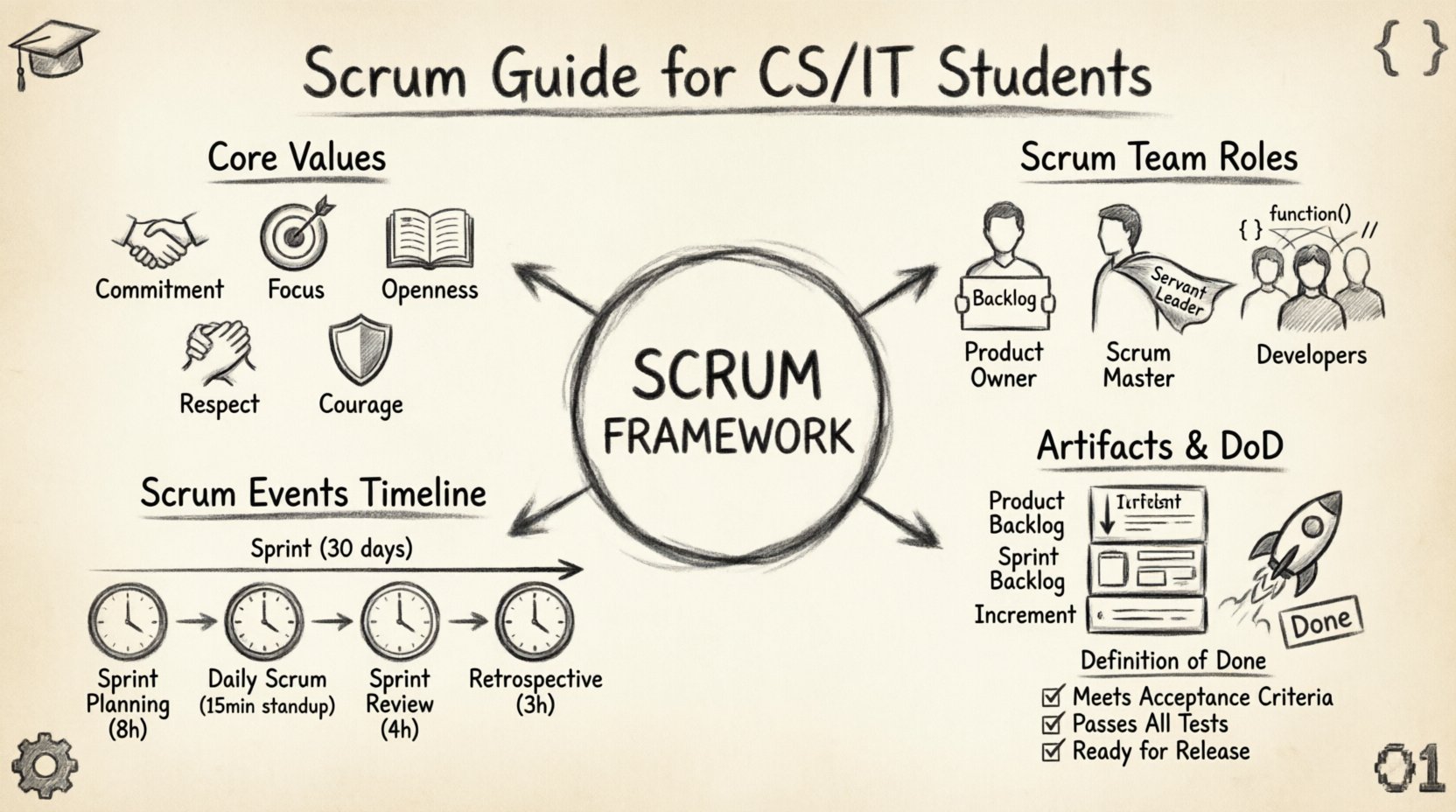
The foundation of any Scrum team lies in its values. These five values guide the behavior of the team members and foster a culture of trust and collaboration. Without these values, the mechanics of Scrum lose their effectiveness.
- Commitment: Team members commit to the goals they set and to the quality of their work. They own the outcome of the Sprint.
- Focus: The team focuses on the work of the Sprint and the goals of the Scrum Team. Distractions are minimized to maintain flow.
- Openness: The Scrum Team and its stakeholders are open about the work and the challenges. Transparency is key to problem-solving.
- Respect: Team members respect each other as capable, independent people. They value the contributions of everyone involved.
- Courage: Team members have the courage to do the right thing and work on tough problems. This includes speaking up about issues.
The Scrum Team 👥
The Scrum Team is a small group of people with all the skills necessary to create a product increment. It is self-managing, meaning it decides internally who does what, when, and how. There are no sub-teams or hierarchies.
1. Product Owner 📋
The Product Owner is accountable for maximizing the value of the product resulting from the work of the Scrum Team. While they are often seen as the voice of the customer, their responsibility extends to managing the Product Backlog effectively.
- Develops and explicitly communicates the Product Goal.
- Orders the items in the Product Backlog to best achieve goals and missions.
- Optimizes the value of the work the Scrum Team performs.
- Ensures that the Product Backlog is visible, transparent, and understood.
2. Scrum Master 🛡️
The Scrum Master is accountable for the Scrum Team’s effectiveness. They serve the Scrum Team in multiple ways, primarily by leading the team to high levels of effectiveness. They are not a traditional project manager; they are a servant-leader.
- Coaches the team on self-management and cross-functionality.
- Removes impediments that hinder the team.
- Ensures that all Scrum events take place and are positive, productive, and kept within the timebox.
- Helps the organization understand and enact Scrum and Agile.
3. Developers 👨💻👩💻
In the Scrum Guide, the term “Developers” is used to encompass all the roles (programmers, testers, designers, etc.) that create the product increment. They are accountable for creating a plan for the Sprint, the Sprint Backlog.
- They create a plan for the Sprint, the Sprint Backlog.
- They hold the quality standards for the work.
- They adapt their plan each day toward the Sprint Goal.
- They create usable increments of functionality.
Scrum Events 📅
Scrum events are designed to create regularity and to minimize the need for meetings not defined in Scrum. All events are timeboxed to ensure efficiency. The following table outlines the core events and their specific purposes.
| Event | Timebox | Purpose | Attendees |
|---|---|---|---|
| Sprint | 1 month or less | The container for all other events. A fixed length of time where a “Done”, usable, and potentially releasable product increment is created. | Scrum Team |
| Sprint Planning | Max 8 hours for 1-month Sprint | To define what can be delivered in the Sprint and how that work will be achieved. | Scrum Team |
| Daily Scrum | 15 minutes | To inspect progress toward the Sprint Goal and adapt the Sprint Backlog as necessary. | Developers |
| Sprint Review | Max 4 hours for 1-month Sprint | To inspect the Increment and adapt the Product Backlog if needed. | Scrum Team + Stakeholders |
| Sprint Retrospective | Max 3 hours for 1-month Sprint | To plan ways to increase quality and effectiveness. | Scrum Team |
Detailed Breakdown of Events
Sprint Planning
This event kicks off the Sprint. The entire Scrum Team collaborates to answer two key questions: “What can be delivered in the increment resulting from the upcoming Sprint?” and “How will the chosen work get done?” The output is the Sprint Backlog.
Daily Scrum
Often called the Daily Stand-up, this is a 15-minute event for the Developers. It is not a status report for the manager. It is a planning meeting. Developers discuss progress toward the Sprint Goal and identify impediments. It happens at the same time and place every day to reduce complexity.
Sprint Review
The Sprint Review is the opportunity for the Scrum Team and stakeholders to inspect the outcome of the Sprint. The Product Owner may present the expected Product Goal if it has changed. The focus is on the product, not the process. Stakeholders provide feedback that may lead to adjustments in the Product Backlog.
Sprint Retrospective
This event occurs after the Sprint Review and before the next Sprint Planning. The focus is on the process, not the product. The Scrum Team inspects how the last Sprint went regarding individuals, interactions, processes, tools, and their Definition of Done. They identify what went well and what needs improvement.
Scrum Artifacts 📦
Artifacts represent work or value. They are designed to maximize transparency of key information. Each artifact contains a commitment to ensure it provides information that enhances understanding and efficiency.
1. Product Backlog 📝
The Product Backlog is an ordered list of everything that is known to be needed in the product. It is the single source of requirements for any changes to be made to the product. It is dynamic; it never completes.
- Ordering: Items are ordered by the Product Owner to optimize value, risk, and necessity.
- Transparency: Anyone can see the backlog and its state.
- Estimation: Items at the top are more clear and can be estimated.
2. Sprint Backlog 🏗️
The Sprint Backlog is composed of the Sprint Goal, the set of Product Backlog items selected for the Sprint, and an plan for delivering the Increment. It is a plan created by the Developers.
- Ownership: It belongs to the Developers.
- Adaptation: It is updated throughout the Sprint as more is learned.
- Commitment: The Sprint Goal is the commitment for the Sprint Backlog.
3. Increment 🚀
An Increment is a concrete stepping stone toward the Product Goal. Each Increment is additive to all prior Increments. An Increment must be usable, meaning it must be “Done” according to the Definition of Done.
- Usability: It must be in a useable condition.
- Definition of Done: It must meet the criteria set by the team.
- Integration: It integrates with all other Increments.
Definition of Done ✅
The Definition of Done (DoD) is a formal description of the state of the Increment when it meets the quality measures required for the product. If a Product Backlog item does not meet the Definition of Done, it cannot be released or presented at the Sprint Review.
For IT students, creating a DoD is a critical exercise. It forces the team to agree on what “finished” means. Is it just code written? Is it tested? Is it documented? Is it reviewed? The DoD ensures that the team does not accumulate technical debt.
- Code is peer-reviewed.
- Unit tests are written and passing.
- Integration tests are executed.
- Documentation is updated.
- Security checks are passed.
If the DoD is not met for an item, it must be returned to the Product Backlog and re-prioritized. It cannot be counted as part of the Sprint Goal achievement.
Scaling Scrum for Larger Teams 📈
While the core Scrum Guide focuses on a single team, real-world IT projects often require multiple teams working on the same product. When scaling, the core values and principles remain the same, but the structure changes.
- Multiple Scrum Teams: They all work on the same Product Backlog.
- Shared Product Goal: All teams align toward a common goal.
- Integration: The Increment created by one team must integrate with others.
- Communication: Communication channels must be established to prevent silos.
For students managing capstone projects, this is relevant when the project is too large for one group. You may need to coordinate with other groups acting as dependencies.
Applying Scrum in Academic Projects 🎓
Many Computer Science students approach their final projects as a linear waterfall process. They design everything, then code everything, then test everything. This often leads to burnout and poor quality. Applying Scrum principles can improve the outcome significantly.
Practical Steps for Students
- Create a Backlog: Write down every feature you think you need. Prioritize them. Start with the most critical functionality.
- Timebox Sprints: Set a 2-week cycle. Commit to what you can finish in that time.
- Hold Daily Check-ins: Spend 15 minutes discussing progress. Don’t just talk about code; talk about blockers.
- Inspect and Adapt: At the end of every cycle, review what you built. Did it work? If not, change the plan for the next cycle.
- Define Done: Agree on what “Done” means for your code. Is it tested? Is it deployed? Don’t skip the testing phase.
Benefits for Career Growth
Learning Scrum while studying provides a significant advantage in the job market. Most tech companies use Agile methodologies. Understanding the terminology and the mindset shows employers that you are ready to integrate into their teams quickly.
- Collaboration: You learn to work in cross-functional teams.
- Communication: You practice communicating status without micromanagement.
- Adaptability: You learn to handle changing requirements without panic.
- Quality Focus: You understand that shipping code is not enough; it must be valuable and usable.
Common Misconceptions ❌
There are several myths surrounding Scrum that can confuse students. It is important to clear these up to ensure proper implementation.
- Myth: Scrum is a methodology. Fact: It is a framework. It provides structure but allows you to fill in the details.
- Myth: You must use specific software tools. Fact: Scrum can be managed with sticky notes or whiteboards. Tools are optional.
- Myth: The Scrum Master is the boss. Fact: They are a servant-leader who facilitates, not manages.
- Myth: You can skip events if you are busy. Fact: Events provide the inspection and adaptation points. Skipping them breaks the feedback loop.
- Myth: All work must be completed. Fact: In Scrum, it is better to have a partial, high-quality increment than a late, low-quality full release.
Conclusion and Next Steps 🚀
Understanding the Scrum Guide is the first step toward becoming an effective software professional. It provides a structure that helps teams navigate complexity and deliver value consistently. For CS and IT students, applying these concepts in academic settings builds the muscle memory required for industry success.
Start by reviewing the official Scrum Guide document. It is short, concise, and written by the creators of Scrum. Read it regularly as your understanding deepens. Try to implement one or two practices in your current projects. Perhaps start with the Daily Scrum or the Definition of Done.
Remember, Scrum is not a silver bullet. It requires commitment from everyone involved. It requires the courage to admit when things are not going well. But when done right, it creates an environment where innovation and quality thrive. As you progress in your career, you will likely encounter variations of Scrum. Understanding the core rules will help you adapt to any variation.
Keep learning. Keep practicing. The journey of software development is long, and Scrum is a valuable map for the road ahead.