Making strategic technology decisions requires more than just picking a popular tool. It demands a structured approach to how you design, plan, and implement your enterprise architecture. For organizations navigating digital transformation, the choice of framework is critical. This guide provides a detailed look at TOGAF (The Open Group Architecture Framework) compared to other major standards. We focus on practical application, structural differences, and suitability for various business environments. 🧭
Understanding the Need for Enterprise Architecture 🏛️
Before comparing specific models, it is vital to understand why they exist. Enterprise Architecture (EA) serves as a blueprint for an organization. It aligns IT strategy with business goals. Without a framework, technology investments often become fragmented. Systems do not talk to each other. Data integrity suffers. Decision-makers struggle to see the big picture. A framework provides a common language and a set of repeatable processes. It reduces risk and improves agility over time.
Decision-makers face a crowded market of methodologies. Some focus on government compliance. Others prioritize software development speed. The goal is to find the model that fits your organizational maturity and strategic objectives. This article breaks down the most prominent options to help you select the right path.
Deep Dive: The Open Group Architecture Framework (TOGAF) 🏛️
TOGAF is widely recognized as the industry standard for enterprise architecture. Developed by The Open Group, it offers a comprehensive approach to designing, planning, implementing, and governing an enterprise information architecture. It is modular, meaning you can adopt parts of it without implementing everything at once.
The Architecture Development Method (ADM) 🔄
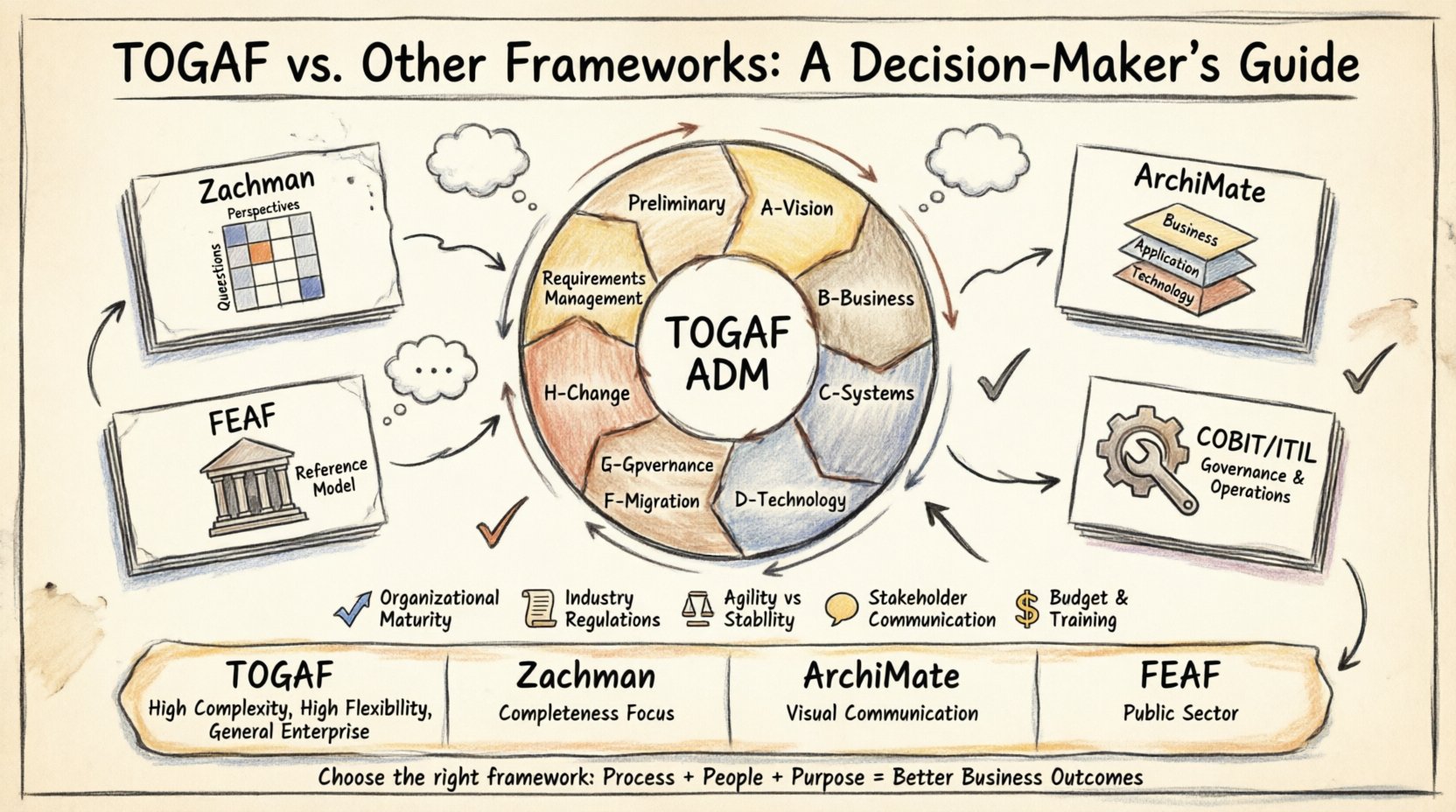
The core of TOGAF is the Architecture Development Method. It is an iterative process consisting of several distinct phases. Each phase produces specific deliverables. This ensures that no step is skipped and that stakeholder needs are met throughout the lifecycle.
- Preliminary Phase: Defines the scope and principles. Prepares the organization for the work ahead.
- Phase A (Architecture Vision): Establishes the business case. Defines the stakeholders and their concerns.
- Phase B (Business Architecture): Describes the business processes, organization, and governance.
- Phase C (Information Systems Architectures): Covers Data and Application architectures. How data flows and what systems support it.
- Phase D (Technology Architecture): Defines the hardware, software, and network capabilities.
- Phase E (Opportunities and Solutions): Identifies implementation projects. Plans the transition.
- Phase F (Migration Planning): Creates a detailed plan for moving from current to target state.
- Phase G (Implementation Governance): Ensures the projects align with the architecture.
- Phase H (Architecture Change Management): Manages changes to the architecture over time.
- Requirements Management: Runs throughout all phases to ensure alignment.
TOGAF is highly scalable. It works for small startups and massive global corporations. However, its comprehensive nature means it can be heavy. Adopting it fully requires significant training and commitment. Organizations often use the Business Architecture or Technology Architecture portions independently.
Alternative Frameworks: A Closer Look 🔍
While TOGAF is dominant, it is not the only option. Different frameworks address specific needs. Some focus on military or government standards. Others emphasize agile development or specific industry verticals.
1. The Zachman Framework 📋
Created by John Zachman, this is one of the oldest frameworks. It is less about process and more about a classification schema. Think of it as a matrix rather than a step-by-step guide.
- Rows (Perspectives): Planner, Owner, Designer, Builder, Subcontractor, User.
- Columns (Questions): What, How, Where, Who, When, Why.
This structure ensures that every aspect of the enterprise is defined from every stakeholder perspective. It is excellent for ensuring completeness. It does not dictate how to move from point A to point B. It is often used alongside TOGAF to ensure nothing is missed in the design phase.
2. ArchiMate 🎨
ArchiMate is a modeling language, not a full framework like TOGAF. It is designed to describe, analyze, and visualize business architecture. It works in close conjunction with TOGAF. If TOGAF is the process, ArchiMate is the vocabulary.
- Business Layer: Processes, functions, and roles.
- Application Layer: Software components and services.
- Technology Layer: Infrastructure and hardware.
It provides visual diagrams that make complex relationships clear to non-technical stakeholders. This is a strong choice for organizations needing clear visual communication of their architecture.
3. FEAF (Federal Enterprise Architecture Framework) 🏛️
FEAF is specifically designed for the US Federal Government. It was created to improve collaboration and reduce redundancy across agencies. It focuses on reference models and building blocks.
- Performance Reference Model: Measures business performance.
- Business Reference Model: Defines the business functions.
- Service Component Reference Model: Describes reusable services.
- Data Reference Model: Standardizes data classification.
- Infrastructure Reference Model: Defines technical standards.
While less common in the private sector, it offers a robust model for public sector compliance and interoperability.
4. COBIT and ITIL 🛠️
These frameworks focus on IT governance and service management rather than pure architecture.
- COBIT: Focuses on governance and management of enterprise IT. It ensures IT meets business needs. It is excellent for auditing and compliance.
- ITIL: Focuses on IT service management. It deals with the operational lifecycle of IT services. It is crucial for teams managing day-to-day operations.
Many organizations combine TOGAF for design with COBIT for governance and ITIL for operations.
Comparative Analysis: Key Differences 📊
To make a decision, you must weigh the pros and cons. The following table highlights the primary distinctions between the major frameworks.
| Feature | TOGAF | Zachman | ArchiMate | FEAF |
|---|---|---|---|---|
| Primary Focus | Process & Methodology | Classification Schema | Modeling Language | Government Compliance |
| Complexity | High | Medium | Medium | High |
| Best For | General Enterprise | Completeness Check | Visual Communication | Public Sector |
| Implementation Cost | High (Training) | Low | Medium | High (Compliance) |
| Flexibility | Very High | High | Medium | Low |
Decision Criteria for Leaders 🤔
Choosing the right framework is not a one-size-fits-all decision. You must evaluate your organization against specific criteria. Consider the following factors before committing to a standard.
1. Organizational Maturity 📈
Do you have a dedicated EA team? If not, a heavy framework like TOGAF might overwhelm your resources. Smaller organizations might prefer a lighter approach or a subset of TOGAF. Mature organizations with complex IT landscapes benefit from the rigor of a full framework.
2. Industry Regulations 📜
Are you in healthcare, finance, or government? Regulatory bodies often dictate standards. If you are a US federal agency, FEAF is likely mandatory. In finance, you might need COBIT for governance alongside your architecture work. Always check compliance requirements first.
3. Agility vs. Stability ⚖️
Does your business change weekly? Or does it run on legacy systems for decades? TOGAF can be slow if followed rigidly. Agile frameworks like SAFe (Scaled Agile Framework) might be better for fast-paced product teams. However, SAFe focuses on software delivery. You may need to blend EA frameworks with Agile methods.
4. Stakeholder Communication 🗣️
Who needs to understand the architecture? Executives need high-level views. Developers need technical details. ArchiMate excels at creating visual models that bridge this gap. If communication is your biggest hurdle, prioritize a modeling language.
5. Budget and Training 💰
TOGAF certification is expensive. Training architects takes time. Zachman is free to use but requires intellectual effort. Evaluate the cost of implementation against the value of the output. Sometimes, a hybrid approach is the most cost-effective solution.
Implementation Challenges and Realities ⚠️
Adopting a framework is not just about buying a license or reading a book. It involves cultural change. Here are common pitfalls to avoid.
- Bureaucracy Trap: Frameworks can become paperwork exercises. Ensure the process adds value. If the architecture is not used in decision-making, it will be ignored.
- Lack of Buy-in: Without executive sponsorship, the architecture team cannot enforce standards. Leaders must champion the initiative.
- Tool Overload: Do not invest in expensive modeling software immediately. Start with standard office tools. Define the process before automating it.
- Ignoring the Business: Architecture must solve business problems. If the design does not improve revenue or efficiency, it is not successful.
Integrating Architecture with Modern Practices 🚀
The landscape is shifting. DevOps and Cloud Native architectures are changing how we build systems. Frameworks must adapt.
TOGAF and DevOps
Traditional EA can feel slow compared to DevOps speeds. The solution is to integrate architecture into the pipeline. Automate compliance checks. Use infrastructure as code. TOGAF provides the guardrails, while DevOps provides the speed.
Cloud Strategy
Cloud migration requires a clear target state. TOGAF’s migration planning phase is useful here. Define the cloud governance model. Understand the shared responsibility model. Ensure security and cost controls are embedded in the architecture.
Future Trends in Enterprise Architecture 🔮
Technology evolves rapidly. Frameworks must stay relevant. Here is what to watch for in the coming years.
- AI and Automation: AI tools can now generate architectural models. This reduces the manual burden of documentation. Frameworks will need to define how AI fits into the design process.
- Continuous Architecture: Instead of big design upfront, architecture will become continuous. It will evolve with the software. This requires more agile frameworks.
- Data-Centric Design: Data is becoming the primary asset. Frameworks are shifting focus from infrastructure to data governance and usage.
Frequently Asked Questions ❓
Is TOGAF certification worth it?
For architects working in large enterprises or government, yes. It validates knowledge and is often a hiring requirement. For small businesses, the practical experience may be more valuable than the certificate.
Can I use multiple frameworks?
Yes. Many organizations use a hybrid model. They might use Zachman for structure, TOGAF for process, and ArchiMate for visualization. The key is to ensure they do not contradict each other.
How long does implementation take?
It depends on the scope. A pilot program might take 3 to 6 months. A full enterprise rollout can take years. Start small and expand as you prove value.
What if my company is too small for TOGAF?
Use a lightweight version. Focus on the ADM phases that matter most. You do not need the full library of artifacts. Adapt the methodology to fit your size.
How does ArchiMate relate to TOGAF?
They are complementary. TOGAF tells you what to do. ArchiMate tells you how to draw it. They are often used together in the same project.
Final Thoughts on Selection ✅
Selecting an enterprise architecture framework is a strategic investment. It requires patience and discipline. There is no magic bullet that fixes all problems. However, a structured approach reduces chaos. It aligns technology with business goals. It creates a sustainable path for growth.
TOGAF remains the gold standard for general enterprise architecture. Its depth and community support are unmatched. However, alternatives like Zachman and ArchiMate offer specialized value. The best choice depends on your unique context. Evaluate your needs, budget, and culture. Test a framework on a pilot project before full adoption.
Remember, the framework is a tool, not the goal. The goal is better business outcomes. Use the structure to enable innovation, not to hinder it. Keep the process lean and focused on value. With the right approach, architecture becomes a competitive advantage rather than a bureaucratic burden.