Enterprise architecture frameworks often face skepticism. Many practitioners assume that adopting a structured methodology like TOGAF conflicts with the iterative, fast-paced nature of Agile delivery. This belief creates friction between architects and development teams. It suggests that governance slows down progress. However, this view is outdated. The reality is that TOGAF and Agile are not enemies. They are complementary disciplines that, when aligned correctly, enhance organizational stability and speed.
This guide explores the integration of TOGAF principles within Agile environments. We will dismantle the narrative that architecture must be a bottleneck. Instead, we will demonstrate how a robust framework supports agility. By understanding the core mechanics, teams can deliver value faster while maintaining architectural integrity. Let us examine the evidence and the practical applications.
Understanding the Core Misconception 🤔
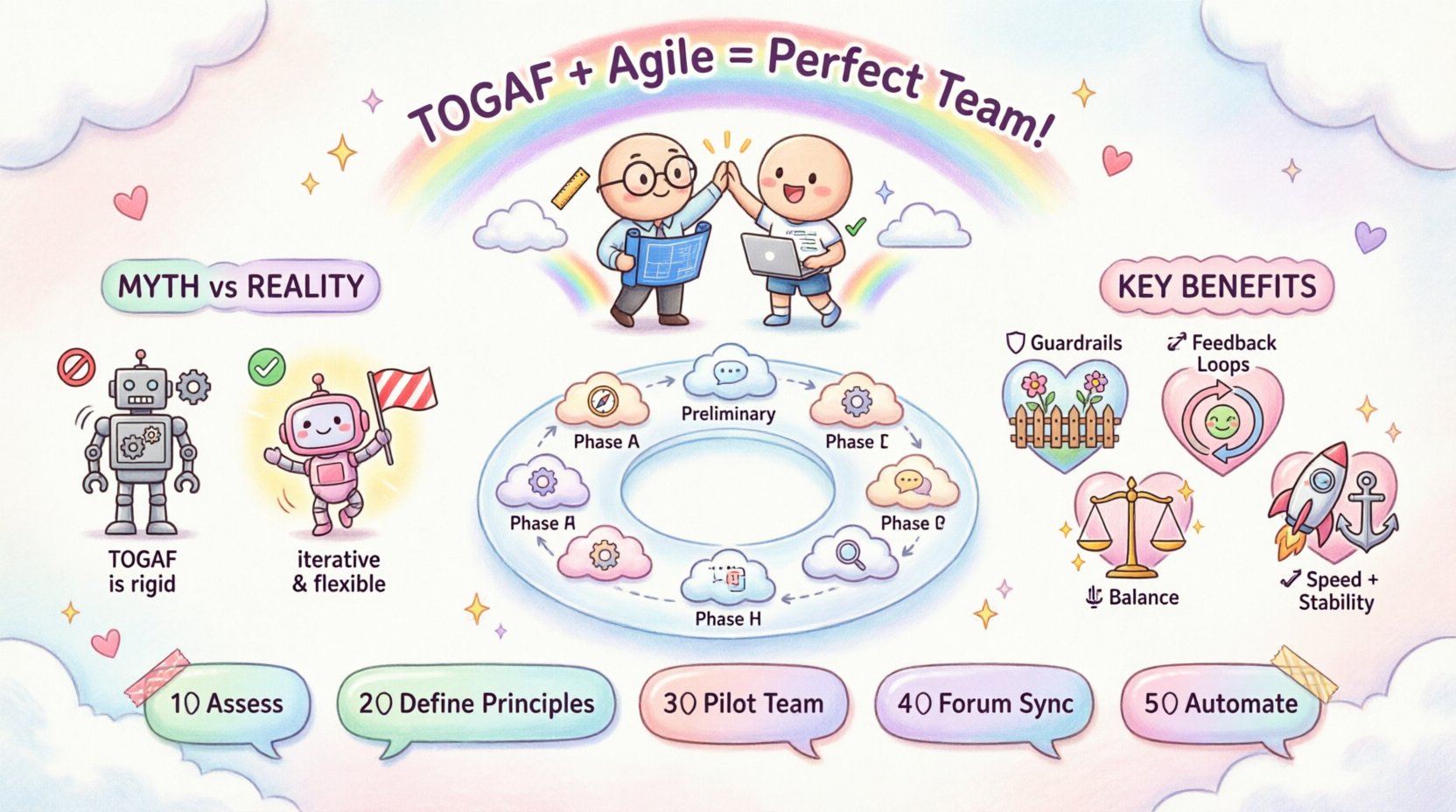
The primary reason for the resistance to TOGAF in Agile settings is the perception of linearity. Critics argue that TOGAF is a waterfall model. They see the Architecture Development Method (ADM) as a rigid sequence of phases. This leads to the assumption that no changes are allowed until a phase is complete.
This is not entirely accurate. The framework is designed to be iterative. It acknowledges that business needs evolve. Here are the key points of the misunderstanding:
- Linear vs. Iterative: The ADM is structured, but it allows for loops and iterations. Teams can cycle through phases as requirements change.
- Documentation Burden: There is a fear that TOGAF requires excessive paperwork. In practice, documentation should be just enough to ensure clarity and compliance.
- Speed vs. Control: Some believe control hinders speed. However, poor architecture causes technical debt, which slows teams down significantly over time.
- Centralized vs. Distributed: There is a worry that architecture becomes a silo. Agile architecture encourages distributed decision-making within guardrails.
When teams adopt a mindset of “architecture as code” or “architecture as documentation” rather than “architecture as gatekeeping,” the friction decreases. The goal is to enable decision-making, not restrict it.
How TOGAF Adapts to Iterative Delivery 🔄
The Architecture Development Method (ADM) is the heart of TOGAF. It provides a step-by-step approach to designing an enterprise architecture. Contrary to popular belief, the ADM does not force a “big bang” release.
Here is how the phases align with Agile cycles:
- Preliminary Phase: This sets the stage. It defines the principles and the context. Agile teams can adopt these principles early to guide their sprint planning.
- Phase A (Architecture Vision): This defines the scope. It is similar to defining the epic or the release goal in a product roadmap.
- Phase B (Business Architecture): This maps business capabilities. It helps prioritize which features deliver the most business value first.
- Phase C (Information Systems Architectures): This covers data and application. It ensures that data models remain consistent across different microservices.
- Phase D (Technology Architecture): This defines the infrastructure. It ensures that the cloud or on-premises setup supports the application requirements.
- Phase E (Opportunities and Solutions): This maps the migration. It plans how to move from the current state to the target state incrementally.
- Phase F (Migration Planning): This creates the detailed plan. It aligns with the release train or sprint backlog.
- Phase G (Implementation Governance): This oversees the build. It ensures that the delivered code matches the architectural design.
- Phase H (Architecture Change Management): This handles evolution. It manages changes as the business context shifts.
By mapping these phases to Agile ceremonies, teams can maintain structure without losing momentum. For example, the Architecture Vision (Phase A) can be updated during sprint reviews. Implementation Governance (Phase G) can be integrated into the definition of done.
Balancing Governance and Autonomy ⚖️
One of the biggest concerns is governance. Agile teams want autonomy. TOGAF provides a governance framework. How do these coexist? The answer lies in the concept of Architecture Contracts.
Architecture contracts define the relationship between the architecture group and the implementation team. They set boundaries. Within these boundaries, teams have freedom. This is the essence of Agile governance.
Key elements of this balance include:
- Architectural Guardrails: Define what cannot be done (e.g., security standards, data privacy rules). Teams can choose how to achieve compliance.
- Decision Rights: Clarify who approves which changes. Small changes may not need a full architecture review board.
- Technical Standards: Establish common libraries or patterns. This reduces the time spent reinventing the wheel.
- Feedback Loops: Ensure that implementation issues feed back into the architecture quickly.
Without guardrails, teams might drift into incompatible solutions. Without feedback loops, the architecture becomes disconnected from reality. The balance ensures that the system remains coherent while allowing rapid change.
Comparing Approaches: Waterfall, Agile, and Integrated 📊
To clarify the differences, consider the following comparison of how architecture is handled in different models. This table highlights the operational differences.
| Aspect | Traditional Waterfall | Agile Only | Integrated (TOGAF + Agile) |
|---|---|---|---|
| Planning Horizon | Long-term, fixed | Short-term, adaptive | Long-term vision with short-term iterations |
| Change Management | Formal, slow | Informal, fast | Lightweight, rapid review |
| Documentation | Heavy upfront | Minimal, just-in-time | Living documents, updated continuously |
| Architecture Role | Gatekeeper | Ad-hoc | Enabler and Guide |
| Risk Focus | Compliance and stability | Delivery and speed | Stability through speed and speed through stability |
The integrated approach combines the stability of the traditional model with the adaptability of the Agile model. It prevents the chaos of pure agility and the stagnation of pure structure.
Roles and Responsibilities in a Hybrid Model 👥
When integrating TOGAF with Agile, roles must evolve. The Enterprise Architect cannot remain a distant figure. They must be involved in the process. Similarly, Agile practitioners must understand architectural implications.
Enterprise Architect Responsibilities:
- Define the strategic direction and principles.
- Maintain the architecture repository.
- Review high-level design decisions.
- Identify cross-cutting concerns (security, data, integration).
- Coach teams on architectural best practices.
Agile Team Responsibilities:
- Implement features within architectural guardrails.
- Identify local architectural debt.
- Communicate technical constraints to the product owner.
- Participate in architecture reviews.
- Ensure code quality and adherence to standards.
This shared responsibility model fosters collaboration. The architect provides the map; the team drives the car. Both need to communicate constantly to stay on course.
Common Pitfalls to Avoid ⚠️
Even with a good plan, implementation can go wrong. Here are common mistakes organizations make when trying to combine these methodologies.
- Over-Engineering: Creating detailed designs for features that may never be built. Keep designs lightweight and relevant to the immediate sprint.
- Under-Engineering: Ignoring technical debt. If teams move too fast without regard for structure, the system becomes unmaintainable.
- Lack of Visibility: If the architecture group is not visible in sprint reviews, they miss opportunities to guide the team.
- Static Repository: Keeping the architecture repository out of date. If the documentation does not match the code, it is useless.
- Ignoring Business Value: Focusing too much on technology and not enough on business outcomes. TOGAF emphasizes business architecture, which must remain the priority.
Avoiding these pitfalls requires discipline. It requires teams to prioritize value over vanity metrics. It requires architects to trust the teams while ensuring quality.
Practical Steps for Integration 🛠️
How do you start? You do not need to overhaul the entire organization. Small, targeted steps yield better results. Follow this progression:
- 1. Assess Current State: Understand where the organization stands. Is there technical debt? Is there a lack of standards?
- 2. Define Principles: Establish 5-10 core principles. Examples include “Data is an asset” or “Security is built-in.”
- 3. Pilot a Team: Select one Agile team to test the integration. Measure their velocity and quality.
- 4. Establish a Forum: Create a regular meeting for architects and scrum masters to discuss blockers and alignment.
- 5. Automate Governance: Use tools to check for compliance automatically. This reduces manual review time.
- 6. Iterate: Review the process regularly. Adjust the framework based on feedback.
This iterative approach mirrors the Agile methodology itself. You build the process as you go, refining it based on real-world experience.
The Impact on Technical Debt 📉
One of the strongest arguments for using TOGAF in an Agile environment is the management of technical debt. Without a framework, technical debt accumulates silently. It looks like speed at first, but it becomes a drag later.
TOGAF provides mechanisms to track and manage this debt:
- Architecture Board: Reviews decisions that introduce debt.
- Repository: Tracks the state of the architecture over time.
- Gap Analysis: Identifies the difference between current and target states.
When teams have visibility into debt, they can plan to pay it down. They can allocate a percentage of sprint capacity to refactoring. This prevents the system from becoming brittle. It ensures long-term sustainability.
Communication Strategies 🗣️
Communication is the glue that holds TOGAF and Agile together. Different stakeholders speak different languages. Architects speak in diagrams and models. Developers speak in code and commits. Product owners speak in user stories and value.
To bridge this gap:
- Visualize Everything: Use diagrams that are easy to understand. Avoid overly complex notation.
- Use Common Terminology: Agree on a glossary. Ensure everyone knows what a “component” or “service” means.
- Embed Architects: Have architects sit with the teams. This reduces miscommunication.
- Regular Syncs: Hold brief, focused meetings to align on goals and blockers.
Effective communication reduces friction. It ensures that everyone is working toward the same destination. It turns the architecture function from a hurdle into a support system.
Measuring Success 📈
How do you know if the integration is working? You need metrics. Do not just measure speed. Measure quality, stability, and alignment.
- Deployment Frequency: Are releases happening regularly?
- Lead Time for Changes: How long does it take from code commit to production?
- Change Failure Rate: How often do changes cause issues?
- Mean Time to Recovery: How quickly are issues resolved?
- Architectural Compliance: Are teams adhering to the guardrails?
These metrics provide a holistic view. They show if the organization is becoming more agile without losing control. They validate the approach and guide future improvements.
Final Thoughts on Flexibility and Structure 🌟
The debate between structure and agility is not new. It is a fundamental tension in software engineering. TOGAF offers a path to resolve this tension. It provides the structure necessary for complex systems to function. It allows for the flexibility needed to respond to market changes.
When implemented correctly, TOGAF does not slow down Agile teams. It empowers them. It gives them a clear understanding of the landscape. It allows them to make decisions with confidence. The myth of rigidity is just that—a myth. The reality is a robust framework that supports modern delivery.
Organizations that embrace this integration gain a competitive advantage. They deliver faster. They build better systems. They manage risk more effectively. The journey requires effort and mindset shifts. But the destination is worth it.
Start by challenging the assumptions. Engage with the teams. Apply the principles incrementally. Watch how the organization evolves. The result is an architecture function that is relevant, valuable, and essential to the business.