
Enterprise architecture is not merely about drawing diagrams; it is about governance, alignment, and strategic execution. Within the TOGAF framework, the Architecture Board plays a pivotal role in ensuring that IT investments support business objectives. However, without a formal charter, the board operates in ambiguity. This guide details the process of establishing a robust Architecture Board Charter, ensuring clarity, authority, and operational effectiveness.
Creating this document requires precision. It defines who holds decision-making power, what the scope of authority is, and how the board interacts with the rest of the organization. This tutorial walks through the necessary steps to draft a charter that stands the test of time and organizational change.
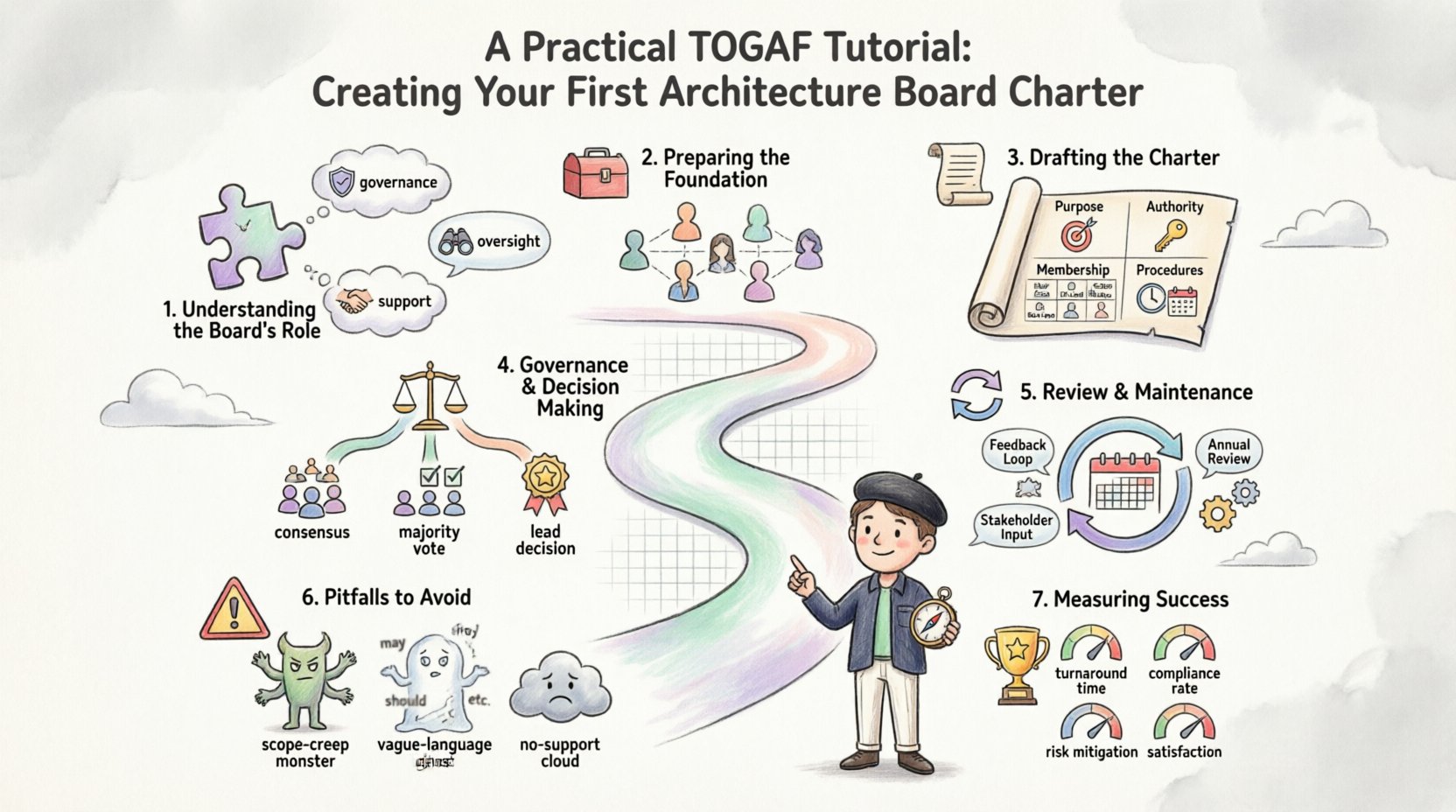
1. Understanding the Architecture Board’s Role 🧩
Before drafting a single line of the charter, you must understand the function of the board. In the TOGAF Architecture Governance framework, the Architecture Board is not an advisory body. It is a decision-making entity responsible for:
- Reviewing and approving Architecture Contracts.
- Managing Architecture Change Requests.
- Ensuring compliance with defined standards and principles.
- Providing guidance on enterprise-wide architectural issues.
The charter formalizes these responsibilities. It transforms vague expectations into documented authority. Without this document, architects may find themselves negotiating authority rather than exercising it.
Key Responsibilities Defined
To ensure the board functions correctly, the charter must explicitly list the core duties. These duties typically fall into three categories: governance, oversight, and support.
- Governance: Enforcing adherence to the Architecture Vision and Standards.
- Oversight: Monitoring the progress of major architectural initiatives.
- Support: Providing technical guidance to project teams when conflicts arise.
Clarity here prevents scope creep. The board should not micromanage projects, but it must intervene when strategic alignment is at risk.
2. Preparing the Foundation 🛠️
Writing the charter is a process that begins before the first word is written. Preparation involves identifying stakeholders, understanding the current governance landscape, and securing leadership buy-in.
Stakeholder Identification
You cannot create a charter in a vacuum. You must identify who holds power within the organization. This includes:
- Executive Sponsors: Senior leaders who fund the initiatives.
- Chief Architect: The individual accountable for the architecture function.
- Project Managers: Those responsible for delivery.
- Business Unit Leaders: Stakeholders who define the business requirements.
Engaging these individuals early ensures the charter reflects reality rather than theoretical ideals. It also builds the necessary coalition to support the board’s decisions later.
Assessing Current Processes
Before introducing a new charter, review existing governance mechanisms. Are there other committees? Do they overlap with the Architecture Board? If multiple bodies claim authority over the same projects, the charter must clarify the hierarchy. This assessment prevents confusion and ensures the board adds value rather than bureaucratic overhead.
3. Drafting the Charter Content 📝
This is the core of the exercise. The charter document should be concise yet comprehensive. It serves as the constitution for the Architecture Board. Below is a breakdown of the essential sections required.
3.1 Purpose and Mission
Start with a clear statement of intent. What is the board here to achieve? This section should align with the overall enterprise strategy. It answers the question: Why does this board exist?
Example statement: “The Architecture Board exists to ensure that IT investments align with enterprise strategy and that architectural standards are maintained across all business units.”
3.2 Authority and Scope
Define the limits of the board’s power. What can they say yes to? What can they say no to? This section is critical for preventing friction between the board and project teams.
- Approval Authority: Does the board approve the Architecture Definition Document? Do they sign off on major technology choices?
- Change Management: Does the board control the pace of architectural changes?
- Exceptions: Under what conditions can the board grant exceptions to standards?
3.3 Composition and Membership
Who sits at the table? The charter must define the roles required for effective representation. A balanced board includes technical expertise and business acumen.
| Role | Responsibility | Decision Rights |
|---|---|---|
| Chairperson | Leads meetings, facilitates discussion | Voting on deadlock situations |
| Chief Architect | Provides technical direction | Recommendation on standards |
| Business Representative | Ensures business alignment | Veto on business impact |
| Security Lead | Validates security posture | Veto on security risks |
This table structure can be adapted to your organization’s specific hierarchy. The goal is to ensure that every critical perspective is represented without making the group too large to function efficiently.
3.4 Operating Procedures
How does the board operate? This section covers the logistics of meetings and decision-making. It includes:
- Meeting Frequency: Weekly, monthly, or quarterly? High-volume organizations may require weekly cadences.
- Quorum Requirements: How many members must be present to make a valid decision?
- Submission Process: How do projects submit requests for review? Is there a standardized form?
- Turnaround Time: How quickly must the board respond to requests?
Defining these rules prevents bottlenecks. If a project team waits three weeks for a review, the charter has failed to support delivery.
4. Governance and Decision Making ⚖️
A charter is useless without a clear mechanism for making decisions. Ambiguity here leads to delays and frustration. You must define how the board reaches consensus.
Decision Models
There are several models for decision-making. The charter should specify which one applies.
- Consensus: All members must agree. This is democratic but slow.
- Majority Vote: More than 50% approval. Faster, but can alienate minority views.
- Lead Decision: A specific role (like the Chair) makes the final call after hearing input.
For most organizations, a hybrid model works best. Technical standards might require consensus, while resource allocation might use a lead decision model.
Escalation Paths
What happens when the board cannot agree? Or when a decision impacts the executive strategy beyond the board’s scope? The charter must outline the escalation path.
Typically, this involves an escalation to a higher-level committee or the Chief Information Officer (CIO). Defining this path upfront ensures that disagreements do not stall projects indefinitely.
Conflict Resolution
Disagreements between business units and IT are common. The charter should provide a framework for resolving these conflicts. This might involve:
- Reviewing the Architecture Principles.
- Re-evaluating the Business Case.
- Bringing in an independent mediator.
By establishing these rules, you reduce the emotional weight of conflict and focus on objective criteria.
5. Review and Maintenance 🔄
A charter is not a one-time document. It must evolve as the organization changes. The charter should include a clause for its own review.
Periodic Audits
Set a schedule to review the charter itself. Annually is a standard cadence. During this review, ask:
- Are the current members still appropriate?
- Has the scope of the board changed?
- Are the decision-making processes still efficient?
If the organization merges, acquires, or pivots strategy, the charter must be updated to reflect the new reality. Stale governance documents create friction.
Feedback Loops
Include a mechanism for feedback from the project teams. If the board is seen as an obstacle, the charter should allow for a review of that perception. Regular surveys or feedback sessions can highlight areas where the board is adding value versus where it is creating bureaucracy.
6. Common Pitfalls to Avoid ⚠️
Many Architecture Boards fail because of avoidable mistakes. When drafting your charter, watch out for these common traps.
- Overly Ambitious Scope: Trying to control every detail. The board should focus on high-level decisions, not project management tasks.
- Lack of Executive Support: If the C-suite does not back the board, the charter is just paper. Ensure sponsorship is secured before publishing.
- Vague Language: Avoid phrases like “review when appropriate.” Use “review within 10 business days.” Specificity is key.
- Ignoring Culture: If the organization values speed, a slow board will be rejected. Align the charter with the cultural expectations of delivery.
7. Measuring Success 📊
How do you know the charter is working? You need metrics to track the effectiveness of the governance process. These metrics should be tracked in the Architecture Repository.
Key Performance Indicators
- Decision Turnaround Time: Average time from request to decision.
- Compliance Rate: Percentage of projects adhering to architectural standards.
- Risk Mitigation: Number of high-risk issues identified and resolved early.
- Stakeholder Satisfaction: Feedback from project teams on the board’s helpfulness.
These metrics provide objective data to justify the board’s existence and value. They also highlight areas for improvement in the charter’s execution.
Conclusion on Best Practices ✅
Creating an Architecture Board Charter is a strategic initiative. It requires a balance of authority and flexibility. By following the steps outlined in this guide, you establish a foundation for effective enterprise architecture governance. The charter becomes a living document that supports the organization’s journey toward digital transformation.
Remember that governance is a service, not a gate. The goal is to enable delivery, not hinder it. With a clear charter, the Architecture Board becomes a trusted partner to the business, ensuring that technology investments deliver on their promises.
Start drafting. Define the roles. Set the rules. Build the governance that your enterprise needs.