


Projects often start with a clear vision, a defined timeline, and a specific budget. However, as work progresses, requirements shift, new features are requested, and the original boundaries blur. This phenomenon is known as scope creep. It is one of the most common reasons projects fail to deliver on time or within budget.
Managing scope is not about saying “no” to every new idea. It is about understanding the impact of changes and making informed decisions. Whether you are working in a predictive environment or an iterative one, controlling scope requires discipline, communication, and robust processes.
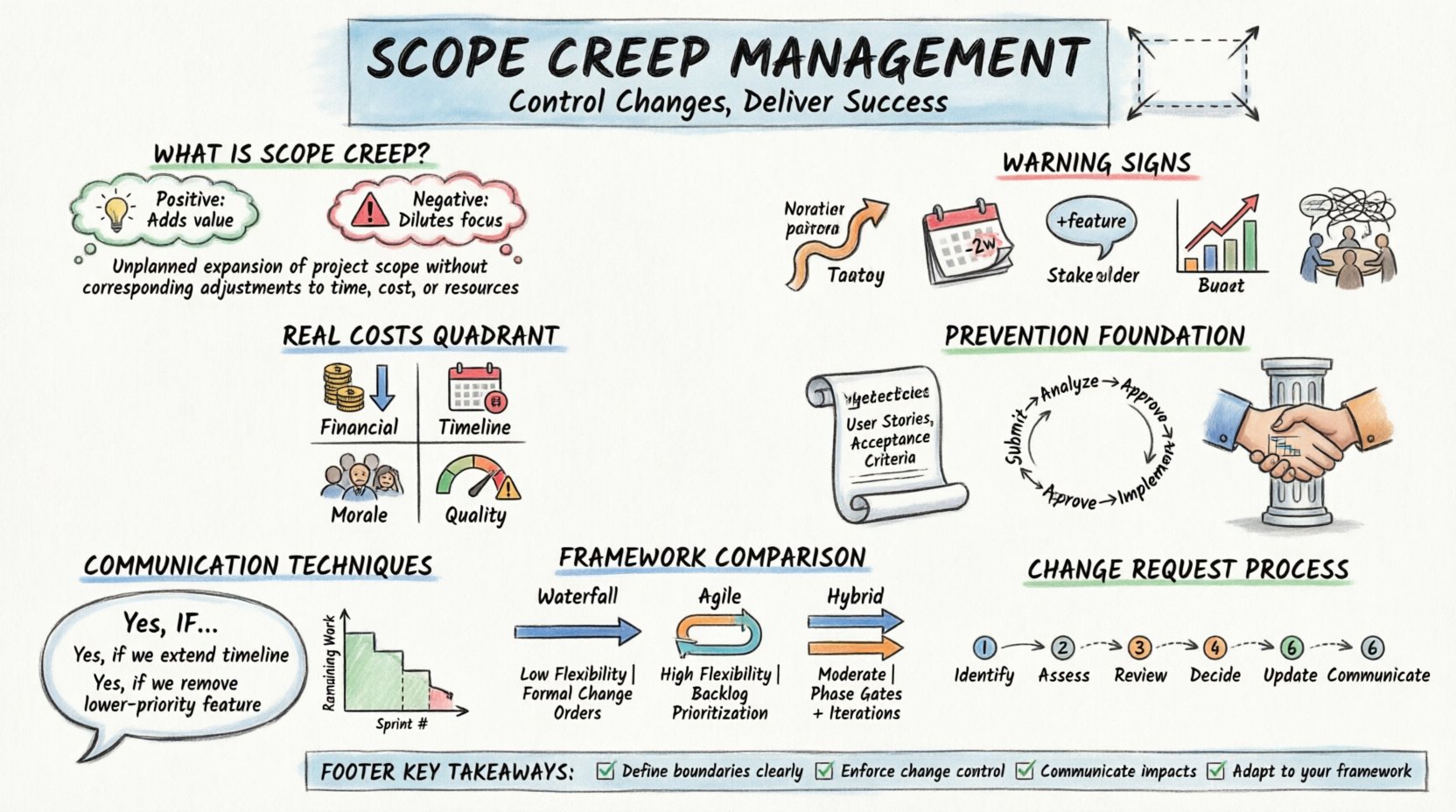
🔍 What Exactly Is Scope Creep?
Scope creep, also known as requirement creep or feature creep, refers to uncontrolled changes or continuous growth in a project’s scope. Unlike a formal change request, scope creep happens organically and often without approval.
It typically manifests in two ways:
- Positive Scope Creep: Adding value that was not originally planned but is beneficial.
- Negative Scope Creep: Adding work that dilutes focus, delays delivery, or increases costs without clear benefit.
Understanding the difference is crucial. The goal is not to eliminate positive changes, but to ensure they are evaluated against the project constraints.
Common Signs of Scope Creep
How do you know if your project is drifting? Look for these indicators:
- Team members are working on tasks not in the original plan.
- Deadlines are constantly slipping without formal extensions.
- Stakeholders expect features to be added “just a little bit more”.
- Budget overruns occur frequently due to “small” additions.
- Meetings become dominated by new feature discussions rather than progress tracking.
💸 The Real Cost of Unchecked Scope
When scope expands without adjustment to time and cost, the project suffers. The impact is rarely limited to just the schedule. It affects the entire project ecosystem.
Financial Implications
Every hour of work costs money. When the scope expands, resources are consumed at a higher rate. If the budget is fixed, profit margins shrink. If the budget is variable, the client may become dissatisfied with the rising costs.
Timeline Delays
Adding tasks extends the critical path. If resources are not increased proportionally, delivery dates slip. This can lead to missed market windows or contractual penalties.
Team Morale and Burnout
When the goalposts move, team members feel a sense of futility. They finish a task, only to be told it is not enough. This leads to fatigue and reduced productivity over time.
Quality Compromise
To meet the new deadlines created by added scope, teams often cut corners. Testing may be skipped, documentation may be incomplete, and technical debt increases.
🛡️ Prevention Strategies: Building a Strong Foundation
Preventing scope creep starts before the first task is assigned. It begins with clarity and agreement.
1. Define Requirements Clearly
Use detailed requirement documents. Vague terms like “user-friendly” or “modern design” are open to interpretation. Define specific metrics and acceptance criteria.
- Functional Requirements: What must the system do?
- Non-Functional Requirements: Performance, security, and reliability standards.
- Exclusions: Clearly state what is not included in the project.
2. Establish a Change Control Process
This is the most critical defense mechanism. No change should be implemented without a formal review.
A standard Change Control Process includes:
- Submission: A stakeholder submits a Change Request form.
- Analysis: The project team assesses the impact on time, cost, and resources.
- Approval: A Change Control Board (CCB) or authorized sponsor reviews the analysis.
- Implementation: If approved, the plan is updated, and work begins.
3. Secure Stakeholder Buy-In Early
Involve key stakeholders during the planning phase. When they understand the trade-offs, they are less likely to request changes later without understanding the consequences.
🔄 Managing Scope in Different Frameworks
Different methodologies handle scope differently. The approach must adapt to the framework being used.
Waterfall and Predictive Models
In Waterfall, scope is defined upfront. The focus is on strict adherence to the plan.
- Change Management: Strictly enforced. Any deviation requires a formal change order.
- Flexibility: Low. Changes are expensive and time-consuming to integrate.
- Strategy: Invest heavily in the requirements gathering phase to minimize later changes.
Agile and Iterative Models
Agile embraces change. However, this does not mean scope is unlimited. It means scope is managed dynamically.
- Backlog Management: The product backlog is prioritized. New items are added, but old items may be removed to maintain capacity.
- Timeboxing: Sprints have a fixed duration. If scope is added, something else must be removed to fit the timebox.
- Strategy: Focus on value delivery. If a feature is not high priority, it stays in the backlog.
Hybrid Approaches
Many organizations use a mix of both. They define the high-level scope rigidly but allow flexibility in the details.
| Framework | Scope Flexibility | Primary Control Mechanism |
|---|---|---|
| Waterfall | Low | Formal Change Orders |
| Agile | High | Backlog Prioritization |
| Hybrid | Moderate | Phase Gates + Iterations |
🗣️ Communication Techniques for Control
Technical processes fail without communication. You must communicate the boundaries and the cost of changes effectively.
The “Yes, If” Technique
Instead of a flat “no,” use “Yes, if.” This acknowledges the value of the request while highlighting the trade-off.
- Bad: “We can’t add that feature.”
- Good: “We can add that feature, if we move the launch date by two weeks.”
- Good: “We can add that feature, if we remove the reporting module.”
Regular Status Reporting
Keep stakeholders informed about current scope status. If the scope is trending upward, report it early. Surprise is the enemy of management.
- Include scope metrics in weekly reports.
- Highlight new requests and their status.
- Visualize the burn-up chart to show work added vs. work completed.
Managing Expectations
Be honest about what is possible. If a stakeholder believes a feature is easy, correct that assumption with data. Transparency builds trust.
📝 The Change Request Process
A formal process ensures that every change is documented and evaluated. Do not rely on verbal agreements.
- Identify the Change: Document who requested it and why.
- Assess Impact: Calculate the effect on schedule, budget, quality, and resources.
- Review Options: Present alternatives. Can the change be deferred? Can it be done in a future phase?
- Decision: The sponsor or CCB approves or rejects.
- Update Baseline: If approved, update the project plan and baseline.
- Communicate: Inform the team of the approved change.
🛠️ Tools for Scope Control (Process-Based)
You do not need specific software to control scope. You need discipline and the right documents.
1. Scope Statement
A document that describes the project boundaries. It is the reference point for all decisions.
2. Work Breakdown Structure (WBS)
Decomposes the project into manageable work packages. If a request falls outside the WBS, it is immediately visible as a change.
3. Scope Register
A log of all scope-related activities, including requirements, change requests, and rejections. This provides an audit trail.
4. Stakeholder Register
Identifies who has the authority to approve changes. Prevents unauthorized requests from individuals without decision-making power.
🧩 Psychology of Scope Creep
Understanding human behavior helps in managing scope. Why does it happen?
- Good Intentions: Stakeholders want the best outcome for the business.
- Lack of Visibility: Stakeholders may not see the full impact of a small change.
- Pressure: Teams may fear saying “no” to a powerful stakeholder.
- Incrementalism: Small changes accumulate over time without a single person noticing the total sum.
To counter this, foster a culture where saying “no” or “not now” is acceptable when backed by data.
🚨 Recovery Strategies
What if scope creep has already happened? You cannot undo the past, but you can stabilize the present.
1. Freeze the Scope
Announce a freeze. No new changes are accepted until the current work is completed. This allows the team to focus.
2. Rebaseline the Project
If the changes are too significant to ignore, formally update the baseline. Adjust the schedule and budget to reflect the new reality. Get this approved by the sponsor.
3. Cut Features
If time and budget are fixed, scope must be reduced. Identify low-value features to remove to accommodate the new high-value requests.
4. Increase Resources
If the budget allows, add team members. Note that this may increase complexity and communication overhead.
🏁 Final Thoughts
Scope management is a continuous activity. It requires vigilance from the first meeting to the final sign-off. By implementing clear processes, communicating trade-offs, and respecting the constraints of time and cost, you can navigate changes effectively.
Remember, the goal is not to prevent change, but to manage it intelligently. When scope changes are controlled, projects deliver value without sacrificing quality or team well-being.
- Define boundaries clearly.
- Enforce a change control process.
- Communicate impacts transparently.
- Adapt your approach to the framework.
With these practices in place, you build a resilient project environment capable of handling the inevitable shifts in business needs.
Related posts:
 How Project Management Actually Works: A Definitive Overview for Intermediate Professionals
 The Hidden Cost of Chaos: Common Mistakes Stalling Your Project Management Career
 Agile vs. Waterfall: A Real-World Comparison for Senior Project Managers Deciding Frameworks
 5-Step Quick Start Guide to Structuring Any Project Management Initiative from Scratch