


Project management is often visualized as a series of Gantt charts, critical paths, and resource allocation matrices. While these technical frameworks are essential, they represent only the skeleton of the discipline. The muscle that drives a project to completion is human behavior. When teams operate under tight deadlines and complex constraints, the psychological dynamics shift. Understanding the psychology of project management is not merely an optional soft skill; it is a fundamental competency for navigating high-pressure environments.
Leaders who ignore the cognitive and emotional states of their teams often find themselves fighting against invisible resistance. Scope creep, burnout, and communication breakdowns are rarely caused by a lack of tools or processes. They are symptoms of unmanaged psychological stress and cognitive bias. This guide explores the mechanics of human behavior in project settings, offering a framework for managing teams through the turbulence of delivery.
The Cognitive Load of Leadership 🧩
The human brain has a limited capacity for working memory. In project management, leaders are frequently asked to juggle competing priorities, conflicting stakeholder demands, and technical dependencies simultaneously. This creates a state of high cognitive load. When cognitive load exceeds capacity, decision-making quality deteriorates.
Effective project leadership requires managing this load for oneself and the team. Here is how cognitive load manifests in typical project scenarios:
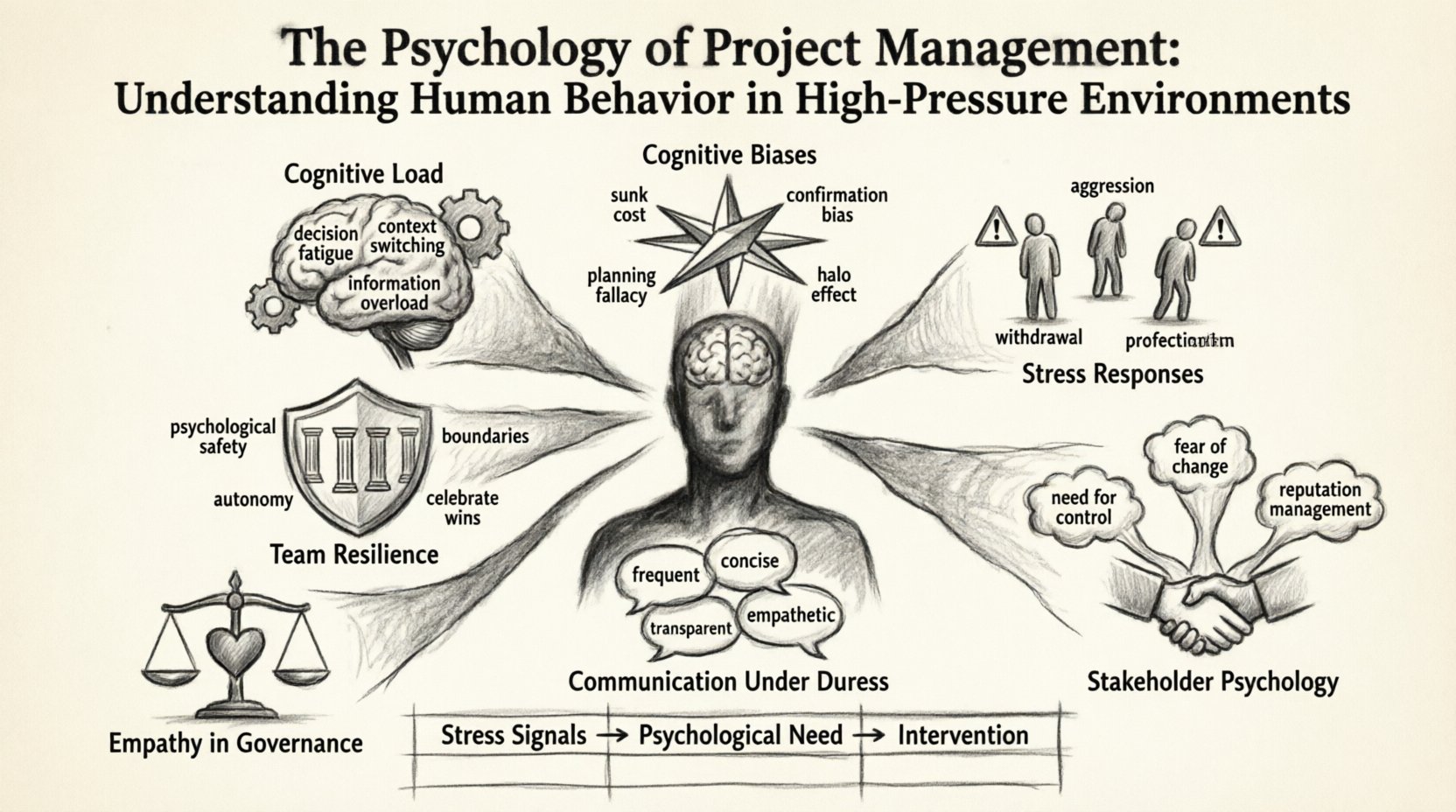
- Decision Fatigue: As the number of micro-decisions increases throughout a day, the quality of subsequent decisions drops. This is why strategic planning should occur early in the day when mental energy is highest.
- Context Switching: Moving between a budget meeting, a technical review, and a client call fragments attention. Each switch incurs a cognitive cost, reducing the depth of focus required for complex problem-solving.
- Information Overload: Receiving too much data without clear prioritization paralyzes action. The brain struggles to distinguish signal from noise, leading to analysis paralysis.
To mitigate these effects, leaders must structure information. This does not mean simplifying the work, but rather organizing the delivery of information. Breaking large problems into smaller, digestible cognitive chunks allows the brain to process complexity without triggering stress responses.
Understanding Team Stress Responses 🚨
Under pressure, the human body activates the sympathetic nervous system. This is the fight-or-flight response. In a project environment, this physiological reaction can be detrimental to collaboration. When team members perceive a threat, such as an unrealistic deadline or a hostile stakeholder, their prefrontal cortex—the area responsible for logic and planning—becomes less active.
Recognizing the signs of stress is the first step in intervention. Behavioral indicators often appear before verbal complaints. Common stress responses in project teams include:
- Withdrawal: Silence in meetings, delayed responses to emails, and reduced participation in brainstorming sessions.
- Aggression: Interrupting others, raising voices during status updates, or becoming defensive about work quality.
- Perfectionism: An inability to move forward on tasks due to fear of making mistakes. This often masks anxiety about the outcome.
- Procrastination: Delaying work not out of laziness, but as a coping mechanism to avoid the immediate anxiety associated with the task.
Leaders must respond to these signals with empathy and structural changes. If a team member exhibits withdrawal, a private conversation focused on well-being rather than output is more effective than a public reminder to deliver.
Cognitive Biases in Decision Making 🎯
Human decision-making is rarely purely rational. We rely on heuristics, or mental shortcuts, which are prone to systematic errors known as cognitive biases. In project management, these biases can lead to significant financial loss and schedule delays. Awareness of these biases allows for more objective governance.
Consider the following biases that frequently impact project outcomes:
- Sunk Cost Fallacy: Continuing a project because of the resources already invested, even when the future outlook is poor. The instinct is to justify past spending rather than assess current value.
- Confirmation Bias: Seeking information that supports a pre-existing belief about a vendor, technology, or team member while ignoring contradictory evidence.
- Planning Fallacy: The tendency to underestimate the time and resources required to complete a task. This is the root cause of most missed deadlines.
- Halo Effect: Allowing one positive trait of a team member or vendor to influence the assessment of their overall performance or reliability.
Mitigating these biases requires structured processes. For example, implementing a “pre-mortem” exercise where the team assumes the project has failed and works backward to determine why can help uncover risks that optimism bias obscures.
Stakeholder Psychology and Expectation Management 🤝
Stakeholders are not monolithic entities; they are individuals with their own fears, motivations, and anxieties. A project manager who treats stakeholder management as a transaction of information will struggle. It requires managing the emotional state of the stakeholders as well as their informational needs.
High-pressure environments amplify stakeholder anxiety. When a project is critical, stakeholders often feel a loss of control. This can manifest as micromanagement, frequent status requests, or sudden changes in requirements. Understanding the psychology behind these behaviors is key.
Common psychological drivers in stakeholder interactions include:
- Need for Control: Stakeholders may demand excessive detail to feel secure in the outcome. Providing structured, high-level summaries can satisfy this need without overwhelming the project team.
- Fear of Change: New initiatives often threaten existing power structures or workflows. Resistance to adoption is often a defense mechanism against perceived threat.
- Reputation Management: Stakeholders may push for features or deadlines that make them look good to their own superiors, even if it harms the project integrity.
Effective communication strategies involve validating these concerns. Acknowledging the pressure they are under builds rapport. When stakeholders feel heard, their demand for control often decreases naturally.
Building Resilience in Project Teams 🛡️
Resilience is the capacity to recover quickly from difficulties. In project management, resilience is not just about enduring stress; it is about maintaining performance and well-being through volatility. A resilient team can absorb shocks without breaking.
Psychological safety is the foundation of team resilience. This concept refers to a shared belief that the team is safe for interpersonal risk-taking. In a psychologically safe environment, team members admit mistakes, ask for help, and propose novel ideas without fear of punishment.
Strategies to foster resilience include:
- Normalize Failure: Treat errors as data points for learning rather than grounds for blame. Conduct blameless post-mortems.
- Encourage Autonomy: Allow team members ownership over their specific tasks. Autonomy is a powerful buffer against stress.
- Establish Boundaries: Respect working hours and downtime. Continuous availability leads to rapid burnout.
- Celebrate Small Wins: In long projects, momentum is vital. Recognizing milestones, even minor ones, releases dopamine and sustains motivation.
Communication Strategies Under Duress 📢
When stress levels rise, communication quality often declines. People become more direct, sometimes to the point of rudeness. Information becomes fragmented. A structured approach to communication is necessary to maintain clarity when emotions run high.
The goal is to reduce ambiguity. Ambiguity fuels anxiety. In high-pressure situations, communication should be:
- Frequent: Reduce the gap between status updates to prevent rumors and speculation.
- Concise: Get to the point. Long-winded explanations increase cognitive load for the receiver.
- Transparent: Share bad news early. Hiding problems until they become crises destroys trust.
- Empathetic: Acknowledge the difficulty of the situation before diving into logistics.
Using a standardized communication protocol helps. For example, defining exactly what information goes into a daily stand-up versus a weekly executive summary prevents information fatigue.
Table: Stress Signals and Psychological Interventions
The following table outlines common behavioral signs of stress in a project environment and the corresponding psychological interventions a leader can apply.
| Behavioral Signal | Underlying Psychological Need | Intervention Strategy |
|---|---|---|
| Missed Deadlines | Overwhelm or Resource Constraint | Review workload distribution and remove non-essential tasks. |
| Defensive Tone | Threat to Competence | Provide specific, positive feedback on past successes. |
| Withdrew from Meetings | Loss of Safety or Purpose | Conduct a private check-in to explore disengagement. |
| Increased Conflict | Frustration or Unclear Roles | Clarify responsibilities and mediate with a focus on goals. |
| Perfectionism | Fear of Criticism | Explicitly state that “good enough” is acceptable for drafts. |
The Role of Empathy in Governance ⚖️
Empathy is often misunderstood as weakness in corporate environments. In reality, it is a strategic asset. Empathy allows a project manager to understand the constraints and motivations of every stakeholder. It enables the leader to negotiate trade-offs that satisfy the core needs of all parties.
Without empathy, a project manager acts as a gatekeeper, enforcing rules without understanding the human cost. With empathy, they act as a bridge, facilitating flow between the technical requirements and human capacity.
Developing empathy involves active listening. This means listening to understand, not listening to reply. In a high-pressure meeting, the instinct is to solve the problem immediately. Slowing down to ask, “How does this impact your team’s capacity?” shifts the dynamic from adversarial to collaborative.
Conclusion: Sustainable Performance 🏁
The psychology of project management is the study of how people function within systems of constraints. It acknowledges that efficiency cannot be engineered out of human nature. By understanding cognitive load, stress responses, and biases, leaders can create environments where high performance is sustainable.
Projects are not just about delivering outputs; they are about navigating human dynamics. A project delivered on time but at the cost of team burnout is a failure in the broader sense. Conversely, a project that maintains team health while meeting objectives sets a precedent for organizational success. The most effective project managers are those who recognize that the work is done by people, for people, and that managing the human element is the true work of leadership.
As you move forward in your practice, remember that every deadline, every budget, and every requirement is filtered through the human mind. Adjusting your approach to account for this reality is the path to more predictable and humane project outcomes.
Related posts:
 How Project Management Actually Works: A Definitive Overview for Intermediate Professionals
 The Hidden Cost of Chaos: Common Mistakes Stalling Your Project Management Career
 Agile vs. Waterfall: A Real-World Comparison for Senior Project Managers Deciding Frameworks
 5-Step Quick Start Guide to Structuring Any Project Management Initiative from Scratch