


Entering the world of project coordination often feels like stepping into a high-speed engine room. You are the lubricant, the signal, and the safety check. However, without a clear roadmap, it is easy to find yourself stuck in the middle of the operation, processing information without directing it. This is known as the middle-manager trap. For a junior coordinator, this role can be a career accelerator or a dead end. The difference lies in how you approach your daily responsibilities, your communication strategies, and your long-term vision.
Many professionals begin their careers believing that success is measured by the number of emails answered or meetings attended. True success is measured by the clarity of the path forward and the autonomy you hold over your work. This guide provides actionable, strategic advice for navigating the complexities of project management without losing your professional identity to administrative overhead.
🧐 Defining the Middle-Manager Trap
The middle-manager trap is not about hierarchy; it is about function. It occurs when a professional spends the majority of their time filtering information rather than creating value. In a project environment, this looks like passing messages between stakeholders without adding context, insight, or direction. You become a bottleneck rather than a bridge.
When you fall into this trap, several things happen:
- Reactive Workflows: You spend your day putting out fires rather than preventing them.
- Limited Decision Power: You gather data but cannot act on it without approval from above.
- Reduced Visibility: Your contributions are seen as administrative support rather than strategic facilitation.
- Context Switching: Constant interruptions prevent deep work and critical thinking.
For a junior coordinator, understanding this distinction is the first step toward professional growth. You are not just a taskmaster; you are the architect of the project’s flow.
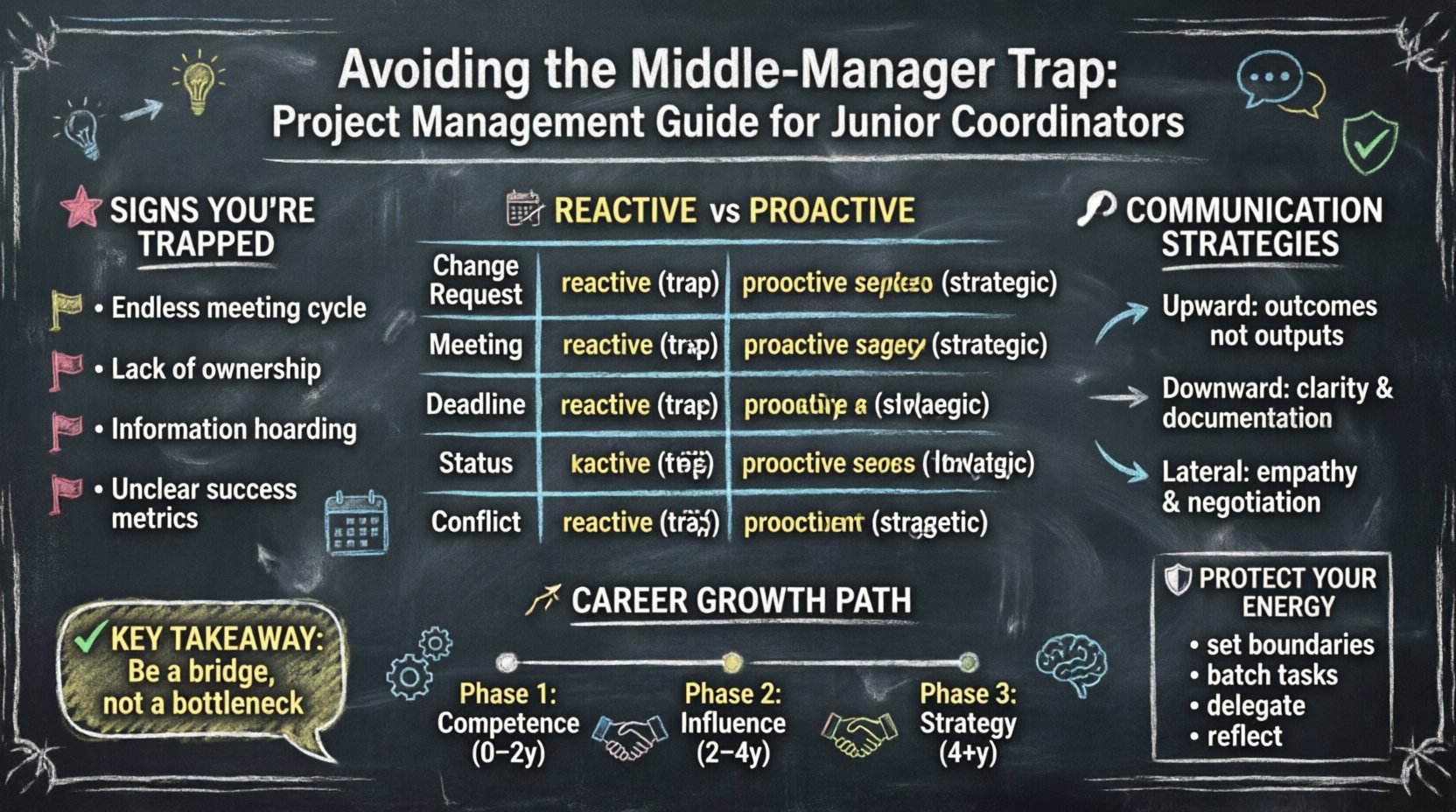
🚩 Signs You Are Stuck in the Trap
Recognizing the symptoms early allows you to pivot before frustration sets in. Below are specific indicators that you may be functioning more as a gatekeeper than a coordinator.
1. The Endless Meeting Cycle
If your calendar is dominated by status updates that could be asynchronous, you are likely wasting time that could be spent on planning. Meetings should drive decisions, not just report status.
2. Lack of Ownership
Do you feel like you are merely recording decisions made by others? If you are not involved in the “why” behind a project, you will struggle to lead the “how”.
3. Information Hoarding
Are you the only person who knows where the latest files are located? This creates a dependency on you that limits your scalability and value.
4. Unclear Success Metrics
If you cannot define what a successful project looks like beyond “on time and on budget,” you are missing the strategic picture. Projects deliver value, not just outputs.
🗣️ Communication Strategies for Impact
Communication is the primary tool in a coordinator’s toolkit. However, not all communication is equal. To avoid the trap, you must shift from broadcasting information to facilitating understanding.
Upward Communication
When reporting to leadership, focus on outcomes, not outputs. Instead of saying, “I sent five emails to the vendor,” say, “The vendor has confirmed the timeline, removing a risk from the schedule.” Leaders care about risk mitigation and progress, not the mechanics of your work.
- Be Concise: Executive summaries should be one paragraph.
- Highlight Risks: Bring problems with proposed solutions.
- Know the Audience: Adjust the technical depth based on who is reading.
Downward Communication
For the team executing the work, clarity is king. Ambiguity leads to rework. Ensure that instructions are actionable and that the “why” is understood to foster ownership.
- Document Decisions: Write down what was agreed upon in meetings.
- Clarify Roles: Ensure everyone knows their specific responsibilities.
- Set Expectations: Define what “done” looks like for every task.
Lateral Communication
Working with peers requires empathy and negotiation. You often need to borrow resources or time from other teams without direct authority. Building rapport is essential here.
- Respect Constraints: Acknowledge that other teams have their own priorities.
- Offer Trade-offs: If you need help now, offer help later.
- Keep it Professional: Avoid blaming other teams for delays.
📊 Reactive vs. Proactive: A Comparison
To visualize the shift from the middle-manager trap to a strategic role, consider the differences in daily behaviors. The following table outlines how proactive coordinators handle common scenarios differently than their reactive counterparts.
| Scenario | Reactive Approach (The Trap) | Proactive Approach (Strategic) |
|---|---|---|
| Change Request | Passes the request to the team immediately. | Evaluates impact on scope, time, and budget before routing. |
| Meeting Request | Schedules the meeting to discuss the issue. | Provides an agenda and background data before scheduling. |
| Missing Deadline | Asks the team member why they are late. | Identifies the blocker and offers resources to resolve it. |
| Status Update | Compiles raw data from everyone. | Analyzes trends and highlights critical path risks. |
| Conflict | Escalates to a manager immediately. | Attempts to mediate and find common ground first. |
🛡️ Managing Scope and Expectations
Scope creep is the silent killer of projects and a major contributor to the middle-manager trap. When scope expands without adjustment, you end up managing an ever-growing list of tasks that dilute your focus.
The Power of “No”
Saying “no” is not about being unhelpful. It is about protecting the project’s integrity. When a new feature or task is requested, follow this process:
- Acknowledge the Value: Validate that the request makes sense.
- Assess the Cost: Determine what must be dropped or delayed to accommodate the new item.
- Present Options: Give stakeholders a choice. “We can add this, but we must delay X.”
Baseline Management
Establish a baseline for scope, schedule, and cost at the beginning. Any deviation from this baseline must be formally recognized. This creates a paper trail that justifies decisions and protects you from blame when changes occur.
📈 Building Influence Without Authority
As a junior coordinator, you likely do not have direct reports. Your influence comes from trust, competence, and reliability. You cannot command people to do things; you must persuade them.
1. Deliver Consistent Reliability
If you say you will send an update by 10 AM, send it by 10 AM. If you say a document is ready, it must be ready. Consistency builds a reputation that precedes you. People trust your word, which allows you to navigate friction more easily.
2. Be a Problem Solver, Not a Problem Reporter
When you bring an issue to a stakeholder, always bring a recommendation. This shows that you have thought through the implications. It shifts your role from a messenger to a consultant.
3. Understand Stakeholder Motivations
Why does the marketing team care about the launch date? Why does engineering care about technical debt? When you understand their personal and professional goals, you can frame your requests in a way that aligns with their interests.
🛠️ Process and Workflow Optimization
Without relying on specific software platforms, you can still optimize how work flows through your team. The goal is to reduce friction and increase transparency.
- Centralize Information: Create a single source of truth for project documents. Avoid scattered emails and chat logs for critical data.
- Standardize Templates: Use consistent formats for status reports, meeting agendas, and project charters. This reduces the cognitive load on your team.
- Implement Check-Ins: Establish regular touchpoints that are predictable. This prevents the need for emergency meetings.
- Review Retrospectives: After major milestones, hold a session to discuss what went well and what did not. Use this data to improve future processes.
🧠 Psychological Safety and Team Dynamics
Project management is a human endeavor. The best processes fail if the team feels unsafe. As a coordinator, you play a crucial role in setting the tone.
Encouraging Open Dialogue
Create an environment where bad news is welcomed early. If a team member hides a delay because they fear reprimand, the project suffers. Make it clear that reporting issues early is a sign of responsibility, not incompetence.
Recognizing Burnout
The middle-manager trap often leads to burnout. Watch for signs of fatigue in yourself and your team. Encourage breaks, respect boundaries, and ensure that workloads are distributed fairly.
🚀 Long-Term Career Trajectory
For a junior coordinator, the goal is not to stay in this role forever. The skills you develop here should pave the way for senior project management, program management, or leadership roles. Here is how to structure your growth.
Phase 1: Competence (0-2 Years)
Focus on mastering the fundamentals. Learn how to plan, track, and report. Become the person others rely on for information accuracy.
Phase 2: Influence (2-4 Years)
Start leading small initiatives. Manage your own scope. Begin to negotiate with stakeholders without needing constant supervision.
Phase 3: Strategy (4+ Years)
Align projects with organizational goals. Understand the business case behind the work. Mentor junior coordinators and shape the methodology of the department.
🔍 Common Pitfalls to Avoid
Even with good intentions, it is easy to stumble. Here are specific pitfalls to watch out for during your journey.
- Over-Documenting: Creating process documents that no one reads is a waste of time. Focus on what is useful.
- Under-Communicating: Assuming everyone knows what you know is a fatal error. Over-communicate context.
- Ignoring Politics: Organizational dynamics exist. Understanding who holds influence helps you navigate roadblocks.
- Working in Silos: Isolate your work too much. Share your learnings with the broader team to build collective intelligence.
🛡️ Protecting Your Mental Energy
Finally, remember that you are a professional, not a machine. The middle-manager trap often demands your mental energy without providing a sense of accomplishment. Protect your mental bandwidth.
- Set Boundaries: Define work hours and stick to them.
- Batch Tasks: Group similar tasks (like emails) to reduce context switching.
- Delegate Administrative Tasks: If possible, push routine data entry to others so you can focus on coordination.
- Reflect Daily: Spend five minutes at the end of the day noting what you achieved. This combats the feeling of busyness without progress.
🏁 Final Thoughts on Career Trajectory
Avoiding the middle-manager trap is an active process. It requires constant vigilance over your own habits and a commitment to adding value beyond administration. By focusing on strategic communication, clear scope management, and building influence, you transform your role from a passive observer to an active driver of project success.
The journey from junior coordinator to seasoned project leader is not about working harder. It is about working smarter. You have the opportunity to shape the way work gets done. Use that opportunity to build a career defined by impact, not just activity. The skills you hone today will serve as the foundation for your future leadership roles.
Related posts:
 How Project Management Actually Works: A Definitive Overview for Intermediate Professionals
 The Hidden Cost of Chaos: Common Mistakes Stalling Your Project Management Career
 Agile vs. Waterfall: A Real-World Comparison for Senior Project Managers Deciding Frameworks
 5-Step Quick Start Guide to Structuring Any Project Management Initiative from Scratch