


At the intermediate level, project management shifts from learning terminology to understanding the mechanics of delivery. You likely know what a Gantt chart is, but do you know when to abandon it? You understand stakeholder registers, but can you navigate conflicting interests without burning bridges? This guide explores the operational reality of project management, moving beyond theory into the practical application of governance, risk, and human dynamics. 🧠
The goal is not to manage tools, but to manage outcomes. Success in this domain relies on structure, adaptability, and clear communication. We will dissect the lifecycle, examine governance frameworks, and analyze the human elements that often dictate project health. Let us build a robust understanding of how work actually gets done. ⚙️
1. The Project Lifecycle: Beyond the Phases 🔄
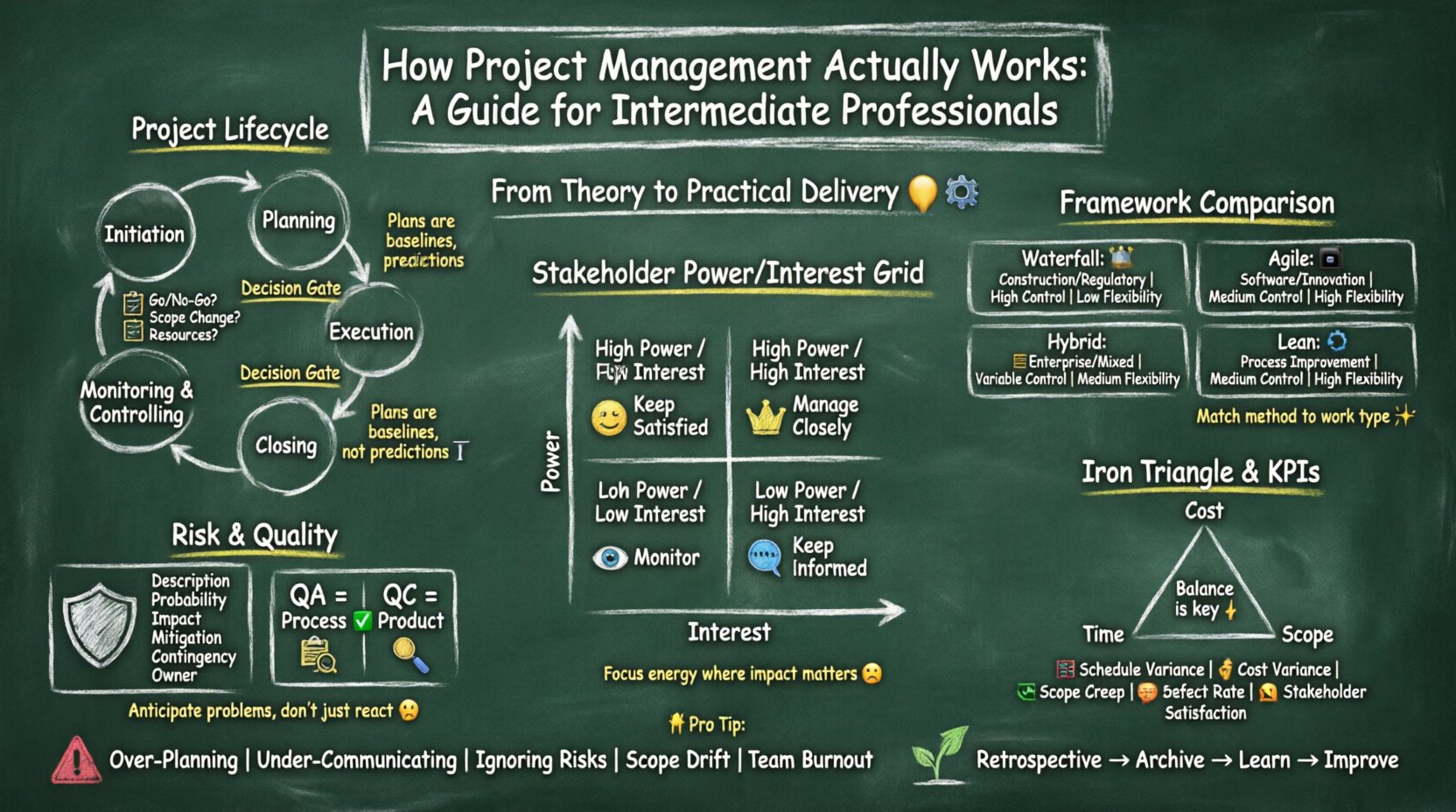
Most frameworks divide the project lifecycle into five distinct phases. For an intermediate professional, the nuance lies not in the names, but in the decision gates between them. These gates determine whether a project moves forward, pivots, or terminates. Skipping the rigor of these gates is the fastest path to failure.
- Initiation: This is about defining value. It is not merely creating a document. It is answering: Does this initiative align with organizational strategy? Who holds the authority to approve resources? What is the high-level scope?
- Planning: This is the blueprint phase. It involves breaking down work, estimating effort, and identifying dependencies. A plan is not a prediction; it is a baseline for measuring variance.
- Execution: This is where the work happens. It requires coordination, team motivation, and quality assurance. The plan meets reality here, and variance is inevitable.
- Monitoring & Controlling: This runs parallel to execution. It involves tracking progress against the baseline. Are we on schedule? Are we within budget? Are quality standards met? If not, corrective action is required.
- Closing: Many projects end abruptly without proper closure. Formal closing ensures all deliverables are accepted, contracts are settled, and resources are released. It also involves capturing lessons learned for future initiatives.
Decision Gates Explained
Intermediate professionals must master the art of the decision gate. These are points where a project review board evaluates the viability of continuing. At these gates, you must present data, not feelings.
- Go/No-Go Decision: Based on current performance, should we continue?
- Scope Change Approval: Has the change request been formally assessed for impact on time and cost?
- Resource Reallocation: Do we have the capacity to proceed, or must we pause other work?
2. Governance and Methodological Frameworks 📊
Choosing a methodology is not a binary choice between rigid and flexible. It is about matching the process to the nature of the work. Different types of projects require different levels of control and adaptability.
Comparing Frameworks
Understanding when to apply specific approaches is critical. Below is a comparison of common frameworks used in professional environments.
| Framework | Best For | Control Level | Flexibility |
|---|---|---|---|
| Waterfall | Construction, Manufacturing, Regulatory Compliance | High | Low |
| Agile | Software Development, Product Innovation, Unclear Requirements | Medium | High |
| Hybrid | Large Enterprises with Mixed Portfolios, Regulatory Tech | Variable | Medium |
| Lean | Process Improvement, Waste Reduction, Efficiency | Medium | High |
Implementing Governance
Governance ensures that the project remains aligned with business objectives. It is the system of rules, practices, and processes by which the project is directed and controlled.
- Roles and Responsibilities: Define who does what. Use a RACI matrix (Responsible, Accountable, Consulted, Informed) to clarify expectations and avoid duplication of effort.
- Reporting Cadence: Establish a regular rhythm for updates. Weekly status reports should focus on variance, risks, and decisions needed, not just a list of tasks completed.
- Change Control: Establish a formal process for scope changes. Every change request must be evaluated for impact before implementation. This prevents scope creep from eroding value.
3. Stakeholder Dynamics and Influence 🤝
Projects are delivered by people, for people. The technical work is only half the battle. The other half is managing expectations and influence. Intermediate professionals often struggle here because they focus on the task rather than the person.
Mapping Stakeholders
Not all stakeholders have equal power or interest. You must categorize them to determine your engagement strategy. A Power/Interest Grid is a standard tool for this analysis.
- High Power, High Interest: Manage these stakeholders closely. They can make or break the project. Regular, detailed communication is required.
- High Power, Low Interest: Keep these stakeholders satisfied. They may not care about daily details, but they can block progress if they feel ignored. Provide high-level summaries.
- Low Power, High Interest: Keep these stakeholders informed. They are often the end-users or subject matter experts who can provide valuable feedback.
- Low Power, Low Interest: Monitor these stakeholders. Minimal effort is required, but ensure they do not become resistant unexpectedly.
Managing Conflict
Conflict is inevitable when resources are scarce and deadlines are tight. Avoid the trap of viewing conflict as purely negative. It can surface hidden issues that need addressing.
- Identify the Root Cause: Is it a resource constraint? A personality clash? A misalignment on goals? Address the cause, not the symptom.
- Facilitate Dialogue: Bring parties together to discuss the issue objectively. Focus on interests, not positions.
- Escalate When Necessary: If a conflict impacts project delivery and cannot be resolved at the team level, escalate it to the sponsor or steering committee with a recommended solution.
4. Risk Management and Quality Assurance 🛡️
Beginners react to problems. Intermediate professionals anticipate them. Risk management is not about eliminating all risk; it is about understanding the probability and impact of potential events and preparing responses.
The Risk Register
A risk register is a living document that tracks identified risks throughout the project lifecycle. It should include:
- Risk Description: What could happen?
- Probability: How likely is it? (Low, Medium, High)
- Impact: What is the consequence if it occurs? (Low, Medium, High)
- Mitigation Strategy: What will we do to reduce the likelihood?
- Contingency Plan: What will we do if the risk occurs?
- Owner: Who is responsible for monitoring this risk?
Quality Assurance vs. Quality Control
These terms are often confused, but they serve different functions. Quality Assurance (QA) is process-oriented. It ensures the processes used to create deliverables are effective. Quality Control (QC) is product-oriented. It involves inspecting the deliverable to ensure it meets requirements.
- QA Activities: Process audits, training, defining standards, creating templates.
- QC Activities: Testing, reviews, inspections, defect tracking.
Neglecting QA leads to inconsistent outputs. Neglecting QC leads to defective deliverables. Both are required for a professional outcome.
5. Resource and Budget Realities 💰
Projects rarely have infinite resources. Intermediate professionals must learn to optimize what is available. This involves balancing cost, time, and scope—the iron triangle. Adjusting one side inevitably affects the others.
Resource Allocation Strategies
Allocating people to tasks requires more than just checking availability. It requires understanding skills, capacity, and morale.
- Capacity Planning: Ensure team members are not overallocated. 100% utilization is a myth; it leads to burnout and reduced quality.
- Skills Matrix: Map the required skills against available talent. Identify gaps early and plan for training or hiring.
- Cross-Training: Encourage team members to learn multiple roles. This reduces the risk of a single point of failure.
Budget Management
Tracking expenses is simple. Forecasting future spend is harder. Use earned value management concepts to understand where you stand.
- Budget at Completion (BAC): The total planned budget for the project.
- Actual Cost (AC): The cost incurred so far.
- Planned Value (PV): The budgeted cost of work scheduled.
- Earned Value (EV): The budgeted cost of work actually performed.
By comparing these values, you can determine if you are over or under budget and behind or ahead of schedule. This data drives informed decision-making.
6. Communication Protocols and Metrics 📢
Communication is the glue that holds a project together. Poor communication is cited as a leading cause of project failure. Establishing clear protocols prevents information silos and confusion.
Communication Channels
Not every message requires a meeting. Choose the right channel for the right message.
- Formal Reports: Use for status updates, financial data, and milestone achievements. These are documented and archived.
- Meetings: Use for decision-making, problem-solving, and brainstorming. Keep them focused with an agenda.
- Informal Updates: Use for quick clarifications, team morale, and minor adjustments. Chat tools or quick emails work well here.
- Visual Dashboards: Use for real-time progress tracking. Visuals allow stakeholders to grasp status quickly.
Key Performance Indicators (KPIs)
Track metrics that matter to the business, not just the team.
- Schedule Variance: Are we on time?
- Cost Variance: Are we on budget?
- Scope Creep: Is the scope expanding without approval?
- Defect Rate: How many issues are found during testing?
- Stakeholder Satisfaction: Are the key users happy with the progress and outcome?
7. Common Failure Points for Intermediate PMs ⚠️
Even with a strong foundation, pitfalls exist. Recognizing these early can save a project. The following are common areas where intermediate professionals stumble.
- Over-Planning: Spending too much time planning and not enough time executing. Plans should be detailed enough to guide action, not so rigid that they cannot adapt.
- Under-Communicating: Assuming the team knows what is happening. Silence is often interpreted as agreement or lack of concern.
- Ignoring Risks: Hoping that problems won’t happen. This is a gamble that rarely pays off.
- Scope Drift: Allowing small changes to accumulate until the original vision is lost. Enforce change control strictly.
- Team Burnout: Pushing the team too hard to meet unrealistic deadlines. Sustainable pace is better than sprint speed.
8. Post-Project Analysis and Continuous Improvement 📈
The project is not done when the product is delivered. The project is done when the value is realized and the team is ready for the next challenge. The closing phase is critical for organizational learning.
Conducting a Retrospective
A retrospective is a meeting held at the end of a project or phase to discuss what went well, what went wrong, and how to improve.
- What Went Well: Celebrate wins. This boosts morale and reinforces good practices.
- What Went Wrong: Identify root causes without assigning blame. Focus on process, not people.
- Action Items: Create a list of improvements to implement in the next project. Assign owners and deadlines to these items.
Archiving Knowledge
Documentation should not disappear with the project. Store all key artifacts, including plans, risk registers, and meeting minutes, in a central repository. This ensures that future teams can learn from past experiences.
Final Thoughts on Professional Growth 🌱
Becoming an expert project manager is a continuous journey. It requires a balance of technical skill and emotional intelligence. You must be comfortable with ambiguity and capable of leading through influence rather than authority alone. The frameworks and processes discussed here provide a structure, but the application depends on your judgment.
Focus on delivering value. Focus on supporting your team. Focus on maintaining transparency with stakeholders. These principles will serve you well regardless of the specific methodology or industry you operate in. Keep refining your approach, learn from every project, and maintain a commitment to excellence. That is the true essence of the profession.
Related posts:
 The Hidden Cost of Chaos: Common Mistakes Stalling Your Project Management Career
 Agile vs. Waterfall: A Real-World Comparison for Senior Project Managers Deciding Frameworks
 5-Step Quick Start Guide to Structuring Any Project Management Initiative from Scratch
 Deep Dive into Project Management Components: What Every Intermediate Leader Must Know