


Enterprise architecture (EA) frameworks provide structured approaches to planning, designing, and managing complex IT landscapes. For mid-sized organizations, the decision to adopt a formal framework like the TOGAF Standard involves weighing significant benefits against potential overhead. This guide examines the TOGAF framework in detail, contrasting it with alternative methodologies to determine suitability for businesses with moderate scale and resource constraints. 📊
🔍 Understanding the TOGAF Standard
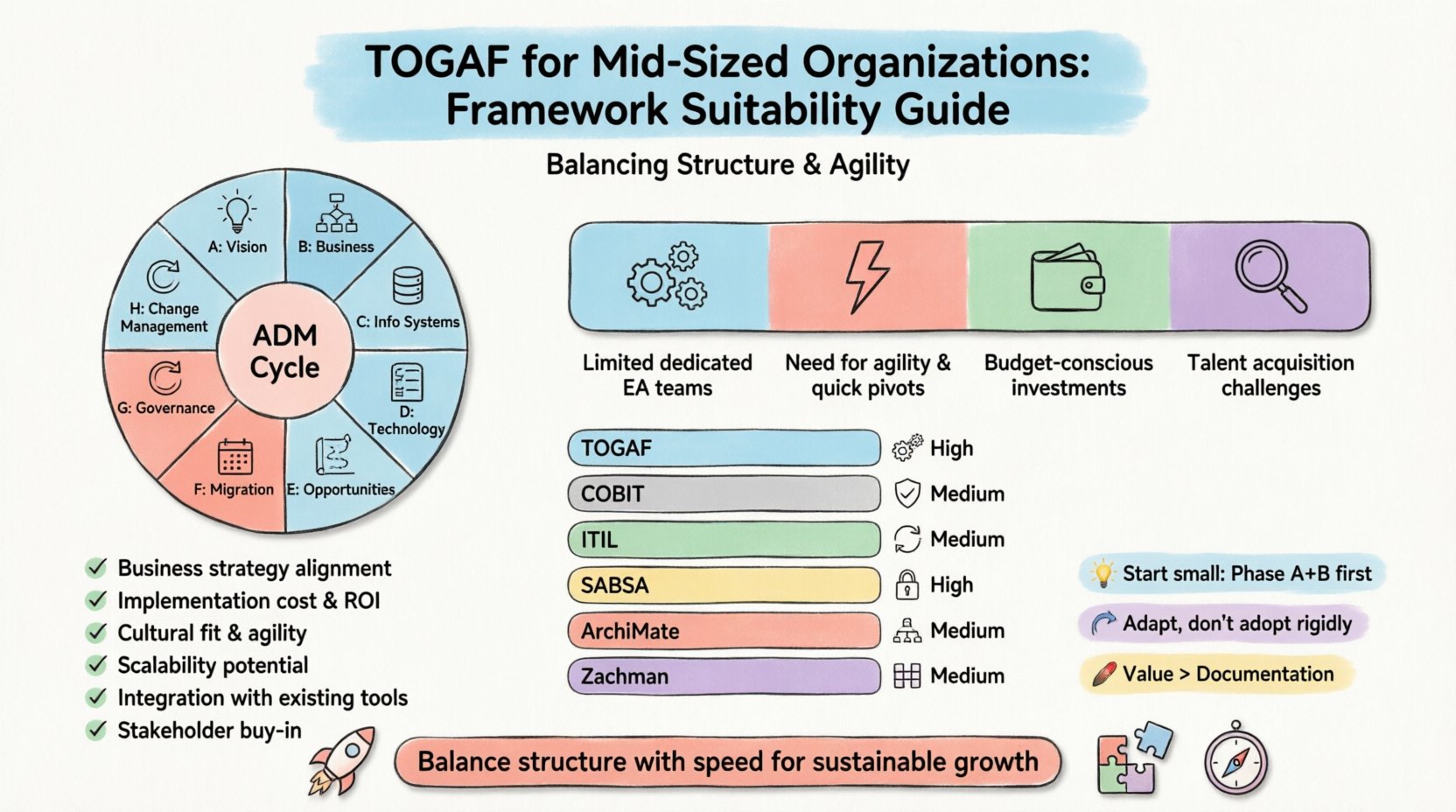
The The Open Group Architecture Framework (TOGAF) remains one of the most widely recognized standards in the industry. It offers a comprehensive model for developing an enterprise architecture that aligns business strategy with IT capabilities. The core of TOGAF lies in the Architecture Development Method (ADM), a cyclical process that guides architects through various phases.
- Phase A: Architecture Vision defines the scope and identifies stakeholders.
- Phase B: Business Architecture models the business strategy and governance.
- Phase C: Information Systems Architectures covers data and application layers.
- Phase D: Technology Architecture defines the infrastructure and technology platforms.
- Phase E: Opportunities and Solutions identifies major transition plans.
- Phase F: Migration Planning creates a detailed roadmap.
- Phase G: Implementation Governance ensures the solution matches the design.
- Phase H: Architecture Change Management maintains the architecture over time.
Beyond the ADM cycle, TOGAF includes a Content Metamodel, which standardizes how architectural artifacts are named and stored. It also provides a reference model for common architecture artifacts, ensuring consistency across the organization. This structure is designed to handle complexity, making it robust for large enterprises. However, the depth of documentation and rigor required can present challenges for smaller teams. 🛠️
📉 The Mid-Sized Organization Context
Mid-sized organizations occupy a unique space between small startups and large conglomerates. They typically possess established processes but lack the vast resources of Fortune 500 companies. Several factors influence their ability to adopt heavy frameworks:
- Resource Availability: Dedicated architecture teams are rare. Often, a single individual or a small group manages architecture alongside other responsibilities.
- Agility Needs: Mid-sized firms must pivot quickly to market changes. Heavy governance can slow down decision-making.
- Budget Constraints: Investment in training, certification, and tooling must demonstrate clear ROI.
- Talent Pool: Finding certified TOGAF practitioners can be difficult and expensive compared to other roles.
When evaluating TOGAF, it is crucial to recognize that the standard is not monolithic. It allows for adaptation. However, the default expectation of documentation and process rigor often exceeds what a mid-sized entity can sustain without significant adjustment. ⚖️
🆚 Framework Comparison Matrix
To determine suitability, we must compare TOGAF against other common architectural and governance frameworks. The following table outlines key differentiators regarding complexity, focus, and resource requirements.
| Framework | Primary Focus | Complexity | Best For |
|---|---|---|---|
| TOGAF | Enterprise Architecture & ADM Process | High | Large Enterprises needing standardization |
| COBIT | IT Governance & Risk Management | Medium | Organizations prioritizing control and compliance |
| ITIL | IT Service Management | Medium | Service delivery and support operations |
| SABSA | Security Architecture | High | Security-focused organizations |
| ArchiMate | Visualization & Modeling Language | Medium | Visualizing complex architectures (often paired with TOGAF) |
| Zachman | Enterprise Architecture Schema | Medium | Comprehensive taxonomy of business assets |
As shown, TOGAF is distinct in its process-driven nature (ADM). Others like COBIT focus on governance controls, while ITIL focuses on service lifecycle. For a mid-sized organization, the choice often depends on whether the primary need is process definition (TOGAF), control (COBIT), or service optimization (ITIL). 📊
🧩 Alternative Approaches and Frameworks
While TOGAF is a market leader, it is not the only path. Mid-sized organizations often benefit from lighter or more specialized frameworks that address specific pain points without requiring full-scale adoption.
COBIT for Governance
Control Objectives for Information and Related Technologies (COBIT) provides a framework for the governance and management of enterprise IT. It is particularly useful if the primary driver for architecture is regulatory compliance or audit readiness. COBIT aligns well with TOGAF but focuses more on the “what” and “why” of governance rather than the “how” of development. For mid-sized firms where risk management is paramount, COBIT can be a more direct fit than the full TOGAF suite. 🛡️
ITIL for Service Delivery
The Information Technology Infrastructure Library (ITIL) concentrates on the lifecycle of IT services. If an organization’s architecture struggles with service continuity, incident management, or customer satisfaction, ITIL offers practical processes. It is less concerned with the strategic design of the enterprise and more focused on operational excellence. Combining ITIL practices with architectural oversight can bridge the gap between design and delivery. 🔄
Agile Architecture
Agile architecture is not a formal framework but a mindset and set of practices. It emphasizes iterative development, collaboration, and responsiveness to change. Instead of extensive upfront design, agile architecture promotes just-enough documentation and continuous refactoring. For mid-sized organizations operating in fast-paced markets, this approach often yields better results than rigid, waterfall-style planning. It reduces the time-to-value for architectural initiatives. 🚀
SABSA for Security
SABSA (Sherwood Applied Business Security Architecture) is a layered security architecture framework. It is designed to ensure that security is embedded throughout the enterprise, not added as an afterthought. While TOGAF covers security as a cross-cutting concern, SABSA dives deep into risk management and security controls. If security is the primary business driver, SABSA may offer more granular guidance than TOGAF alone. 🔒
🎯 Key Evaluation Criteria for Suitability
Selecting the right framework requires a structured evaluation. Do not rely on market popularity alone. Use the following criteria to assess fit for your specific organizational context.
- Alignment with Business Strategy: Does the framework help translate business goals into technical requirements? TOGAF excels here, but lighter frameworks may suffice if strategy is simple.
- Implementation Cost: Consider training, certification, and tooling costs. TOGAF certification is a significant investment. Can the budget support multiple certified staff members?
- Cultural Fit: Does the organization value documentation and process over speed? A culture of rapid iteration may clash with TOGAF’s rigorous phases.
- Scalability: Will the framework grow with the company? TOGAF is highly scalable, but its initial setup cost is high. Smaller frameworks may hit limits as complexity grows.
- Integration Capabilities: Can the framework integrate with existing processes? For example, does it work well with Agile teams or DevOps pipelines?
- Stakeholder Buy-in: Will leadership and IT staff support the framework? Resistance often stems from perceived bureaucracy.
Mid-sized organizations should prioritize frameworks that offer flexibility. Rigid adherence to a standard without adaptation often leads to “architecture bureaucracy,” where the process becomes an end in itself rather than a tool for value creation. 💡
🛠️ Implementation Considerations
If an organization decides to proceed with TOGAF or a hybrid approach, careful planning is essential. Success depends on tailoring the framework to the environment rather than forcing the environment to fit the framework.
Phased Adoption
A full-scale TOGAF implementation is rarely necessary. Start with the Architecture Vision (Phase A) and Business Architecture (Phase B). These phases provide high-level clarity without immediate technical overhead. As maturity grows, introduce Information Systems and Technology Architectures. This gradual approach allows the team to learn the methodology without being overwhelmed. 📈
Tooling and Automation
While specific software products are not the focus, the use of architectural repositories is critical. Mid-sized teams need a single source of truth for models and documents. Manual documentation spreadsheets often fail to keep pace with changes. Automation tools that support model management help maintain accuracy and reduce administrative burden. ⚙️
Roles and Responsibilities
Clearly define who owns the architecture. In mid-sized firms, this role might sit within a Chief Information Officer (CIO) or a dedicated Enterprise Architect. Ensure that architects have the authority to influence decisions without becoming bottlenecks. Governance boards can help balance speed with control. 👥
Training and Certification
Invest in training, but prioritize practical application over certification exams. Understanding the concepts of the ADM cycle is more valuable than holding a certificate if the certificate does not lead to better outcomes. Mentorship programs can help disseminate knowledge across the team. 🎓
🚧 Common Pitfalls to Avoid
Many initiatives fail not because of the framework itself, but due to misapplication. Recognizing these risks early can save time and resources.
- Over-Engineering: Creating detailed models for every potential future scenario. Focus on the architecture needed for the next 12 to 18 months. Future-proofing often leads to unnecessary complexity.
- Ignoring the Business: Architecture that is purely technical fails to deliver value. Regular engagement with business stakeholders ensures alignment.
- Lack of Executive Sponsorship: Without leadership support, architectural standards are easily bypassed. Ensure the C-suite understands the long-term value.
- Documentation Fatigue: Excessive documentation can stall projects. Aim for sufficient documentation to ensure clarity and compliance, not perfection.
- One-Size-Fits-All: Treating the framework as a rigid set of rules. Adaptation is key. Mid-sized organizations should feel empowered to modify the framework to suit their needs.
Avoid the trap of viewing the framework as a product to be installed. It is a capability to be built. This requires patience and consistent effort over time. 🧱
📈 Strategic Alignment and Long-Term Value
The ultimate goal of any architectural framework is to enable the organization to achieve its strategic objectives. Whether using TOGAF or an alternative, the measure of success is business performance.
- Reduced Redundancy: Eliminate duplicate systems and processes. This lowers costs and simplifies maintenance.
- Improved Agility: A well-structured architecture allows for faster integration of new technologies and business capabilities.
- Risk Mitigation: Clear visibility into the IT landscape helps identify vulnerabilities and compliance gaps before they become issues.
- Cost Optimization: Better resource allocation and vendor management result from a unified view of the enterprise.
For mid-sized organizations, the balance between structure and speed is critical. A framework that imposes too much friction will hinder growth, while one that is too loose will lead to chaos. The TOGAF framework offers a proven path, but it requires disciplined tailoring to fit the mid-sized context. Alternatives like COBIT or Agile Architecture may offer a better starting point depending on the specific maturity and goals of the organization. 🎯
🔮 Future Considerations
The landscape of enterprise architecture continues to evolve. The integration of artificial intelligence, cloud computing, and microservices challenges traditional architectural models. Frameworks must remain adaptable to these shifts.
- Cloud-Native Design: Frameworks need to support cloud-first strategies. TOGAF has updated its guidance to address cloud, but organizations must ensure their implementation reflects modern infrastructure.
- Data Governance: As data becomes a core asset, architecture frameworks must integrate closely with data governance policies. This ensures data quality and security across the enterprise.
- Continuous Architecture: The concept of architecture as a continuous activity rather than a periodic event is gaining traction. This aligns well with DevOps practices and requires a shift in mindset.
Maintaining relevance requires staying informed about industry trends. Regular reviews of the chosen framework ensure it continues to meet organizational needs. Adaptation is not a sign of weakness; it is a sign of maturity. 🌐
💡 Summary of Strategic Fit
Evaluating the TOGAF framework for a mid-sized organization requires a clear understanding of internal capabilities and external pressures. While TOGAF provides a robust foundation, its complexity may not be justified for every scenario. Organizations should weigh the benefits of standardization against the costs of implementation.
Key takeaways include:
- TOGAF is comprehensive but resource-intensive.
- Mid-sized firms often benefit from hybrid or lighter frameworks.
- Alignment with business strategy is the primary success metric.
- Flexibility and adaptation are more important than strict adherence.
- Training and culture change are critical for long-term success.
By carefully assessing these factors, organizations can select an architectural approach that drives value without imposing unnecessary burden. The goal is not to follow a standard, but to build a capability that supports the business. With the right balance of structure and agility, mid-sized organizations can navigate complexity and achieve sustainable growth. 🚀