


Enterprise architecture is not a static artifact; it is a living, breathing framework that must evolve alongside the business landscape. As organizations navigate digital transformation, regulatory shifts, and technological advancements, the need to modify the established architecture becomes inevitable. Within the The Open Group Architecture Framework (TOGAF), managing these modifications requires a disciplined approach. This guide details the systematic handling of Architecture Change Requests (ACRs), ensuring stability while allowing necessary evolution.
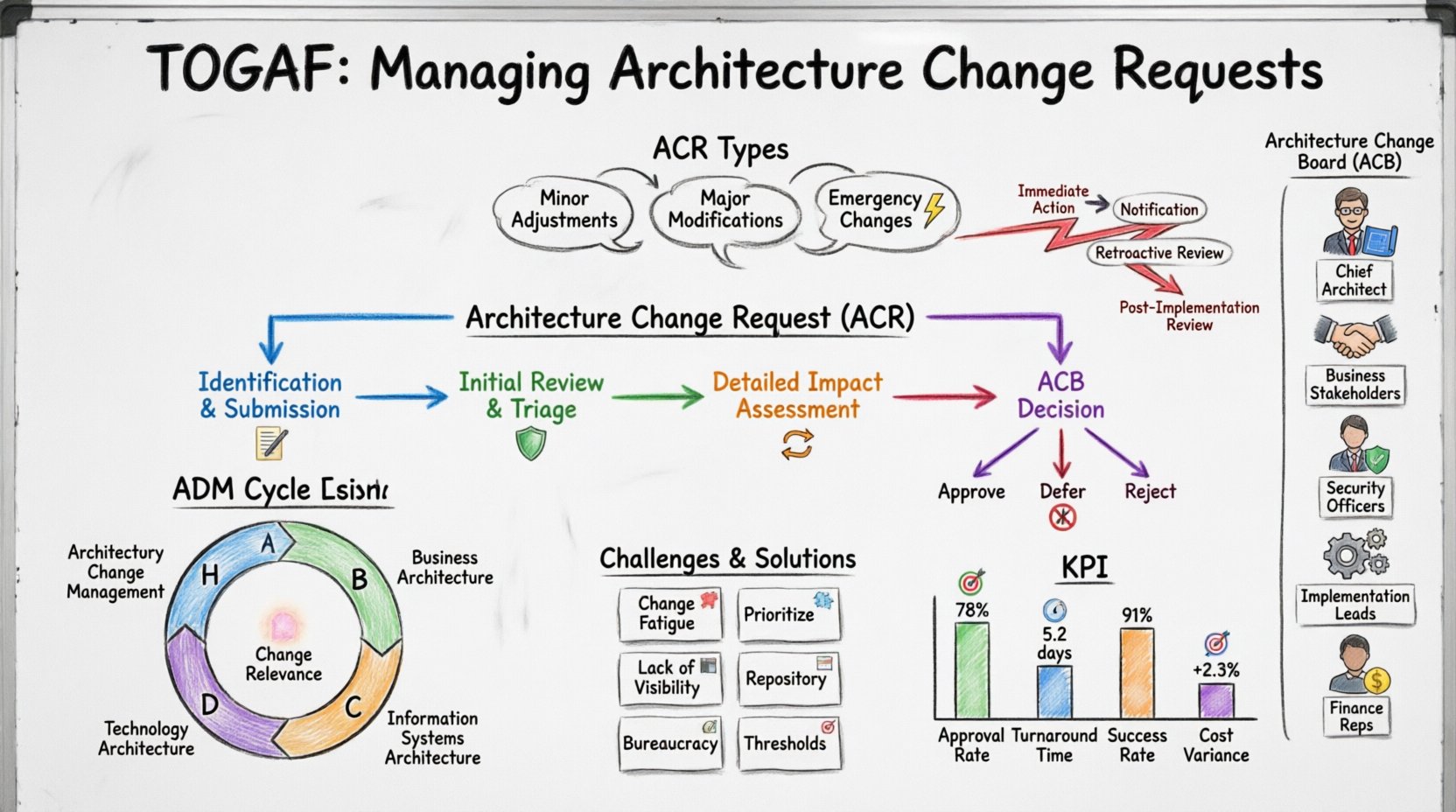
Understanding the Architecture Change Request (ACR) 📝
An Architecture Change Request is a formal proposal to modify an existing architecture baseline or a component within the Architecture Repository. It is not merely a suggestion; it is a documented artifact that triggers a review process. The ACR serves as the entry point for change management within the Architecture Development Method (ADM) cycle.
Why is this critical? Without a structured mechanism, changes can lead to fragmentation, technical debt, and misalignment with business goals. A well-managed ACR ensures that every modification is vetted against current standards, security requirements, and strategic objectives.
Types of Changes
- Minor Adjustments: Updates to documentation or non-critical components that do not affect the overall architecture baseline.
- Major Modifications: Significant shifts in the technology stack, data model, or business process that require re-evaluation of the entire architecture.
- Emergency Changes: Urgent fixes required due to security vulnerabilities or system failures, often following a streamlined approval path.
The Role of the Architecture Change Board (ACB) 🛡️
The Architecture Change Board is the governing body responsible for reviewing, approving, and rejecting Architecture Change Requests. This group ensures that changes align with the enterprise strategy and do not introduce unacceptable risks.
Composition of the ACB
Effective governance requires diverse representation. The board typically includes:
- Chief Architect: Provides technical oversight and strategic alignment.
- Business Stakeholders: Ensure business value is maintained or improved.
- Security Officers: Validate compliance with security policies.
- Implementation Leads: Assess feasibility and resource requirements.
- Finance Representatives: Evaluate cost implications and ROI.
The Architecture Change Management Process 🔄
Managing change within TOGAF is not a linear path but a cyclical process integrated into the ADM lifecycle. The process begins when a need for change is identified and ends when the change is implemented and verified.
Step 1: Identification and Submission
The process initiates when a stakeholder identifies a gap between the current state and the desired state. This could be driven by a new market opportunity, a compliance requirement, or a technological obsolescence. The requester must document the following:
- Reason for Change: Why is this modification necessary?
- Impact Analysis: What areas of the architecture will be affected?
- Proposed Solution: What is the suggested architectural adjustment?
- Timeline: When is the change required?
Step 2: Initial Review and Triage
Before the full ACB meets, an initial review determines the scope and urgency of the request. This step filters out duplicate requests or those that can be resolved through standard operational procedures without architectural intervention.
Step 3: Detailed Impact Assessment
For requests that pass triage, a deep-dive analysis is conducted. This involves examining dependencies across the business, data, application, and technology layers. The goal is to understand the ripple effects of the proposed change.
Step 4: ACB Review and Decision
The full board convenes to review the assessment. Decisions are typically categorized as:
- Approved: The change is authorized to proceed.
- Approved with Conditions: The change is allowed if specific constraints are met.
- Deferred: The request is postponed due to resource constraints or strategic timing.
- Rejected: The change does not align with goals or poses excessive risk.
Integration with the ADM Cycle ⏱️
Changes do not occur in a vacuum; they intersect with specific phases of the Architecture Development Method. Understanding where changes fit helps in planning the effort.
| ADM Phase | Change Relevance |
|---|---|
| Phase A: Architecture Vision | Strategic changes affecting the overall scope. |
| Phase B: Business Architecture | Changes to business processes or organizational structure. |
| Phase C: Information Systems | Updates to data or application architectures. |
| Phase D: Technology Architecture | Modifications to infrastructure or platform standards. |
| Phase H: Architecture Change Management | Ongoing monitoring and implementation of approved changes. |
Documentation and Governance 📂
Transparency is the cornerstone of effective governance. Every step of the ACR process must be recorded. This creates an audit trail and ensures knowledge retention even if personnel change.
Key Artifacts
- Architecture Change Request Form: The primary document capturing the request details.
- Impact Assessment Report: Analysis of risks and benefits.
- ACB Meeting Minutes: Record of decisions and rationale.
- Architecture Contract: Agreement between the architecture team and implementation teams regarding the change.
Handling Emergency Changes ⚡
Not all changes follow the standard timeline. Security patches or critical system failures require immediate action. TOGAF accommodates this through an Emergency Change process.
Criteria for Emergency Status
- Imminent threat to data integrity or security.
- System outage affecting critical business operations.
- Regulatory violation requiring immediate remediation.
The Emergency Workflow
- Immediate Action: The responsible team implements the fix to restore stability.
- Notification: The ACB is notified immediately after the action.
- Retroactive Review: A formal ACR is filed to document the change after the fact.
- Post-Implementation Review: Analyze why the emergency occurred and how to prevent recurrence.
Common Challenges and Solutions 🧩
Implementing a robust change management process is not without hurdles. Recognizing these common pitfalls allows architects to mitigate risks.
Challenge 1: Change Fatigue
When too many changes are requested simultaneously, stakeholders may ignore the process.
- Solution: Prioritize changes based on business value and risk. Batch minor updates together.
Challenge 2: Lack of Visibility
Teams may propose changes without understanding the broader architectural context.
- Solution: Maintain an accessible Architecture Repository that is regularly updated and searchable.
Challenge 3: Bureaucracy
Excessive red tape can slow down delivery and frustrate developers.
- Solution: Define clear thresholds for when a full ACB review is required versus a lightweight approval.
Metrics for Success 📊
To ensure the change management process is effective, organizations must measure performance. Data-driven insights help refine the workflow over time.
Key Performance Indicators (KPIs)
- Approval Rate: Percentage of requests approved versus rejected.
- Turnaround Time: Average time from submission to decision.
- Implementation Success Rate: Percentage of approved changes implemented without critical errors.
- Cost Variance: Deviation between estimated and actual costs of architectural changes.
Continuous Improvement and Feedback 🔄
The architecture function must evolve. Regular feedback loops from the ACB and implementation teams help identify bottlenecks.
- Quarterly Reviews: Assess the volume and nature of incoming requests.
- Process Audits: Ensure compliance with the defined change management policy.
- Training: Keep the architecture team updated on new tools and methodologies.
Aligning with Business Strategy 🎯
The ultimate goal of managing architecture changes is to support business agility. The architecture must enable the business to adapt, not hinder it.
Strategic Alignment Checks
- Does the change support the current business roadmap?
- Does it improve customer experience or operational efficiency?
- Is the investment justified by the expected outcome?
Case Scenario: Cloud Migration 🌥️
Consider an organization deciding to migrate its on-premise data center to a cloud environment. This is a major architectural change.
- Request Initiation: The IT Director submits an ACR outlining the benefits of cloud migration.
- Assessment: The Architecture Team analyzes security implications, cost models, and data sovereignty requirements.
- ACB Decision: The board approves the migration but mandates a hybrid approach for sensitive data.
- Implementation: Development teams proceed with the migration under the guidance of the Architecture Contract.
- Monitoring: Post-migration reviews ensure the new architecture meets performance baselines.
Best Practices for Architects 🏛️
To excel in this discipline, architects should adopt specific habits.
- Proactive Communication: Engage stakeholders early in the process.
- Standardization: Use templates for ACRs to ensure consistency.
- Automation: Leverage tools to track request status and automate notifications.
- Collaboration: Work closely with security and compliance teams.
Conclusion on Governance 🏁
Managing Architecture Change Requests is a fundamental responsibility of the TOGAF framework. It bridges the gap between strategic vision and operational reality. By adhering to a structured process, organizations can maintain architectural integrity while embracing innovation. The key lies in balance—allowing flexibility for growth while enforcing the discipline needed for stability.
As you implement these practices, remember that the goal is not to control change, but to guide it. Effective governance turns potential chaos into a structured evolution of the enterprise. This ensures that your architecture remains a competitive asset rather than a liability.
Start by reviewing your current change management policies. Identify gaps in your process and prioritize improvements. With a robust framework in place, your organization will be better positioned to navigate the complexities of the modern digital landscape.