


In the complex landscape of Enterprise Architecture, few challenges are as persistent as the disconnect between business intent and technical execution. When an organization invests in The Open Group Architecture Framework (TOGAF), the expectation is a structured pathway to strategic clarity. However, real-world implementation often reveals friction. Projects stall, budgets inflate, and deliverables fail to meet stakeholder needs. This article provides a technical guide to troubleshooting these misalignments using the Architecture Development Method (ADM). We focus on practical diagnostics, structural corrections, and governance adjustments to restore harmony between business goals and IT capabilities.
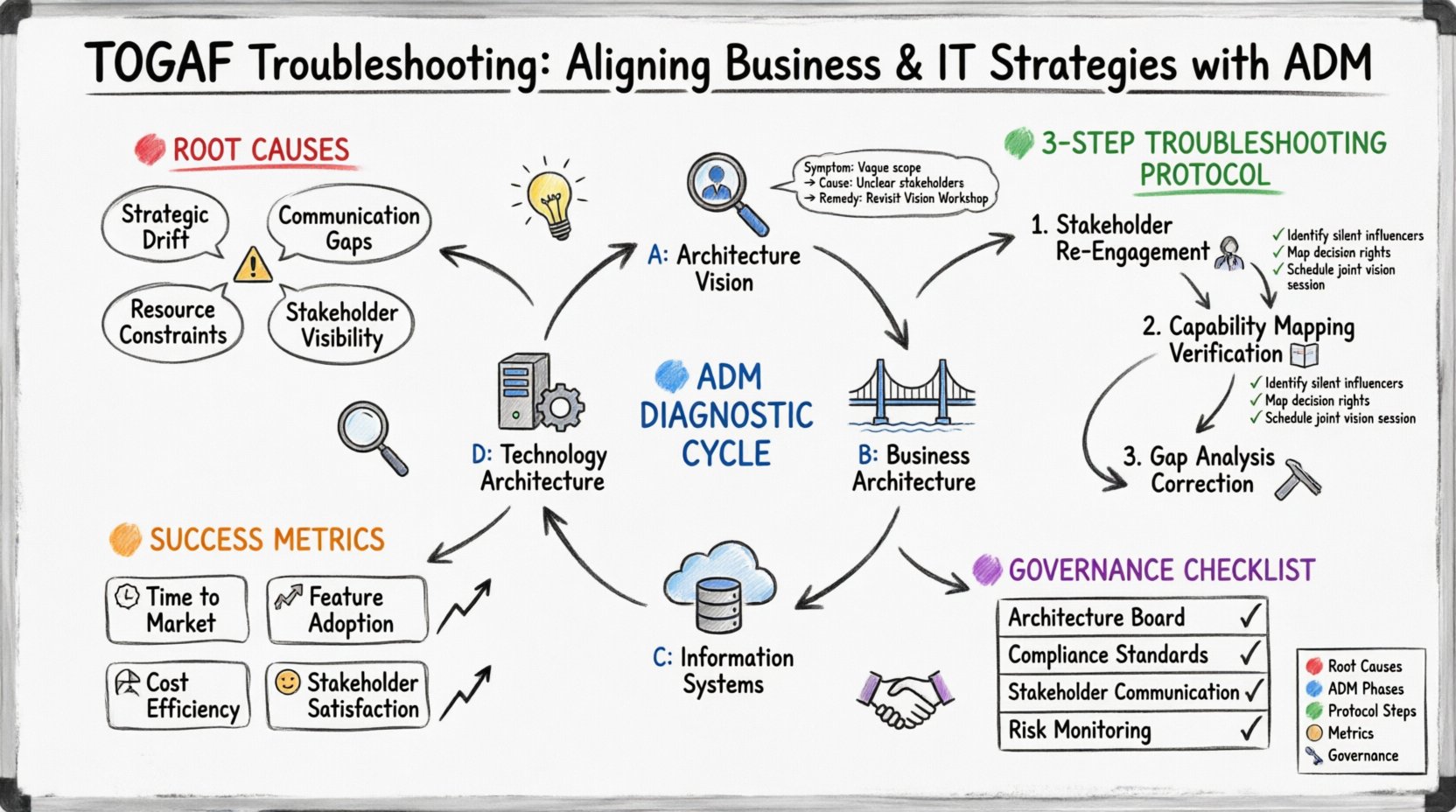
🧐 Understanding the Root Causes of Misalignment
Misalignment is rarely a single-point failure. It is usually the accumulation of small deviations across the architecture lifecycle. To troubleshoot effectively, we must first identify where the signal is lost. In many enterprises, business leaders define value in terms of market share or customer experience, while IT teams measure success through system uptime, code quality, or infrastructure stability. Without a unified vocabulary and shared objectives, these two groups operate in parallel tracks that rarely intersect.
- Strategic Drift: Business strategies evolve quarterly, but IT roadmaps often lock in annually. This lag creates a gap where the target moves before the vehicle arrives.
- Communication Gaps: Technical jargon obscures business value. Architects may describe “microservices” without explaining how this reduces time-to-market for a specific product line.
- Resource Constraints: Limited budgets force trade-offs that prioritize short-term fixes over long-term architectural integrity.
- Stakeholder Visibility: Key decision-makers are often excluded from the early phases of architecture definition, leading to surprises during the implementation phase.
Resolving these issues requires a systematic review of the Architecture Development Method. By treating the ADM not just as a design process but as a diagnostic tool, architects can pinpoint exactly where the strategy diverges from execution.
🔍 The ADM Framework as a Diagnostic Tool
The ADM is a cyclical process designed to guide the creation and implementation of enterprise architecture. When misalignment occurs, it typically manifests in specific phases. Below is a detailed breakdown of where issues commonly arise and what the symptoms look like.
🧭 Phase A: Architecture Vision
This phase sets the scope and defines the stakeholders. If alignment fails here, the entire project is built on shaky ground. Common issues include vague mission statements or a lack of clear business drivers.
- Symptom: Projects start without a signed-off Statement of Architecture Work.
- Root Cause: Stakeholders were not fully identified, or their requirements were assumed rather than elicited.
- Remedy: Conduct a formal stakeholder analysis workshop. Document the specific business value proposition for every project initiated.
🏢 Phase B: Business Architecture
This is the bridge between strategy and execution. It defines the business strategy, governance, organization, and key business processes. Misalignment here means IT is building solutions that do not support the actual business model.
- Symptom: Applications are duplicated because business processes were not mapped correctly.
- Root Cause: Failure to map business capabilities to current applications.
- Remedy: Perform a capability mapping exercise. Ensure every business capability has a corresponding supporting application or service identified.
🗃️ Phase C: Information Systems Architectures
Here, data and application architectures are defined. Misalignment often occurs when data silos prevent business users from accessing the information they need to make decisions.
- Symptom: Reports show conflicting data from different departments.
- Root Cause: Lack of a unified data model or insufficient data governance policies.
- Remedy: Establish a central data governance council. Define master data management standards that align with business data definitions.
💻 Phase D: Technology Architecture
This phase defines the hardware, software, and network capabilities. If the technology stack is too rigid or too expensive, it stifles business agility.
- Symptom: IT infrastructure cannot support new business initiatives without months of procurement.
- Root Cause: Technology selection was driven by cost rather than strategic fit.
- Remedy: Review technology selection criteria. Ensure standards support the required business agility and scalability.
📋 Step-by-Step Troubleshooting Protocol
When the architecture is not delivering value, follow this structured protocol to diagnose and correct the trajectory. This approach prioritizes communication and evidence over assumptions.
1. Stakeholder Re-Engagement 👥
The first step is to return to the source. Do not rely on secondary documentation. Go back to the business leaders and ask direct questions about their current priorities.
- Identify the Gap: Ask stakeholders to describe the difference between what they expected and what they received.
- Verify the Vision: Revisit the Architecture Vision document. Is it still accurate? Has the market context changed?
- Document Feedback: Record all feedback in a structured format. Look for patterns in the complaints.
2. Capability Mapping Verification 🗺️
Business capabilities are the building blocks of strategy. If the architecture does not map to these blocks, the strategy is disconnected.
- Map Capabilities: Create a matrix of Business Capabilities vs. Current Applications.
- Identify Gaps: Highlight capabilities that have no supporting application.
- Identify Redundancies: Highlight capabilities supported by multiple applications that should be consolidated.
3. Gap Analysis Correction 🔨
Gap analysis compares the Baseline Architecture to the Target Architecture. In troubleshooting, we must also compare the Baseline to the Realized Architecture.
- Review Deliverables: Check if the implemented solution matches the design specifications.
- Assess Impact: Determine how the deviation affects business outcomes.
- Adjust the Roadmap: If the target is no longer viable, update the roadmap to reflect current realities.
⚖️ Governance and Compliance Checks
Without governance, architecture drifts. The Architecture Board plays a critical role in maintaining alignment. It ensures that all projects adhere to the defined standards and strategy.
| Component | Role in Alignment | Common Failure Point |
|---|---|---|
| Architecture Board | Reviews and approves architecture work | Meetings are skipped or attendance is low |
| Compliance | Ensures adherence to standards | Standards are too complex to follow |
| Compliance Officer | Monitors adherence | Reporting is manual and infrequent |
| Stakeholder Management | Ensures communication flows | Stakeholders are not informed of changes |
To fix governance issues, simplify the approval process. Ensure that the Architecture Board meets regularly and that decisions are documented. Make compliance checking an automated part of the delivery pipeline where possible.
📊 Measuring Realignment Success
How do you know the troubleshooting worked? You need metrics that reflect business value, not just technical health. Traditional IT metrics like “uptime” or “defect density” are insufficient. You need metrics that link IT output to business outcomes.
- Time to Market: Measure the time from idea to production. Does the architecture enable faster delivery?
- Feature Adoption: Are the features built actually being used by the business?
- Cost Efficiency: Is the cost of running applications proportional to the value they generate?
- Stakeholder Satisfaction: Survey business leaders on their confidence in the IT portfolio.
Implementing these metrics requires a shift in mindset. IT must stop thinking of itself as a cost center and start thinking of itself as a value enabler. The architecture function must facilitate this shift by providing the data and insights needed to make that argument.
🔄 Continuous Improvement Loops
The ADM is iterative. It is not a linear path from start to finish. It is a cycle that repeats as the enterprise evolves. Troubleshooting is not a one-time event; it is a continuous activity.
- Review after each iteration: After every cycle of the ADM, pause to assess alignment.
- Update the Repository: Ensure the Architecture Repository reflects the current state, not the desired state.
- Feedback Integration: Feed lessons learned back into the principles and standards.
This iterative approach ensures that the architecture remains relevant. It prevents the accumulation of technical debt that often leads to severe misalignment later in the lifecycle.
🎯 Practical Application: A Scenario
Consider a scenario where a retail company wants to improve online sales but the IT team is focused on migrating legacy databases. The business strategy is clear: grow digital revenue. The IT strategy is clear: reduce technical debt. These are not mutually exclusive, but they are misaligned in terms of priority.
Using the ADM, the team can resolve this through Phase B (Business Architecture). They would map the “Online Sales” capability to the “Legacy Database” infrastructure. The gap analysis reveals that the legacy system is the bottleneck. The solution is not to stop the migration, but to prioritize the migration of the specific database components that support online sales. This ensures the business goal is met without ignoring the technical necessity of modernization.
🛡️ Risk Management in Alignment
Misalignment introduces risk. Projects may fail, budgets may be wasted, and customer trust may erode. Effective troubleshooting includes identifying these risks early.
- Identify Risk Triggers: What signals indicate alignment is slipping? (e.g., repeated scope changes, stakeholder complaints).
- Assess Impact: How bad is it if the misalignment continues?
- Develop Mitigation Plans: What steps can be taken to reduce the risk?
- Monitor: Keep watching the risk indicators.
🤝 Building a Shared Culture
Finally, technology and process are only part of the solution. People are the other part. A culture of collaboration is essential for long-term alignment. Architects must speak the language of business, and business leaders must understand the constraints of technology.
- Joint Workshops: Bring business and IT teams together to solve problems.
- Shared Goals: Define objectives that require both groups to succeed.
- Transparency: Share information openly. Hide nothing.
When trust is established, troubleshooting becomes easier. Issues are brought to light early rather than hidden until they become crises. The relationship shifts from adversarial to collaborative.
📝 Final Considerations for Enterprise Architects
Fixing misalignment is a challenging but necessary task. It requires patience, rigor, and a commitment to the truth of the business reality. The Architecture Development Method provides the structure, but the architect provides the leadership. By following the steps outlined in this guide, you can move from a state of friction to a state of flow.
Remember that alignment is not a destination; it is a practice. It requires constant attention and adjustment. The enterprise environment is dynamic, and the architecture must move with it. By embedding these troubleshooting practices into your daily workflow, you ensure that your architecture remains a strategic asset rather than a technical burden.
Start by auditing your current state. Identify the friction points. Apply the diagnostic tools from the ADM. Engage your stakeholders. Measure your progress. Over time, the gap between business and IT will narrow, and your organization will achieve the agility and efficiency it seeks.