


Enterprise Architecture (EA) acts as the backbone for modern organizations, aligning business strategy with IT infrastructure. Among the various frameworks available, The Open Group Architecture Framework (TOGAF) remains the most widely adopted standard globally. For professionals seeking to validate their expertise in this domain, obtaining a TOGAF certification is a significant career milestone. However, preparing for the examination requires a strategic approach that goes beyond simple memorization.
This guide provides a comprehensive overview of the certification process, exam structure, and preparation strategies. It is designed to help architects and IT professionals navigate the requirements without unnecessary confusion or hype.
🔍 Understanding the TOGAF Framework
TOGAF provides a structured approach for designing, planning, implementing, and governing enterprise information architecture. It is not a software tool, nor is it a specific methodology for coding. Instead, it is a framework of best practices and content standards.
- Core Purpose: To ensure that IT investments support business goals efficiently.
- Key Component: The Architecture Development Method (ADM) is the central pillar of TOGAF.
- Flexibility: The framework is adaptable to various organizational sizes and industries.
When you pursue certification, you are demonstrating knowledge of these standards and your ability to apply them in real-world scenarios. The current version, TOGAF Standard 10, offers a modular structure that allows for greater customization compared to previous iterations.
🎓 Certification Levels and Pathways
The Open Group offers distinct certification levels. Understanding the differences is crucial before registering for an exam.
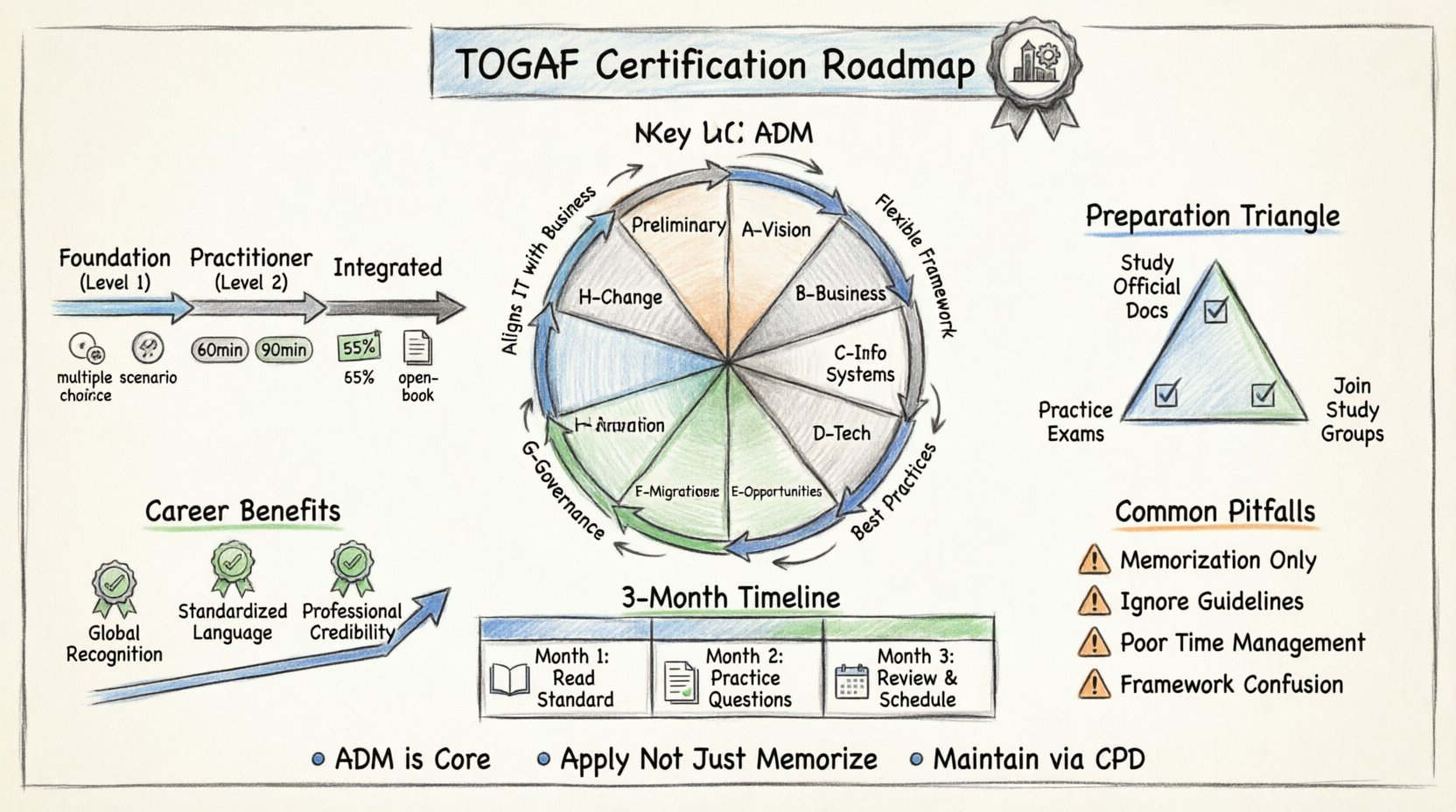
1. TOGAF Enterprise Architecture Foundation (Level 1)
This entry-level certification validates your understanding of the terminology and concepts within TOGAF. It focuses on the “what” and “why” of the framework.
- Format: Multiple-choice questions.
- Focus: Definitions, basic concepts, and the ADM cycle overview.
- Prerequisites: None.
2. TOGAF Enterprise Architecture Practitioner (Level 2)
This level assesses your ability to apply the concepts in practical scenarios. It moves beyond theory into application.
- Format: Scenario-based questions requiring analysis.
- Focus: Using the ADM to solve specific architectural problems.
- Prerequisites: You must first pass the Foundation exam.
3. TOGAF Integrated Certification
This pathway allows candidates to take both exams in a single session. It is often preferred by those who want to complete the full qualification quickly.
📝 Exam Structure and Logistics
Knowing the mechanics of the exam helps in planning your study schedule. The Open Group maintains strict standards for examination delivery.
| Feature | Foundation | Practitioner |
|---|---|---|
| Question Count | 40 | 40 |
| Duration | 60 minutes | 90 minutes |
| Passing Score | 55% | 65% |
| Question Type | Multiple Choice | Scenario Analysis |
| Open Book? | No | Yes (Selected sections) |
Note: The Practitioner exam allows access to specific sections of the TOGAF documentation during the test. This requirement highlights the importance of knowing where to find information quickly.
📚 Preparation Strategies
Success in certification relies on a balanced study plan. Relying solely on intuition is rarely sufficient.
1. Study the Official Documentation
The TOGAF Standard is the primary source of truth. While it can be dense, it is the definitive reference. Focus on the following areas:
- The ADM Cycle: Understand the phases (Preliminary, A, B, C, D, E, F, G, H).
- Architecture Content Framework: Learn the building blocks of architecture deliverables.
- Architecture Capability Framework: Understand governance and compliance.
2. Utilize Practice Exams
Mock exams simulate the pressure of the real environment. They help identify knowledge gaps. When reviewing incorrect answers, focus on the reasoning behind the correct option rather than just memorizing the letter.
3. Join Study Groups
Collaboration with peers can clarify complex concepts. Discussing real-world scenarios helps bridge the gap between theory and practice.
⚙️ Deep Dive: The Architecture Development Method (ADM)
The ADM is the iterative process at the heart of TOGAF. A solid grasp of this cycle is essential for both exam levels.
- Phase A: Architecture Vision. Define the scope and constraints. Identify stakeholders.
- Phase B: Business Architecture. Model the business capabilities and processes.
- Phase C: Information Systems Architectures. Define Data and Application architectures.
- Phase D: Technology Architecture. Define the hardware and software infrastructure.
- Phase E: Opportunities and Solutions. Plan the migration and implementation.
- Phase F: Migration Planning. Coordinate the transition between states.
- Phase G: Implementation Governance. Ensure the project aligns with the architecture.
- Phase H: Architecture Change Management. Manage changes post-implementation.
Each phase has specific inputs, outputs, and architecture building blocks. Memorizing the flow is helpful, but understanding the logic behind the sequence is more valuable.
🚧 Common Challenges and How to Avoid Them
Candidates often face specific hurdles during preparation. Awareness of these pitfalls can streamline your journey.
- Over-reliance on Memory: The Practitioner exam tests application. Do not just memorize definitions; understand how the ADM applies to different contexts.
- Ignoring the Guidelines: The documentation includes guidelines on how to tailor the framework. Read these sections carefully.
- Time Management: The Practitioner exam allows open-book access, but finding information quickly takes time. Practice locating specific sections within the standard.
- Confusing Frameworks: While other frameworks exist (like Zachman or ITIL), focus strictly on TOGAF concepts for this exam.
🔄 Certification Maintenance
Certification is not a one-time event. Maintaining your status requires ongoing engagement with the profession.
- Continuing Professional Development (CPD): You must earn points annually to keep your certification active.
- Activities: Training, teaching, publishing, or attending relevant events count towards your CPD score.
- Renewal: Failure to maintain CPD can result in the revocation of certification.
This requirement ensures that certified professionals remain up-to-date with the evolving standards of the industry.
💼 Career Impact
Obtaining the certification signals competence to employers and clients. It validates your ability to communicate effectively about architecture.
- Global Recognition: TOGAF is recognized across industries and geographies.
- Standardized Language: It provides a common vocabulary for architects and stakeholders.
- Professional Credibility: It demonstrates a commitment to professional development and best practices.
📅 Timeline and Planning
Creating a realistic timeline prevents last-minute stress.
- Month 1: Read the TOGAF Standard. Focus on the ADM phases.
- Month 2: Complete practice questions. Identify weak areas.
- Month 3: Review specific documentation sections. Schedule the exam.
Adjust this schedule based on your prior experience. Those with existing Enterprise Architecture experience may require less time for the Foundation exam.
📍 Where to Find Official Resources
All official materials are managed through The Open Group website. Third-party training providers are available, but the official standard remains the primary reference.
- Official Website: Check for the latest exam syllabus.
- Training Partners: Look for accredited training organizations.
- Community Forums: Engage with other professionals for insights.
🛠️ Exam Day Preparation
Logistics matter. Ensure you are ready for the day of the test.
- Identification: Bring valid government-issued ID.
- Environment: Ensure your testing environment is quiet and distraction-free if taking the exam online.
- Tools: Have your calculator and any permitted reference materials ready.
📈 Post-Exam Steps
After receiving your results, take the next steps to maximize the value of your achievement.
- Update Profiles: Add the certification to your professional profiles immediately.
- Share Knowledge: Present what you learned to your team.
- Plan Next Steps: Consider specialized certifications or advanced training.
The journey does not end with passing. The true value lies in applying the knowledge to drive organizational success.
🔗 Summary of Key Points
- TOGAF is a framework for Enterprise Architecture, not a software tool.
- There are two main exam levels: Foundation and Practitioner.
- The ADM cycle is the core methodology you must understand.
- Maintain your certification through annual CPD activities.
- Focus on application and logic, not just memorization.
Preparation requires dedication and a structured approach. By understanding the requirements and utilizing the correct resources, you can confidently navigate the certification process. This path offers a clear route to validating your expertise in one of the most critical fields of modern technology.