


Enterprise architecture often finds itself at a crossroads. On one side lies the need for structure, consistency, and compliance. On the other stands the demand for speed, adaptability, and creative problem solving. When these forces collide, friction occurs. Too much control can paralyze progress. Too little structure leads to chaos and technical debt.
This guide explores how to implement TOGAF governance effectively. It focuses on the Architecture Governance component within the TOGAF framework. The goal is to create a system where standards protect the organization without hindering its ability to move forward. We will examine the mechanisms, roles, and practices that define a healthy governance model.
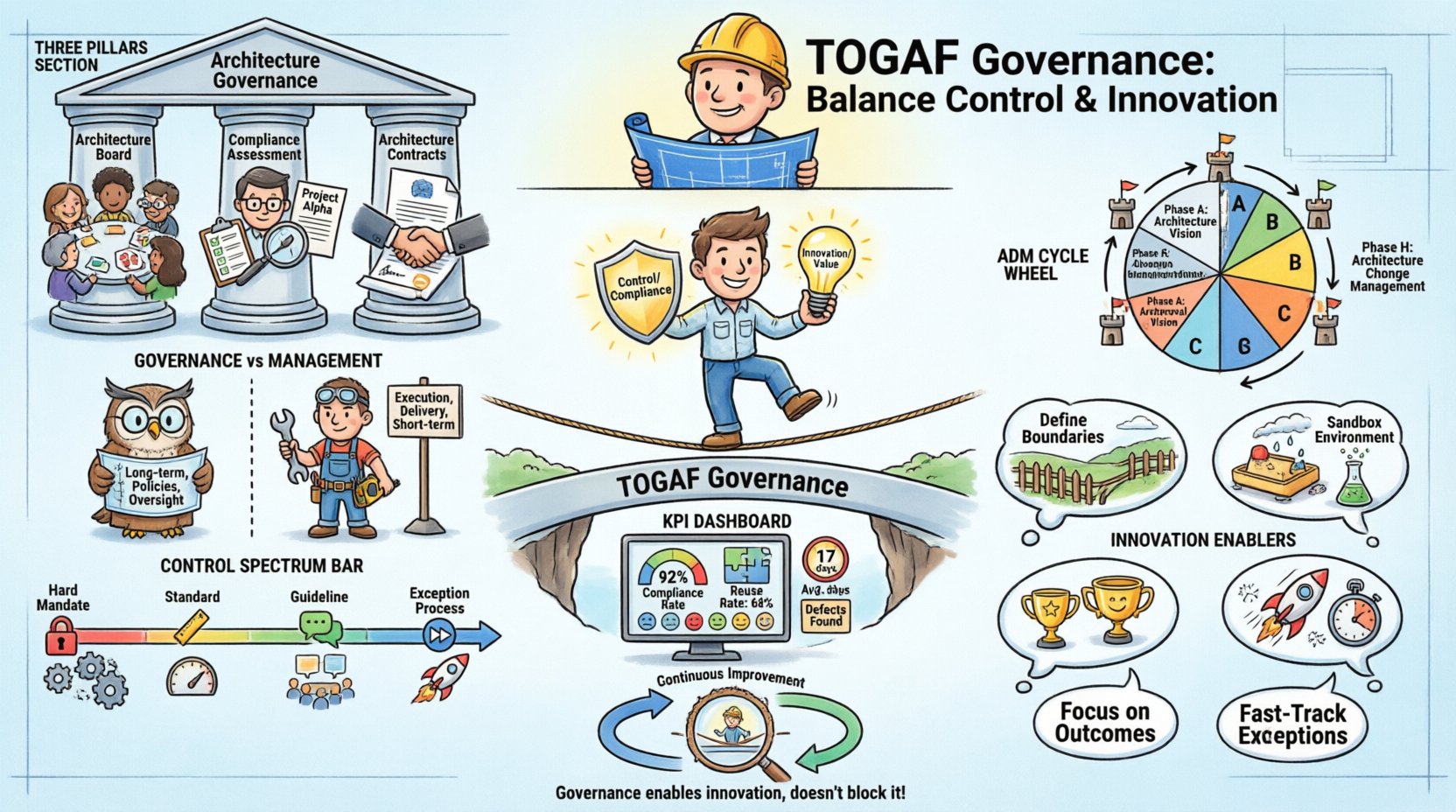
🔍 Understanding the Core Tension
Many organizations view governance as a policing mechanism. They see it as a roadblock that slows down development teams. This perspective is often a result of poor implementation. Governance is not about stopping work; it is about ensuring work aligns with strategic objectives.
In the context of enterprise architecture governance, the objective is twofold:
- Compliance: Ensuring solutions adhere to defined standards and policies.
- Value: Ensuring solutions deliver intended business outcomes.
If you focus solely on compliance, you risk creating bureaucracy. If you focus solely on value, you risk creating silos. The balance lies in understanding that governance is a facilitator of innovation, not its enemy.
🏗️ The Architecture Governance Framework
The TOGAF framework provides a structured approach to governance. It does not dictate specific tools or software. Instead, it defines processes and roles. The Architecture Governance framework is built on three main pillars:
- Architecture Board: The decision-making body.
- Compliance Assessment: The verification process.
- Architecture Contracts: The agreements between stakeholders.
1. The Architecture Board (AB)
The Architecture Board is the central authority within the governance structure. It is not a committee of individuals, but a functional role defined by responsibility. The board oversees the architecture and ensures it supports the business strategy.
Key Responsibilities of the Architecture Board:
- Reviewing architecture artifacts for quality and alignment.
- Resolving architectural disputes between different business units.
- Approving changes to the architecture baseline.
- Ensuring compliance with enterprise standards.
- Monitoring the implementation of architectural decisions.
The board must include representation from various departments. Technical experts, business leaders, and risk managers should all have a voice. This diversity ensures that decisions are not made in isolation.
2. Compliance Assessment
Compliance assessment is the method used to verify that projects adhere to the architecture. It is not a one-time event. It occurs throughout the lifecycle of a project.
Types of Assessments:
- Formal: Scheduled reviews at specific milestones.
- Informal: Ad-hoc checks during development.
- Automated: Tools that scan code or configurations (where applicable).
The outcome of an assessment is either a pass or a fail. A fail does not mean the project stops. It means a remediation plan must be created. This approach keeps projects moving while addressing risks.
3. Architecture Contracts
An architecture contract is a formal agreement between the Architecture Board and the project team. It outlines the architectural requirements and the responsibilities of each party.
What goes into a Contract?
- Scope of the architecture work.
- Key deliverables and milestones.
- Standards and technologies to be used.
- Roles and responsibilities.
- Acceptance criteria.
This document serves as a reference point. If a dispute arises, the contract clarifies what was agreed upon. It reduces ambiguity and builds trust between stakeholders.
⚖️ Governance vs. Management
It is crucial to distinguish between governance and management. While they overlap, they serve different functions. Confusing the two leads to role ambiguity and inefficiency.
| Aspect | Architecture Governance | Architecture Management |
|---|---|---|
| Focus | Control and Compliance | Execution and Delivery |
| Goal | Ensure alignment with strategy | Build the solution correctly |
| Timeframe | Long-term (Strategic) | Short-term (Tactical) |
| Authority | Decision-making and Approval | Operational Implementation |
| Output | Standards, Policies, Decisions | Designs, Code, Deployments |
Understanding this distinction helps in assigning the right tasks to the right people. Governance sets the rules. Management plays the game within those rules.
🔄 Governance within the ADM Cycle
The TOGAF Architecture Development Method (ADM) is the core process for developing architecture. Governance is not a separate phase; it is integrated throughout the cycle. Here is how governance applies to specific phases.
Phase A: Architecture Vision
Governance begins here. The board must approve the vision. They ensure the proposed architecture aligns with the organization’s strategic goals. If the vision is misaligned, resources will be wasted.
Phase B: Business Architecture
During the design of business architecture, governance ensures that business processes are documented accurately. It checks for consistency with existing enterprise models.
Phase C: Information Systems Architectures
This is where data and technology architecture are defined. Governance checks for integration points. It ensures new systems can talk to legacy systems without creating excessive complexity.
Phase D: Technology Architecture
Standards for hardware and software are established here. Governance reviews these standards to prevent vendor lock-in or unsupported technologies.
Phase E: Opportunities and Solutions
This phase identifies implementation projects. Governance assesses the feasibility of these projects. It ensures the organization has the capacity to deliver the architecture.
Phase F: Migration Planning
The transition plan is reviewed. Governance checks for risk management. It ensures the migration path minimizes disruption to business operations.
Phase G: Implementation Governance
This is the active governance phase. The Architecture Board monitors projects to ensure they stay on track. They review compliance assessments and manage architectural changes.
Phase H: Architecture Change Management
Once the architecture is live, change is inevitable. Governance manages these changes. It evaluates the impact of proposed changes on the overall architecture.
🛡️ Establishing Control Mechanisms
Control mechanisms are the tools used to enforce governance. They range from strict mandates to flexible guidelines. The key is to choose the right mechanism for the context.
| Mechanism | Description | When to Use |
|---|---|---|
| Hard Mandate | Strict requirement that must be met. | Critical security or compliance issues. |
| Standard | Recommended best practice. | Common technology choices. |
| Guideline | Suggestion with justification allowed. | Innovation areas or experimental tech. |
| Exception Process | Formal path to bypass a rule. | When business need outweighs standard. |
Using a Hard Mandate for everything will stifle innovation. Using only Guidelines will lead to inconsistency. A mix is required.
Best Practices for Control:
- Document Everything: Keep a record of all decisions and exceptions.
- Communicate Clearly: Ensure teams understand why a control exists.
- Review Regularly: Standards become outdated. Review them annually.
- Empower Teams: Allow local teams to propose alternatives.
🚀 Enabling Innovation
How do you allow teams to experiment without breaking the architecture? The answer lies in controlled flexibility.
1. Define Boundaries, Not Paths
Instead of dictating exactly how a solution should be built, define the boundaries. Tell teams what the system must achieve and what constraints they must respect. Inside those boundaries, they have freedom.
2. Sandbox Environments
Create isolated environments where new ideas can be tested. This allows for experimentation without impacting the production environment. Governance reviews the sandbox results before any wider adoption.
3. Fast-Track Exceptions
When a team has a valid reason to deviate from standards, the exception process should be fast. If the approval takes months, the opportunity is lost. Set clear timeframes for governance reviews.
4. Focus on Outcomes
Shift the focus from compliance checklists to business outcomes. If a team achieves the desired result, does the method matter as much? If the outcome is achieved securely and efficiently, the architecture is serving its purpose.
📊 Measuring Governance Effectiveness
You cannot improve what you do not measure. Governance needs metrics to prove its value. If the board cannot show value, it risks being viewed as unnecessary overhead.
Key Performance Indicators (KPIs):
- Compliance Rate: Percentage of projects adhering to standards.
- Time to Approval: How long does it take to get architectural sign-off?
- Defect Rate: Number of architectural issues found post-deployment.
- Reuse Rate: Percentage of solutions using existing components.
- Business Satisfaction: Feedback from business stakeholders on architecture support.
These metrics should be reported regularly. A dashboard can provide real-time visibility into the health of the architecture program.
⚠️ Common Pitfalls to Avoid
Even with a solid plan, things can go wrong. Awareness of common mistakes helps you steer clear of them.
- Over-Engineering: Creating too much documentation and too many layers of approval. Keep it lean.
- Under-Communication: Assuming everyone knows the standards. Train teams continuously.
- Static Standards: Keeping standards frozen in time. Update them as technology evolves.
- Centralized Bottlenecks: Having one person approve everything. Distribute authority appropriately.
- Ignoring Legacy: Trying to force new standards on legacy systems without a migration plan. Acknowledge the reality of technical debt.
🤝 Stakeholder Engagement
Governance is a social activity. It requires buy-in from people, not just processes. Engaging stakeholders is critical for success.
Strategies for Engagement:
- Identify Champions: Find influential people within teams who support the architecture. They can advocate for the standards.
- Hold Office Hours: Make architecture staff available for questions. This reduces friction.
- Show Success Stories: Highlight projects that benefited from following the architecture. Use these as examples.
- Listen Actively: If a team complains about a standard, listen. There may be a valid reason to change it.
When stakeholders feel heard, they are more likely to comply. When they feel policed, they find workarounds.
🔄 Continuous Improvement
The architecture landscape changes. Governance models must evolve with them. Regular retrospectives help identify areas for improvement.
Retrospective Questions:
- Did the Architecture Board meet its goals?
- Were projects delayed due to governance?
- Did we miss any risks?
- Are the standards still relevant?
Use the answers to refine the process. Governance is a living system, not a static rulebook.
📝 Final Considerations
Implementing TOGAF governance is a journey. It requires patience, communication, and discipline. The goal is not perfection, but progress. By establishing control mechanisms that support rather than hinder, you create an environment where innovation can flourish safely.
Remember that the value of architecture is in its ability to enable the business. If governance stops the business from moving, it has failed. If it guides the business to success, it has succeeded.
Start small. Define the core standards. Build the Architecture Board. Communicate the vision. Iterate based on feedback. Over time, the governance framework will become a natural part of the organization’s culture.
The balance between control and innovation is delicate. It requires constant attention. But when struck, it creates a resilient, adaptable, and high-performing enterprise.