


Establishing a robust architecture repository is a critical milestone for any organization adopting the The Open Group Architecture Framework (TOGAF). It serves as the central hub for storing, managing, and accessing architecture artifacts. Without a structured repository, architecture efforts often become fragmented, leading to redundancy and a lack of visibility across the enterprise.
This guide provides a detailed walkthrough on constructing your first architecture repository. We will explore the foundational concepts, the content metamodel, and the governance mechanisms required to sustain it. By following these steps, you create a single source of truth that aligns business strategy with IT capabilities.
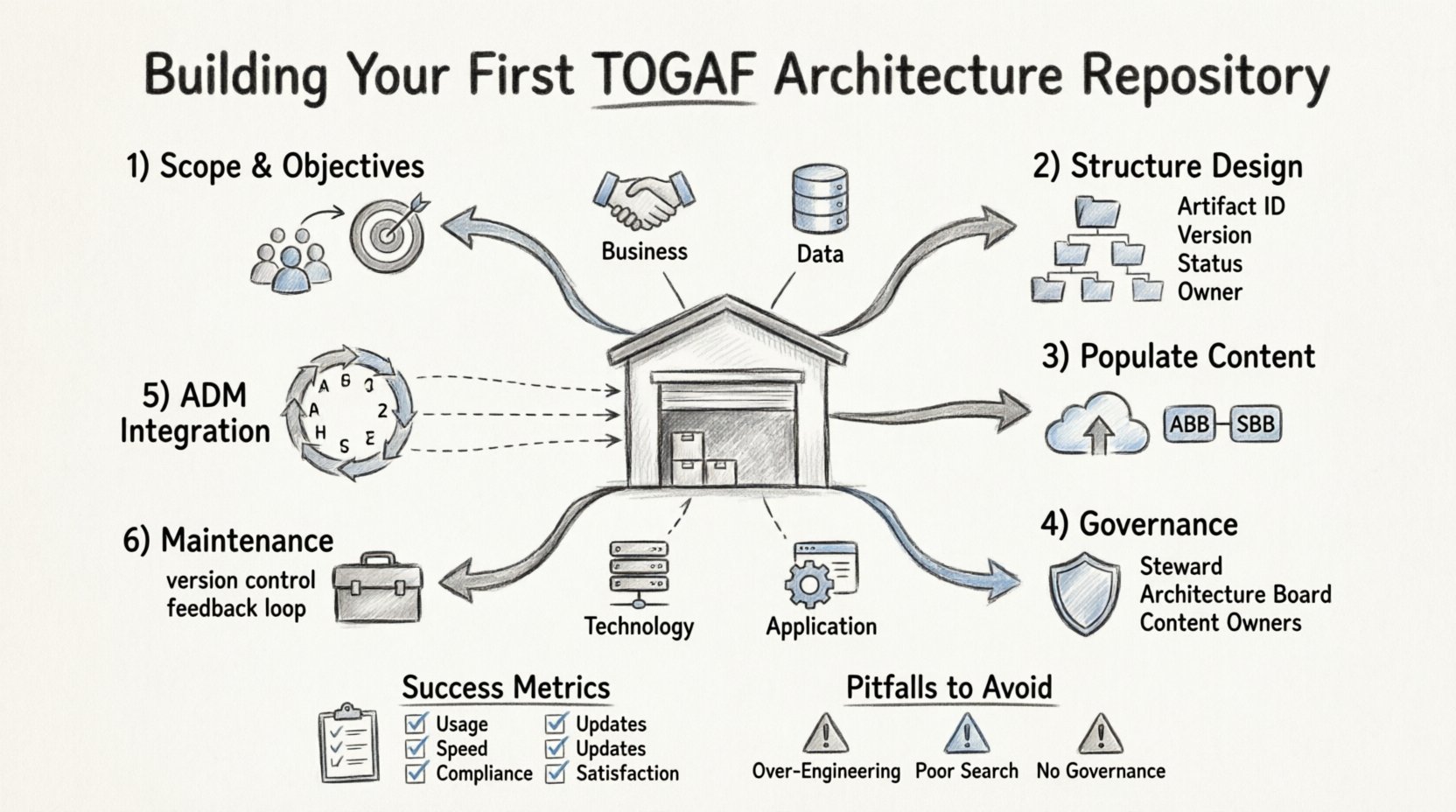
📚 Understanding the Architecture Repository
The Architecture Repository is more than just a digital storage drive. In the context of TOGAF, it is a logical repository that stores information about the current and target architectures. It contains the architecture metamodel, which defines the structure and relationships of the content stored within.
Key components of the repository include:
- Architecture Metamodel: Defines the types of data and how they relate to one another.
- Standards, Patterns, and Constraints: Rules that govern design and implementation.
- Architecture Building Blocks (ABBs): Specifications for reusable components.
- Solution Building Blocks (SBBs): Actual implementations of the ABBs.
- Reference Models and Content: Models that guide the development of the architecture.
It is essential to distinguish between the Repository and the Repository Governance. The repository is the physical or logical storage, while governance is the set of policies and procedures that ensure the quality and consistency of the stored data.
🧩 The TOGAF Content Framework
Before populating the repository, you must understand the Content Framework. This framework organizes the architecture information into logical categories. It ensures that every piece of data has a defined place and purpose.
1. Architecture Content Metamodel
The metamodel provides the schema for the repository. It categorizes content into four main domains:
- Business Architecture: Strategy, governance, organization, and business processes.
- Data Architecture: Logical data models, data standards, and data distribution.
- Application Architecture: Application portfolio, application components, and interactions.
- Technology Architecture: Hardware, software, networks, and facilities.
2. Architecture Building Blocks (ABB)
ABBs are functional requirements and specifications. They are generic and vendor-neutral. When building the repository, you must catalog these to ensure they can be matched with specific solutions later.
3. Solution Building Blocks (SBB)
SBBs are the actual products or services used to build the solution. They are specific to a project or organization. The repository must link ABBs to SBBs to track compliance and progress.
🚀 Step 1: Define Scope and Objectives
The first step in building the repository is to define what it will contain and who will use it. A clear scope prevents the repository from becoming a “graveyard” of unused documents.
- Identify Stakeholders: Determine who requires access. This includes architects, developers, business analysts, and management.
- Define Use Cases: List specific scenarios where the repository adds value. Examples include impact analysis, compliance checks, and portfolio management.
- Set Success Metrics: Establish how you will measure the repository’s effectiveness. Metrics might include artifact usage rates or query response times.
Do not attempt to capture every document immediately. Start with high-value artifacts that support critical decision-making processes.
🏗️ Step 2: Design the Repository Structure
Designing the structure involves creating the folders, categories, and metadata tags that will organize the content. This design should reflect the TOGAF Content Framework.
Organizational Hierarchy
Structure the repository to mirror the organization’s operating model. Common top-level categories include:
- Strategy & Planning
- Business Architecture
- Data & Information
- Application & Systems
- Technology & Infrastructure
- Governance & Compliance
Metadata Standards
Every artifact stored must have consistent metadata. This allows for efficient searching and filtering. Required metadata fields typically include:
- Artifact ID: A unique identifier.
- Version: Current revision number.
- Status: Draft, Approved, Retired.
- Owner: The individual or team responsible for the content.
- Creation Date: When the artifact was created.
- Tags: Keywords for categorization.
| Field | Purpose | Example Value |
|---|---|---|
| Artifact ID | Unique Reference | BA-2024-001 |
| Status | Lifecycle Stage | Approved |
| Domain | Architecture Layer | Business |
| Owner | Responsible Party | Lead Business Architect |
📥 Step 3: Populate Initial Content
Once the structure is ready, you can begin loading the repository. This phase should focus on existing high-value documents and models.
- Import Existing Models: Convert legacy diagrams and documents into the new repository format. Ensure they are tagged with the correct metadata.
- Create Standards Documents: Upload the architectural standards, patterns, and constraints that teams must follow.
- Link to Projects: Associate current active projects with their relevant architecture artifacts.
- Define ABBs: Document the generic building blocks that the organization intends to use across multiple projects.
Avoid uploading raw files without context. Every document should be accompanied by a summary explaining its purpose and relationship to other artifacts.
🛡️ Step 4: Establish Governance
Governance is the engine that keeps the repository accurate and useful. Without governance, the repository will quickly become outdated.
Roles and Responsibilities
Define clear roles for managing the repository. A typical governance structure includes:
- Repository Steward: Responsible for the technical health of the repository system.
- Architecture Board: Reviews and approves major architectural decisions and standards.
- Content Owners: Individuals responsible for updating specific domains (e.g., Data Owner).
- Architects: Users who consume and contribute to the content.
Access Control
Implement role-based access control (RBAC). Not everyone needs to edit the repository. Some users may only need read access to view standards, while others need write access to update models.
- Read Access: Granted to all architects and stakeholders for visibility.
- Edit Access: Restricted to Content Owners and Stewards.
- Admin Access: Limited to the Repository Steward for system configuration.
Review Cycles
Schedule regular reviews to ensure content quality. A quarterly review cycle is common. During these reviews, verify that:
- Artifacts are up to date.
- Obsolete documents are retired.
- Metadata is consistent.
- Links between artifacts are valid.
🔄 Step 5: Integrate with the ADM Cycle
The Architecture Repository is not a static library. It must be integrated into the Architecture Development Method (ADM) cycle. This ensures that the repository evolves as the architecture evolves.
Phase A: Architecture Vision
During the vision phase, reference the repository to identify existing standards and patterns. This prevents reinventing the wheel and ensures alignment with enterprise strategy.
Phase B, C, and D: Business, Information Systems, and Technology
As you develop the target architecture, store the models and diagrams in the repository. Use the repository to check for conflicts between the new designs and existing standards.
Phase E and F: Opportunities and Solutions
Map the Architecture Building Blocks from the repository to the Solution Building Blocks being procured. This linkage is vital for tracking compliance.
Phase G: Implementation Governance
Monitor the implementation against the architecture stored in the repository. Any deviations must be documented and, if necessary, trigger a change request to the repository content.
Phase H: Architecture Change Management
When changes occur, update the repository immediately. This ensures that the “single source of truth” remains accurate for future projects.
🛠️ Step 6: Maintenance and Evolution
A repository requires ongoing maintenance to remain valuable. Content rot is a significant risk where information becomes obsolete and unreliable.
- Version Control: Maintain a history of changes. This allows you to revert to previous versions if a new change causes issues.
- Retirement Policy: Define rules for archiving old artifacts. Documents from completed projects should be moved to an archive section.
- Training: Regularly train staff on how to use the repository. If users do not know how to query or upload content, they will not use it.
- Feedback Loop: Collect feedback from users. If the search function is slow or the structure is confusing, adjust the design.
⚠️ Common Pitfalls to Avoid
Building an architecture repository is complex. Several common mistakes can derail the project.
| Pitfall | Impact | Mitigation Strategy |
|---|---|---|
| Over-Engineering | Users find the system too complex | Start simple; add complexity only when needed. |
| Lack of Governance | Data becomes inconsistent and unreliable | Implement strict approval workflows. |
| Poor Searchability | Users cannot find relevant information | Enforce strict metadata tagging standards. |
| One-Way Traffic | Repository is only for storage, not collaboration | Enable comments and change requests. |
| Ignoring Standards | Artifacts do not align with enterprise norms | Integrate standards into the upload process. |
📊 Measuring Repository Success
To ensure the repository is delivering value, track specific indicators. These metrics help justify the investment and guide future improvements.
- Artifact Usage: How often are documents downloaded or viewed?
- Query Speed: How long does it take to retrieve information?
- Compliance Rate: How many projects reference the repository?
- Update Frequency: How often is content refreshed?
- User Satisfaction: Surveys to gauge how easy the system is to use.
🔗 Linking to Enterprise Architecture
The repository should not exist in isolation. It must connect to other enterprise systems. Integration with project management tools, asset management systems, and compliance platforms creates a holistic view of the organization.
When linking systems, ensure data consistency. If a project status changes in the project management tool, the architecture repository should reflect this change to maintain alignment. This interoperability reduces manual data entry and the risk of errors.
🌱 Future-Proofing the Repository
Technology and business needs change rapidly. The repository design must accommodate future growth.
- Scalability: Ensure the storage solution can handle increasing data volumes.
- Flexibility: The schema should allow for new artifact types without major structural changes.
- Security: As data grows, security requirements will increase. Plan for encryption and advanced access controls.
- Interoperability: Support standard data exchange formats to facilitate integration with other tools.
📝 Summary of Implementation Steps
To recap the core actions required to build this repository:
- Analyze Requirements: Understand what data is needed and by whom.
- Design Structure: Create categories, metadata, and access rules.
- Load Content: Import existing models and standards.
- Train Users: Ensure the team knows how to interact with the repository.
- Establish Governance: Define roles, responsibilities, and review cycles.
- Monitor and Evolve: Track usage and refine the system over time.
Building a TOGAF Architecture Repository is a foundational step in maturing your enterprise architecture capability. It transforms scattered information into a managed asset. By following these structured steps, you ensure that your architecture knowledge is preserved, accessible, and actionable. This investment pays dividends in reduced redundancy, faster decision-making, and better alignment between business goals and technology execution.
Remember that the repository is a living entity. It requires care, attention, and continuous improvement to remain effective. With a solid foundation and clear governance, your organization can leverage the repository to drive strategic value and operational efficiency.