


Welcome to the foundational guide for anyone stepping into the role of an Enterprise Architecture Lead using The Open Group Architecture Framework (TOGAF). Transitioning into this position often involves navigating a complex landscape of standards, methodologies, and stakeholder expectations. This document addresses the most frequent inquiries regarding TOGAF implementation, governance, and strategic alignment.
Our goal is to provide clear, actionable insights without the fluff. We focus on practical application and structural understanding. Whether you are preparing for certification or managing a live architecture practice, these answers will ground your approach in proven principles.
📋 Section 1: Foundations and Core Concepts
1. What is the primary purpose of TOGAF?
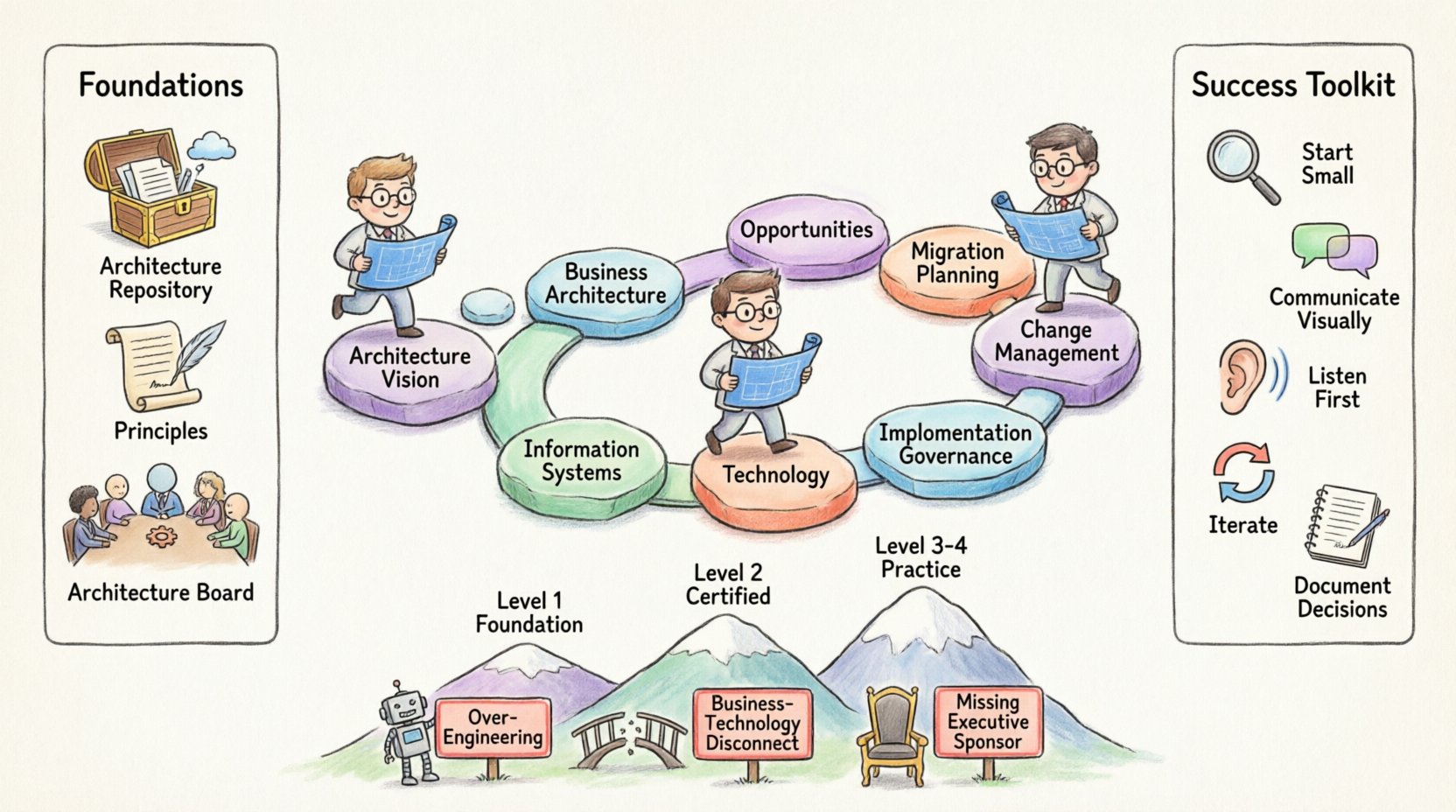
The primary purpose of TOGAF is to provide a standardized approach for designing, planning, implementing, and governing an enterprise information architecture. It serves as a framework rather than a prescriptive product. It offers a methodology, best practices, and reusable assets to ensure that IT investments align with business goals.
2. How does TOGAF differ from other frameworks like Zachman?
While Zachman provides a classification schema for architecture artifacts, TOGAF focuses on the process of creating those artifacts. TOGAF includes the Architecture Development Method (ADM) to guide execution. Zachman is more of a taxonomy, whereas TOGAF is a process framework. Many organizations use them in tandem.
3. Who should be involved in the Architecture Board?
The Architecture Board typically includes senior management, key stakeholders, and the lead architects. Their role is to oversee the architecture, approve major changes, and ensure compliance with standards. Representation should cover business, technology, and security domains.
4. What is the Architecture Repository?
The Architecture Repository is the storage mechanism for all architecture assets. It holds the architecture metamodel, architecture capability, architecture principles, and the specific artifacts created during the ADM cycle. It ensures that knowledge is preserved and accessible.
5. How do Architecture Principles function?
Principles act as general rules and guidelines for decision-making. They are distinct from standards and patterns. A principle defines a condition that must be met. For example, “Data is an asset” implies that data must be managed and protected consistently across the enterprise.
🔄 Section 2: The Architecture Development Method (ADM)
6. Can you summarize the phases of the ADM?
The ADM consists of eight phases, plus a preliminary phase and architecture definition phase:
- Phase A: Architecture Vision
- Phase B: Business Architecture
- Phase C: Information Systems Architectures
- Phase D: Technology Architecture
- Phase E: Opportunities and Solutions
- Phase F: Migration Planning
- Phase G: Implementation Governance
- Phase H: Architecture Change Management
7. What happens in Phase A (Architecture Vision)?
Phase A defines the scope, constraints, and stakeholders. The Architecture Vision document is created here, outlining the high-level strategy. It sets the stage for the entire project by securing stakeholder buy-in and defining the project charter.
8. Why is Phase B (Business Architecture) critical?
Business Architecture defines the business strategy, governance, organization, and key business processes. It ensures that subsequent technology and data architectures are rooted in actual business needs rather than assumed requirements.
9. How do you handle the scope of Phases C and D?
Phase C covers Data and Application architectures. Phase D covers Technology architecture. These are often iterative. You define the business capability, then map the applications and data required to support it, and finally the infrastructure needed to host them.
10. What is the role of Gap Analysis?
Gap Analysis is performed throughout the ADM to compare the Baseline Architecture (current state) with the Target Architecture (future state). It identifies what is missing, what needs to change, and what can be reused. This drives the work packages in later phases.
| Phase | Focus Area | Key Output |
|---|---|---|
| Phase A | Scope & Vision | Architecture Vision Document |
| Phase B | Business | Business Architecture Model |
| Phase C | Apps & Data | System Interoperability Diagram |
| Phase D | Technology | Technology Reference Model |
🤝 Section 3: Stakeholders and Governance
11. How do you identify and manage stakeholders?
Stakeholder management begins with identifying individuals and groups affected by the architecture. You must understand their concerns, influence, and interests. Tools like the Stakeholder Map help visualize this. Regular communication plans are essential to keep them engaged.
12. What is Architecture Compliance?
Compliance refers to adherence to established architecture standards and principles. It is verified through compliance assessments during the ADM. If a project deviates, it requires an exception request or a revision of the architecture.
13. How often should the Architecture Board meet?
The frequency depends on the organization’s pace of change. Some meet monthly, others quarterly. The key is consistency. The board must review migration plans, approve exceptions, and resolve architectural disputes promptly.
14. What is the role of an Enterprise Architect versus a Solution Architect?
The Enterprise Architect focuses on the broader organizational strategy, standards, and long-term vision. The Solution Architect focuses on a specific project or solution. The Enterprise Architect guides the Solution Architect to ensure alignment.
15. How do you handle conflicting stakeholder requirements?
Conflicts are resolved by referring back to the Architecture Principles and Business Strategy. Facilitation is key. You must bring stakeholders together to understand the trade-offs. Documentation of the decision and the rationale is vital for future reference.
🛠️ Section 4: Implementation and Governance
16. What is the Implementation Governance Phase (Phase G)?
Phase G ensures that the solution implementation aligns with the architecture. It involves monitoring the project, validating that the build matches the design, and managing any deviations. It acts as a checkpoint between design and deployment.
17. How do you manage Architecture Change Management (Phase H)?
Phase H addresses changes required after the initial implementation. As the business environment shifts, the architecture may need updates. This phase ensures that changes are evaluated and incorporated into the baseline without losing stability.
18. What is the role of the Architecture Contract?
An Architecture Contract is an agreement between the architecture team and the project team. It defines the scope of work, the deliverables, and the compliance requirements. It formalizes the relationship and ensures accountability.
19. How do you measure the value of Enterprise Architecture?
Value is measured through alignment metrics, risk reduction, and cost avoidance. Common indicators include the reduction in redundant systems, faster time-to-market for new solutions, and improved compliance rates. Qualitative feedback from stakeholders is also crucial.
20. What tools should be used for Architecture Repository management?
The choice of tool depends on the organization’s size and budget. The tool should support version control, searchability, and visualization of models. It must integrate with project management and IT service management tools where possible to ensure data consistency.
🚀 Section 5: Practical Advice for Leads
Stepping into an Architecture Lead role requires a balance of technical depth and political savvy. Here are additional considerations for success:
- Start Small: Do not attempt to model the entire enterprise immediately. Pick a high-impact domain.
- Communicate Visually: Stakeholders respond better to diagrams than text. Use clear models to explain complex interactions.
- Listen First: Understand the business pain points before proposing technical solutions.
- Iterate: Architecture is not a one-time deliverable. It evolves with the business.
- Document Decisions: Maintain an Architecture Decision Record (ADR) to track why choices were made.
🔗 Section 6: Certification and Skills
For those looking to validate their knowledge, the TOGAF certification offers a structured path:
- Level 1: Foundation. Tests basic knowledge of terms and concepts.
- Level 2: Certified. Tests the ability to apply the methodology in a scenario.
- Level 3 & 4: Practice. Focuses on real-world implementation and advanced mastery.
Beyond certification, soft skills are often the differentiator. Negotiation, facilitation, and strategic thinking are as important as modeling skills. Continuous learning is required as the industry shifts toward cloud, AI, and agile integration.
📝 Section 7: Common Pitfalls to Avoid
New leads often encounter specific hurdles. Being aware of them helps in mitigation:
- Over-Engineering: Creating detailed models that no one reads. Keep artifacts lean and useful.
- Ignoring the Business: Focusing on technology without understanding the business model leads to rejection.
- Lack of Executive Sponsorship: Without support from leadership, architecture initiatives stall.
- Resistance to Change: Users may resist new standards. Involve them early to build ownership.
- Static Planning: Treating the architecture as a fixed document rather than a living system.
By adhering to these principles and maintaining a focus on value delivery, you can navigate the complexities of enterprise architecture effectively. The framework provides the structure, but your judgment provides the direction.