


Enterprise Architecture frameworks provide the structure necessary to align business strategy with technology capabilities. The TOGAF® Standard is one of the most widely adopted frameworks globally, offering a detailed approach to designing, planning, implementing, and governing an enterprise information architecture. However, adopting this framework without a nuanced understanding often leads to friction. New practitioners frequently encounter roadblocks that slow down progress or dilute the value of the architecture function.
This guide outlines the most frequent errors observed in early TOGAF implementation and provides practical strategies to navigate them. By understanding these pitfalls, you can ensure your architectural efforts remain focused, valuable, and sustainable.
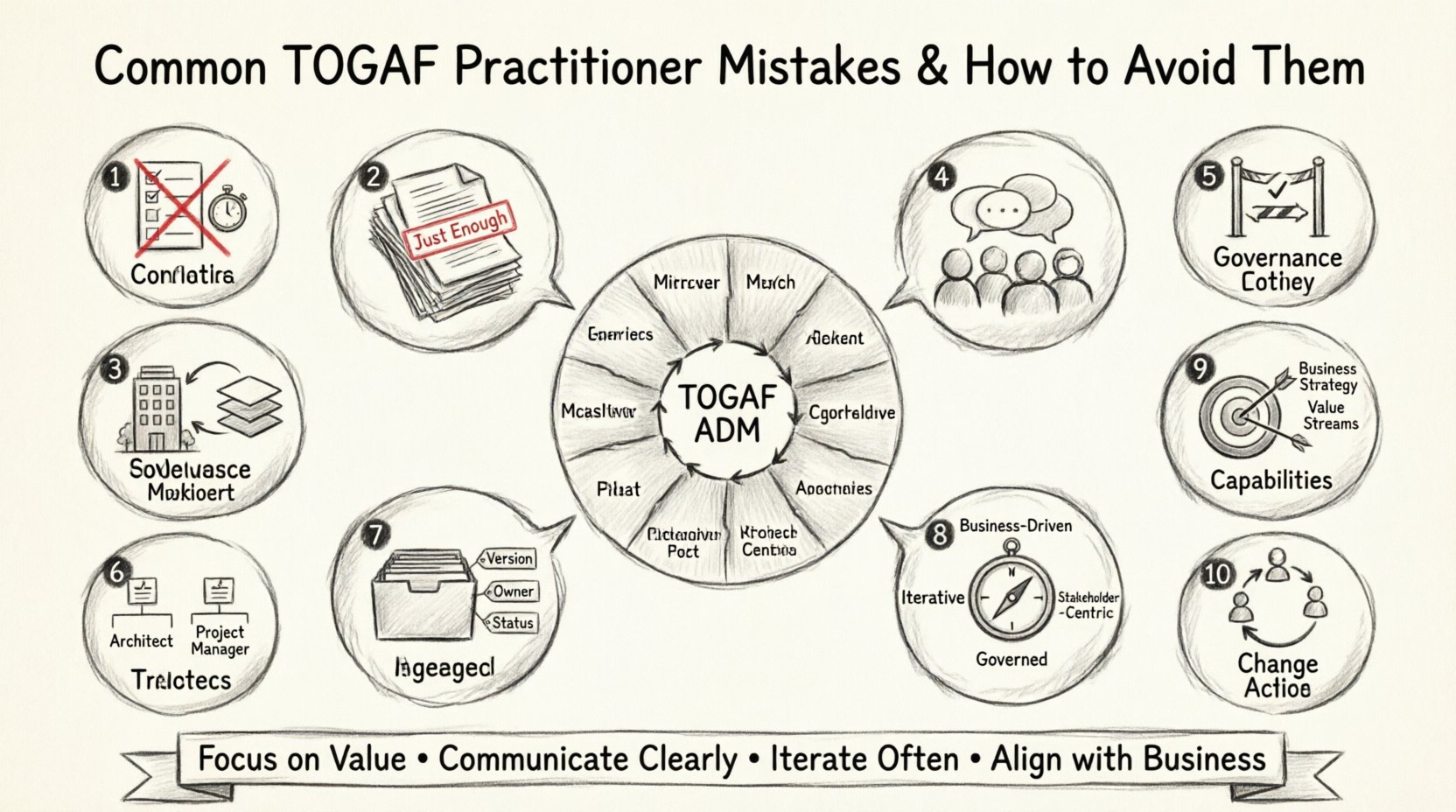
1. Treating the ADM as a Linear Checklist ⏱️
The Architecture Development Method (ADM) is the core engine of TOGAF. It consists of a series of phases designed to guide the creation of an enterprise architecture. A common error is viewing the ADM as a strictly linear process where you complete Phase A, then move immediately to Phase B, and so on, without looking back.
- The Mistake: Practitioners often feel compelled to finish the documentation for one phase before starting the next. This creates bottlenecks and ignores the iterative nature of real-world architecture.
- The Reality: The ADM is iterative. You may need to revisit the Architecture Vision (Phase A) after discovering constraints in the Business Architecture (Phase B). You might need to loop back to the Technology Architecture (Phase D) after reviewing the Information Systems Architectures (Phases C).
- The Consequence: Rigid adherence to linearity results in obsolete documentation. By the time Phase H is reached, the requirements defined in Phase A may have shifted due to market changes.
To avoid this, adopt an agile mindset within the ADM. Define iterations or cycles where specific architectural domains are refined multiple times. Ensure that the Architecture Board understands that the process is cyclical, not a straight line.
2. Over-Engineering Artifacts 📄
TOGAF defines a vast repository of potential artifacts: diagrams, matrices, lists, and models. New practitioners often feel a pressure to create every possible artifact to demonstrate compliance with the framework.
- The Mistake: Producing extensive documentation that no one reads. For example, creating detailed data flow diagrams for every minor process change when a high-level capability map would suffice.
- The Reality: The purpose of an artifact is to communicate. If a diagram does not aid decision-making or clarify a concept for stakeholders, it is noise. The TOGAF Content Framework allows you to select the relevant building blocks for your specific context.
- The Consequence: Document bloat. Stakeholders lose trust in the architecture function when they are inundated with irrelevant technical details. The architecture team becomes bogged down in maintenance rather than value creation.
Strategy for Mitigation:
- Identify the audience for each artifact before creation.
- Adopt a “Just Enough” philosophy. Ask: Does this deliver value to the current project or decision?
- Link artifacts to specific architectural requirements rather than creating them for the sake of completeness.
3. Neglecting Business Architecture (Phase B) 🏢
IT professionals often gravitate toward Technology and Data Architecture (Phases D and C) because it aligns with their technical expertise. They may rush through Phase B (Business Architecture) to get to the “meat” of the technology.
- The Mistake: Treating Business Architecture as a minor formality. Skipping deep dives into business capabilities, value streams, and organizational mapping.
- The Reality: Business Architecture provides the context for all other domains. Without a clear understanding of what the business does and how it creates value, technology decisions are guesses. You cannot design a solution if you do not understand the problem space.
- The Consequence: Technology solutions that solve technical problems but fail to address business needs. This leads to low adoption rates and wasted investment.
How to Fix It:
- Allocate sufficient time in the schedule for Phase B.
- Engage business leaders directly. Do not rely solely on IT intermediaries.
- Ensure the Architecture Vision (Phase A) explicitly links business drivers to the architectural outcomes.
4. Poor Stakeholder Management 🤝
Architecture is inherently political. It involves influencing decisions across various departments and hierarchies. A frequent oversight is assuming that technical correctness is enough to gain approval.
- The Mistake: Focusing on the diagram rather than the person. Presenting complex technical models to executives who need high-level strategic alignment.
- The Reality: Different stakeholders require different views. The CIO needs a roadmap; a project manager needs specific interface requirements; a developer needs data models.
- The Consequence: Projects stall because stakeholders do not understand the proposal or feel their concerns were ignored. The architecture becomes a barrier rather than an enabler.
Best Practices:
- Create a Stakeholder Map early in Phase A.
- Define specific communication plans for different groups.
- Use the Architecture Principles to justify decisions rather than personal preference.
- Establish an Architecture Board that includes key business representatives, not just IT leaders.
5. Skipping Implementation Governance (Phase H) 🏗️
Many teams finish the design (Phases A through D) and hand off the work to project teams, assuming the job is done. They fail to engage in Phase H: Architecture Compliance and Implementation Governance.
- The Mistake: Abandoning the architecture after the plan is approved. There is no mechanism to ensure the build matches the design.
- The Reality: Without governance, projects drift. Technical debt accumulates, and the architecture degrades over time. The “As-Designed” state diverges significantly from the “As-Built” state.
- The Consequence: The architecture repository becomes a historical record of what was planned, not a guide for what is running. Future initiatives must re-architect the same systems repeatedly.
Ensuring Compliance:
- Define clear Architecture Contracts for projects.
- Establish checkpoints where projects must demonstrate adherence to standards.
- Create a process for handling deviations. Not all deviations are bad, but they must be recorded and approved.
- Monitor the Architecture Repository to track the health of the environment.
6. Confusing Architecture with Project Management 📋
There is a distinct difference between defining the destination (Architecture) and managing the journey (Projects). New practitioners often blur these lines.
- The Mistake: Getting involved in day-to-day project scheduling, resource allocation, and bug tracking. Acting as a project manager instead of an architect.
- The Reality: Architecture provides the constraints and the blueprint. Projects execute within those constraints. If the architect manages the project, the strategic oversight is lost.
- The Consequence: The architecture team becomes a bottleneck. Strategic initiatives stall while architects get caught up in tactical project issues.
Role Clarity:
- Focus on the “What” and “Why” (Architecture).
- Leave the “How” and “When” (Execution) to project teams.
- Ensure the Architecture Vision remains stable while projects adapt to it.
7. Ignoring the Architecture Repository 🗄️
The TOGAF Content Framework relies heavily on the Architecture Repository. This is the storage mechanism for all architecture work products. Many teams treat this as a simple file share.
- The Mistake: Storing documents in disparate locations without metadata. Using a shared drive with no version control or search capability.
- The Reality: The repository should be the single source of truth. It needs to support search, versioning, and relationships between artifacts (e.g., linking a principle to a specific solution).
- The Consequence: Information silos. Architects spend more time searching for existing work than creating new work. Duplicate efforts occur because previous work cannot be found.
Repository Strategy:
- Implement a centralized platform that supports architecture modeling.
- Enforce naming conventions and metadata tagging.
- Regularly audit the repository for outdated or superseded artifacts.
- Ensure access controls are in place to maintain data integrity.
Summary of Common Pitfalls and Solutions
The following table summarizes the critical mistakes and the corresponding corrective actions for a smoother TOGAF implementation.
| Mistake | Impact | Corrective Action |
|---|---|---|
| Linear ADM Execution | Obsolete documentation, slow delivery | Adopt iterative cycles and feedback loops |
| Artifact Overload | Stakeholder fatigue, maintenance burden | Produce “just enough” value-driven artifacts |
| Neglecting Business Architecture | Technology misalignment, wasted investment | Invest time in Phase B before Phase C/D |
| Poor Stakeholder Management | Project delays, low adoption | Map stakeholders and tailor communication |
| Skipping Governance (Phase H) | Technical debt, architecture drift | Enforce Architecture Contracts and compliance checks |
| Confusing Roles | Architect bottleneck, strategic loss | Separate strategic design from tactical execution |
| Repository Neglect | Information silos, duplicate work | Centralize storage with metadata and versioning |
8. Lack of Clear Architecture Principles 🧭
Architecture Principles are the guiding rules and guidelines that the architecture follows. They are the “constitution” of your enterprise architecture. Skipping the definition of these principles is a foundational error.
- The Mistake: Starting work without defined principles. Making decisions on a case-by-case basis without a standard framework.
- The Reality: Principles provide consistency. They help architects make decisions quickly when facing trade-offs. They also empower the business to understand why certain technologies are approved or rejected.
- The Consequence: Inconsistent solutions. Similar problems are solved differently in different departments, leading to integration headaches and higher costs.
Developing Principles:
- Involve senior leadership to ensure authority.
- Keep them high-level and enduring, not tied to specific technologies.
- Ensure they are actionable and testable.
- Review them periodically to ensure they remain relevant to the business strategy.
9. Failure to Align with Strategic Goals 🎯
Architecture must serve the business. A common disconnect is when the architecture team works in isolation from the strategic planning office.
- The Mistake: Building a “perfect” architecture that does not support the current business strategy. Focusing on technical elegance over business value.
- The Reality: The primary goal of Enterprise Architecture is to reduce complexity and cost while enabling agility. If the architecture does not move the business needle, it is not successful.
- The Consequence: Architecture initiatives are viewed as cost centers rather than value drivers. Funding may be cut when strategic priorities shift.
Alignment Tactics:
- Link every architectural initiative to a specific business capability or goal.
- Regularly report on architectural value in business terms (e.g., cost reduction, time to market).
- Ensure the Architecture Vision is reviewed alongside the Corporate Strategy.
10. Underestimating Change Management 🔄
Introducing an architecture framework changes how people work. It often introduces new processes, standards, and tools. This change is often met with resistance.
- The Mistake: Assuming technical adoption is enough. Ignoring the human element of adopting new ways of working.
- The Reality: People need to understand the “Why” behind the changes. They need training and support to adapt to new architectural standards.
- The Consequence: Shadow IT emerges. Teams bypass the architecture function because it feels like a hurdle rather than help.
Managing Change:
- Communicate benefits clearly to all levels of the organization.
- Provide training on the framework and tools.
- Identify champions within the business to advocate for the architecture.
- Start with low-risk areas to demonstrate value before scaling.
Final Thoughts on TOGAF Adoption 🚀
Successfully implementing the TOGAF Standard requires more than just reading the manual. It demands a cultural shift within the organization. It requires patience, communication, and a willingness to adapt the framework to fit the specific needs of the enterprise.
By avoiding the common mistakes outlined above, practitioners can build a robust architecture function that delivers tangible business value. Focus on value over compliance, communication over documentation, and collaboration over control. The framework is a tool, not a rulebook. Use it to enable your organization’s journey toward digital excellence.
Remember, the goal is not to produce a perfect document set, but to create an environment where technology and business evolve together seamlessly. Continuous improvement is the key to long-term success in Enterprise Architecture.