


Enterprise architecture often feels like a language unto itself. Acronyms stack up, diagrams become complex, and the vision seems distant from daily operations. This confusion is not inherent to the work itself, but rather the way it is often communicated. The TOGAF standard is a powerful framework for designing, planning, implementing, and governing an enterprise information architecture. At its core lies the Architecture Development Method, or ADM.
This guide strips away the unnecessary complexity. We will examine the Architecture Development Method cycle step-by-step, focusing on the practical value of each component. Whether you are a new architect or a business leader seeking clarity, understanding this cycle is essential for aligning technology with business strategy. Let us move forward with a clear view of the process.
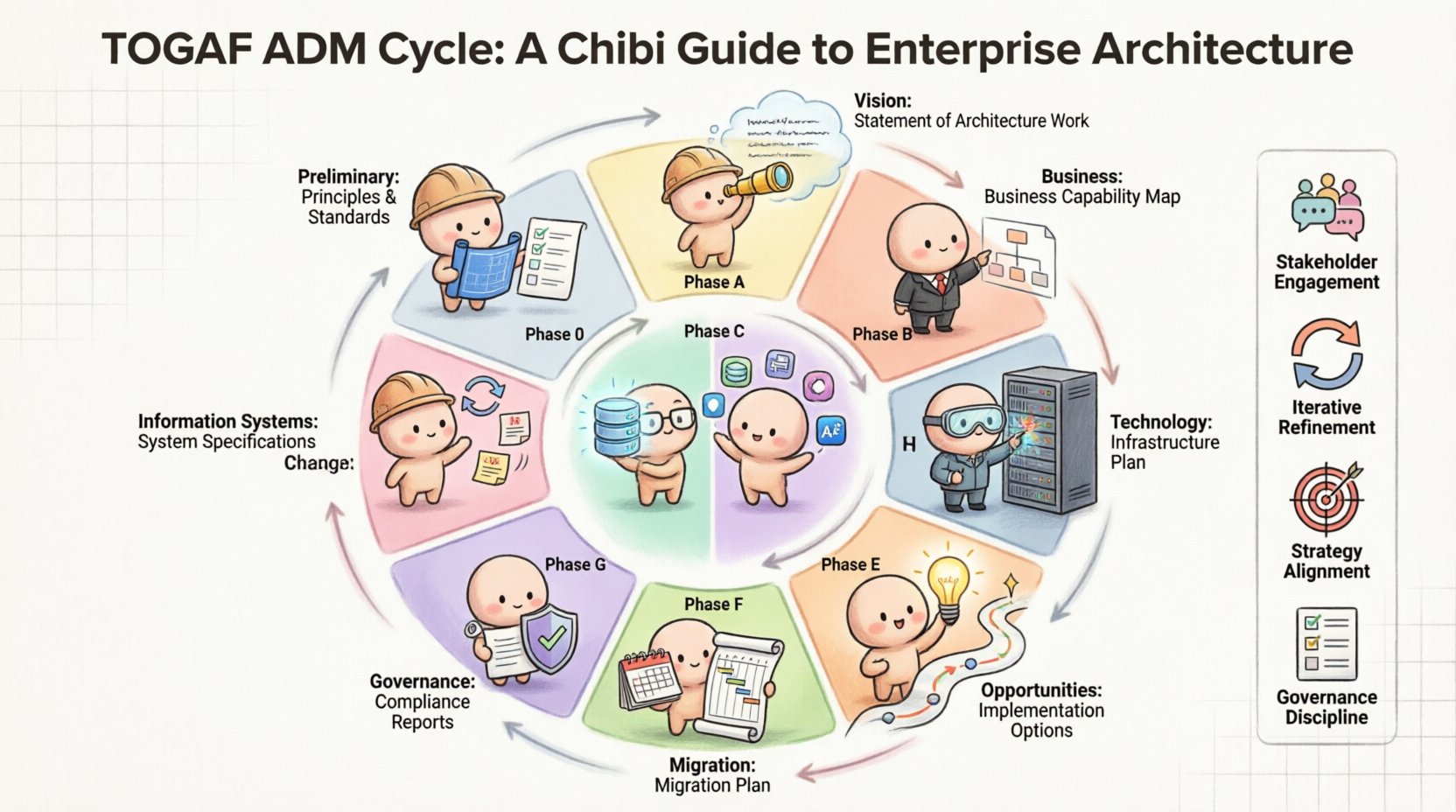
📚 What is the TOGAF Standard?
The Open Group Architecture Framework (TOGAF) is a globally recognized framework for enterprise architecture. It provides a comprehensive approach to managing enterprise architecture. The goal is not just to build systems, but to build systems that support business goals efficiently.
- Standardization: It offers a common vocabulary and set of practices.
- Flexibility: It can be adapted to fit various organizational sizes and industries.
- Integration: It connects business strategy with IT execution.
While the framework contains many components, the ADM is the engine that drives the actual work. It is an iterative process, meaning it repeats and refines over time.
🔄 The Architecture Development Method (ADM) Overview
The ADM is the backbone of TOGAF. It guides architects through the phases required to develop a robust architecture. Think of it as a project lifecycle, but one that is flexible enough to handle changes in requirements and technology.
The cycle consists of several distinct phases, starting from a high-level vision and ending with ongoing governance. It is not strictly linear; feedback loops exist between phases to ensure the output remains relevant.
Key Characteristics of the ADM Cycle
- Iterative: You can loop back to previous phases if requirements change significantly.
- Requirements Driven: The process begins with understanding what the business needs.
- Stakeholder Focused: Every phase involves engaging with specific groups within the organization.
- Artifact Based: Deliverables are documented to ensure knowledge transfer and compliance.
🏁 Phase 0: Preliminary Phase
Before starting the actual architecture work, the organization must prepare. This is the Preliminary Phase. It sets the stage for success.
- Define Principles: Establish rules that guide decision-making. For example, “Cloud first” or “Buy before build”.
- Define Standards: Set technical standards that all solutions must adhere to.
- Define Framework: Customize the ADM to fit the organization’s specific needs.
- Identify Stakeholders: Know who has a say in the outcome.
This phase ensures that when the real work begins, the team has a clear mandate and the necessary governance structures in place.
🔭 Phase A: Architecture Vision
Phase A sets the scope and direction. It is about defining the problem and the goal.
- Identify Constraints: What limits the project? Budget, time, or regulatory requirements?
- Define Scope: What is included in this architecture project and what is excluded?
- Secure Approval: Get the stakeholders to agree on the vision.
- Create Statement of Architecture Work: A document that outlines the plan and resources required.
Without a clear vision, projects drift. This phase ensures everyone agrees on the destination before the journey begins.
🏢 Phase B: Business Architecture
Now we look at the business itself. Business architecture defines the business strategy, governance, organization, and key business processes.
- Business Capability Map: What can the organization do? This helps identify gaps.
- Value Stream Mapping: How does value get delivered to the customer?
- Organization Mapping: How is the company structured to support these capabilities?
- Process Modeling: Documenting the “as-is” state to understand current operations.
This phase is critical because technology must serve the business. If the business architecture is flawed, the technology architecture will not fix it.
💾 Phase C: Information Systems Architectures
Phase C splits into two domains: Data Architecture and Application Architecture. This is where the specific systems are defined.
Data Architecture
- Logical Data Models: How data is structured and related.
- Physical Data Models: How data is stored physically.
- Data Governance: Who owns the data and how is it protected?
- Data Flow: How does information move between systems?
Application Architecture
- Application Portfolio: What applications exist currently?
- Application Interaction: How do applications talk to each other?
- Service Orientation: Defining services to reduce redundancy.
Together, these ensure that the right data is available to the right applications to support business processes.
⚙️ Phase D: Technology Architecture
Phase D defines the hardware and software infrastructure required to support the applications and data.
- Network Infrastructure: Connectivity and communication channels.
- Hardware Platforms: Servers, storage, and endpoints.
- Software Infrastructure: Operating systems, middleware, and databases.
- Security Architecture: Protecting the infrastructure from threats.
This phase translates the logical requirements from Phase C into physical realities. It ensures the environment is scalable, secure, and performant.
🚀 Phase E: Opportunities and Solutions
Now that we know the target state, we must figure out how to get there. This phase focuses on options and implementation planning.
- Identify Options: What are the different ways to achieve the target?
- Build Business Cases: Analyze the cost and benefit of each option.
- Select Transition Architectures: Define intermediate steps to reach the final goal.
- Align Investments: Ensure funding matches the architectural plan.
This is a decision-making phase. It moves the project from theory to a concrete plan of action.
📅 Phase F: Migration Planning
Phase F turns the selected plan into a detailed schedule. It manages the transition from the current state to the target state.
- Project Prioritization: What gets done first?
- Resource Allocation: Who does the work?
- Gap Analysis: What is missing between the current and target state?
- Implementation Plan: A roadmap with milestones and deliverables.
A detailed migration plan prevents chaos during implementation. It ensures that changes happen in a controlled manner.
🛡️ Phase G: Implementation Governance
During the actual build, Phase G ensures the project stays true to the architecture.
- Compliance Monitoring: Are the solutions adhering to the defined standards?
- Architecture Contracts: Agreements between the architecture team and the implementation team.
- Change Management: Handling deviations from the plan.
- Support: Providing guidance to the implementation teams.
This phase acts as a quality gate. It prevents “architecture drift” where the final product differs significantly from the design.
🔄 Phase H: Architecture Change Management
The final phase of the cycle addresses the fact that business needs change over time. Architecture is not a one-time event.
- Monitor Changes: Track new business requirements or technology shifts.
- Assess Impact: How does a change affect the existing architecture?
- Update Architecture: Modify the architecture to accommodate the change.
- Trigger Next Cycle: If the change is significant, a new ADM cycle may be required.
Enterprise architecture must remain relevant. This phase ensures the framework adapts to the evolving landscape.
📊 Summary of the ADM Cycle
To make the phases easier to digest, here is a summary table of the core components and their primary outputs.
| Phase | Focus Area | Key Output |
|---|---|---|
| Preliminary | Preparation | Architecture Principles & Standards |
| A | Vision | Statement of Architecture Work |
| B | Business | Business Capability Map |
| C | Data & Application | System Specifications & Models |
| D | Technology | Technical Standards & Infrastructure Plan |
| E | Options | Implementation Roadmap |
| F | Migration | Migration Plan |
| G | Governance | Compliance Reports |
| H | Change | Architecture Change Request |
🗄️ The Architecture Repository
Throughout the ADM cycle, information is stored in the Architecture Repository. This is not just a file server; it is a structured storage mechanism for architecture artifacts.
- Architecture Metamodel: Defines the structure of the data within the repository.
- Standards Information Base: Stores policies and standards.
- Architecture Landscape: High-level views of the current and target architectures.
- Building Blocks: Reusable components that can be used across projects.
- Reference Models: Generic models that help standardize the architecture.
- Architecture Content: The actual models, diagrams, and documents created during the phases.
Managing this repository ensures that knowledge is preserved and accessible. It prevents the loss of critical design decisions when staff members leave the organization.
🔑 Key Success Factors for the ADM
Implementing the TOGAF ADM successfully requires more than just following the steps. It requires a specific approach to culture and execution.
1. Stakeholder Engagement
Architecture is a social activity. You cannot design in a vacuum. Regular communication with stakeholders ensures that the architecture solves real problems.
- Identify decision-makers early.
- Present findings in terms they understand.
- Listen to concerns and incorporate feedback.
2. Iterative Refinement
Do not aim for perfection in the first pass. Build a draft, review it, and refine it. This reduces risk and allows for learning.
- Start with high-level views.
- Add detail only when necessary.
- Validate assumptions frequently.
3. Alignment with Strategy
Every architectural decision should trace back to a business objective. If a technology choice does not support the strategy, it should be questioned.
- Map capabilities to strategic goals.
- Measure architecture value through business metrics.
- Review strategic shifts regularly.
4. Governance Discipline
Without governance, standards are ignored. A clear process for reviewing and approving changes is vital.
- Define clear roles and responsibilities.
- Establish checkpoints for major milestones.
- Enforce compliance without being obstructive.
🛠️ Practical Application Tips
When applying this framework in a real-world setting, keep these practical tips in mind to maintain momentum.
- Start Small: Apply the ADM to a specific business unit or project before scaling to the enterprise.
- Use Templates: Create standard templates for documents to save time and ensure consistency.
- Automate Where Possible: Use tools to manage the repository and track compliance, but do not let tools drive the strategy.
- Train the Team: Ensure all architects understand the method and its purpose.
- Document Decisions: Record the “why” behind decisions, not just the “what”.
🔍 Addressing Common Misconceptions
There are several myths surrounding the Architecture Development Method that can hinder adoption.
Myth: It is too rigid
The ADM is a framework, not a strict rulebook. It is designed to be tailored. You can skip phases if they are not relevant to your current situation, provided you document why.
Myth: It slows down delivery
While it requires upfront planning, the ADM reduces rework later. By catching issues early in the vision and design phases, you avoid costly changes during implementation.
Myth: It is only for IT
Enterprise architecture spans the whole business. The Business Architecture phase ensures that finance, operations, and HR are aligned with technology, not just IT teams.
📈 Measuring Architecture Value
How do you know the ADM cycle is working? You need metrics that reflect business value, not just technical output.
- Time to Market: Are new products or services being delivered faster?
- System Stability: Is the infrastructure more reliable?
- Cost Efficiency: Are there fewer redundant systems?
- Compliance Rate: Are projects adhering to security and regulatory standards?
- Stakeholder Satisfaction: Are business leaders happy with the outcomes?
Regularly reviewing these metrics helps adjust the approach and demonstrates the contribution of architecture to the organization.
🌐 The Evolving Landscape
The world of enterprise architecture is changing. Cloud computing, artificial intelligence, and remote work are altering how organizations operate. The ADM remains relevant because it is adaptable.
- Cloud Integration: Technology architecture now heavily favors cloud-native solutions.
- Data Privacy: Data architecture must account for GDPR and similar regulations.
- Agile Alignment: The iterative nature of ADM fits well with Agile development practices.
- Ecosystem Thinking: Architecture now extends beyond the enterprise to include partners and suppliers.
Staying current with these trends ensures the architecture remains competitive. The ADM provides the structure to integrate these new elements without losing sight of the core business goals.
📝 Final Thoughts on TOGAF ADM
The Architecture Development Method is a proven path for navigating complex organizational change. It provides structure where there might otherwise be confusion. By breaking down the process into manageable phases, it allows teams to focus on specific goals without losing the big picture.
Success comes from discipline, clear communication, and a willingness to adapt. The framework is a tool, not a goal. Use it to build value, solve problems, and enable the business to move forward with confidence. When implemented with care, the ADM cycle becomes a vital asset for long-term organizational success.
Related posts:
 TOGAF Definitive Overview: A Clear Roadmap for Chief Enterprise Architects Starting Their Journey
 How to Begin Your TOGAF Practice: The Essential Quick Start Guide for Architecture Leads
 The Beginner’s Checklist for Launching a Successful TOGAF Architecture Practice
 TOGAF Case Study: How a Global Enterprise Aligned Strategy and Technology from Day One