

Academic projects often feel like a race against time, where the finish line seems to move depending on the feedback you receive from instructors. This is the reality of student teams working on capstone projects, software development courses, or research initiatives. One of the most common challenges faced during these endeavors is managing scope changes. Unlike professional environments where contracts might lock in requirements, student projects often evolve as understanding deepens or external constraints shift.
Scrum, an agile framework designed for complex problem-solving, offers a robust structure for managing this fluidity. However, applying Scrum in an academic setting requires a nuanced approach. Students must balance the flexibility of the framework with the rigid deadlines imposed by university calendars. This guide explores how to maintain adaptability while ensuring project delivery remains on track.
Understanding the Nature of Scope Changes in Academia 🏛️
Scope creep is not unique to the corporate world; it is prevalent in educational projects. In a student context, scope changes typically stem from several specific sources. Recognizing these sources is the first step toward managing them effectively.
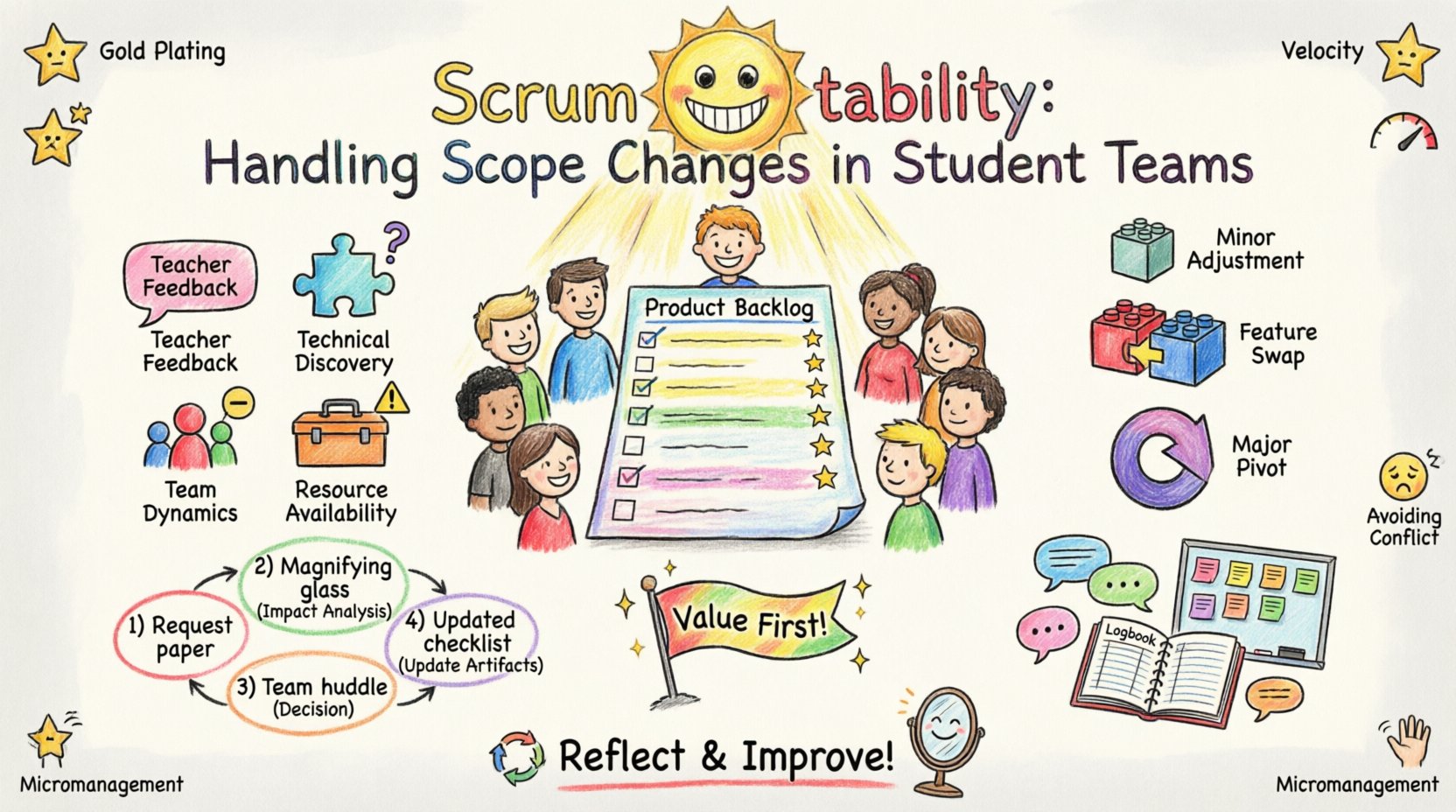
- Instructor Feedback: Professors often provide iterative feedback that can alter the direction of a project. A feature requested in Week 3 might be deemed unnecessary by Week 6, or a new requirement might emerge based on new course material.
- Technical Discovery: During the development phase, teams often discover that a chosen technology stack is insufficient or that a specific integration is more complex than anticipated. This naturally leads to a need for adjustment in deliverables.
- Team Dynamics: Student groups frequently experience changes in membership. If a member leaves or joins mid-semester, the available capacity changes, which directly impacts the amount of work that can be completed.
- Resource Availability: Access to hardware, lab space, or specific datasets might fluctuate. If a dataset becomes unavailable, the team must pivot to a different approach, altering the scope.
Without a structured approach, these changes can lead to stress, missed deadlines, and incomplete work. A rigid plan fails when the environment is dynamic. Scrum thrives in dynamic environments, provided the team understands how to utilize its mechanisms.
Why Student Teams Struggle with Agility 📉
While the theoretical benefits of Scrum are well-documented, practical application in student teams often faces hurdles. Understanding these friction points helps in anticipating where things might go wrong.
- Fixed Deadlines: Unlike commercial projects where a delay might just mean a cost overrun, academic projects have hard stop dates (final submission, presentation day). There is no flexibility to extend the timeline, which puts pressure on scope management.
- Lack of Experience: Many students are encountering agile methodologies for the first time. They may struggle to distinguish between a valid scope change and a distraction.
- Academic Pressure: Students often juggle multiple courses and exams. A spike in workload during finals week can halt progress, leading to a sudden need to cut scope to meet the original deadline.
- Communication Gaps: Student teams often rely on informal communication channels. Without a central source of truth, scope changes can be communicated inconsistently, leading to confusion about what is actually in or out of scope.
The Scrum Framework as a Stabilizer 🛡️
Scrum is not a rigid set of rules; it is a set of roles, events, and artifacts designed to facilitate adaptation. For student teams, the framework provides the necessary scaffolding to handle change without losing focus.
The Product Backlog as a Living Document
The Product Backlog is the single source of truth for what needs to be built. It is ordered by value and priority. In a student context, this list should not be static. When a scope change occurs, it is not a crisis; it is an update to the backlog. This shifts the mindset from “we are failing” to “we are refining our plan.”
- Refinement: Regular backlog refinement sessions allow the team to discuss potential changes before they become urgent issues.
- Re-prioritization: If a new requirement emerges that is more valuable than an existing item, the backlog can be reordered immediately.
Sprint Goals vs. Scope
It is crucial to understand the difference between the Sprint Goal and the Sprint Backlog items. The Sprint Goal is the objective for the iteration. The items are the tasks committed to achieve that goal. If a scope change occurs mid-sprint, the goal might still be achievable if the team swaps out lower-value items for new ones that align with the goal.
Identifying Change Types 🧐
Not all scope changes are created equal. Some are minor adjustments, while others are significant pivots. Student teams need a way to categorize these changes to decide how to react.
| Change Type | Description | Recommended Action |
|---|---|---|
| Minor Adjustment | Small tweaks to existing features (e.g., changing a button color, refining a text field). | Handle within the current Sprint without formal meetings. |
| Feature Swap | Replacing a low-priority item with a high-priority item. | Discuss during the Sprint Review or Retrospective; adjust the Sprint Backlog if capacity allows. |
| Major Pivot | A fundamental change to the product vision or core functionality. | Initiate a new Sprint Planning session to reset the Sprint Goal and Backlog. |
A Protocol for Managing Scope Adjustments 📝
When a change is proposed, the team needs a clear process. Ad-hoc decisions lead to chaos. A structured protocol ensures that every change is evaluated for its impact on the deadline and the team’s well-being.
Step 1: The Request
Any member, including the instructor, can propose a change. However, the proposal should be documented. This prevents the “I thought you were doing that” scenario. The request should include:
- What is changing?
- Why is it changing?
- What is the impact on time or resources?
Step 2: Impact Analysis
The team must assess the change. This involves looking at the remaining capacity. If the deadline is fixed, adding work means removing other work. The team needs to calculate if the new work fits within the current velocity.
- Time Impact: How many hours does this add?
- Quality Impact: Will rushing this feature compromise the rest of the project?
- Dependency Impact: Does this block other team members?
Step 3: Team Decision
Scrum is a team effort. The decision to accept a scope change should be made collectively. The Scrum Master (or project lead) facilitates this discussion. The team must agree on whether they can accommodate the change without jeopardizing the Sprint Goal or the final deadline.
Step 4: Update Artifacts
Once the decision is made, the artifacts must be updated. The Product Backlog is reordered. The Sprint Backlog is adjusted. The task board is updated. This transparency ensures everyone knows the current state of the project.
Communication During Flux 🗣️
Information asymmetry is the enemy of adaptability. When scope changes occur, communication must be frequent and clear. In student teams, this often means moving away from email and towards real-time collaboration.
- Daily Syncs: The Daily Scrum is not just for status updates. It is the ideal time to flag potential scope issues early. If a member realizes a task is taking longer than expected, they can alert the team immediately.
- Visual Management: Using a physical or digital task board makes changes visible. Moving a card from “To Do” to “Done” or adding a new card signals progress and change to everyone.
- Documentation: Keep a simple log of decisions made regarding scope. This serves as a reference point if questions arise later about why certain features were dropped.
The Scrum Master’s Role in Education 👮♂️
In a professional setting, the Scrum Master is a dedicated role. In a student team, this responsibility is often shared or rotated. Regardless of the title, someone must act as the facilitator of change.
The facilitator must protect the team from unnecessary work. They must also ensure that the team does not become complacent. When scope changes are frequent, the team might feel overwhelmed. The facilitator’s job is to maintain morale and focus.
- Shielding: Prevent external stakeholders from making last-minute requests that disrupt the current Sprint.
- Coaching: Help the team understand the value of the framework. Explain why they are re-prioritizing and why it is okay to drop a feature.
- Conflict Resolution: Scope changes often cause conflict. Some members want to add features; others want to stick to the plan. The facilitator mediates these discussions.
Common Pitfalls to Watch Out For ⚠️
Even with a framework, student teams can fall into traps. Being aware of these common pitfalls helps in avoiding them.
- Gold Plating: This happens when the team adds extra features “just because” without a stakeholder request. This is a form of self-inflicted scope creep. It consumes time that should be spent on core requirements.
- Ignoring Velocity: Teams often overestimate their capacity. If a team completes 10 points in a sprint, they cannot suddenly complete 20 points in the next sprint without a significant change in resources. Adjusting scope based on realistic velocity is key.
- Avoiding Conflict: Students often fear saying “no” to a professor or a team member. They agree to changes they know they cannot deliver. This leads to burnout and poor quality. Learning to negotiate scope is a vital skill.
- Micromanagement: Trying to control every detail of the scope change can slow down the team. Trust the team to manage their own tasks within the agreed constraints.
Keeping the Sprint Goal Alive 🎯
The ultimate objective is to deliver value. If scope changes threaten the Sprint Goal, the team must be willing to make sacrifices. This might mean reducing the quality of a non-critical feature or removing a nice-to-have feature entirely.
Value-driven prioritization is essential. Ask: Does this change add value to the final deliverable? If the answer is no, or if the cost is too high, the change should be declined or deferred to a future iteration.
Post-Sprint Reflection on Changes 🔄
The Retrospective is the place to reflect on how scope changes were handled. Did the process work? Were the changes managed smoothly? Or did they cause chaos?
- What went well? Identify successful strategies for handling changes.
- What went wrong? Pinpoint where the process broke down.
- What will we improve? Set a goal for the next Sprint regarding change management.
This continuous improvement loop is the heart of Scrum. It ensures that the team gets better at handling adaptability with every iteration.
Tools for Tracking (Generic) 📋
While there are many software solutions available, student teams can achieve the same results with simple tools. The focus should be on the process, not the tool.
- Spreadsheet: A shared spreadsheet can track the backlog, priorities, and status. It is flexible and easy to update.
- Whiteboard: For in-person teams, a physical whiteboard is excellent for visualizing flow and changes.
- Text Files: For remote teams, a shared text document or markdown file can serve as the backlog.
The tool matters less than the discipline of updating it. Consistency is key to maintaining a clear view of the scope.
Final Thoughts on Adaptability 🌱
Scope changes in student teams are inevitable. They are not a sign of failure; they are a sign of learning and adaptation. By using Scrum principles, students can navigate these changes with confidence. The goal is not to prevent change, but to manage it effectively.
When you embrace flexibility, you build resilience. You learn that the plan is a guide, not a cage. You learn to communicate clearly and make tough decisions together. These are the skills that will serve you long after the course ends.
Remember that the deadline is fixed, but the path to get there can vary. Scrum gives you the map to navigate that path. Use it wisely, and your student projects will not only survive scope changes but thrive because of them.