

Engineering education often focuses heavily on syntax, algorithms, and system architecture. However, the ability to collaborate effectively within a structured framework is equally critical for a successful career. Open source software represents one of the most significant collaborative endeavors in modern technology. It is a global playground where ideas are tested, refined, and deployed without the constraints of a traditional corporate hierarchy.
Integrating Scrum methodologies into open source contributions offers a unique learning opportunity. It bridges the gap between theoretical project management and real-world distributed collaboration. For engineering students, understanding how to navigate the chaos of volunteer-driven development using Agile principles can transform a casual contributor into a valued maintainer. This guide explores the intersection of Scrum and open source, providing actionable insights for students looking to enhance their skills and contributions.
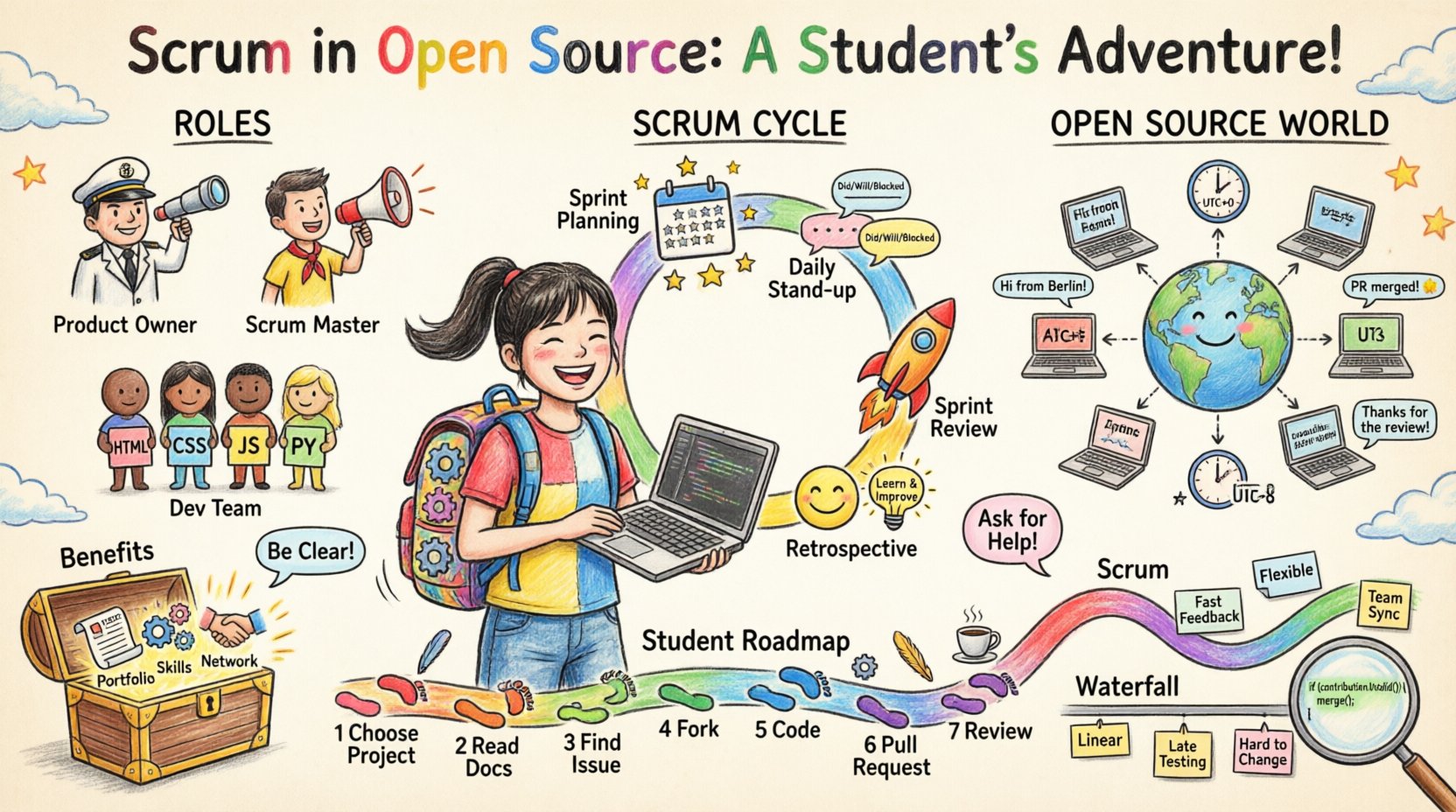
🏗️ Understanding the Scrum Framework
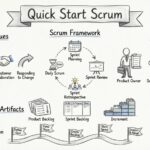
Before applying Scrum to open source, one must understand the core pillars. Scrum is not merely a set of meetings; it is a framework for managing complex product development. It relies on empirical process control, meaning decisions are based on observation and experimentation rather than detailed upfront planning.
👥 Key Roles
In a traditional corporate setting, roles are often assigned by management. In open source, these roles are often emergent or self-assigned.
- Product Owner: Represents the voice of the users. In open source, this is often the project maintainer or core contributor who prioritizes features based on community feedback.
- Scrum Master: Facilitates the process, removes impediments, and ensures the team adheres to Scrum values. In open source, this might be a volunteer moderator or a dedicated contributor who helps organize discussions.
- Development Team: A cross-functional group of professionals who do the work. In open source, these are the contributors who write code, write documentation, and review pull requests.
⏱️ Core Events
Time-boxed events create rhythm and predictability. In a distributed open source environment, these events must be adapted for asynchronous communication.
- Sprint Planning: Selecting work for the upcoming cycle. In open source, this happens when maintainers set up milestone issues or roadmap boards.
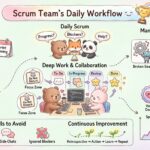
- Daily Stand-up: A sync to discuss progress and blockers. In open source, this is often replaced by a dedicated chat channel or a weekly status update thread.
- Sprint Review: Demonstrating the increment. In open source, this is the release of a new version or feature branch merge.
- Sprint Retrospective: Reflecting on the process. In open source, this occurs in community forums or dedicated feedback sessions after a major release.
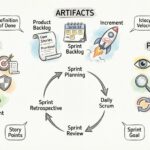
📦 Artifacts
Transparency is key. Artifacts provide the single source of truth for the project state.
- Product Backlog: An ordered list of everything known to be needed in the product. In open source, this is typically the issue tracker or feature request list.
- Sprint Backlog: The set of Product Backlog items selected for the Sprint. This is the list of issues labeled as “In Progress” or “Sprint Goal”.
- Increment: The sum of all Product Backlog items completed during a Sprint. This is the actual code or documentation merged into the main branch.
🌍 The Unique Nature of Open Source
Open source projects differ significantly from internal corporate teams. The motivations, constraints, and workflows require a nuanced approach to Scrum.
- Distributed Teams: Contributors may be on opposite sides of the planet, working in different time zones. Synchronous meetings are often impractical.
- Volunteer Basis: Unlike paid employees, contributors have other jobs or studies. Availability is fluid and unpredictable.
- Meritocracy: Authority is often derived from code quality and contribution history rather than job titles.
- Public Scrutiny: Every line of code and decision is visible to the world. This demands higher standards for documentation and communication.
Applying Scrum here requires flexibility. Rigid adherence to Scrum rules can stifle the organic growth of an open source community. The goal is to adapt the principles, not just the practices.
🔗 Bridging the Gap: Applying Scrum to OSS
For engineering students, the transition from academic group projects to open source contributions can be jarring. Here is how to map Scrum concepts to the open source landscape.
📝 Managing the Backlog Without Tools
While many projects use specific issue tracking systems, the concept remains the same. The backlog must be visible, ordered, and refined.
- Grooming: Regularly reviewing issues to ensure descriptions are clear. As a student, you can contribute by commenting on ambiguous issues and asking for clarification.
- Estimation: Using relative sizing (like Story Points) helps manage expectations. In open source, you might estimate based on complexity rather than time, given the volunteer nature.
- Prioritization: Issues should be ranked by value to the user. Students should look for “good first issues” that provide immediate value to the community.
🤝 Collaboration and Communication
Communication is the lifeblood of Scrum. In open source, this happens via text, not voice.
- Transparency: Post updates in public channels. If you are blocked, state it clearly so others can help.
- Async Stand-ups: Post a daily update in a dedicated channel: “What I did, What I will do, Blockers.” This mimics the daily stand-up without requiring everyone to be online simultaneously.
- Code Reviews: These serve as quality gates and learning opportunities. Treat every comment as feedback for process improvement, not personal criticism.
🎓 Benefits for Engineering Students
Participating in open source using Scrum principles offers tangible career advantages.
📈 Professional Growth
- Portfolio Building: Real-world contributions are more valuable than academic assignments.
- Soft Skills: You learn negotiation, time management, and conflict resolution in a high-stakes environment.
- Network Expansion: You connect with senior engineers and maintainers who can provide mentorship.
🧠 Technical Depth
- Code Quality: You learn to write code that meets community standards, not just passes a test suite.
- Architecture: You see how large systems are structured and maintained over years.
- Tooling Proficiency: You gain experience with version control, CI/CD pipelines, and deployment strategies.
⚖️ Comparison: Scrum vs. Traditional Waterfall in OSS
Understanding why Scrum fits better than other methodologies is crucial for students entering the space.
| Feature | Scrum (Agile) | Waterfall |
|---|---|---|
| Planning | Iterative and adaptive | Fixed upfront |
| Feedback Loop | Short cycles (Sprints) | End of project |
| Flexibility | High (Changes welcomed) | Low (Changes costly) |
| Documentation | Just enough to support work | Comprehensive before coding |
| Best For | Uncertain requirements, innovation | Fixed scope, regulatory needs |
Open source projects often deal with uncertain requirements. Users request features that change the direction of the project. Scrum accommodates this shift, whereas Waterfall might lead to delivering a product that is no longer relevant upon completion.
🛠️ Common Challenges & Solutions
Even with a framework, challenges arise. Here is how to navigate common pitfalls.
🕒 Time Zone Conflicts
Challenge: The team is never online at the same time.
Solution: Adopt asynchronous communication. Document decisions clearly so they can be read later. Use tools that allow threaded discussions to maintain context.
🧩 Scope Creep
Challenge: Too many ideas, too little time.
Solution: Strictly enforce the Sprint Goal. If a new idea arises, add it to the backlog. Do not pull it into the current sprint unless the team agrees and has capacity.
👥 Contributor Burnout
Challenge: Volunteers leave due to pressure.
Solution: Keep tasks manageable. Break large features into smaller, completable increments. Celebrate small wins publicly to maintain morale.
📋 Roles Mapping: Academic vs. Open Source
Students often confuse their academic roles with professional ones. This table clarifies the mapping.
| Academic Role | Open Source Equivalent | Responsibility |
|---|---|---|
| Team Lead | Maintainer / Core Contributor | Decides architecture and merges code. |
| Student Developer | Contributor | Implements features and fixes bugs. |
| Professor | Community Manager | Enforces guidelines and culture. |
| Assignment | Issue / Task | Specific work item to be completed. |
| Grade | Code Review Feedback | Validation of quality and correctness. |
🚀 Practical Steps for Students
Ready to start? Follow this roadmap to begin your journey.
- Choose a Project: Pick an open source project that aligns with your interests. Ensure it is active and has a welcoming community.
- Read the Documentation: Understand the contribution guidelines. Look for a
CONTRIBUTING.mdfile. - Find a Good First Issue: Look for labels like “good first issue” or “beginner-friendly”. These are designed for newcomers.
- Fork and Clone: Create your own copy of the repository and download it to your local machine.
- Communicate: Comment on the issue to let maintainers know you are working on it. This prevents duplicate work.
- Write Code: Implement the feature following the project’s coding standards.
- Submit a Pull Request: Propose your changes. Provide a clear description of what you did and why.
- Review and Iterate: Be open to feedback. Changes are normal. Treat reviews as learning moments.
🗣️ Communication Protocols
Effective communication is the glue that holds Scrum together in open source. Without face-to-face interaction, clarity is paramount.
📝 Writing Clear Descriptions
When creating an issue or a pull request, avoid vague language. Use the following structure:
- Title: Concise summary of the change.
- Description: Context, problem statement, and proposed solution.
- Examples: Show how the code works before and after.
- Testing: Explain how the change was tested.
🤝 Handling Conflict
Disagreements happen. In Scrum, the goal is to resolve them through dialogue, not dominance.
- Focus on the Code: Critique the implementation, not the person.
- Use Data: Reference documentation or standards to support your argument.
- Escalate When Needed: If a deadlock occurs, ask a maintainer or Scrum Master to mediate.
🧪 Quality Assurance & Testing
In a corporate setting, QA teams often test software. In open source, the community shares this responsibility.
- Automated Testing: Ensure your code passes existing test suites. This proves you haven’t broken anything.
- Manual Testing: Verify the user experience. Does the feature work as intended in a real-world scenario?
- Linting: Follow the style guide. Consistent formatting makes the codebase easier to read.
- Security: Be vigilant. Never introduce vulnerabilities. Check dependencies for known issues.
Students often skip testing to rush a submission. This is a critical mistake. Quality is a non-negotiable aspect of Scrum. A sprint is not complete until the increment is potentially shippable and tested.
🔄 Continuous Improvement
Scrum emphasizes continuous improvement through retrospectives. Open source projects often lack formal retrospectives, but students can implement them personally.
- Self-Reflection: After each contribution, ask yourself what went well and what could be improved.
- Feedback Loop: Ask maintainers for feedback on your contribution process, not just the code.
- Iterate: Apply lessons learned to the next issue. Do not make the same mistake twice.
This mindset of constant refinement is what separates junior contributors from senior ones. It shows a commitment to growth and a respect for the project’s longevity.
🌱 Building a Personal Brand
Your open source activity serves as a professional portfolio. Treat it with the same seriousness as a job.
- Consistency: Regular contributions show dedication. Sporadic activity can signal lack of commitment.
- Visibility: Engage in community discussions. Share your learnings on blogs or social media.
- Networking: Connect with other contributors. These relationships can lead to job opportunities or collaborations.
Remember, the community values helpfulness. Answering questions in forums, helping new contributors, and documenting bugs are all valuable contributions that build your reputation.
📉 Managing Expectations
It is important to manage expectations regarding the pace of open source.
- Review Times: Maintainers are volunteers. Reviews can take days or weeks. Patience is required.
- Rejections: Your code might be rejected. This is not a failure; it is part of the process. Understand the reasoning and learn.
- Scope Changes: Requirements change frequently. Be prepared to pivot your work based on new information.
Understanding these realities prevents frustration and burnout. It allows you to focus on the process rather than just the outcome.
🎓 Conclusion
Integrating Scrum into open source projects provides a robust framework for engineering students to develop both technical and soft skills. By understanding the roles, events, and artifacts, students can navigate the complexities of distributed collaboration effectively. The open source environment offers a low-risk, high-reward space to practice Agile principles, learn from peers, and build a lasting professional reputation.
As you embark on this journey, remember that the goal is not just to write code, but to contribute to a community. The skills you gain in managing backlogs, communicating asynchronously, and maintaining quality standards will serve you throughout your career. Embrace the challenges, learn from the feedback, and continue to iterate on your approach. The path to becoming a top-tier engineer is paved with consistent, collaborative effort.
Start small, stay consistent, and let the process guide you. The future of software is built together, and you have a vital role to play in that construction.