

The heartbeat of any agile team lies within the retrospective. It is the dedicated time where the squad pauses to examine its processes, interactions, and outcomes. Without a structured approach, these sessions can drift into complaints or vague generalities. Scrum retrospective templates provide the necessary framework to transform feedback into tangible progress. They ensure that every sprint concludes with clarity and purpose.
Continuous improvement is not a destination but a practice. To maintain momentum, teams need tools that facilitate honest conversation and actionable planning. This guide explores the mechanics of effective retrospective formats, helping teams select the right approach for their specific context. We will look at how to structure these meetings to maximize value without relying on external tools or software.
The Strategic Value of Retrospectives 🎯
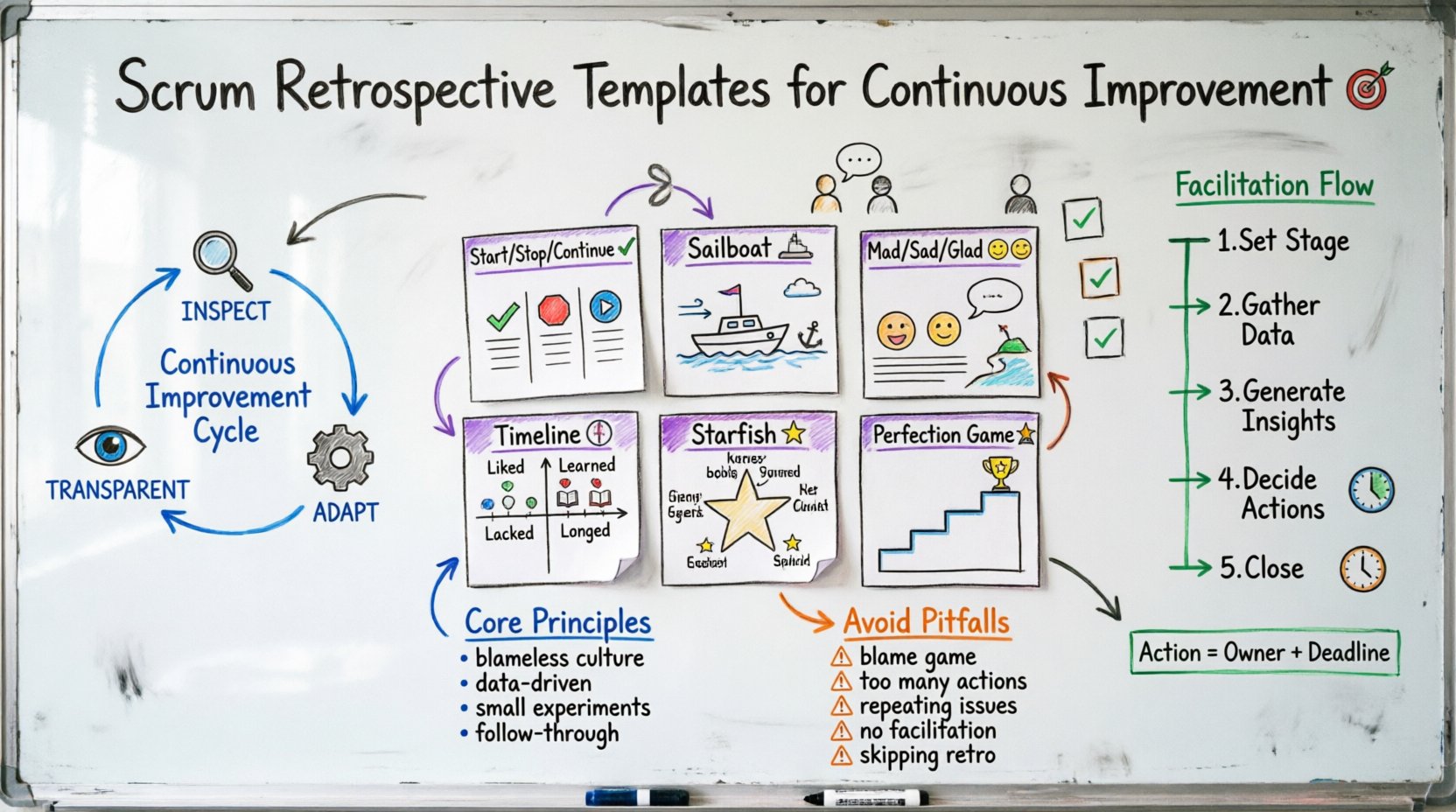
Retrospectives are often misunderstood as simple complaint sessions. In reality, they are strategic planning meetings for the team’s own dynamics. The goal is to inspect the last sprint and adapt the process for the next one. This aligns directly with the empirical process control foundation of Scrum: transparency, inspection, and adaptation.
When conducted effectively, retrospectives yield several key benefits:
- Psychological Safety: A structured environment allows team members to voice concerns without fear of retribution.
- Process Optimization: Identifying bottlenecks in the workflow leads to smoother execution.
- Team Cohesion: Open discussion builds trust and aligns expectations among members.
- Action Ownership: Defined tasks ensure that insights lead to actual change.
Skipping this step or treating it casually often results in repetitive mistakes. The same issues resurface in subsequent sprints because the root causes were never addressed. Templates provide a consistent rhythm that keeps the team focused on improvement rather than symptoms.
Why Structure Matters in Your Retrospective 📝
Unstructured brainstorming can lead to dominant voices taking over the conversation. Some team members may remain silent, while others focus only on minor grievances. A template acts as a scaffold, ensuring that every perspective is heard and that the discussion remains productive.
Structure also reduces the cognitive load on the facilitator. Instead of inventing a new activity every time, the team can focus on the content of the discussion. This consistency builds a habit. Over time, participants learn how to contribute effectively because they understand the format.
Key elements of a structured retrospective include:
- Time Boxing: Allocating specific minutes to each phase prevents the meeting from running over.
- Clear Goals: Knowing what the team hopes to achieve before starting sets the tone.
- Visual Aids: Using boards, sticky notes, or whiteboards makes abstract ideas concrete.
- Actionable Outputs: The session must end with a list of agreed-upon experiments.
Core Principles for Effective Sessions ⚖️
Before selecting a specific template, it is essential to understand the principles that make any retrospective successful. The format is secondary to the culture surrounding the meeting.
Blameless Culture: The focus must be on the process, not the person. If a bug escaped to production, the discussion should be about the testing process, not who wrote the code.
Data-Driven Insights: Relying on metrics and facts rather than feelings leads to better decisions. Velocity, defect rates, and cycle time should inform the conversation.
Small Experiments: Trying to fix everything at once leads to burnout. Implementing small, manageable changes allows the team to test and learn.
Follow-Through: An action item without an owner is merely a wish. Every improvement task needs a responsible person and a deadline.
Top Scrum Retrospective Templates 🛠️
Different situations require different approaches. A team struggling with conflict needs a different format than a team focused on technical debt. Below are several proven templates used across agile organizations.
1. Start, Stop, Continue ✅
This is one of the most versatile and widely used templates. It categorizes team behaviors and processes into three distinct buckets. It is excellent for teams new to retrospectives because of its simplicity.
- Start: What new things should the team begin doing to improve efficiency?
- Stop: What activities are hindering progress or wasting time?
- Continue: What practices are working well and should be maintained?
When to use: General purpose, good for regular cadence.
Pros: Simple, easy to understand, encourages positive reinforcement.
Cons: Can become generic if not discussed deeply.
2. Mad, Sad, Glad 😠😢😄
This template focuses on the emotional state of the team. It acknowledges that work is done by humans, and emotions impact productivity. It helps surface hidden frustrations that standard process discussions might miss.
- Mad: What frustrated the team during the sprint?
- Sad: What disappointed the team or caused demotivation?
- Glad: What made the team happy or proud?
When to use: After a difficult sprint, or when team morale seems low.
Pros: Validates feelings, builds empathy, uncovers hidden blockers.
Cons: Can become a venting session if not guided carefully.
3. The Sailboat 🚢
Metaphorical frameworks help teams visualize abstract concepts. The Sailboat analogy is particularly effective for understanding direction and obstacles.
- Wind: What is pushing the team forward? (Motivators, support)
- Anchor: What is holding the team back? (Constraints, technical debt)
- Island: What is the goal we are sailing toward? (Sprint goal)
- Clouds: What uncertainties or risks are in the sky? (Unknowns)
When to use: Strategic planning, looking at the bigger picture beyond one sprint.
Pros: Visual, engaging, encourages strategic thinking.
Cons: Requires some facilitation to connect metaphors to concrete actions.
4. 4L (Liked, Learned, Lacked, Longed For) 📚
This format provides a balanced view of the past, present, and future. It goes beyond simple feelings to focus on knowledge and desire.
- Liked: What did the team enjoy about the sprint?
- Learned: What new skills or insights were gained?
- Lacked: What was missing that hindered progress?
- Longed For: What does the team wish for in the future?
When to use: Learning-focused teams, end of quarter reviews.
Pros: Promotes growth mindset, identifies resource gaps.
Cons: Can be abstract if not tied to specific events.
5. The Timeline ⏳
Time is a critical resource in Scrum. Mapping the sprint on a timeline helps identify exactly where delays or issues occurred.
- Draw a horizontal line representing the sprint duration.
- Mark key events, milestones, and meetings.
- Place notes above the line for successes or positive events.
- Place notes below the line for blockers or negative events.
When to use: Identifying specific bottlenecks in the workflow.
Pros: Highly visual, pinpoints timing issues.
Cons: Can feel like a post-mortem if not handled with care.
6. The Starfish ⭐
This template divides the retrospective into five categories, encouraging a holistic view of the sprint.
- Keep Doing: What worked well?
- More of: What should we do more of?
- Less of: What should we do less of?
- Start Doing: What new things should we try?
- Stop Doing: What should we cease immediately?
When to use: Teams looking for a detailed breakdown of behaviors.
Pros: Detailed categorization, clear action orientation.
Cons: Can be time-consuming if the team is large.
7. The Perfection Game 🏆
This is a high-energy format designed to identify what a perfect sprint looks like and what stands in the way.
- Perfect Sprint: Imagine the sprint was 100% successful. What happened?
- Obstacles: What prevented that perfection in reality?
- Solutions: How do we remove those obstacles next time?
When to use: When the team is feeling stuck or demotivated.
Pros: Positive framing, focuses on potential rather than failure.
Cons: Requires a confident facilitator to keep it grounded.
Selecting the Right Format for Your Team 🤔
Choosing a template is not a one-time decision. It should evolve as the team matures. A comparison table can help guide this selection process.
| Template | Best For | Time Required | Complexity |
|---|---|---|---|
| Start, Stop, Continue | New teams, routine checks | 30-45 mins | Low |
| Mad, Sad, Glad | Team morale, conflict resolution | 45-60 mins | Medium |
| Sailboat | Strategic alignment, vision | 60 mins | Medium |
| 4L | Learning culture, growth | 45-60 mins | Medium |
| Timeline | Process bottlenecks, workflow | 60 mins | High |
| Starfish | Detailed process analysis | 60 mins | High |
| Perfection Game | Motivation, overcoming blocks | 45-60 mins | Medium |
Consider the team size when making a choice. Larger groups may need more structured formats to ensure everyone participates. Smaller teams can often handle more open-ended formats. Also, consider the current mood. If the team is burned out, a heavy analytical format might feel exhausting. A lighter, positive-focused template might be better.
Facilitating the Session: A Step-by-Step Guide 📅
The facilitator plays a crucial role in the success of the retrospective. They do not need to be the Scrum Master, but someone should own the process. Here is a standard flow for running a session.
1. Set the Stage (5-10 Minutes)
Begin by reviewing the goal of the session. Remind the team of the ground rules. Establish a safe space where honesty is valued but respect is paramount. Use a quick icebreaker if the team is quiet.
2. Gather Data (15-20 Minutes)
Use the chosen template to collect information. If using sticky notes, give everyone time to write silently. This prevents groupthink and allows introverts to contribute. Place notes on a shared board or wall.
3. Generate Insights (15-20 Minutes)
Group similar items together. Discuss patterns. Ask “Why did this happen?” repeatedly to get to the root cause. Avoid jumping to solutions too early. Understanding the problem is half the battle.
4. Decide What to Do (15-20 Minutes)
Select the top 1-3 action items. Voting can help prioritize. Ensure each item has a clear owner. If there are too many ideas, ask the team to pick the ones that will have the highest impact.
5. Close the Retrospective (5 Minutes)
Summarize the agreed actions. Thank the team for their participation. End on a positive note. This reinforces the value of the meeting.
Turning Insights into Actionable Improvements 🚀
The most common failure in retrospectives is the lack of follow-through. An action item without an owner is a suggestion, not a plan. To ensure improvements stick, the team must integrate them into the workflow.
- Assign Owners: Every task needs a specific person responsible for its completion.
- Set Deadlines: Link the action to the next sprint or a specific date.
- Make it Visible: Post the action items in a visible location or on the task board.
- Review Progress: Start the next retrospective by reviewing the previous action items.
If an action item is not completed, do not punish the owner. Ask why it was blocked. Was the scope too large? Was the priority too low? Adjust the plan accordingly. The goal is progress, not perfection.
Common Pitfalls to Avoid ⚠️
Even with a good template, teams can fall into traps that undermine the process. Awareness of these pitfalls helps the team navigate them.
1. The Blame Game
Focusing on individuals rather than processes destroys trust. If a mistake happened, ask how the system allowed it. Shift the language from “You did this” to “The process resulted in this”.
2. Too Many Action Items
Trying to fix everything at once leads to nothing getting fixed. Limit the number of improvements to what the team can realistically achieve. Quality over quantity.
3. Repeating the Same Issues
If the same problem appears in every retrospective, it means no action was taken, or the action was ineffective. Escalate the issue to the wider organization if it is a systemic blocker.
4. Lack of Facilitation
Leaving the meeting to run wild often results in the loudest voices dominating. The facilitator must keep the conversation on track and ensure balanced participation.
5. Skipping the Retrospective
When deadlines are tight, the retrospective is often the first thing cut. This is a mistake. The time spent fixing problems later will far exceed the time spent planning improvements now.
Measuring the Impact of Your Retrospectives 📊
How do you know if the retrospective is working? Look for trends over time. While subjective feedback is valuable, objective data provides clarity.
- Velocity Stability: Does the team’s output become more predictable?
- Defect Rate: Are fewer bugs making it to production?
- Team Satisfaction: Is the team reporting higher morale?
- Action Completion: Is the team completing the agreed-upon improvements?
Track these metrics alongside the qualitative feedback from the sessions. If the team feels better but metrics do not improve, the actions may be too vague. If metrics improve but the team feels worse, the process may be too rigid. Balance is key.
Maintaining Momentum Over Time 🔋
Consistency is the key to continuous improvement. The team must treat the retrospective as a sacred time. It should not be cancelled unless absolutely necessary. If the format becomes stale, rotate the templates. Introduce new exercises occasionally to keep engagement high.
Involve different team members in the facilitation role. This distributes ownership and brings fresh perspectives to the process. It also prevents the facilitation from becoming a burden for one person.
Remember that improvement is a journey. There will be sprints where things do not go as planned. The retrospective is the tool that helps the team navigate those challenges. By committing to the process, the team builds resilience and the capability to adapt to change.
Final Thoughts on Process Evolution 🌱
The tools described here are starting points, not rigid rules. The best retrospective is the one that your team actually uses and finds valuable. Adapt the templates to fit your culture. Ignore the ones that do not resonate.
Continuous improvement is the core engine of the Scrum framework. Without it, the team stagnates. With it, the team evolves. Use these templates to fuel that evolution. Keep the focus on value, keep the atmosphere safe, and keep moving forward.