

University projects often feel like a chaotic sprint toward a deadline. Without a clear roadmap, student groups frequently face the stress of late submissions, uneven workload distribution, and the anxiety of unknown scope. Scrum estimation techniques offer a structured approach to predict effort and time. By adopting these methods, academic teams can improve collaboration, manage expectations, and deliver higher quality work.
Estimation in a student context is not about predicting the future with certainty. It is about creating a shared understanding of the work ahead. This guide explores practical, software-free methods to estimate tasks effectively. We will cover the mechanics of Planning Poker, relative sizing, and how to handle the inevitable disagreements that arise during group work.
🤔 Why Estimation Matters for Student Teams
Many student groups skip the planning phase to get straight to coding or writing. This approach often leads to burnout during the final week. Estimation provides several tangible benefits:
Realistic Deadlines: Helps you decide if a semester project is feasible within the given timeframe.
Balanced Workload: Identifies complex tasks early so they can be distributed evenly among members.
Resource Allocation: Clarifies how many hours per week each member needs to commit.
Early Risk Detection: Highlights high-risk tasks that might require extra support or time.
Grade Improvement: Structured planning often leads to better organization and documentation.
⚠️ Common Pitfalls in Student Estimation
Before diving into techniques, it is important to recognize why estimates often fail in academic settings.
Optimism Bias: Students often assume everything will go perfectly, ignoring potential bugs or research difficulties.
Ignoring Dependencies: Failing to account for tasks that must wait for others to finish first.
Confusing Effort with Time: Thinking a task takes two hours because it is simple, rather than considering interruptions and meetings.
Groupthink: Agreeing on a number too quickly just to move the meeting along, without genuine consensus.
Student Syndrome: Procrastinating on tasks until the last minute because the estimate seemed sufficient.
🃏 Technique 1: Planning Poker
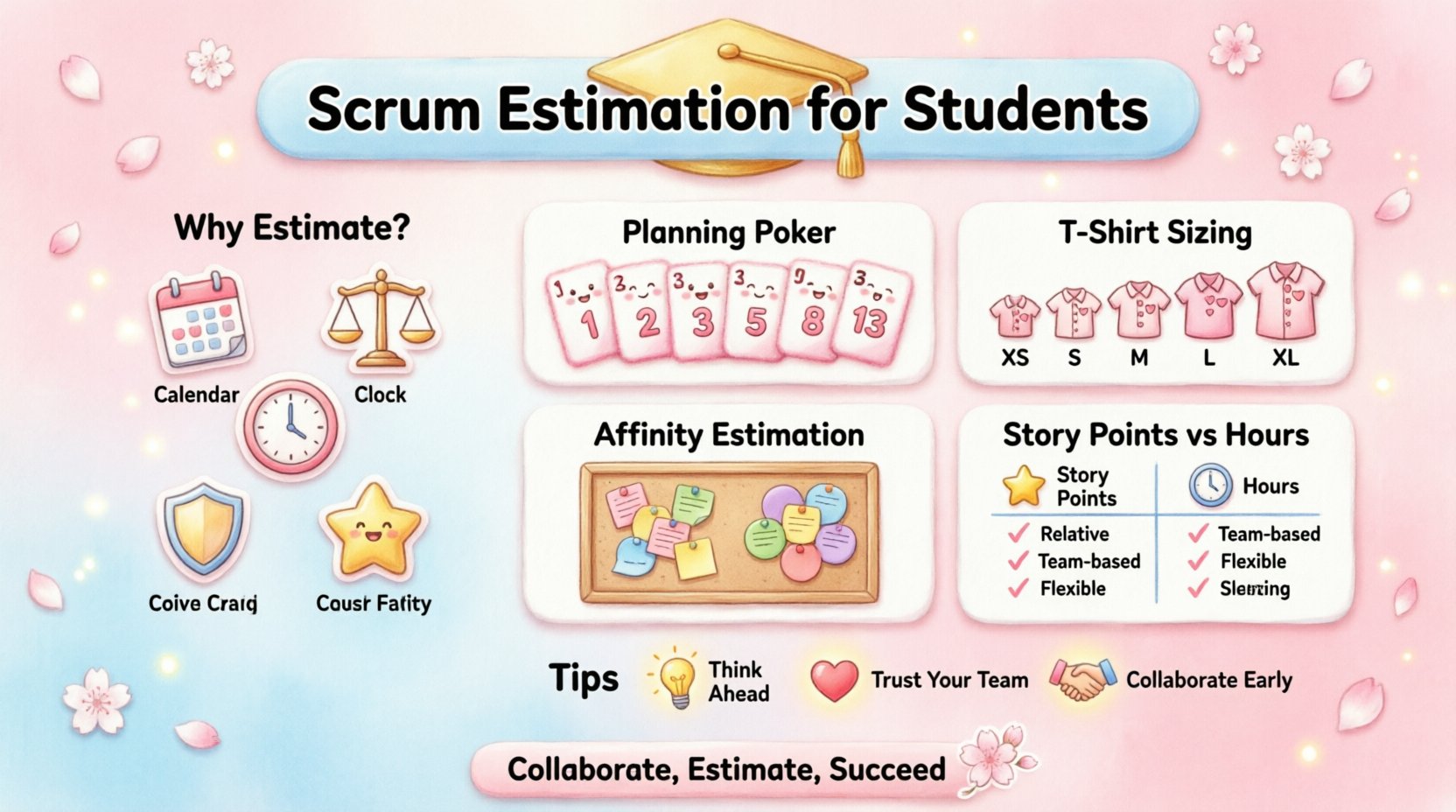
Planning Poker is the most widely used estimation technique in Scrum. It uses a deck of cards with numbers, typically following a modified Fibonacci sequence (0, 1, 2, 3, 5, 8, 13, 21, 34, 55, 89, 100). Each student holds a card to represent their estimate.
The Process
Define the User Story: Read the task description aloud. Ensure everyone understands the requirements.
Private Voting: Each member selects a card that represents their estimate of effort. They keep it face down.
Reveal: On the count of three, everyone reveals their cards simultaneously.
Discuss Discrepancies: If estimates vary widely (e.g., one person picks 2 and another picks 13), the highest and lowest estimators explain their reasoning.
Re-Vote: The team discusses and votes again until a consensus is reached.
Why It Works for Students
Equal Voice: The quietest member can vote just as validly as the loudest.
Psychological Safety: Since everyone votes privately before revealing, no one feels pressured to agree immediately.
Visual Aid: Physical cards or slips of paper make the process tactile and engaging.
👕 Technique 2: T-Shirt Sizing
When a group is new to Scrum, numbers can feel arbitrary. T-Shirt Sizing uses relative sizing labels: XS, S, M, L, XL, XXL. This method removes the pressure of specific numbers and focuses on complexity.
Mapping Sizes to Effort
XS (Extra Small): A tiny task, maybe 30 minutes or less. Example: Fixing a typo in the report.
S (Small): A single afternoon of work. Example: Creating one specific slide.
M (Medium): A full day of work. Example: Writing one chapter of the paper.
L (Large): Multiple days or a week. Example: Building a functional prototype.
XL (Extra Large): A major component spanning weeks. Example: Developing the full backend system.
XXL (Extra Extra Large): Too big to estimate. Should be broken down further.
This technique is excellent for initial brainstorming sessions. Once the sizes are agreed upon, you can convert them to points later if needed.
📊 Technique 3: Affinity Estimation
Affinity Estimation is a rapid way to group and size many items at once. It is particularly useful when you have a long list of features or chapter topics.
Steps to Execute
Write Items: Write each task on a sticky note or piece of paper.
Place on Wall: Stick them on a whiteboard or wall in a random order.
Group Similarities: Move items that seem similar in size or effort into clusters.
Label Clusters: Assign a size label (XS, S, M, L) to each group.
Refine: Review the groups and adjust items that do not fit well.
This visual method helps the team see the distribution of work. You might realize that most tasks are M and L, indicating a heavy workload.
📈 Technique 4: Story Points vs. Hours
Students often confuse story points with hours. Story points measure complexity, risk, and effort, not time. Hours are absolute time.
Use Story Points: For task planning within a sprint or project phase. It focuses on relative value.
Use Hours: For scheduling when you know your specific availability (e.g., “I only have 4 hours on Tuesday”).
For academic projects, a hybrid approach often works best. Use points to prioritize tasks and hours to manage your weekly calendar.
🛠️ How to Run an Estimation Session Without Software
You do not need digital tools to estimate effectively. A physical environment can sometimes foster better collaboration.
Required Materials
A whiteboard or large sheet of paper.
Markers in different colors.
Sticky notes.
A deck of cards or printed number slips for Planning Poker.
A timer.
Session Flow
Set the Time: Limit the estimation session to 60 minutes max. Long meetings kill momentum.
Define the Goal: Agree on what the project must achieve by the end date.
Break Down Work: Use the WBS (Work Breakdown Structure) to list all tasks.
Estimate: Pick a technique (Planning Poker or T-Shirt Sizing) and apply it.
Record Data: Write the estimates on the whiteboard for reference.
Review: Sum the points to check if the total fits the available time.
🤝 Handling Disagreements and Conflict
Disagreement is normal. If one student thinks a task is a 3 and another thinks it is a 13, there is a gap in understanding.
Steps to Resolve
Ask “Why?”: The person with the high estimate explains what they are worried about.
Identify Unknowns: Perhaps the high estimate is due to a lack of knowledge about a specific library or research method.
Split the Task: If the task is too complex, break it into smaller pieces.
Use a Moderator: Appoint a neutral person to facilitate the discussion and keep it focused.
Accept Uncertainty: Sometimes you must agree to disagree and add a buffer to the estimate.
📉 Tracking Accuracy and Velocity
After a project phase ends, review how accurate your estimates were. This process builds a team history for future projects.
The Retrospective
Compare Plan vs. Actual: Did the task take the estimated points? Did it take the estimated hours?
Identify Variances: Why did we underestimate? Was there a distraction? Was the requirement unclear?
Adjust Future Estimates: If you consistently underestimate by 20%, adjust your future planning buffer accordingly.
Celebrate Wins: Acknowledge when estimates were spot on to build confidence.
📋 Comparison of Techniques
Use this table to decide which method fits your current project stage.
Technique | Best For | Pros | Cons |
|---|---|---|---|
Planning Poker | Finalizing specific task effort | High consensus, detailed | Can be time-consuming |
T-Shirt Sizing | Early planning, high-level overview | Fast, easy to understand | Lacks granularity |
Affinity Estimation | Sorting large lists of tasks | Visual, groups similar work | Less precise for individual tasks |
Bucket Estimation | Rapid categorization | Very quick, good for backlog | Low accuracy |
Histogram | Understanding distribution | Shows range of uncertainty | Complex to set up |
💡 Frequently Asked Questions
What if our team has no experience with Scrum?
Start with T-Shirt Sizing. It requires less knowledge of the Fibonacci sequence and focuses on relative complexity. You can introduce numbers later.
How do we handle a student who is unavailable?
Assign a proxy to vote on their behalf, or remove their estimate from the average. Never force a student to vote if they are not fully engaged.
Is it okay to change estimates later?
Yes. Estimates are hypotheses. If you discover new information, update the estimate. Transparency is more important than sticking to the original number.
What if we run out of time?
If the total points exceed the available time, prioritize features. Use the MoSCoW method (Must, Should, Could, Won’t) to decide what to cut.
How do we calculate velocity for a student group?
Velocity is the sum of story points completed in a set period. For students, measure this per week or per phase. Use this data to plan the next phase.
🧠 The Psychology of Estimation
Understanding human behavior is just as important as the technique itself. Students often underestimate because they are passionate about the project. They focus on the happy path where everything works.
Conversely, some students may overestimate to protect themselves from blame. If they say a task will take 10 hours and it takes 5, they look efficient. If they say 5 and it takes 10, they look inefficient.
Creating a culture of psychological safety is key. Make it clear that bad estimates are not failures. They are data points that help the team improve.
📝 Sample Estimation Log
Maintain a simple log to track your progress. This can be a notebook or a spreadsheet.
Task Name: Login Screen
Estimated Points: 5
Actual Time: 4 hours
Deviation: +1 hour
Reason: Authentication library was harder to set up than expected.
Reviewing this log at the end of the term provides valuable insights for future courses.
🔗 Integrating Estimation into Academic Routines
Scrum is not just for software development. It applies to research papers, presentations, and group essays.
Research Papers: Estimate the time for literature review, data collection, and writing.
Presentations: Estimate the time for slide creation, rehearsal, and Q&A preparation.
Case Studies: Estimate the time for analysis, solution design, and report writing.
The principles remain the same. Break the work down, estimate the effort, and track the progress.
🚀 Final Thoughts on Project Management
Effective estimation is a skill that takes practice. You will not get it perfect on the first try. The goal is continuous improvement. By using these techniques, student groups can reduce stress and improve the quality of their output.
Remember that collaboration is the core of Scrum. The estimate belongs to the team, not just one person. When everyone participates in the planning, everyone feels responsible for the outcome.
Start small. Pick one technique for your next project. Review what worked and what did not. Over time, your team will develop a rhythm that leads to successful project delivery.