

In the fast-paced environment of Agile software development, momentum is everything. When a team hits a wall, progress stalls, morale dips, and delivery dates become uncertain. These walls are known as impediments. While some impediments are external or organizational, technical blockers are often the most critical to resolve quickly. They directly impact the ability of developers to write, test, and deploy code. This guide provides a deep dive into the mechanics of identifying, prioritizing, and removing technical impediments within a Scrum framework.
Understanding Impediments vs. Blockers 🛑
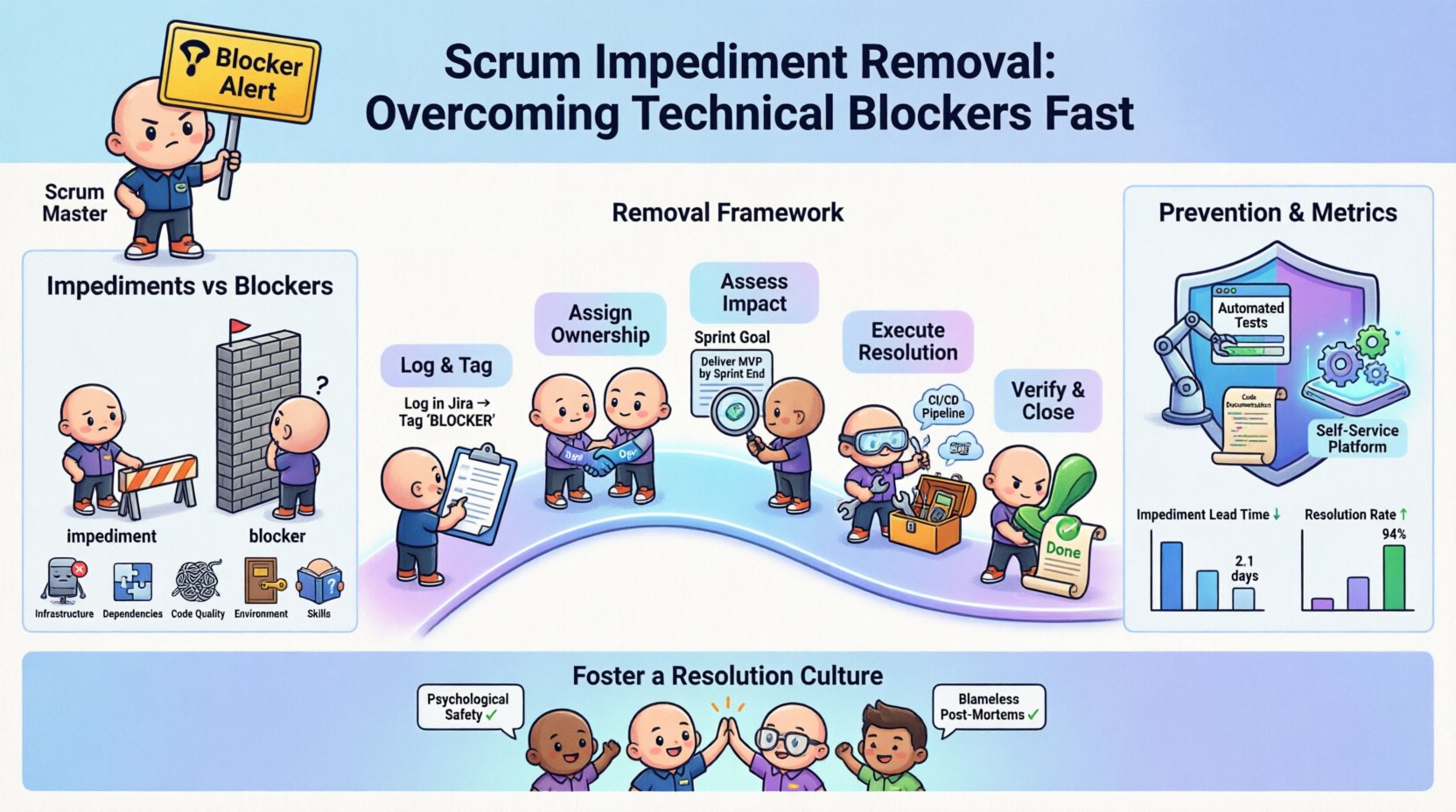
In Scrum terminology, an impediment is any obstacle that prevents a Scrum Team from achieving its goals or delivering value. However, not all impediments are created equal. A blocker is a specific type of impediment that halts progress entirely. For example, a missing requirement is an impediment that slows down work. A lack of access to a production environment is a blocker that stops work completely.
Technical blockers often fall into specific categories:
- Infrastructure Issues: Server downtime, network latency, or CI/CD pipeline failures.
- Environment Access: Inability to deploy to a staging environment due to permission errors.
- Dependency Constraints: Waiting for an API from another team or a third-party service.
- Technical Debt: Legacy code that is so fragile it prevents new features from being added safely.
- Resource Gaps: Missing specialized skills or hardware needed to complete a task.
Recognizing the distinction between a slow-down and a complete stop is vital. Scrum Masters and teams must react differently to each. A slow-down might be managed during backlog refinement. A stop requires immediate intervention.
The Cost of Technical Blockers 💸
Ignoring technical blockers is not an option. The ripple effects extend far beyond the immediate task at hand. Understanding the cost helps teams prioritize removal efforts.
1. Velocity Fluctuation
When a developer cannot complete a user story due to a technical issue, the Sprint Goal is at risk. If blockers are frequent, velocity becomes unreliable. Forecasting future capacity becomes impossible, leading to overcommitment or underutilization.
2. Context Switching
When a developer hits a wall, they often switch tasks to something else. This context switch costs cognitive energy. Research suggests it takes significant time to regain deep focus. Constantly switching between coding and troubleshooting infrastructure issues reduces overall efficiency.
3. Morale and Burnout
Nothing frustrates a skilled engineer more than being unable to ship code. Repeatedly encountering the same technical roadblocks creates a sense of helplessness. Over time, this erodes trust in the system and the team.
4. Debt Accumulation
When teams rush to bypass blockers rather than fixing them, technical debt grows. Short-term fixes often create long-term structural weaknesses. Addressing the root cause is always more efficient than managing the symptoms.
Roles and Responsibilities in Removal 👥
Clear ownership ensures that impediments do not fall through the cracks. While the entire team shares responsibility for the product, specific roles have distinct duties regarding blocker resolution.
The Development Team
- Identification: Developers must speak up immediately when work is halted. Hiding a blocker until the end of the Sprint is dangerous.
- Collaboration: Team members should help each other solve problems. Pair programming can resolve technical doubts faster than solitary debugging.
- Prevention: Contributing to the definition of done to prevent future issues.
The Scrum Master
- Facilitation: The Scrum Master ensures impediments are visible. They maintain the impediment log.
- Removal: They actively work to remove impediments that are outside the team’s control, such as organizational bureaucracy or external dependencies.
- Coaching: They guide the team on how to improve their technical processes to reduce future blockers.
The Product Owner
- Priority: If a blocker prevents the delivery of a high-value feature, the Product Owner may need to adjust priorities or scope.
- Stakeholder Management: They communicate delays caused by blockers to stakeholders honestly.
Identification Strategies 🔍
Blockers are often hidden until they become critical. Proactive identification requires structured rituals and open communication channels.
- Daily Standup: This is the primary forum for blocker discussion. The standard question “What is blocking you?” must be answered honestly. Avoid vague answers like “I am working on it.” Be specific: “I am blocked by the lack of a database connection.”
- Tip: If a blocker is discussed, it should be logged immediately.
- Impediment Log: A visible, shared record of all active impediments. This can be a physical board or a digital tracking system. It should include the severity, owner, and age of the issue.
- Monitoring Tools: Automated alerts for deployment failures, server errors, or test suite failures can surface technical issues before humans notice them.
- Retrospectives: This is the best time to analyze patterns. If the same type of blocker appears in every Sprint, the process needs to change.
Categorizing Technical Obstacles 📊
To manage blockers effectively, you must understand their nature. The table below outlines common technical categories and their typical causes.
| Category | Common Examples | Typical Impact |
|---|---|---|
| Infrastructure | Server outages, slow build times, lack of staging environments | High (Stops deployment) |
| Dependencies | Waiting on API responses, missing third-party credentials | Medium to High (Stops integration) |
| Code Quality | High cyclomatic complexity, missing unit tests, legacy spaghetti code | Medium (Slows development) |
| Environment | Permission issues, conflicting versions, configuration drift | High (Stops local work) |
| Skills | Unfamiliar framework, lack of security knowledge, database expertise | Medium (Requires learning time) |
Understanding the category helps assign the right person to solve it. An infrastructure issue needs an Ops or DevOps engineer. A skills gap might need training or a consultant.
A Framework for Removal 🛠️
Having a standardized process for removing impediments reduces chaos. When a blocker is identified, follow these steps:
- Log and Tag: Add the issue to the tracking system with a “Blocker” tag. Assign a severity level (Low, Medium, Critical).
- Assign Ownership: Designate who is responsible for resolving it. It might be a specific developer, a Scrum Master, or an external team.
- Assess Impact: Determine if the Sprint Goal is at risk. If yes, escalate immediately.
- Execute Resolution: The owner works on the solution. The rest of the team should not be idle if possible; they can work on other stories.
- Verify and Close: Once resolved, confirm with the person who reported it. Close the log entry.
Escalation Paths: Some blockers cannot be solved by the team. If a blocker remains unresolved for more than 24 hours, it should be escalated. The Scrum Master should inform leadership or the relevant department heads. Transparency is key. Do not let the team suffer in silence.
Managing Technical Debt as a Blocker 🏗️
Technical debt is often the root cause of recurring technical blockers. It is the implied cost of additional rework caused by choosing an easy solution now instead of a better approach that would take longer. When debt becomes too high, it acts as a permanent impediment to velocity.
Strategies to Address Debt
- Refactoring Sprints: Dedicate specific time to improve code structure without adding features. This clears the path for future work.
- Boy Scout Rule: Leave the code cleaner than you found it. Every time a developer touches a file, they should fix one small issue.
- Definition of Done: Update the Definition of Done to include code quality standards. A story is not done until it meets quality metrics.
- Capacity Allocation: Reserve a percentage of every Sprint capacity specifically for debt reduction.
Measuring Efficiency 📈
You cannot improve what you do not measure. To ensure impediment removal is effective, track specific metrics over time.
- Impediment Lead Time: The average time from when a blocker is logged to when it is resolved. A decreasing trend indicates improvement.
- Blocker Frequency: The number of blockers per Sprint. A high number suggests systemic issues.
- Resolution Rate: The percentage of blockers resolved within the Sprint.
- Blocked Time: The total hours developers spend waiting due to blockers.
Use these metrics in Retrospectives. If lead time increases, investigate why. Is the team understaffed? Is the infrastructure outdated? Is the process too complex?
Fostering a Resolution Culture 🤝
Tools and processes are useless without the right culture. The team must feel safe reporting problems without fear of blame.
Psychological Safety
If a developer admits a blocker, they should be thanked for the transparency, not punished for the delay. Blameless post-mortems help analyze what went wrong without targeting individuals.
Collaboration Over Silos
Technical blockers often span multiple domains. Encouraging cross-functional collaboration ensures that knowledge is shared. For example, if a database issue arises, the backend developer should not work alone. The QA engineer or DevOps specialist should be involved to find the root cause faster.
Continuous Improvement
Every resolved blocker is a learning opportunity. Ask “Why did this happen?” five times. This technique helps find the root cause rather than just the symptom. If a server crashed, why did it crash? If the answer is “out of memory,” why was it out of memory? If the answer is “memory leak,” why wasn’t it caught in testing?
Prevention Strategies 🛡️
The best way to handle blockers is to prevent them from occurring in the first place. Invest in automation and robust architecture.
- Automated Testing: A comprehensive test suite catches issues before they reach production. It prevents the “works on my machine” blocker.
- Infrastructure as Code: Managing infrastructure through code ensures environments are consistent. It reduces configuration drift and access issues.
- Documentation: Up-to-date documentation prevents knowledge gaps. New team members should not be blocked by missing setup guides.
- Self-Service Platforms: Enable developers to provision their own environments. Waiting for manual approval creates a bottleneck.
- Regular Health Checks: Monitor system health proactively. Fix issues before they cause a Sprint to fail.
Handling External Dependencies 🔗
Often, blockers come from outside the immediate team. This requires a different approach focused on communication and alignment.
- Map Dependencies Early: During Sprint Planning, identify any external dependencies. If a story relies on another team’s API, confirm the availability.
- Mock Services: If an external service is not ready, use mocks to continue development. This keeps the team moving.
- Interface Contracts: Define clear contracts between teams. Both sides agree on the input and output formats before work begins.
- Integration Sprints: Schedule time specifically for integrating with external systems to avoid last-minute surprises.
Common Pitfalls to Avoid ⚠️
Even experienced teams make mistakes when dealing with impediments. Be aware of these common traps.
- Ignoring the Log: If you log an impediment but never review it, it is useless. Review the log daily.
- Blaming Individuals: Focus on the process, not the person. Blame creates silence.
- Over-Engineering: Do not spend weeks trying to create a perfect system to track blockers. Keep it simple.
- Hoarding Information: Only one person should know how to fix the issue. This creates a single point of failure.
- Accepting “Good Enough”: Do not accept temporary workarounds as permanent solutions. They become new blockers later.
Final Thoughts on Momentum 🏁
Scrum is about delivering value continuously. Technical blockers are the primary friction that stops this flow. By treating impediment removal as a core responsibility rather than a side task, teams can maintain high velocity and low stress. The goal is not just to fix problems, but to build a system that adapts and improves.
Start by logging your current blockers. Assign ownership. Measure the time to resolution. Watch the trends. With consistent effort, the team will move faster, build better software, and enjoy the process more. Technical excellence is not a destination; it is a continuous practice of removing obstacles and clearing the path forward.