

Implementing the Scrum framework in an academic setting presents unique challenges. Student teams often balance coursework, personal lives, and the ambitious goal of delivering a functional product. In this environment, the Scrum Definition of Done serves as the primary mechanism for quality assurance. Without a clear standard, projects drift toward incomplete features or broken code. This guide explores how to establish and maintain a robust Definition of Done to ensure student projects meet high standards of quality and readiness.
Quality is not an accident; it is the result of intentional effort. For students learning agile methodologies, understanding the Definition of Done (DoD) is critical. It moves the team from “we think it works” to “we know it works.” This document provides a comprehensive look at defining quality, structuring acceptance criteria, and integrating these standards into the sprint cycle.
Understanding the Definition of Done 🛑
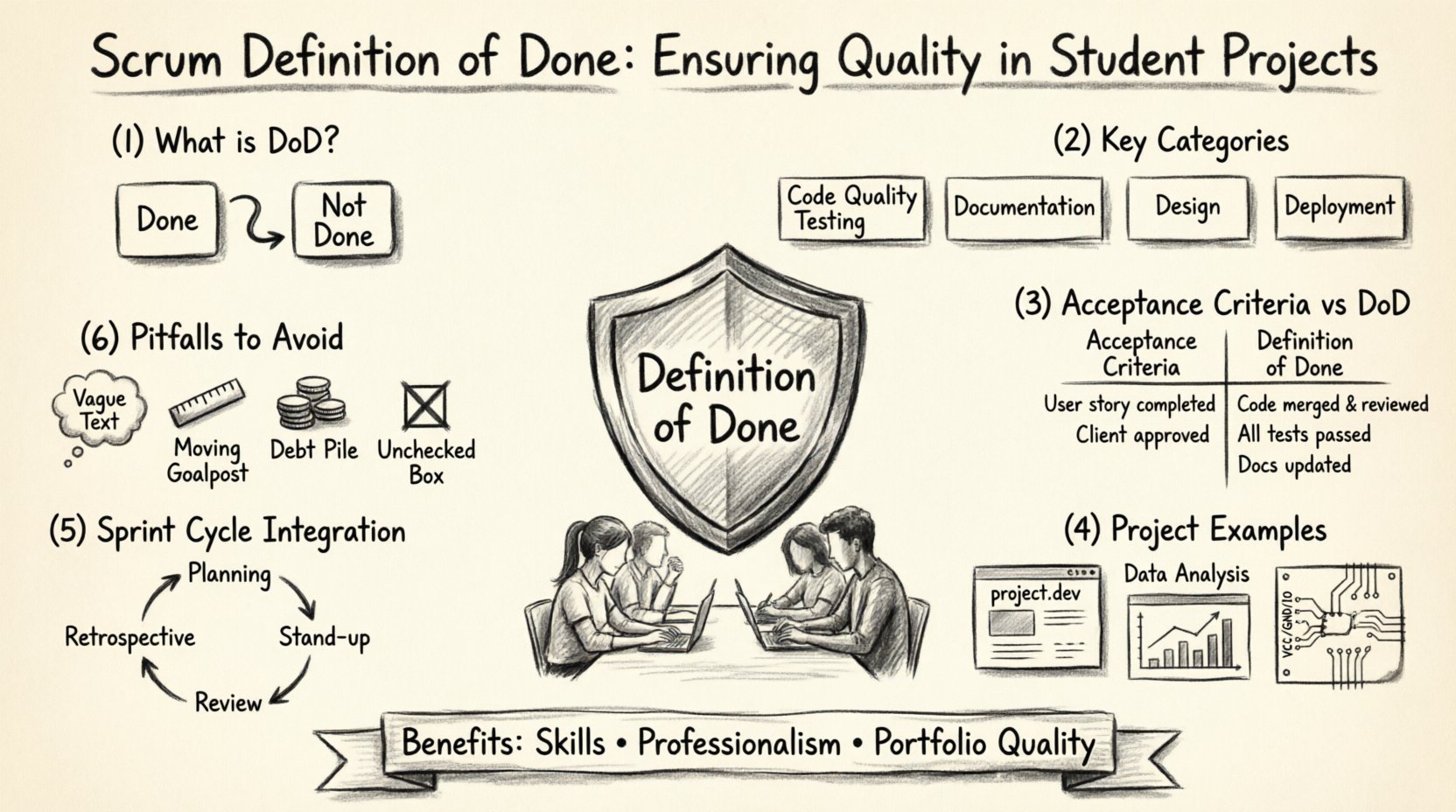
The Definition of Done is a formal description of the state of the Increment when it meets the quality measures required for the product. It is a checklist that every single item in the Product Backlog must satisfy before it can be considered complete. In student projects, where deadlines are often rigid, skipping steps in the DoD is a common temptation. However, doing so compromises the integrity of the final deliverable.
What Does It Mean?
When a user story is marked as Done, it implies that the work is fully implemented, tested, documented, and ready for deployment or demonstration. It is not merely about the code compiling. It encompasses the entire lifecycle of the feature. For a student team, this means moving beyond the initial prototype to a polished artifact.
- Complete Functionality: The feature works as intended in the specified environment.
- Quality Standards: Code follows agreed-upon style guides and best practices.
- Testing: Automated and manual tests pass successfully.
- Documentation: User manuals or code comments are updated.
- Review: The work has been reviewed by peers or instructors.
It Is a Checklist, Not a Wish List
A common mistake is treating the Definition of Done as a set of aspirational goals. Instead, it must be a binary state. A user story is either Done or it is not. There is no “mostly done.” This binary nature forces the team to be honest about their progress during the Sprint Review. If a feature does not meet the DoD, it cannot be presented as a completed increment.
Why Student Projects Need a Strict DoD 📚
Student teams operate under different constraints than professional organizations. The pressure to submit a project for a grade often overshadows the pressure to build a maintainable product. The Definition of Done acts as a stabilizer in this chaotic environment.
Academic vs. Professional Pressure
In a professional setting, the market dictates quality. In academia, the instructor or professor dictates quality. Without a clear Definition of Done, students may focus solely on meeting the professor’s rubric rather than building a robust system. A team-defined DoD shifts the focus to internal quality standards, which aligns better with industry expectations.
Team Dynamics in Education
Student teams often form based on friendship or convenience rather than skill compatibility. Roles may overlap, or gaps may exist. A clear DoD provides a shared understanding of what “finished” looks like, reducing friction between team members. It prevents the scenario where one member finishes their coding but leaves the documentation for another, causing bottlenecks.
Portfolio Quality
For many students, this project is their portfolio piece. A project that works but lacks tests or documentation looks unprofessional to future employers. The Definition of Done ensures that the work presented in a final demo is production-ready, even if it is a prototype. This distinction builds confidence and professional reputation.
Building Your Team’s Definition of Done 🛠️
The Definition of Done is not a one-size-fits-all document. It must be created collaboratively by the Development Team. In a student project, this means every member must agree on the standards. The Product Owner (often a professor or a lead student) should not dictate the DoD alone, though they may have specific constraints.
Collaborative Creation
During the first Sprint Planning, the team should dedicate time to drafting the DoD. This ensures buy-in. If a developer writes the DoD and others ignore it, it fails. If the team writes it together, they are more likely to adhere to it.
Categories of the Definition
To ensure comprehensiveness, the DoD should cover several key areas. A student team can structure their checklist into the following categories:
- Code Quality: Static analysis tools, code reviews, and style checks.
- Testing: Unit tests, integration tests, and manual verification.
- Documentation: README files, API documentation, and user guides.
- Design: UI/UX consistency, accessibility standards, and responsiveness.
- Deployment: Environment setup instructions and build scripts.
Acceptance Criteria vs. Definition of Done 📋
It is vital to distinguish between Acceptance Criteria and the Definition of Done. Confusing these two concepts leads to incomplete work. Acceptance Criteria are specific to a single User Story, while the Definition of Done applies to every single User Story in the project.
| Feature | Acceptance Criteria | Definition of Done |
|---|---|---|
| Scope | Specific to one User Story | Applies to the entire Increment |
| Content | Functional requirements for the feature | Quality standards for all work |
| Example | “User can login with email and password” | “Code is reviewed and tested” |
| Flexibility | Varies per story | Remains consistent across sprints |
Understanding this distinction helps students prioritize. They must meet the Acceptance Criteria for the feature to be useful, and the Definition of Done for the feature to be stable. Both must be satisfied for the story to be marked as Done.
Examples for Different Project Types 💻
Student projects vary widely in nature. A web application requires different standards than a data science project. Below are examples of how to tailor the Definition of Done for specific contexts.
Web Application Project
For a team building a web-based tool, the DoD might include the following items:
- All pages render correctly on Chrome, Firefox, and Safari.
- Responsive design works on mobile and tablet viewports.
- Accessibility audit passes (WCAG 2.1 AA compliance).
- No console errors in the browser developer tools.
- Database migrations are applied successfully.
- Security vulnerabilities are scanned and resolved.
- Code is merged into the main branch.
Data Science Project
For a team analyzing datasets or building machine learning models, the focus shifts to reproducibility and accuracy:
- Scripts run without errors on a clean environment.
- Model performance metrics meet the baseline threshold.
- Data preprocessing steps are documented.
- Random seeds are set for reproducibility.
- Visualizations include clear labels and legends.
- Dependencies are listed in a requirements file.
Hardware Integration Project
For projects involving physical components, the DoD must account for safety and physical constraints:
- Hardware connections are secure and insulated.
- Power consumption is within safe limits.
- Code handles edge cases (e.g., sensor failure).
- Assembly instructions are written clearly.
- Physical prototype functions in the intended environment.
Integrating DoD into the Sprint Cycle 🔄
Creating the Definition of Done is not enough; it must be integrated into the daily rhythm of the team. In a student project, sprints are often short (1-2 weeks). Efficiency is key.
During Sprint Planning
The team should review the Definition of Done before committing to a story. If a story requires work that violates the DoD (e.g., skipping tests), the team should adjust the scope or the timeline. This prevents overcommitment.
During Daily Stand-ups
When discussing progress, team members should reference the DoD. Instead of saying “I am almost done,” they should say “I have met 4 out of 6 DoD items.” This transparency helps identify blockers early. It also highlights if technical debt is accumulating.
During the Sprint Review
The Increment presented to the instructor or stakeholders must satisfy the Definition of Done. If a feature is demonstrated but fails the DoD, it cannot be considered complete. This honesty protects the team’s reputation and ensures accurate progress tracking.
During the Sprint Retrospective
This is the time to refine the Definition of Done. If the team realizes that a specific checklist item is too difficult or unnecessary, they can adjust it. The DoD is a living document. It should evolve as the team matures and the project requirements change.
Common Pitfalls and How to Avoid Them ⚠️
Even with the best intentions, student teams often stumble when implementing quality standards. Recognizing these pitfalls early can save significant time and stress.
Vagueness
A common error is writing criteria like “Code should be clean.” This is subjective. One student’s clean code is another’s messy spaghetti. The Definition of Done must be objective.
- Poor: “Code should be clean.”
- Good: “Code passes static analysis with zero warnings.”
- Good: “All functions have comments explaining their purpose.”
Moving Goalposts
Mid-sprint, a team might add new items to the Definition of Done to fix a specific issue. While improvement is good, changing the DoD mid-sprint creates confusion. Changes should be made in the Retrospective for the next Sprint.
Ignoring Technical Debt
Students often rush to finish features and ignore technical debt. The Definition of Done can help mitigate this by including items like “Refactor code related to previous sprint.” This ensures debt is addressed continuously rather than accumulating until the final week.
Lack of Enforcement
If the team agrees to a DoD but does not enforce it, it becomes useless. One member should be responsible for verifying the checklist before marking a story as Done. This role can rotate to ensure everyone understands the standards.
The Impact on Learning Outcomes 📈
Beyond the immediate project deliverable, the Definition of Done impacts the educational experience of the students. It transforms the project from a task completion exercise into a learning opportunity.
Skill Acquisition
By adhering to a strict DoD, students learn industry-standard practices. They learn to write tests, document code, and review peers’ work. These skills are transferable to their future careers. The habit of quality becomes ingrained.
Soft Skills
Collaborating on the Definition of Done teaches negotiation and consensus building. Students learn to advocate for quality without blocking progress. They learn to communicate technical constraints to non-technical stakeholders.
Professionalism
Submitting a project that is fully tested and documented demonstrates professionalism. It shows the team takes pride in their work. This attitude is often noticed by instructors and potential employers during interviews.
Maintaining Quality Over Time 🛡️
Quality is not a destination; it is a continuous journey. As the student project evolves, the Definition of Done must remain relevant. This requires ongoing attention and maintenance.
Continuous Improvement
Each Sprint provides feedback. If the team finds that a specific DoD item is causing delays, they should analyze why. Is the process inefficient? Is the tooling inadequate? Adjustments should be made to optimize the workflow.
Updating the DoD
As the project matures, requirements may change. A web project might need to add “SEO optimization” to the DoD in a later sprint. A hardware project might need to add “Battery efficiency tests.” The DoD should grow with the product.
Knowledge Transfer
If a team member leaves the project, the Definition of Done ensures continuity. The new member can pick up the DoD checklist and understand the quality expectations immediately. This reduces the learning curve for new additions to the team.
Final Thoughts on Implementation 🚀
Implementing the Scrum Definition of Done in student projects is a strategic decision that pays dividends in the quality of the final product and the skills of the team members. It moves the focus from “getting it done” to “getting it done right.” By establishing clear, objective standards and adhering to them throughout the sprint cycle, students can deliver work that stands up to professional scrutiny.
The journey involves discipline and collaboration. It requires the team to be honest about their capabilities and willing to stop and fix issues before moving forward. While this may slow down the initial pace of development, it prevents the costly delays associated with fixing bugs later in the lifecycle. For students, this approach bridges the gap between academic theory and professional practice. It prepares them not just to pass a course, but to build valuable, sustainable solutions.
Start small. Draft a basic checklist for the first sprint. Review it at the end of the sprint. Refine it. Repeat. Over time, the Definition of Done becomes a natural part of the team’s culture. It becomes the foundation upon which high-quality software and systems are built.