

Scrum is a lightweight framework that helps people, teams, and organizations generate value through adaptive solutions for complex problems. At the heart of this framework lies a specific structure of accountabilities. Unlike traditional project management models that rely on hierarchy, Scrum distributes authority across three distinct roles. Understanding the nuances of these roles is critical for successful implementation. This guide explores the Product Owner, the Scrum Master, and the Development Team in detail.
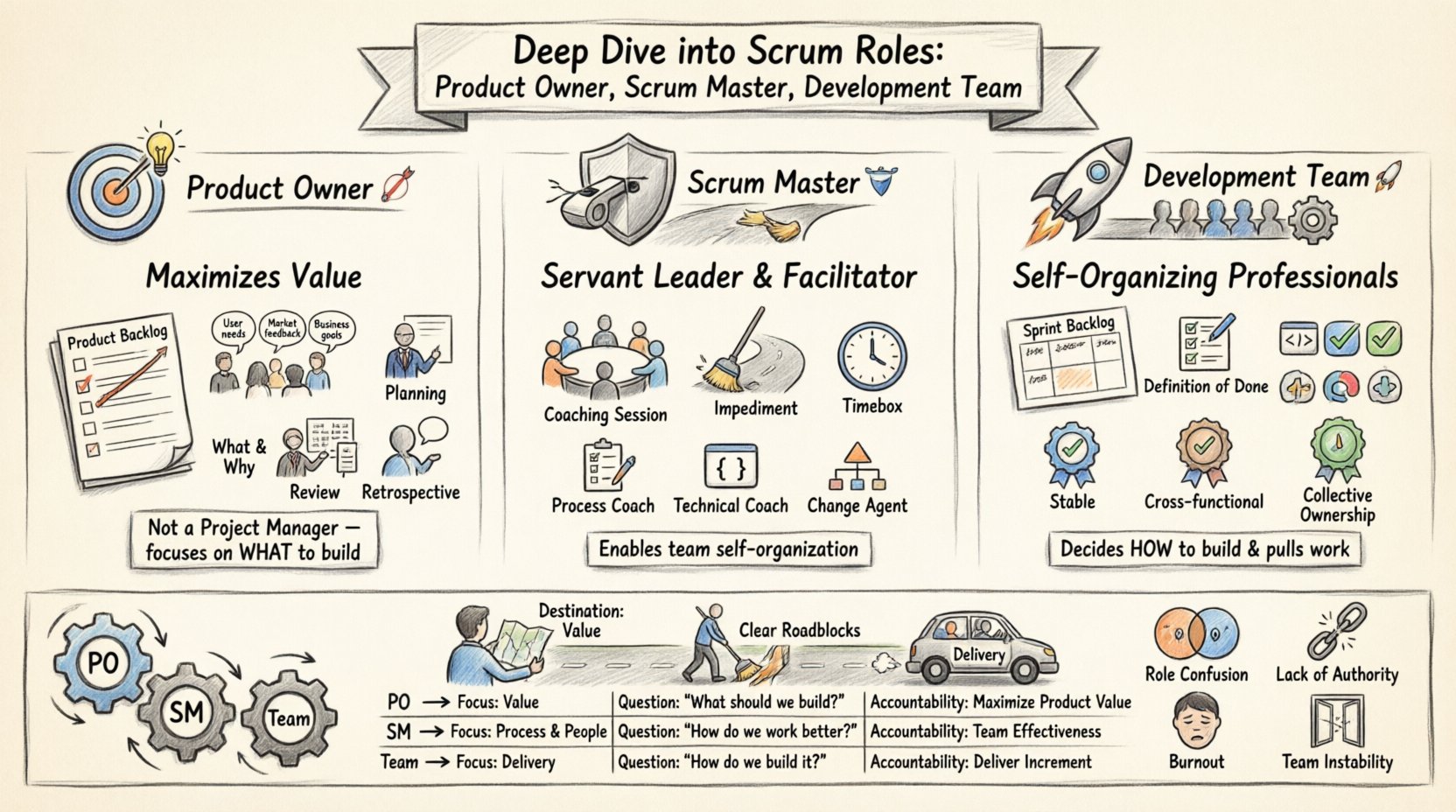
🎯 The Product Owner: Maximizing Value
The Product Owner represents the voice of the customer and the business within the Scrum Team. This role is not merely about managing a list of tasks; it is about maximizing the value of the product resulting from the work of the Development Team. The Product Owner is accountable for effective Product Backlog management. This involves a combination of strategy, vision, and communication.
Key Accountabilities
- Developing and Communicating the Product Goal: The Product Owner ensures everyone understands what the product aims to achieve. This vision guides all planning and execution.
- Managing the Product Backlog: This is the primary artifact. It contains everything that is known to be needed in the product. The Product Owner is responsible for ordering the items in the backlog to best achieve goals and missions.
- Optimizing the Value of the Product: Decisions are made based on value. The Product Owner must constantly evaluate whether a feature is worth the effort required to build it.
- Ensuring the Backlog is Visible, Transparent, and Clear: Stakeholders and the Development Team must understand what is in the backlog. It should not be a secret document.
Interactions During Sprint Events
The Product Owner plays an active role in every Sprint event, though their focus shifts based on the stage of the cycle.
- Sprint Planning: The Product Owner explains the items in the Product Backlog to the Development Team. They clarify what is expected and why it matters. They collaborate on selecting items for the Sprint.
- Daily Scrum: While not required to attend, the Product Owner is often present to answer questions and clarify requirements for the Development Team.
- Sprint Review: The Product Owner leads this event. They demonstrate the work completed and gather feedback from stakeholders to update the Product Backlog.
- Sprint Retrospective: The Product Owner attends to help the team inspect how the last Sprint went regarding individuals, interactions, processes, tools, and their Definition of Done.
Common Misconceptions
Many organizations confuse the Product Owner with a Project Manager. While both manage scope, the Product Owner focuses on what is built and why, whereas a Project Manager often focuses on how and when within a command-and-control structure. The Product Owner does not assign tasks; the Development Team pulls work.
🛡️ The Scrum Master: Servant Leadership
The Scrum Master is responsible for promoting and supporting Scrum as defined in the Scrum Guide. They are a true servant-leader for the Scrum Team. This role is often misunderstood as a project coordinator or a team lead. In reality, the Scrum Master is a facilitator and a coach.
Key Accountabilities
- Coaching the Team: The Scrum Master helps the Development Team focus on creating high-value Increments that meet the Definition of Done. They coach the team on self-organization and cross-functionality.
- Coaching the Organization: They help everyone understand and enact Scrum and Agile theory. This includes helping stakeholders understand how to interact with the Scrum Team effectively.
- Removing Impediments: When the Development Team is working on a goal, the Scrum Master helps remove obstacles that hinder progress. This could be technical debt, organizational bureaucracy, or resource conflicts.
- Facilitating Events: The Scrum Master ensures that all Scrum events take place and are positive, productive, and kept within the timebox. They coach the team to understand the purpose of the event.
Types of Scrum Masters
The Scrum Master role can manifest in different ways depending on the organizational maturity:
- Process Coach: Focuses on ensuring Scrum rules are followed and events are held correctly.
- Technical Coach: Helps the team improve technical practices, such as testing, deployment, and code quality.
- Change Agent: Works at an organizational level to remove systemic barriers that prevent the team from succeeding.
Interactions During Sprint Events
- Sprint Planning: The Scrum Master facilitates the session, ensuring the team understands the timebox and the purpose.
- Daily Scrum: The Scrum Master ensures the Development Team holds this meeting. They do not run it, but they might intervene if the meeting drifts off-topic.
- Sprint Review: The Scrum Master ensures stakeholders are engaged and that the feedback loop is open.
- Sprint Retrospective: The Scrum Master facilitates this event. They create a safe environment where the team can discuss improvements without fear of blame.
🚀 The Development Team: Delivering Value
The Development Team consists of professionals who do the actual work of delivering a potentially releasable Increment of functionality at the end of each Sprint. There are no titles within the Development Team, except for the one called Developer. They are autonomous and self-organizing.
Key Accountabilities
- Creating a Plan for the Sprint: During Sprint Planning, the Development Team determines how much work they can commit to. They create the Sprint Backlog.
- Installing Quality: The team is responsible for the Definition of Done. If an item does not meet the Definition of Done, it cannot be released.
- Self-Organization: The team decides who does what, when, and how. This leads to better motivation and efficiency.
- Continuous Improvement: The team constantly looks for ways to improve their processes and technical capabilities.
Characteristics of a High-Performing Team
- Cross-Functional: The team has all the skills necessary to create the product. It includes developers, testers, designers, and analysts as needed.
- Stable: Teams perform best when they remain intact over time. Frequent turnover disrupts momentum.
- Co-located: While remote work is possible, co-location improves communication and collaboration significantly.
- Collective Ownership: Code and work are owned by the whole team, not by individuals. This reduces bottlenecks.
📋 Role Comparison and Interactions
Understanding the distinct yet interconnected nature of these roles is vital. Below is a table summarizing their primary focus areas.
| Role | Primary Focus | Key Question Answered | Accountability |
|---|---|---|---|
| Product Owner | Value | What should we build? | Maximize Product Value |
| Scrum Master | Process & People | How do we work better? | Effectiveness of the Scrum Team |
| Development Team | Delivery | How do we build it? | Deliver Increment |
🤝 Collaboration Dynamics
These three roles do not exist in silos. Their effectiveness depends on how well they collaborate. The Product Owner defines the destination, the Scrum Master clears the road, and the Development Team drives the car.
Conflict Resolution
Disagreements are natural. When they arise, the focus should remain on the goal. The Scrum Master facilitates the resolution without imposing a solution. The Product Owner provides the value context, and the Development Team provides the technical feasibility context.
Stakeholder Management
- Product Owner: The primary interface for stakeholders. They manage expectations and feedback.
- Development Team: They may interact with stakeholders during the Sprint Review to demonstrate work.
- Scrum Master: They help stakeholders understand how to engage with the team effectively.
⚠️ Common Challenges and Pitfalls
Implementing Scrum roles is not always straightforward. Organizations often encounter specific hurdles that can derail the process.
Role Confusion
One of the most common issues is role overlap. A manager might try to assign tasks to the Development Team, violating self-organization. A Product Owner might try to micromanage the technical implementation, bypassing the team’s autonomy. Clear boundaries must be established early.
Lack of Authority
The Product Owner often lacks the authority to make decisions on budget or strategy. This leads to a backlog that cannot be prioritized effectively. The organization must empower the Product Owner to make value-based decisions.
Scrum Master Burnout
The Scrum Master can become a bottleneck if they try to solve every problem for the team. The goal is to empower the team to solve their own problems. If the Scrum Master is constantly firefighting, the team is not learning.
Team Stability
Agile teams require stability to reach high performance. Frequent turnover or part-time assignments on the Development Team can prevent the team from establishing a rhythm.
🔄 Scaling Considerations
When multiple Scrum Teams work on the same product, the roles scale differently. The Product Owner might still be a single point of contact for the Product Backlog, but they may need support to manage the complexity. The Scrum Masters might form a group to share knowledge and resolve organizational impediments. The Development Teams remain autonomous but align on technical standards and architecture.
🏁 Moving Forward
Successful Scrum implementation relies on clarity of roles. Each accountability must be understood and respected. The Product Owner drives the vision, the Scrum Master supports the process, and the Development Team delivers the product. By adhering to these responsibilities, organizations can navigate complexity and deliver value consistently. Regular inspection of how these roles are functioning allows for continuous adaptation and improvement. This cycle of inspection and adaptation is the core of the framework.
Organizations should invest in training for these roles. Understanding the theoretical underpinnings ensures that the roles are enacted correctly. It is not enough to have the titles; the behaviors must align with the Scrum Guide. When the roles function as intended, the team can achieve sustainable productivity and high morale.