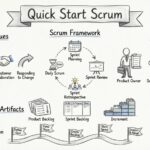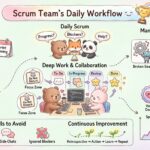


Welcome to this comprehensive guide designed specifically for IT students navigating the world of Agile software development. If you are studying computer science, information technology, or software engineering, you have likely encountered the term Scrum in your curriculum. It is one of the most widely adopted frameworks for managing complex projects, yet it often comes with confusion regarding its specific mechanics and application.
This article addresses the most frequent questions asked by students entering the field. We will break down the framework, roles, events, and artifacts without the noise. Our goal is to provide clarity on how Scrum functions in real-world scenarios, helping you build a solid foundation for your future career.
🧩 What Exactly is Scrum?
Many students mistake Scrum for a methodology. It is important to clarify this distinction early. Scrum is not a prescriptive methodology that tells you exactly how to write code or test software. Instead, it is a lightweight framework that allows people to address complex adaptive problems while productively delivering solutions of the highest possible value.
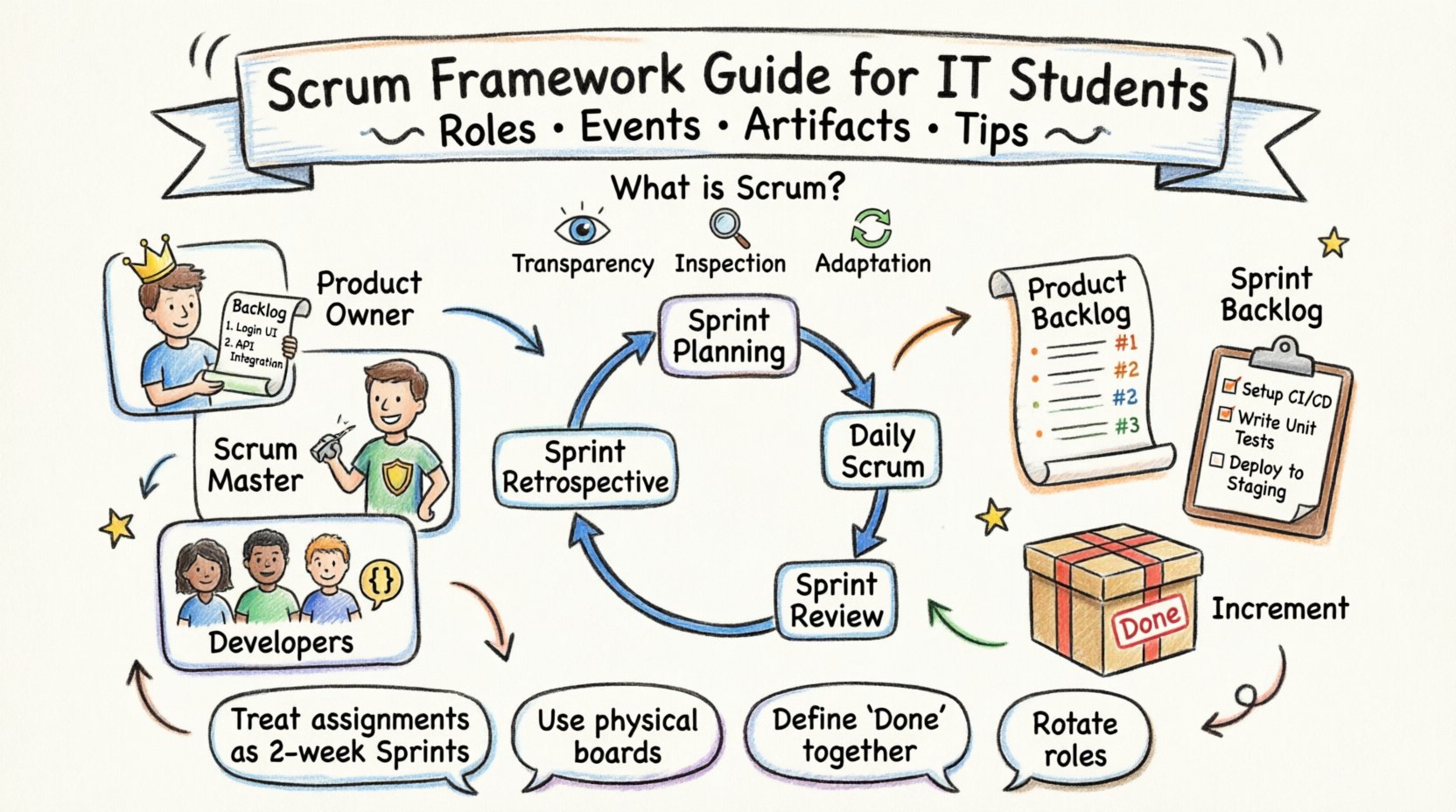
Scrum is built on three pillars:
- Transparency: Significant aspects of the process must be visible to those responsible for the outcome.
- Inspection: Frequent inspection of Scrum artifacts to detect undesirable variances.
- Adaptation: If an inspection reveals that some aspects of the process deviate outside acceptable limits, the process or the material being processed must be adjusted.
For IT students, understanding these pillars is crucial. When you work on group projects, you are not just building a database; you are building a system where the team can see progress, check for issues, and adjust their approach quickly.
👥 Who are the Key Roles?
In a traditional project management setting, you might see a Project Manager, a Business Analyst, and a Development Lead. Scrum simplifies this structure into three specific accountabilities. There are no sub-roles within these categories, though people may have different responsibilities.
| Role | Primary Focus | Key Responsibility |
|---|---|---|
| Product Owner | The Value | Managing the Product Backlog and maximizing value. |
| Scrum Master | The Process | Ensuring the team understands and enacts Scrum. |
| Developers | The Work | Creating a usable Increment at the end of every Sprint. |
1. The Product Owner
The Product Owner is the voice of the customer. They are responsible for ordering the items in the Product Backlog to best achieve goals and missions. In a university setting, this role is often filled by the person who understands the requirements best, such as a stakeholder or a student lead acting on behalf of the client.
Key tasks include:
- Clearly expressing Product Backlog items.
- Ordering the items in the Product Backlog.
- Ensuring the backlog is visible, transparent, and understood.
- Optimizing the value of the product resulting from the work of the Developers.
2. The Scrum Master
The Scrum Master is a servant-leader for the Scrum Team. They do not manage the team in a traditional sense. Instead, they help everyone understand the theory, practices, rules, and values of Scrum. They work to remove impediments that are slowing the team down.
Common misconceptions include thinking the Scrum Master is a project manager. They are not. They do not assign tasks. They facilitate meetings and coach the team on self-organization.
3. The Developers
These are the people in the Scrum Team that are committed to creating any aspect of a usable Increment that is required at the Sprint. In IT, this includes programmers, testers, designers, and anyone contributing to the code or product.
Developers have the following characteristics:
- Self-Organizing: The team decides who does what, when, and how.
- Cross-Functional: The team has all the skills necessary to create the product increment.
- Unified: No titles within the Developers other than Scrum Master or Product Owner.
📅 What are the Events in Scrum?
Scrum events are time-boxed meetings designed to create regularity and minimize the need for other meetings. They are essential for maintaining rhythm in a project. Every event is an opportunity to inspect and adapt.
1. The Sprint
The Sprint is the heartbeat of Scrum. It is a fixed-length event of one month or less during which a “Done”, useable, and potentially releasable product Increment is created. Sprints contain and consist of the other Scrum Events.
- Duration: Usually 1 to 4 weeks. Consistency is key.
- Goal: To produce a measurable increment of value.
- Rule: The Sprint length never changes once it begins.
2. Sprint Planning
This event kicks off the Sprint. The entire Scrum Team collaborates on what can be delivered in the upcoming Sprint and how the work will be achieved. The output of this meeting is the Sprint Backlog.
Two main topics are covered:
- What can be delivered? (The Sprint Goal)
- How will the work be done? (The plan)
3. Daily Scrum
Often called the Daily Standup, this is a 15-minute time-boxed event for the Developers. It is not a status report to management. It is a synchronization meeting for the Developers to inspect progress toward the Sprint Goal and adapt the Sprint Backlog as necessary.
Typical questions asked during this meeting include:
- What did I do yesterday that helped the team meet the Sprint Goal?
- What will I do today to help the team meet the Sprint Goal?
- Do I see any impediments that prevent me or the team from meeting the Sprint Goal?
4. Sprint Review
The Sprint Review is the occasion to inspect the outcome of the Sprint and determine future adaptations. The Scrum Team presents the results of their work to key stakeholders. This is not a formal presentation; it is a collaborative session.
Key outcomes:
- Inspection of the Increment.
- Discussion of what was done and what was not done.
- Adaptation of the Product Backlog if needed.
5. Sprint Retrospective
The Sprint Retrospective takes place after the Sprint Review and prior to the next Sprint Planning. This is the team’s time to reflect on themselves. They inspect how the last Sprint went regarding individuals, interactions, processes, tools, and their Definition of Done.
The goal is to identify ways to improve and implement them in the next Sprint. This is often the most valuable meeting for team growth.
| Event | Timebox | Participants | Outcome |
|---|---|---|---|
| Sprint Planning | 8 hours (for a 1-month Sprint) | Scrum Team | Sprint Goal & Plan |
| Daily Scrum | 15 minutes | Developers | Updated Plan for Next 24 Hours |
| Sprint Review | 4 hours (for a 1-month Sprint) | Scrum Team + Stakeholders | Inspected Increment & Backlog Updates |
| Sprint Retrospective | 3 hours (for a 1-month Sprint) | Scrum Team | Plan for Quality Improvements |
📄 What are the Artifacts?
Artifacts represent work or value. They are designed to maximize transparency of key information. Every artifact contains a commitment to ensure it provides information that enhances understanding.
1. Product Backlog
The Product Backlog is an ordered list of everything that is known to be needed in the product. It is the single source of requirements for any changes to be made to the product.
Characteristics of the Product Backlog:
- Ordered: Items are prioritized by the Product Owner.
- Emergent: It evolves as the product and environment evolve.
- Refined: Items are groomed to ensure clarity and estimation.
2. Sprint Backlog
The Sprint Backlog is the set of Product Backlog items selected for the Sprint, plus a plan for delivering the Increment and realizing the Sprint Goal.
Key aspects:
- It is owned by the Developers.
- It is updated throughout the Sprint as more is learned.
- It shows the work to be done during the Sprint.
3. Increment
An Increment is a concrete stepping stone toward the Product Goal. Each Increment is additive to all prior Increments and fully tested.
For IT students, the concept of “Done” is critical. An Increment is not just code written; it is code that is compiled, tested, documented, and ready for potential release. If it is not “Done,” it cannot be part of the Increment.
❓ Frequently Asked Questions from Students
As you study Scrum, you will encounter specific scenarios that seem to contradict the rules. Here are answers to the most common doubts.
Q: Can we change the Sprint Goal during the Sprint?
A: Generally, no. The Sprint Goal is the objective of the Sprint. If the work proves unachievable, the Sprint Goal might become invalid, but the Scrum Master and Product Owner should discuss this. Changing the goal disrupts the rhythm. However, the scope of the Sprint Backlog may be clarified and renegotiated with the Product Owner as the Developers learn more.
Q: What if the team cannot finish all the items in the Sprint Backlog?
A: This is a normal occurrence. The unfinished items are returned to the Product Backlog. The team should discuss why this happened during the Retrospective. It could be due to underestimation, unexpected technical debt, or external impediments. The goal is to improve estimation accuracy over time, not to blame individuals.
Q: Is Scrum only for software development?
A: No. While it originated in software, Scrum is applicable to any product or service development. However, the core principles of iterative delivery and feedback are most visible in IT contexts. The framework adapts to the complexity of the work.
Q: How do we handle bugs found after a Sprint ends?
A: Bugs are treated as work items. If a bug is found in the Increment, it is added to the Product Backlog. If it is critical, it may be prioritized for the next Sprint. The team must maintain a Definition of Done that includes testing to minimize these issues.
Q: Can a team have two Scrum Masters?
A: The Scrum Guide recommends one Scrum Master per team. However, if a team is large or distributed, you might have multiple Scrum Masters supporting different parts of the same team. It is not standard practice for small student teams to have more than one.
Q: Do we need documentation in Scrum?
A: Yes. Scrum does not ban documentation. It values working software over comprehensive documentation, but it does not say documentation is bad. Documentation is necessary for knowledge transfer, maintenance, and compliance. The amount should be sufficient to meet the needs of the project without being excessive.
🚀 Practical Tips for IT Students
Applying Scrum in an academic setting differs from industry work. Here is how to approach your university projects using these principles.
1. Treat Assignments as Sprints
Break your semester projects into 2-week Sprints. At the end of each 2 weeks, you should have a working piece of the project, not just a plan. This mimics the “Increment” requirement and prevents last-minute scrambling.
2. Use Physical Boards
Instead of digital tools, try using sticky notes on a whiteboard. This forces you to physically move cards from “To Do” to “Done.” It improves transparency and makes the work visible to everyone in the room.
3. Rotate Roles
Rotate the Product Owner and Scrum Master roles among group members. This helps everyone understand the challenges faced by each role. It builds empathy and a holistic view of project management.
4. Focus on the Definition of Done
Agree on what “Done” means before you start. Does it include unit tests? Does it include a README file? Does it mean it compiles without errors? If you don’t agree on this, you will have disagreements at the end of the Sprint.
5. Be Honest About Velocity
In school, you might overpromise to impress instructors. In Scrum, honesty is a core value. If you know you cannot finish a task, say so during the Daily Scrum. Hiding the truth prevents the team from adapting and helping.
🔍 Understanding the Empirical Process
Scrum relies on empirical process control theory. This means knowledge comes from experience and making decisions based on what is observed. It contrasts with defined process control theory, where work is planned in advance and steps are followed strictly.
In software development, requirements are rarely clear at the start. You cannot define every step of the path. You must inspect the code, test it, see what works, and adapt. This is why Scrum is so effective for IT students. It acknowledges that uncertainty is part of the process.
🛠️ Handling Impediments
Impediments are obstacles that prevent the Developers from working efficiently. In a student group, these might be:
- Access to a server is blocked.
- A team member is sick.
- A library is outdated.
- Dependencies on another project are delayed.
The Scrum Master is responsible for removing these impediments. If you are a student acting as Scrum Master, your job is to ask for help, escalate issues to professors, or find alternative solutions. Do not let the team wait on a blocker.
📊 Measuring Progress
How do you know if you are moving forward? In Scrum, progress is measured by the Increment. It is not measured by hours worked or lines of code written. Lines of code can be misleading; writing more code does not mean more value.
Instead, look at the Burn-Down Chart. This is a visual representation of the work remaining in the Sprint. It helps the team see if they are on track to complete the Sprint Goal. While you may not use complex software to generate this, you can track it manually on a whiteboard.
🤝 Collaboration Over Contracts
Agile Manifesto values individuals and interactions over processes and tools. In a student group, this means communication is more important than the tool you use. If you have a disagreement, talk it out. Do not rely solely on email or ticket systems.
Build a culture of trust. If a team member struggles, others should offer help. This is the essence of a self-organizing team. You are not competing against each other; you are competing against the problem.
🎓 Preparing for the Industry
When you enter the workforce, you will likely encounter Scrum teams. Understanding the framework gives you an advantage. However, remember that real-world Scrum is often adapted to fit the organization.
Employers look for candidates who understand the why behind the process. They want to know that you understand transparency, inspection, and adaptation. They do not expect you to be an expert immediately. They expect you to be willing to learn and collaborate.
Be prepared to discuss:
- How you handled a conflict in a group project.
- How you managed a deadline that was at risk.
- How you prioritized tasks when time was short.
These stories demonstrate your grasp of Scrum values better than memorizing definitions.
🧭 Final Thoughts on Scrum for Students
Scrum provides a structure that helps IT students navigate the complexity of software development. It shifts the focus from simply finishing tasks to delivering value. It encourages continuous improvement and open communication.
As you move forward in your studies, apply these concepts to your coursework. Treat every project as a learning opportunity. Embrace the failures as data points for improvement. The framework is a tool to help you think, not a set of rules to restrict you.
By understanding the roles, events, and artifacts, you are building a career foundation that is resilient and adaptable. The industry changes rapidly. The skills you learn in Scrum—communication, collaboration, and adaptability—will remain valuable regardless of the technology stack you use.
Keep the dialogue open. Keep the work visible. Keep the team focused on value. That is the essence of Scrum.