

In the fast-paced environment of software development and product management, the Scrum framework is often adopted to improve speed and adaptability. However, when the iterative cycles of a sprint begin to lose momentum, teams face significant challenges. A stagnant sprint is more than just a delay; it signals underlying issues in process, communication, or scope. When deadlines slip repeatedly, the team loses trust, morale drops, and the value of the product delivery diminishes. This guide provides a comprehensive, authoritative approach to diagnosing and resolving these issues without relying on external tools or software platforms.
Addressing sprint stagnation requires a shift from reactive firefighting to proactive process optimization. It involves examining the Definition of Done, refining the backlog, and ensuring that roles are functioning as intended. Below, we break down the symptoms, root causes, and actionable strategies to restore velocity and reliability to your agile workflow.
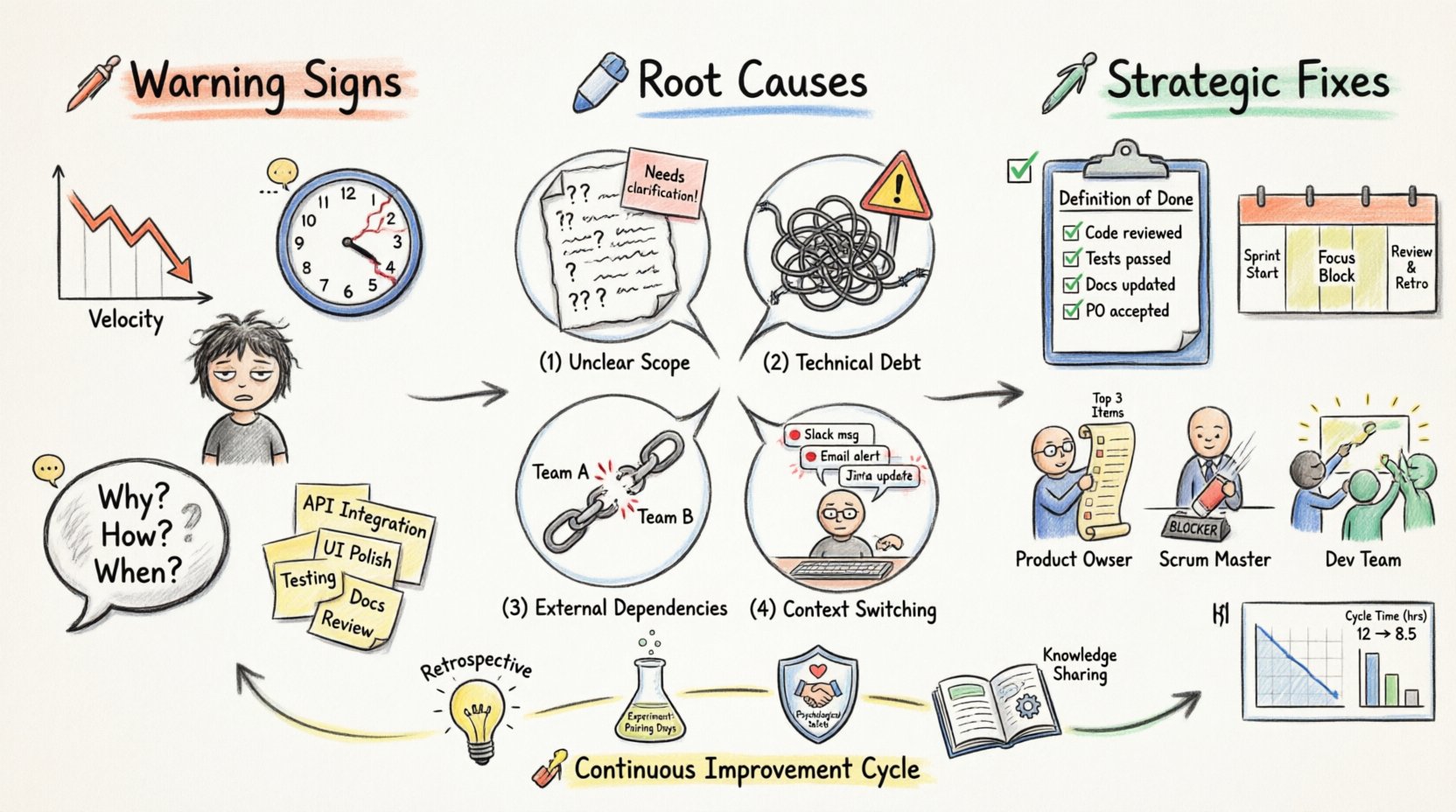
Recognizing the Signs of a Stagnant Sprint 📉
Before fixing the problem, you must accurately identify it. Stagnation rarely happens overnight. It is often a slow drift where the gap between planned work and completed work widens. Teams may not realize they are struggling until the sprint review arrives with unfinished items. Look for these specific indicators:
- Consistently Missed Commitments: The team fails to complete the items they committed to in Sprint Planning more than 20% of the time.
- Zero Velocity Days: Days pass where no new work moves from “In Progress” to “Done”.
- Extended Daily Standups: Meetings drag on for 45 minutes or more, indicating a lack of focus or unresolved blockers.
- High Work In Progress (WIP): Multiple items are started but few are finished, creating a bottleneck effect.
- Retrospective Fatigue: The same issues are raised in every retrospective without any tangible change in the process.
Understanding these symptoms helps distinguish between a temporary setback and a systemic failure. The table below contrasts a healthy sprint cycle with a stagnant one to clarify the differences.
| Indicator | Healthy Sprint | Stagnant Sprint |
|---|---|---|
| Velocity Trend | Stable or slowly increasing | Unpredictable or declining |
| Blocker Resolution | Addressed within 24 hours | Left unresolved for weeks |
| Team Morale | High engagement and confidence | Low energy, avoidance of meetings |
| Definition of Done | Strictly adhered to | Ignored or applied inconsistently |
| Stakeholder Feedback | Regular and actionable | Delayed or critical |
Common Root Causes of Sprint Stagnation 🔍
When a sprint stalls, it is rarely due to a single factor. Usually, it is a combination of planning errors, technical debt, and team dynamics. Identifying the specific root cause is essential for a lasting fix.
1. Unclear or Inflated Scope
One of the most frequent culprits is taking on too much work during Sprint Planning. If the Product Owner does not provide clear acceptance criteria, developers spend valuable time guessing requirements. This leads to rework and delays. Additionally, if the backlog is not refined beforehand, the team wastes time discussing details during the planning session rather than committing to work.
- Symptom: Stories are moved to “In Progress” but never finish.
- Impact: Velocity drops because the team cannot accurately estimate capacity.
- Fix: Enforce a strict “Backlog Refinement” session prior to planning. Ensure every story has a clear “Definition of Ready”.
2. Technical Debt Accumulation
When a team focuses solely on new features to meet deadlines, they often neglect the underlying code quality. Over time, this debt becomes a heavy anchor. Bugs multiply, and the system becomes fragile. Fixing a new feature then requires navigating through layers of bad code, slowing down development significantly.
- Symptom: More time is spent fixing bugs than building new functionality.
- Impact: Quality decreases, and the time required for testing increases.
- Fix: Allocate a specific percentage of sprint capacity (e.g., 20%) to technical improvement and debt reduction.
3. External Dependencies and Blockers
Teams often get stuck waiting for information, resources, or approvals from outside their immediate group. If a team relies on another department to provide API access or design assets, any delay in that external process halts their progress. This is a common source of frustration that feels out of the team’s control.
- Symptom: Work items remain in “Blocked” status for extended periods.
- Impact: The sprint burndown chart flattens out, showing no progress.
- Fix: Map out dependencies before the sprint begins. Assign a specific owner to track and unblock these external tasks daily.
4. Lack of Focus and Context Switching
Agile teams require deep work to be productive. When developers are pulled into meetings, ad-hoc requests, or support tickets throughout the day, their focus is broken. Every time they switch contexts, it takes time to regain their train of thought. This fragmentation kills productivity without anyone realizing it immediately.
- Symptom: Low output despite high attendance in meetings.
- Impact: The sprint goal is missed because no one had enough uninterrupted time.
- Fix: Implement “Focus Hours” where no meetings are scheduled. Protect the team from non-urgent interruptions.
Strategic Fixes for Process Drift 🛠️
Once the root cause is identified, the team must adjust the process. This is not about changing the framework, but optimizing the implementation of Scrum within the specific context of the team.
Refining the Definition of Done (DoD)
The Definition of Done is the checklist that determines when a story is actually complete. If this list is vague, the team may mark a story as done when it is only coded but not tested. This creates a false sense of progress. A robust DoD should include testing, documentation, code review, and deployment readiness.
- Review: Have the team review the current DoD. Is it too easy? Is it too hard?
- Standardize: Ensure everyone agrees on what “done” means. A story is not done until it is in the hands of the user or ready for release.
- Visualize: Make the DoD visible on every task card or board to ensure it is checked off before moving to “Done”.
Adjusting Sprint Length
Standard Scrum suggests a two-week sprint. However, if the team is consistently overwhelmed, a shorter sprint might provide better feedback loops. Conversely, if the team is too small and needs time to stabilize, a longer sprint might reduce the administrative overhead of planning. The goal is to find a rhythm that allows for completion without burnout.
- Shorter Sprints: Increase feedback frequency and reduce risk.
- Longer Sprints: Allow for deeper work on complex items.
- Consistency: Whichever length is chosen, maintain it consistently to build a predictable rhythm.
Improving Sprint Planning
Planning is where many teams go wrong. If the planning session is rushed, the commitment is flawed. Teams often fall into the trap of saying “yes” to everything to please stakeholders. This sets them up for failure. Planning should be about capacity, not just wishlists.
- Capacity Planning: Account for holidays, meetings, and leave during the sprint.
- Story Splitting: Break large stories into smaller, testable chunks that can be completed within the sprint.
- Commitment vs. Forecast: Treat the plan as a forecast. If the team cannot commit to 100% of the work, plan for 80% to allow for unforeseen issues.
Role-Specific Responsibilities in Crisis 🎯
Each role in the Scrum framework has a distinct responsibility when the team struggles. Blame is not the solution; clarity is.
The Product Owner (PO)
The PO is responsible for the value of the product. If the sprint is stagnant, the PO must evaluate if the right work is being done.
- Re-prioritize: Cut lower-priority items from the sprint to focus on the critical path.
- Clarify: Be available to answer questions immediately to prevent developer stalls.
- Manage Stakeholders: Shield the team from external pressure and manage expectations regarding deadlines.
The Scrum Master (SM)
The SM serves the team by removing impediments and ensuring the process is followed. In a stagnant sprint, the SM must be more active than usual.
- Facilitate: Ensure the Daily Standup is effective and focused on blockers.
- Coach: Help the team understand why they are missing commitments and guide them toward self-correction.
- Protect: Prevent the team from taking on new work while the current backlog is unfinished.
The Development Team
The developers are responsible for the quality and quantity of the work. They must own the process.
- Swarming: Instead of working in silos, team members should collaborate to finish one item before starting another.
- Transparency: Admit early if a task is going to be late. Hiding bad news worsens the problem.
- Peer Review: Conduct code reviews immediately to prevent defects from accumulating.
Managing External Dependencies and Stakeholders 🤝
Sometimes the stagnation comes from outside the team. Managing these external factors is crucial for maintaining momentum.
- Dependency Mapping: Create a visual map of all external inputs required for the sprint. Identify which ones are risky.
- Regular Check-ins: Schedule brief syncs with the teams or departments you depend on. Do not wait for the sprint review to ask for updates.
- Buffer Time: Build slack into the plan. If an external task is due on Day 5, plan for it to be available on Day 3.
- Escalation Paths: Define who to contact when a blocker cannot be resolved at the team level. Do not let a single blocker stop the entire sprint for weeks.
Leveraging Metrics Without Pressure 📊
Data is useful, but it can also be damaging if used to punish teams. Metrics should be used to understand the system, not to judge individuals.
- Variation: Look at velocity over time. A single low sprint is noise; a trend is a signal.
- Burndown Charts: Use these to see if the team is on track. If the line is flat, investigate the cause immediately.
- Cycle Time: Measure how long it takes for an item to move from “In Progress” to “Done”. If this increases, the process is slowing down.
- Defect Rate: Track the number of bugs found after release. High rates indicate rushed work or poor testing.
Building a Culture of Continuous Improvement 🌱
The ultimate goal is not just to fix the current sprint, but to prevent future stagnation. This requires a culture where improvement is constant and psychological safety is high.
- Effective Retrospectives: The Retrospective is the engine of improvement. It must not be a complaint session. It should result in specific action items with owners and deadlines.
- Experimentation: Encourage the team to try small process changes. If a change fails, analyze why and try something else.
- Psychological Safety: Team members must feel safe to say “I don’t know” or “I made a mistake” without fear of retribution. This honesty is vital for troubleshooting.
- Knowledge Sharing: Document solutions to common problems. This prevents the team from hitting the same wall twice.
When to Pivot or Restart 🔄
There are times when the current sprint cannot be salvaged. This is not a failure; it is a strategic decision to preserve value.
- Scope Cut: If the deadline is immovable, remove the lowest priority items to ensure the core goal is met.
- Sprint Cancellation: If the sprint goal becomes obsolete due to market changes, the Product Owner can cancel the sprint. This frees the team to work on more valuable items.
- Reset: If the team is burnt out, a short pause or a sprint dedicated solely to rest and planning may be necessary.
Final Thoughts on Sustainable Delivery 💡
Stagnant sprints are a natural part of the learning curve in any agile journey. The key is not to avoid them, but to learn from them. By systematically analyzing the causes, adjusting the process, and maintaining open communication, teams can regain their rhythm. The focus should remain on delivering value consistently rather than hitting arbitrary dates. When the process serves the team, the team serves the product. This alignment is the foundation of a successful Scrum implementation.
Remember, the goal is sustainable pace. A sprint that finishes on time with high quality is better than one that finishes early with technical debt. Trust the process, trust the team, and keep iterating towards better performance.