

Learning the Scrum framework often feels like decoding a new language. For students and beginners entering the world of Agile, the terminology can seem straightforward, but the application is nuanced. Many learners grasp the ceremonies and artifacts quickly, yet stumble when trying to implement the underlying principles effectively. This gap between theory and practice creates a phenomenon often referred to as “Scrum but”—where teams follow the ritual without reaping the benefits.
Understanding the pitfalls is the first step toward genuine agility. This guide dissects the most frequent errors made by those new to the framework. By identifying these traps, you can build a stronger foundation for your future projects and professional career. Let us explore where the misunderstandings lie and how to navigate them with clarity.
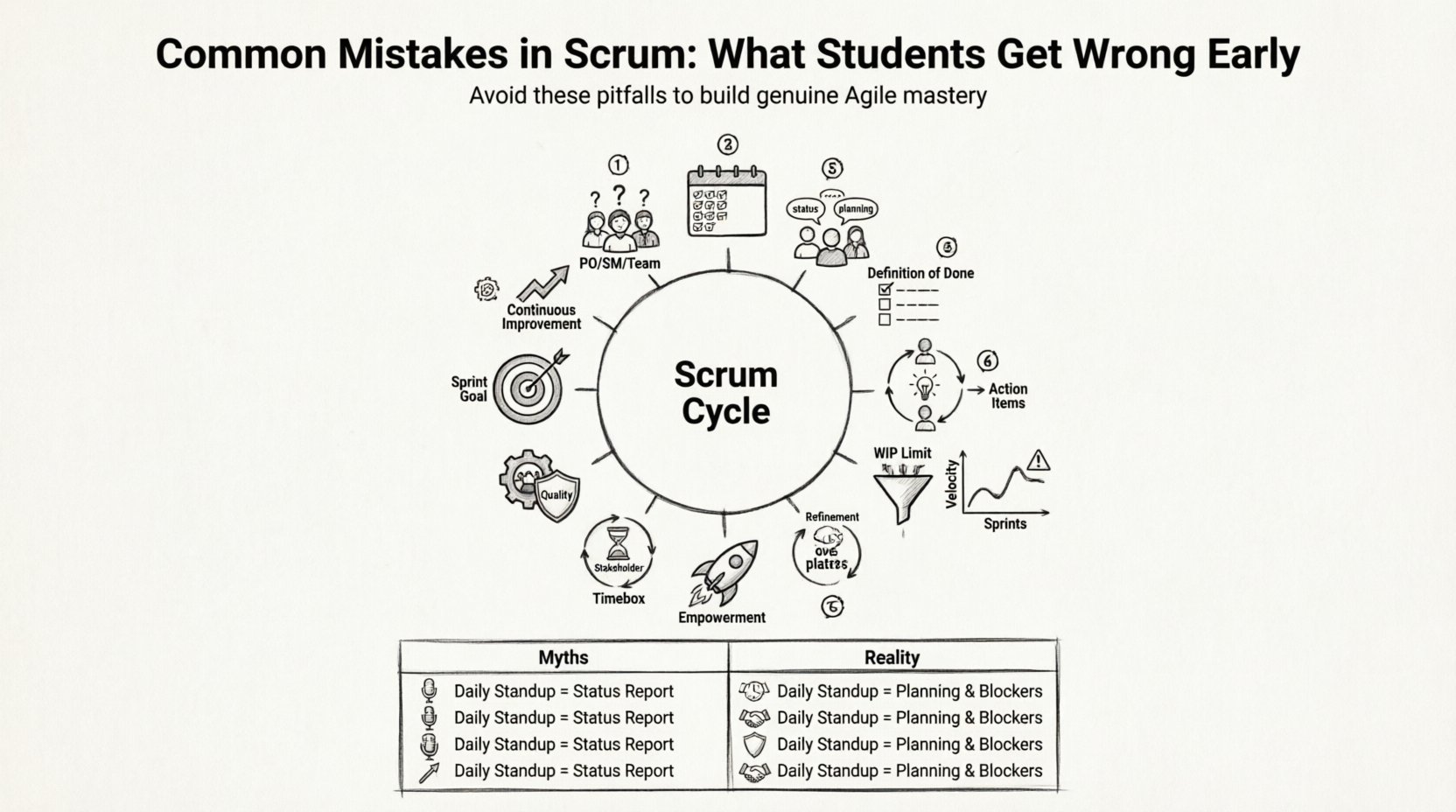
1. Confusing the Roles: PO, SM, and Team 🤝
The Scrum Guide defines three specific roles. However, in educational settings, these titles are often conflated with traditional project management positions. This confusion leads to friction and unclear accountability.
- The Product Owner (PO): Students often mistake this role for a Project Manager or a Business Analyst. The PO is not merely a task assigner. They own the vision, manage the backlog, and maximize value. They decide what to build, not how.
- The Scrum Master (SM): This is frequently confused with a Team Lead or a Manager. The SM is a servant leader, not a boss. Their job is to remove impediments, coach the team on Scrum theory, and ensure the process is followed. They do not assign work.
- The Development Team: Students sometimes view the team as passive executors waiting for orders. In reality, the team is self-managing. They decide how to turn the backlog items into increments of value.
When students treat the PO as a boss, the team loses autonomy. When they treat the SM as a manager, the team loses the opportunity to solve their own problems. The distinction is subtle but critical for sustainable growth.
2. Sprint Planning: Overcommitting and Under-planning 📅
Sprint Planning is the engine of the Scrum cycle. Yet, it is often the first place where things go wrong. The goal is not to fill the sprint with as many items as possible, but to select what can be realistically completed.
The Overcommitment Trap
Enthusiasm can be a double-edged sword. Early learners often want to prove they can do everything. They select tasks based on capacity rather than certainty. This leads to:
- High stress levels by the end of the Sprint.
- Technical debt as shortcuts are taken to finish.
- Unfinished items carried over, causing guilt and confusion.
The Under-planning Trap
Conversely, some students fear commitment. They plan for a few hours of work and leave the rest of the time open. This results in idle time and a lack of focus. The Sprint backlog should be a firm agreement on what the team commits to delivering.
Breaking Down Work
A common error is selecting large User Stories that cannot be finished in one Sprint. Items must be broken down into smaller, actionable pieces. If an item cannot be tested and potentially released by the end of the Sprint, it is too big. This principle is vital for maintaining a steady flow of value.
3. The Daily Scrum: Status Update vs. Planning 🗓️
Often called the “Daily Stand-up,” this 15-minute event is frequently misinterpreted as a status report to a manager. Students often spend the time talking about what they did yesterday rather than what they will do today to meet the Sprint Goal.
- Wrong: “I finished the login module yesterday. Today I am starting the profile page.”
- Right: “Yesterday I worked on the login. Today I will finish the tests to ensure the Sprint Goal is met. I need help with the API integration.”
The meeting is for the Developers to synchronize. It is not a reporting session for stakeholders. If stakeholders attend, they should be silent observers. The focus must remain on the plan for the next 24 hours and identifying any blockers that prevent the team from moving forward.
4. Definition of Done (DoD) Neglect ✅
The Definition of Done is a shared understanding of what it means for work to be complete. It is often the most overlooked artifact in student projects. Many assume that “coding is done” is sufficient.
Without a clear DoD, a team risks delivering incomplete value. Consider these criteria that are often missed:
- Code reviewed by peers.
- Unit tests passed.
- Documentation updated.
- Deployed to a staging environment.
- Security checks passed.
If an item is not DoD, it is not done. It is not “almost done.” It cannot be considered an increment. Students often skip this to save time, but this creates a bottleneck later where the product is technically functional but not shippable.
5. Ineffective Retrospectives 🔄
The Sprint Retrospective is the primary mechanism for improvement. Yet, it often turns into a complaint session or a superficial discussion. The goal is not just to talk, but to change the process.
Common mistakes include:
- Blame Culture: Focusing on who made a mistake rather than what the process failed to prevent.
- No Action Items: Identifying problems but agreeing on no concrete changes for the next Sprint.
- Repetition: Discussing the same issues every week without resolution.
A successful retrospective identifies one or two actionable improvements. These must be added to the Sprint Backlog for the next iteration. Without execution, the meeting is a waste of time.
6. Work In Progress (WIP) Limits 🛑
Students often believe that multitasking is a sign of efficiency. They start five tasks at once to look busy. In Scrum, this is a major efficiency killer. Context switching reduces cognitive bandwidth and increases errors.
Limiting WIP forces the team to finish work before starting new work. This creates a pull system rather than a push system. When tasks are not finished, the team stops starting. This visibility highlights bottlenecks immediately.
7. Velocity Misuse 📉
Velocity is a measure of how much work a team can complete in a Sprint. It is used for forecasting, not for performance evaluation. Students often try to increase velocity artificially to impress others.
This leads to:
- Padding estimates to look safer.
- Reducing the quality of work to move faster.
- Ignoring the variability of the work.
Velocity is a planning tool for the team, not a metric for management to judge productivity. Changing the team composition or the nature of the work will naturally change the velocity. Comparing velocities between different teams is meaningless.
8. Backlog Grooming Gaps 📝
The Product Backlog is a living artifact. It requires constant refinement. Many student teams treat the backlog as a static list created at the start of the project. They neglect to refine items until they are ready for a Sprint.
Refinement ensures that items are clear, estimated, and prioritized. Without this, Sprint Planning becomes a discovery session rather than a commitment session. The team spends the first half of the planning meeting figuring out what the item actually is.
9. Stakeholder Management Oversights 👥
Scrum emphasizes working software over comprehensive documentation. However, this does not mean stakeholders should be left in the dark. Students often isolate the team from feedback to avoid distractions.
Stakeholders should be engaged during the Sprint Review. This event is a feedback loop, not a demo. If stakeholders are not involved, the team builds what they think is needed, not what the business needs. Regular communication is essential to maintain alignment.
Common Myths vs. Reality Table 📊
| Myth | Reality |
|---|---|
| Scrum is for small teams only. | Scrum scales, but requires more coordination. |
| Scrum means no documentation. | Documentation is needed, but value is prioritized. |
| Scrum is a methodology. | Scrum is a lightweight framework. |
| Velocity determines speed. | Velocity measures capacity for planning. |
| Managers are replaced. | Management roles evolve to support the team. |
| Projects have fixed dates and scope. | Scope is fixed per Sprint; date is flexible. |
10. Timeboxing Misunderstandings ⏱️
Timeboxing is a core concept in Scrum. Events have a maximum duration. However, students often view this as a minimum requirement. They think, “We need 30 minutes, so we will talk for 30 minutes.” Timeboxing is a constraint to force focus.
If a meeting finishes early, it should end. If it runs out of time, the discussion must stop or move to a separate session. This discipline prevents meetings from consuming the workday. It forces the team to prioritize the most important topics.
11. Ignoring Technical Excellence 🛠️
Agile is often used to speed up delivery. But speed without quality is a debt trap. Students often skip automated testing or code reviews to meet the Sprint Goal. This is a short-term win with long-term pain.
Technical debt must be managed. The team should dedicate time to refactoring. If the code is messy, velocity will drop over time. The team must invest in the health of the product to maintain sustainable pace.
12. Lack of Empowerment 🚀
Finally, a common mistake is the lack of trust. Students look to the instructor or manager for answers. In Scrum, the team must own the solution. If a team cannot decide how to implement a feature, they are not self-managing.
Empowerment means the team has the authority to make decisions. It also means accepting responsibility for failures. When things go wrong, the team learns. When things go right, the team succeeds. This psychological safety is essential for high performance.
13. Overlooking the Sprint Goal 🎯
The Sprint Goal is the single objective for the Sprint. It provides flexibility. If the team discovers they cannot complete a specific item, they can swap it out as long as the Goal is met. Students often focus on the list of items and forget the Goal. This rigidity leads to failure when scope changes.
The Goal should be a coherent statement of value. It guides the team’s decision-making. If the Goal is not met, the Sprint is a failure, even if the items are done. The value delivered matters more than the tasks completed.
14. Neglecting Continuous Improvement 📈
Scrum is built on the empiricism of Transparency, Inspection, and Adaptation. Students often treat the framework as a one-time setup. They do not revisit the process. Continuous improvement is the heartbeat of Scrum.
Every Sprint offers a chance to tweak the workflow. Maybe the Daily Scrum is too long. Maybe the Definition of Done needs a new item. Maybe the environment is unstable. These adjustments are what make the team better over time.
15. Tool Dependency 🛠️
Many students believe they need a specific software platform to run Scrum. While tools help, they are not the framework. You can use a whiteboard, a notebook, or a digital tool. The value comes from the interaction, not the medium.
Relying too heavily on tools can create a false sense of progress. A green ticket in a tool does not mean the work is done. It means the ticket was moved. The work is the value. The tool is just the tracker.
Moving Forward with Confidence 🌟
Avoiding these mistakes requires awareness and practice. Scrum is not about following a checklist. It is about adapting to the environment. Students who embrace the mindset over the mechanics will find more success. The journey is iterative.
Start by auditing your current process. Identify which of these mistakes are present. Pick one to fix in the next Sprint. Measure the impact. Repeat. This is the path to maturity in the framework.
Remember that mistakes are part of the learning process. The goal is not perfection, but progress. By understanding the common pitfalls, you position yourself to navigate the complexities of Agile development with insight and resilience. Focus on value, collaboration, and continuous improvement, and the framework will serve you well.