

Engineering projects in academia often mirror real-world software development challenges. Without a structured approach, group dynamics can fracture, deadlines may slip, and technical debt can accumulate. This guide provides a comprehensive Scrum checklist for engineering undergraduates. It focuses on practical application of Agile principles within a university setting, ensuring your capstone projects run smoothly and effectively.
📚 Understanding Scrum in Academia
Scrum is not just a set of rules; it is a framework for managing complex work. For engineering students, it serves as a scaffold for collaboration. Unlike traditional Waterfall models where requirements are fixed at the start, Scrum embraces change. This adaptability is crucial when dealing with evolving project requirements or unexpected technical hurdles during a semester.
When applying Scrum in a student team, the goal is not merely to ship code. It is to learn how to deliver value iteratively. Each cycle, known as a Sprint, typically lasts two weeks. This timeframe allows for frequent feedback from instructors or potential users while maintaining momentum.
👥 Core Roles for Student Teams
Clear role definition prevents confusion. In a university setting, roles should rotate or be assigned based on strengths. The following table outlines the primary responsibilities for each role.
| Role | Primary Responsibility | Student Context |
|---|---|---|
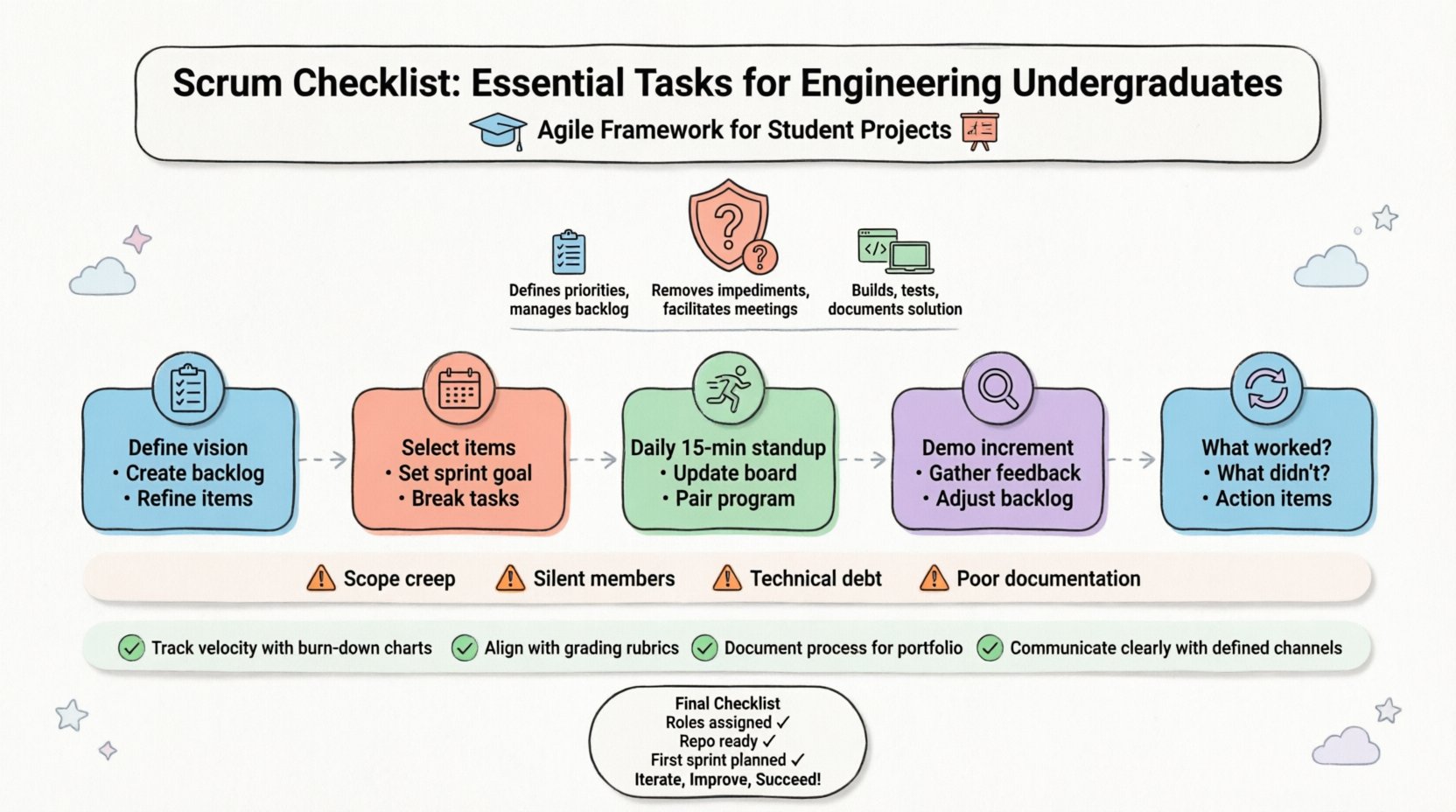
| Product Owner | Defines priorities and goals | Acts as the voice of the client or instructor; manages the backlog. |
| Scrum Master | Removes impediments | Facilitates meetings, ensures adherence to process, and handles team conflicts. |
| Development Team | Delivers the Increment | Engineers who build, test, and document the solution. |
Note: In many academic groups, the Scrum Master and Product Owner roles may be shared or rotated to ensure everyone understands the full lifecycle.
📋 Phase 1: Sprint Preparation Checklist
Before work begins, the foundation must be solid. This phase ensures the team is aligned on what needs to be built and why.
1.1 Define the Product Vision
- Ensure all members understand the project’s main objective.
- Document the Product Vision in a shared location.
- Identify key stakeholders (e.g., professors, industry mentors).
1.2 Create the Product Backlog
- Gather all potential features and requirements.
- Write items as user stories using the format: As a [user], I want [feature], so that [benefit].
- Prioritize items based on value and risk. High-value items go to the top.
- Ensure every item is clear enough to be estimated.
1.3 Refine the Backlog
- Review the top items regularly (Backlog Grooming).
- Break large tasks into smaller, manageable stories.
- Assign rough estimates (e.g., points or hours) to each item.
📅 Phase 2: Sprint Planning Checklist
Planning sets the pace for the upcoming two weeks. It is a collaborative event where the team decides what they can commit to delivering.
2.1 Select Items from the Backlog
- Review the top priority items in the backlog.
- Select only what the team believes they can complete within the sprint.
- Avoid over-committing; under-promise and over-deliver.
2.2 Define Sprint Goals
- Establish a clear goal for the sprint (e.g., “Implement user login system”).
- Ensure the goal aligns with the broader product vision.
2.3 Break Down Tasks
- Convert selected user stories into technical tasks.
- Assign tasks to team members based on skill and availability.
- Estimate effort for each technical task.
- Track progress on a physical or digital board.
🏃 Phase 3: Execution & Daily Scrum Checklist
During the sprint, the team focuses on execution. The Daily Scrum is the heartbeat of this phase.
3.1 The Daily Standup
- Hold the meeting at the same time and place every day.
- Keep it to 15 minutes maximum.
- Each member answers three questions:
- What did I do yesterday?
- What will I do today?
- Are there any blockers?
3.2 Managing Workflows
- Update the task board daily.
- Move cards from “To Do” to “In Progress” to “Done”.
- Ensure code is committed to the repository regularly.
- Run automated tests to catch regressions early.
3.3 Collaboration
- Use pair programming for complex logic.
- Conduct code reviews before merging changes.
- Document architectural decisions as you go.
🔍 Phase 4: Sprint Review Checklist
The Sprint Review is not just a demo; it is a feedback loop. It happens at the end of every sprint.
4.1 Demonstrate the Increment
- Show working software to stakeholders.
- Highlight completed features against the original plan.
- Be transparent about what was not finished and why.
4.2 Gather Feedback
- Ask stakeholders for specific input on functionality.
- Record feedback for the next planning session.
- Update the Product Backlog based on new insights.
4.3 Adjust the Plan
- Review the current progress against the release target.
- Re-prioritize the backlog if necessary.
- Discuss potential changes to the product direction.
🔄 Phase 5: Sprint Retrospective Checklist
The Retrospective is for the team only. It is a safe space to discuss how to improve the process.
5.1 Set the Stage
- Create a psychological safe environment.
- Remind the team that the goal is process improvement, not blame.
5.2 Review the Past Sprint
- What went well?
- What did not go well?
- What are the top 3 things to improve?
5.3 Create Action Items
- Identify specific changes to try in the next sprint.
- Assign ownership for each action item.
- Review progress on these items in the next retrospective.
⚠️ Common Pitfalls for Undergraduates
Even with a checklist, students often face unique challenges. Awareness of these common issues can prevent project failure.
1. Scope Creep
Adding new features mid-sprint is a major risk. If a new idea arises, add it to the backlog for the next sprint. Do not disrupt the current commitment unless it is a critical blocker.
2. The Silent Team Member
In group projects, some members may disappear. The Scrum Master must identify this early. Encourage participation during Daily Scrums. If a member is consistently absent, address it immediately.
3. Ignoring Technical Debt
Undergraduate projects often rush to meet deadlines. This leads to messy code. Allocate time in every sprint for refactoring and testing. Do not leave it for the final week.
4. Overlooking Documentation
Code is not enough. Academic projects require reports. Integrate documentation tasks into the backlog. Treat documentation stories the same as coding stories.
📊 Managing Artifacts Effectively
Artifacts represent work or value. For engineering students, managing these artifacts is key to organization.
- Product Backlog: Keep this visible. Use a shared document or tool to maintain a single source of truth.
- Sprint Backlog: Track daily progress. Update it when tasks are completed or new tasks are discovered.
- Increment: Ensure every sprint ends with a potentially shippable product. This means code that compiles, tests pass, and basic functionality works.
📝 Assessment Alignment Checklist
University projects often have grading rubrics that do not perfectly match industry Scrum. Align your process with academic requirements.
- Check Grading Criteria: Ensure your Scrum activities (meetings, artifacts) satisfy course deliverables.
- Log Time: Some courses require time logs. Track time spent on tasks for each team member.
- Mid-Term Checks: Use the Sprint Review to simulate midterm presentations. Get early feedback on progress.
- Final Submission: Ensure the final code and report are linked to specific sprint increments.
🛠️ Communication Protocols
Clear communication reduces friction. Establish ground rules early in the project.
- Channels: Define where to talk about what. Use specific channels for technical questions and others for general updates.
- Response Times: Agree on expected response times for messages.
- Meeting Cadence: Stick to the schedule. If you say 9 AM, be there at 9 AM.
- Conflict Resolution: Define how decisions are made. Is it consensus? Voting? Or does the Product Owner decide?
📈 Tracking Progress
Visualizing progress helps the team stay motivated and aware of risks.
- Velocity: Track how many story points are completed per sprint. Use this to plan future sprints more accurately.
- Burn-down Charts: Use a chart to show remaining work. It should trend downward over the sprint.
- Bug Tracking: Log bugs separately from features. Do not let critical bugs block the sprint goal.
🎓 Preparing for the Future
Completing a project using this checklist provides tangible skills for the job market. Employers value experience with Agile methodologies.
- Portfolio: Document your Scrum process. Include screenshots of your boards and logs of your retrospectives.
- Resume: List specific tools and practices you used (e.g., “Managed team of 5 using Scrum framework”).
- Interviews: Be ready to discuss how you handled conflict or scope changes during your project.
✅ Final Implementation Checklist
Before starting your first sprint, ensure the following foundational items are in place.
- ☐ Team members introduced and roles assigned.
- ☐ Communication channel established.
- ☐ Version control repository created and shared.
- ☐ Development environment configured for all members.
- ☐ First Product Backlog created and prioritized.
- ☐ First Sprint Goal defined.
- ☐ Sprint Planning meeting scheduled.
- ☐ Daily Standup time slot agreed upon.
- ☐ Retrospective format decided.
By adhering to this structured approach, engineering undergraduates can navigate complex projects with confidence. The process is iterative. It requires discipline, but the reward is a functional product and a deeper understanding of professional engineering practices.
Remember, the goal is continuous improvement. Each sprint offers a chance to do better than the last. Use the Scrum framework not just to pass a course, but to build a foundation for a successful engineering career.