

Transitioning from traditional project management to an Agile approach is a significant shift. It requires a change in mindset, not just a change in process. Scrum is the most widely adopted framework for implementing Agile practices. It provides a structure for teams to build complex products through iterative progress and frequent inspection. This guide outlines the essential steps to begin your journey with Scrum, ensuring your team can deliver value consistently and adapt to change effectively.
What is Scrum? 🤔
Scrum is a lightweight framework that helps people, teams, and organizations generate value through adaptive solutions for complex problems. It is not a methodology or a process, but rather a set of roles, events, artifacts, and rules. Scrum is founded on empiricism and lean thinking. Empiricism asserts that knowledge comes from experience and making decisions based on what is observed. Lean thinking reduces waste and focuses on the essential.
Unlike waterfall methodologies, where requirements are defined upfront and changes are costly, Scrum embraces change. It allows teams to inspect and adapt their product and process regularly. This flexibility is crucial in modern software development, where market needs evolve rapidly.
Core Principles of Agile 🛠️
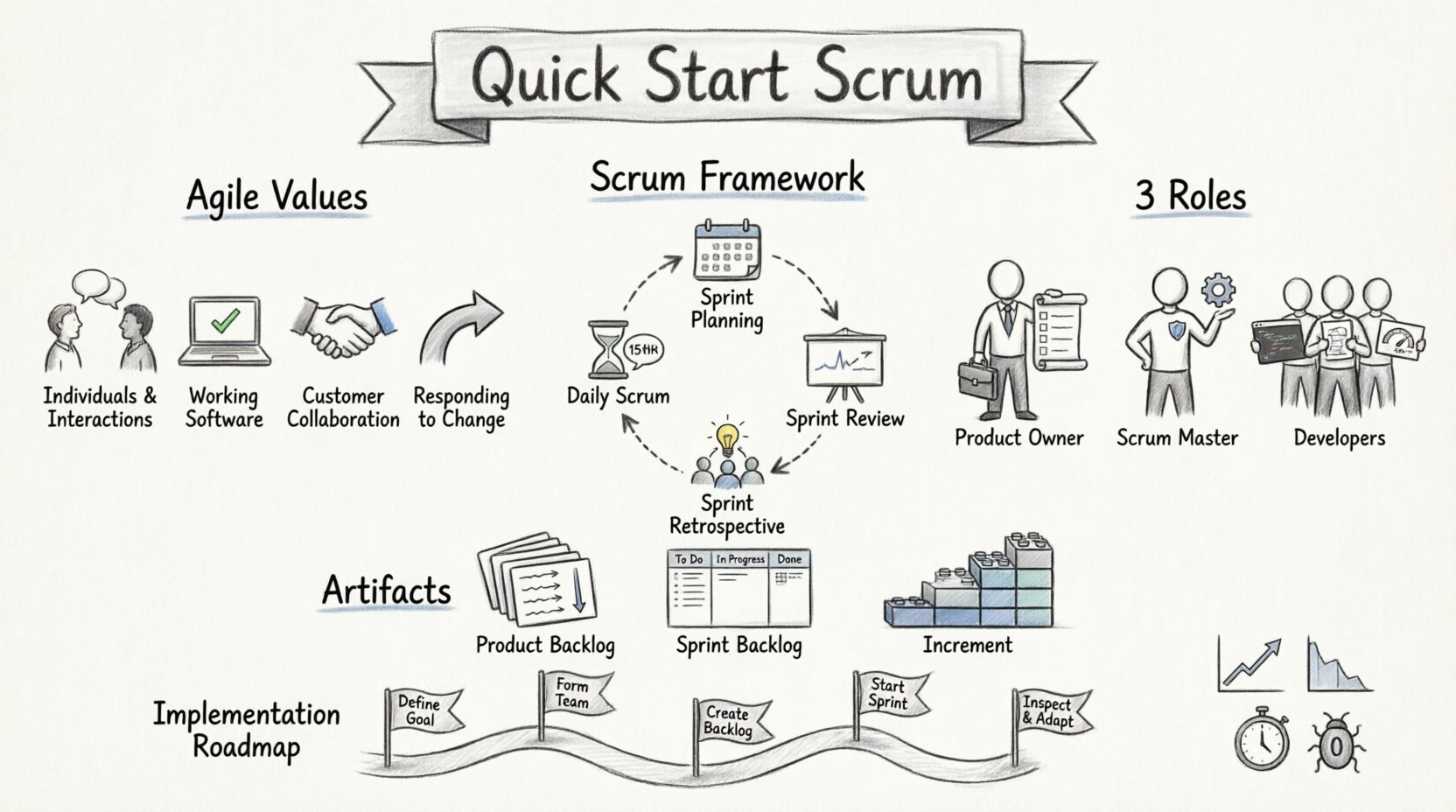
Before diving into the mechanics of Scrum, it is vital to understand the underlying values. The Agile Manifesto highlights four core values:
- Individuals and interactions over processes and tools.
- Working software over comprehensive documentation.
- Customer collaboration over contract negotiation.
- Responding to change over following a plan.
While the items on the right have value, the items on the left are prioritized. In a Scrum environment, the focus remains on delivering working increments of software frequently. Documentation is necessary but should not hinder progress. Collaboration with stakeholders ensures the product meets actual needs rather than just fulfilling a static contract.
Scrum Roles 👥
Scrum defines three specific roles. These roles are not job titles but accountabilities within the framework. Every team member must fulfill one of these roles to ensure the framework functions correctly.
1. The Product Owner (PO) 💼
The Product Owner is responsible for maximizing the value of the product resulting from the work of the Development Team. They are the voice of the customer and the stakeholder. Key responsibilities include:
- Developing and explicitly communicating the Product Goal.
- Organizing the Product Backlog.
- Ensuring the Product Backlog is transparent, visible, and understood.
- Ordering items in the Product Backlog to best achieve goals and missions.
The Product Owner does not manage the team but manages the content and priorities. They are the single point of truth regarding what needs to be built next.
2. The Scrum Master (SM) 🛡️
The Scrum Master is responsible for promoting and supporting Scrum as defined in the Scrum Guide. They are a servant-leader for the Scrum Team. Their duties include:
- Coaching the team in self-management and cross-functionality.
- Helping everyone understand the need for clear products.
- Removing impediments to the Development Team’s progress.
- Ensuring that all Scrum events take place and are positive.
- Facilitating Scrum events as requested or needed.
The Scrum Master protects the team from external distractions and ensures the process is followed without becoming a bottleneck themselves.
3. The Developers 👷
Developers are the people in the Scrum Team that are committed to creating any aspect of a usable Increment each Sprint. This term includes designers, testers, and programmers. They are cross-functional, meaning they have all the skills necessary to create the product increment.
- They create the plan for the Sprint.
- They hold themselves accountable for the work.
- They do not have sub-roles within the Development Team.
The Development Team is autonomous. They decide how to turn Product Backlog items into working software.
Scrum Events 📅
Events are used in Scrum to create regularity and to minimize the need for meetings not defined in Scrum. All events are time-boxed, meaning there is a maximum duration. This ensures focus and efficiency.
The Sprint ⏱️
The Sprint is the heartbeat of Scrum. It is a fixed-length event of one month or less during which a “Done”, useable, and potentially releasable product Increment is created. Sprints start immediately after the previous one ends. There is no inter-sprint gap. If a Sprint is cancelled, previous work is reviewed, and the Product Backlog is updated.
Sprint Planning 🗓️
This event kicks off the Sprint. The entire Scrum Team collaborates to define the goal and select the work. The output is a Sprint Goal and a Sprint Backlog. The Planning meeting is time-boxed to eight hours for a one-month Sprint. For shorter Sprints, the event is usually shorter.
- What can be done? The Product Owner presents the highest priority items.
- How will it get done? The Developers figure out the technical approach.
- Who will do it? Developers commit to specific tasks based on capacity.
Daily Scrum 🗣️
The Daily Scrum is a 15-minute event for the Developers. It is held at the same time and place every working day. The purpose is to inspect progress toward the Sprint Goal and adapt the Sprint Backlog for the next 24 hours. It is not a status report for management; it is a planning session for the team.
Participants often answer three questions:
- What did I do yesterday that helped the team meet the Sprint Goal?
- What will I do today to help the team meet the Sprint Goal?
- Do I see any impediment that prevents me or the team from meeting the Sprint Goal?
Sprint Review 🎯
At the end of the Sprint, the Scrum Team and stakeholders review what was accomplished. This is not a demonstration of every item, but a focused look at the Increment. The goal is to collaborate on what to do next. The Product Backlog may be adjusted to reflect new insights or changes in the market.
Sprint Retrospective 🔍
The final event of the Sprint is the Retrospective. The Scrum Team inspects itself. They discuss what went well, what did not, and how to improve. This is the key event for continuous improvement. The output is a plan for implementing improvements in the next Sprint.
Scrum Artifacts 📦
Artifacts represent work or value. They are designed to maximize transparency of key information. Each artifact contains a specific commitment that relates to the content of the artifact.
Product Backlog 📝
The Product Backlog is an ordered list of everything that is known to be needed in the product. It is the single source of requirements for any changes to be made to the product. The Product Owner is responsible for the Product Backlog, including its content, availability, and ordering.
Items in the backlog are not static. They emerge from the requirements and evolve as the product and the environment evolve. The level of detail increases as items move up the list. This process is called Backlog Refinement.
Sprint Backlog 📋
The Sprint Backlog is the set of Product Backlog items selected for the Sprint, plus a plan for delivering the Increment and realizing the Sprint Goal. It is a plan created by the Developers. It is owned by the Developers.
Increment 🏗️
The Increment is the sum of all the Product Backlog items completed during a Sprint and the value of the increments of all previous Sprints. To be useful, each Increment must be in a usable condition, regardless of whether it is released. This is often defined by a Definition of Done.
Step-by-Step Implementation 🛣️
Starting Scrum can seem daunting. Here is a practical roadmap to get your team moving.
Step 1: Define the Product Goal
Before writing code, understand the destination. The Product Owner must articulate a clear vision. What problem are we solving? Who is the user? This goal guides all future decisions.
Step 2: Form the Team
Identify the people who will build the product. Ensure the team has the necessary skills. If skills are missing, plan for training or hiring. A cross-functional team reduces dependencies on external groups.
Step 3: Create the Initial Backlog
Gather requirements and write them as user stories or items. Prioritize them based on value and risk. Do not try to define every detail upfront. Leave room for discovery.
Step 4: Start the First Sprint
Hold a Sprint Planning session. Select items that fit within the team’s capacity. Define the Sprint Goal clearly. Commit to the work.
Step 5: Inspect and Adapt
Hold the Daily Scrum, Review, and Retrospective. Use the feedback from the Review to adjust the backlog. Use the feedback from the Retrospective to adjust the process.
Common Challenges & Solutions 🧩
Teams often face hurdles when adopting Scrum. Here are common issues and how to address them.
| Challenge | Root Cause | Solution |
|---|---|---|
| Unclear Requirements | Trying to plan too far ahead | Refine the backlog regularly. Focus on the immediate Sprint. |
| Team Resistance | Fear of change or loss of control | Train the team. Explain the benefits. Let them own the process. |
| Scope Creep | Stakeholders adding items mid-Sprint | Protect the Sprint Goal. Add new items to the backlog, not the Sprint. |
| Distributed Teams | Time zone differences | Use collaboration tools. Record meetings. Ensure overlapping hours. |
Measuring Success 📊
How do you know if Scrum is working? You need metrics that reflect value and efficiency without encouraging bad behavior.
- Velocity: The amount of work a team completes during a Sprint. This helps with forecasting, but should not be used to compare teams.
- Sprint Burndown: A chart showing the work remaining in the Sprint. It helps the team see if they are on track to complete the Sprint Goal.
- Cycle Time: The time it takes for a work item to go from start to finish. Lower cycle times indicate faster delivery.
- Defect Rate: The number of bugs found in the Increment. A lower rate indicates higher quality.
Getting Started Today 🏁
Implementing Scrum is a journey. It requires patience and commitment. Start small. Pick a project or a feature set and try Scrum on that. Learn from the experience. Do not try to implement every rule perfectly on day one.
The goal is to become more effective at delivering value. If the team is collaborating better, shipping faster, and producing higher quality work, you are on the right path. Continuous improvement is the engine of Scrum.
Remember, Scrum is simple to understand but difficult to master. It is a tool for managing complexity. Use it to navigate the uncertainty of software development. Build the product your users need, adapt to the market, and enjoy the process of creation.