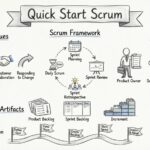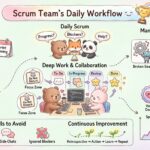


Agile methodologies have reshaped how teams approach complex work, and at the heart of this transformation lies the Scrum framework. It provides a structured yet flexible environment for delivering value incrementally. Understanding the core components of Scrum is essential for any team aiming to improve efficiency, transparency, and continuous improvement. This guide breaks down the essential elements, roles, events, and artifacts that make the Scrum framework function effectively.
📋 Understanding the Scrum Framework
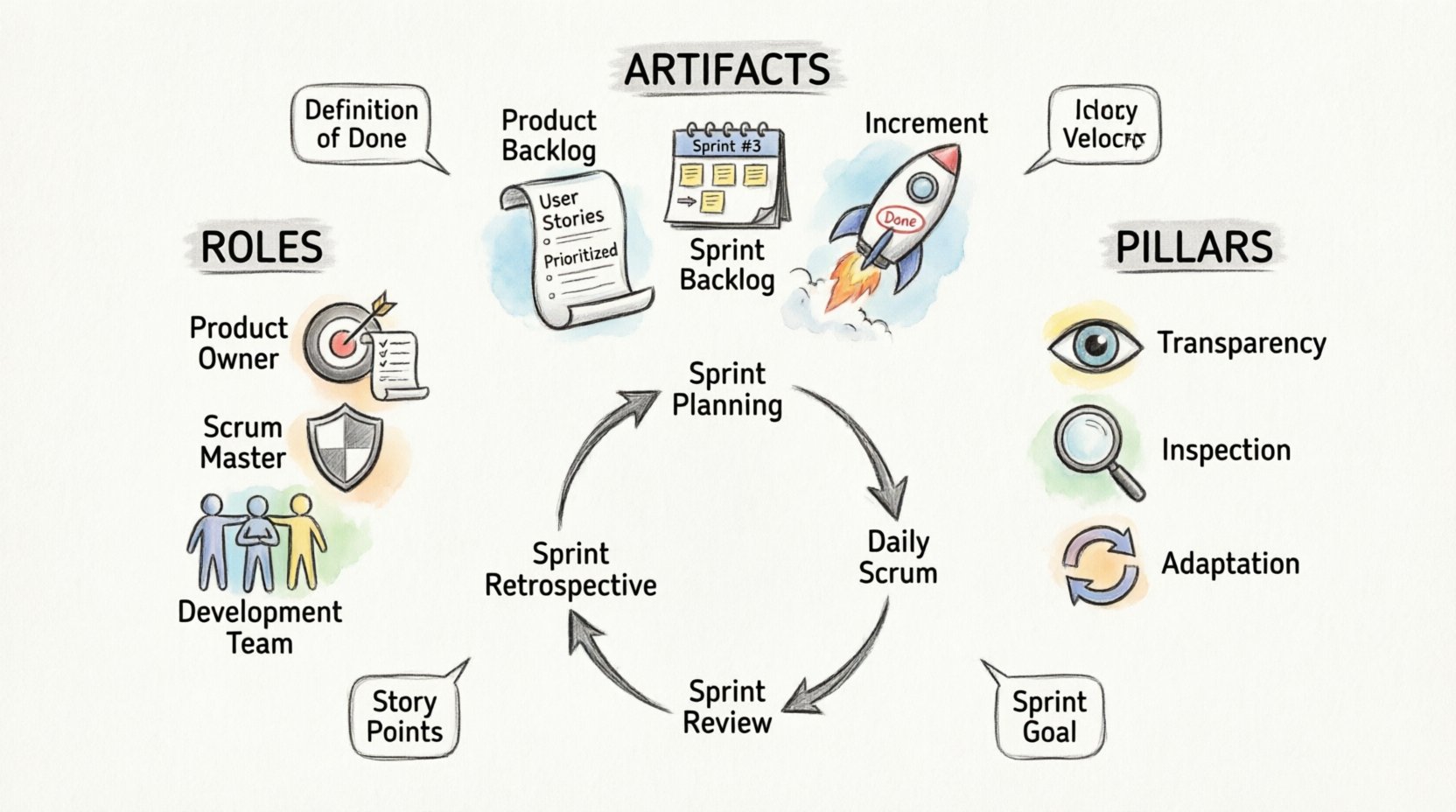
Scrum is not merely a set of rules; it is a lightweight framework that helps people, teams, and organizations generate value through adaptive solutions for complex problems. It relies on empirical process control, which means decisions are based on observation and experimentation rather than extensive upfront planning. The framework consists of three pillars:
- Transparency: Significant aspects of the process must be visible to those responsible for the outcome.
- Inspection: Frequent inspection of Scrum artifacts to detect undesirable variances.
- Adaptation: If an aspect of the process deviates outside acceptable limits, the process must be adjusted.
Without a clear understanding of these pillars, teams often struggle to implement Scrum effectively. The framework is designed to be simple, yet mastering the interplay between its components requires discipline and commitment.
👥 Scrum Roles
Scrum defines three specific roles to ensure accountability and focus. There are no sub-roles or teams within these primary roles.
1. Product Owner 🎯
The Product Owner is responsible for maximizing the value of the product resulting from the work of the Development Team. This role is not about managing a team in the traditional sense but rather managing the backlog and communicating the vision.
- Key Responsibilities:
- Developing and explicitly communicating the Product Goal.
- Ordering the items in the Product Backlog to best achieve goals and missions.
- Ensuring that the Product Backlog is visible, transparent, and understood.
- Ensuring the Development Team understands items in the Product Backlog to the level needed.
The Product Owner is a single person, not a committee. While they may consult stakeholders and experts, the final authority on the order of the backlog rests with them.
2. Scrum Master 🛡️
The Scrum Master is responsible for promoting and supporting Scrum as defined in the Scrum Guide. They serve the Product Owner, the Development Team, and the organization in different ways.
- Key Responsibilities:
- Coaching the organization in its Scrum adoption.
- Facilitating Scrum events as requested or needed.
- Removing impediments to the Development Team’s progress.
- Ensuring that all Scrum events take place and are positive, productive, and kept within the timebox.
This role is often described as a servant-leader. They do not assign work but rather help the team find the best way to accomplish their goals.
3. Development Team 👷
The Development Team consists of professionals who do the work of delivering a potentially releasable Increment of functionality at the end of each Sprint. They are cross-functional, meaning they have all the skills necessary to create the product.
- Key Characteristics:
- Self-Organizing: The team decides how best to accomplish their work, rather than being directed by others outside the team.
- Collaborative: Members work together to create value.
- Size: Typically between 3 and 9 members to maintain agility.
📦 Scrum Artifacts
Artifacts represent work or value. They are designed to maximize transparency of key information. Every artifact contains a commitment to ensure it provides information that is relevant to the stakeholders.
1. Product Backlog 📝
The Product Backlog is an ordered list of everything that is known to be needed in the product. It is the single source of requirements for any changes to be made to the product.
- Dynamic: The Product Backlog never ends. It evolves as the product and the environment evolves.
- Ordered: Items at the top are more clear and more detailed than items further down.
- Refined: The Product Owner refines the backlog to ensure it is ready for future Sprints.
2. Sprint Backlog 🗓️
The Sprint Backlog is the set of Product Backlog items selected for the Sprint, plus a plan for delivering the Increment and realizing the Sprint Goal.
- Owned by: The Development Team.
- Granularity: Contains tasks broken down from user stories.
- Commitment: The team commits to delivering the Sprint Goal based on the selected items.
3. Increment 🚀
An Increment is a concrete stepping stone toward the Product Goal. Each Increment is additive to all prior Increments and thoroughly verified.
- Definition of Done: An Increment must meet the Definition of Done to be considered complete.
- Usable: It must be in a usable condition, regardless of whether the Product Owner decides to release it.
| Artifact | Primary Owner | Commitment | Purpose |
|---|---|---|---|
| Product Backlog | Product Owner | Product Goal | Defines the value to be built |
| Sprint Backlog | Development Team | Sprint Goal | Defines the work for the Sprint |
| Increment | Development Team | Definition of Done | Represents completed value |
🔁 Scrum Events
Events are time-boxed activities that create regularity and minimize the need for unnecessary meetings. They are used to inspect progress and adapt the plan.
1. The Sprint 🏃
The Sprint is the heartbeat of Scrum. It is a fixed-length event of one month or less during which a “Done”, useable, and potentially releasable product Increment is created. Sprints contain and consist of other Scrum Events.
- Duration: Consistent length throughout the project.
- Goal: Every Sprint has a goal.
- No Changes: Once a Sprint starts, its scope cannot be reduced, but it may be clarified by the Product Owner.
2. Sprint Planning 🗓️
Sprint Planning initiates the Sprint by laying out the work to be performed for the Sprint. This event results in the Sprint Backlog.
- Timebox: Maximum of 8 hours for a one-month Sprint.
- Who: The entire Scrum Team.
- Key Questions:
- What can be delivered in the Increment resulting from the upcoming Sprint?
- How will the chosen work get done?
The Product Owner explains the highest priority items, and the Development Team forecasts how much they can commit to completing.
3. Daily Scrum 🌤️
Developed to inspect progress toward the Sprint Goal and adapt the Sprint Backlog as necessary, adjusting the upcoming planned work. This is a 15-minute time-boxed event for the Development Team.
- When: Every day of the Sprint at the same time and place.
- Focus: Progress toward the Sprint Goal, not a status report for management.
- Three Questions:
- What did I do yesterday that helped the Development Team meet the Sprint Goal?
- What will I do today to help the Development Team meet the Sprint Goal?
- Do I see any impediment that prevents me or the Development Team from meeting the Sprint Goal?
4. Sprint Review 👀
The Sprint Review is held at the end of the Sprint to inspect the Increment and adapt the Product Backlog if needed. During the event, the Scrum Team and stakeholders collaborate about what was done in the Sprint.
- Timebox: Maximum of 4 hours for a one-month Sprint.
- Focus: Product demonstration and feedback.
- Outcome: Updated Product Backlog items based on feedback.
This is not a gatekeeping meeting. It is a collaborative session where stakeholders provide input that influences future product direction.
5. Sprint Retrospective 🔍
The Sprint Retrospective occurs after the Sprint Review and prior to the next Sprint Planning. Its purpose is to plan ways to increase quality and effectiveness.
- Timebox: Maximum of 3 hours for a one-month Sprint.
- Who: The Scrum Team.
- Focus: Process improvement.
- Output: A plan for implementing improvements in the next Sprint.
The team inspects how the last Sprint went regarding individuals, interactions, processes, tools, and their Definition of Done.
| Event | Timebox (1-Month Sprint) | Participants | Primary Output |
|---|---|---|---|
| Sprint Planning | 8 Hours | Scrum Team | Sprint Backlog |
| Daily Scrum | 15 Minutes | Development Team | Updated Plan for Day |
| Sprint Review | 4 Hours | Scrum Team + Stakeholders | Adapted Product Backlog |
| Sprint Retrospective | 3 Hours | Scrum Team | Improvement Plan |
🛠️ Definition of Done
The Definition of Done is a formal description of the state of the Increment when it meets the quality measures required for the product. It is the shared understanding among the Scrum Team of what it means for work to be complete.
- Quality Standard: If an Increment does not meet the Definition of Done, it cannot be released.
- Transparency: It ensures everyone has the same understanding of quality.
- Examples: Code reviewed, unit tests passed, documentation updated, performance standards met.
Without a clear Definition of Done, teams risk accumulating technical debt. It acts as a gatekeeper for quality and ensures that every Sprint delivers genuine value.
🧩 Estimation and Planning
Accurate planning is crucial for sustainable pacing. Teams often use relative estimation techniques rather than absolute time estimates.
1. Story Points 📏
Story Points are a unit of measure for expressing the estimate of the overall effort required to fully implement a Product Backlog item. They account for complexity, effort, and risk.
- Fibonacci Sequence: Often uses 1, 2, 3, 5, 8, 13 to represent uncertainty.
- Relative Value: Helps compare items against each other.
2. Velocity 🏎️
Velocity is a measure of the amount of work a Team can tackle during a single Sprint. It is calculated at the end of the Sprint by summing the Story Points of the completed items.
- Forecasting: Helps predict how much work can be taken on in future Sprints.
- Stability: Velocity should be stable over time to be useful for planning.
- Improvement: Focus on improving quality rather than just increasing velocity numbers.
🚧 Impediments and Risks
Impediments are any obstacles that prevent the Development Team from doing their work. They can be technical, organizational, or environmental.
- Examples: Waiting for access, broken hardware, unclear requirements, external dependencies.
- Management: The Scrum Master helps remove these impediments.
- Transparency: Impediments should be visible to the team and stakeholders.
Identifying risks early allows the team to mitigate them before they impact the Sprint Goal. Regularly reviewing impediments during the Daily Scrum ensures they do not linger.
🔄 Continuous Improvement
The core of Scrum is the cycle of inspection and adaptation. The Sprint Retrospective is the dedicated time for this, but improvement should happen constantly.
- Small Steps: Implementing small changes leads to significant improvements over time.
- Experimentation: Teams should feel safe to try new processes.
- Feedback Loops: Short feedback loops allow for quicker course corrections.
Teams that focus on continuous improvement often find that their efficiency grows, and their stress levels decrease. It is not about being perfect immediately; it is about getting better with every iteration.
📈 Metrics for Success
While Scrum focuses on value delivery, certain metrics can help gauge health and progress.
- Sprint Burndown: Shows the amount of work remaining in the Sprint.
- Velocity: Tracks the amount of work completed over time.
- Lead Time: The time from when a request is made to when it is delivered.
- Cycle Time: The time it takes to complete a task from start to finish.
These metrics should be used to help the team, not to judge them. The goal is to gain insights into the process and identify areas for optimization.
🤝 Collaboration and Communication
Effective collaboration is the glue that holds the Scrum framework together. Communication should be frequent, open, and honest.
- Face-to-Face: Whenever possible, communication should be direct.
- Visual Management: Using boards to track progress helps maintain transparency.
- Shared Understanding: Everyone should understand the Sprint Goal and the Product Goal.
When communication breaks down, the team risks misalignment and wasted effort. Regular check-ins and clear documentation help maintain alignment.
🌟 Final Thoughts
Implementing the Scrum framework requires dedication to its principles. It is not a silver bullet, but a tool that empowers teams to navigate complexity. By focusing on the roles, artifacts, and events outlined in this guide, organizations can build a foundation for sustainable agility.
Remember that the journey is iterative. Teams will face challenges, but the framework provides the structure to address them. By maintaining transparency, inspecting progress regularly, and adapting to change, teams can deliver high-quality value consistently.
The components of Scrum are interconnected. A weak link in one area can affect the whole. Therefore, it is vital to treat the framework as a cohesive system. Whether you are new to agile or refining an existing process, a deep understanding of these components is the key to success.
Start by mastering the basics. Ensure the Definition of Done is clear. Keep the Sprints time-boxed. Foster a culture of open communication. Over time, these habits will become second nature, leading to a more resilient and responsive organization.