

Process discovery workshops sit at the intersection of business strategy and technical implementation. When executed with precision, they bridge the gap between abstract operational goals and concrete workflow models. However, the quality of the output depends entirely on the rigor applied during the discovery phase. A diagram that looks clean but reflects reality poorly creates technical debt that accumulates over time. This guide outlines a systematic approach to conducting workshops that result in high-fidelity Business Process Model and Notation (BPMN) diagrams.
Accuracy in process mapping is not merely about drawing lines correctly. It is about capturing the logic, the exceptions, the roles, and the data flows that drive daily operations. Without this fidelity, subsequent automation efforts or optimization projects face significant risks of failure. The following sections detail the methodology required to extract truthful data from stakeholders and translate it into standard notation.
📋 Preparation: Setting the Stage for Success
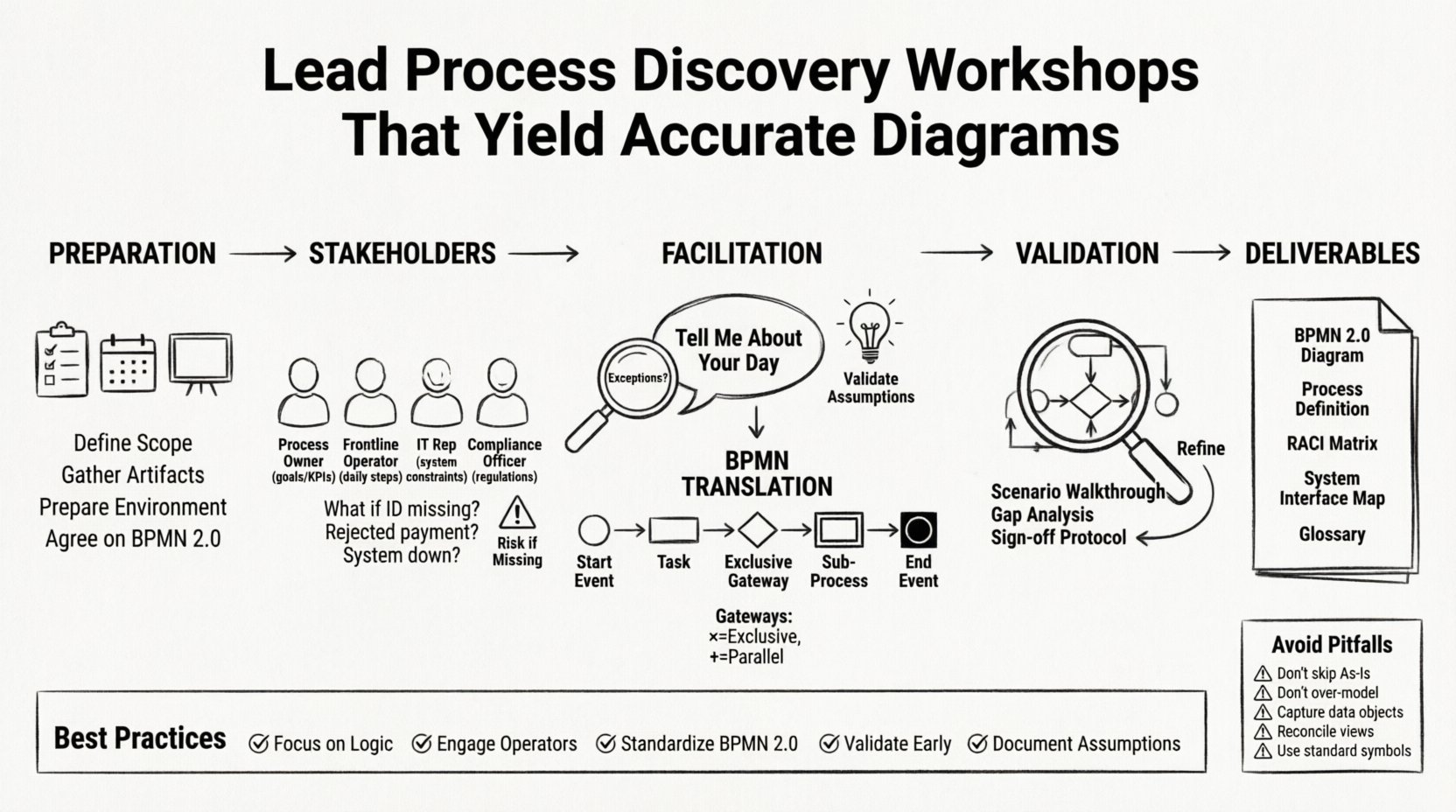
The workshop itself is only a fraction of the effort. The majority of the work happens before the first session begins. Preparation ensures that the time spent with stakeholders is utilized for deep diving rather than basic orientation.
- Define the Scope Clearly: Determine the start and end points of the process. Avoid trying to map the entire organization in a single session. Focus on specific value streams.
- Gather Existing Artifacts: Collect any current documentation, emails, or legacy diagrams. These serve as reference points but should not dictate the new model.
- Prepare the Environment: Ensure the room or virtual space supports collaboration. Whiteboards, sticky notes, and digital modeling tools must be ready.
- Identify the Notation Standard: Agree on BPMN 2.0 as the standard. This ensures consistency in symbols for events, gateways, and activities.
Without a clear agenda, discussions drift. A structured agenda keeps the team focused on the specific steps required to reach the workshop objectives.
👥 Identifying the Right Stakeholders
Choosing the right people is critical. Subject Matter Experts (SMEs) provide the content, but their availability and perspective must be managed carefully. Relying solely on management can lead to a “theoretical” map that ignores ground-level realities.
| Role | Primary Contribution | Risk if Missing |
|---|---|---|
| Process Owner | Defines goals and KPIs | Loss of strategic alignment |
| Frontline Operator | Details actual daily steps | Gap between theory and practice |
| IT Representative | Clarifies system constraints | Unfeasible automation requirements |
| Compliance Officer | Flags regulatory requirements | Risk of audit non-compliance |
When inviting participants, explain the purpose of the workshop. They need to understand that they are helping to improve the process, not being judged by it. This psychological safety encourages honest reporting of inefficiencies.
💬 Facilitation Techniques for Truthful Data
Facilitation is an art form that requires active listening and strategic questioning. The goal is to uncover the “As-Is” reality, including all the workarounds and shadow processes that exist outside official documentation.
1. The “Tell Me About Your Day” Approach
Start by asking stakeholders to describe a specific transaction from start to finish. Do not interrupt with technical terms. Let them speak in natural language. This helps identify the actual triggers and outcomes.
2. Probing for Exceptions
Standard flows are easy to document. Exceptions are where the value lies. Ask specific questions like:
- “What happens if the customer does not have the required ID?”
- “How do you handle a rejected payment?”
- “What if the system goes down during this step?”
Documenting these exceptions is vital for creating a robust model. A process without exception handling is incomplete.
3. Validating Assumptions
Participants often assume certain steps are automatic. Challenge these assumptions. Ask who performs the task and what data is required. Often, manual handoffs are hidden within automated descriptions.
📊 Translating Talk into BPMN Symbols
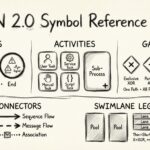
Once the information is gathered, it must be converted into BPMN notation. This translation requires strict adherence to the standard to ensure the diagram is readable by other modelers and technical teams. The following breakdown highlights how to map common process elements.
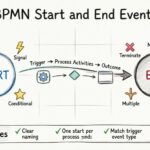
- Start Events: These represent the trigger. Is it a message from a customer? A scheduled time? A data change? Distinguish between Message Start Events and Timer Start Events clearly.
- Tasks and Sub-Processes: Break down complex activities. If a step involves multiple people or systems, consider a sub-process. This keeps the main diagram clean.
- Gateways: These control the flow. Use Exclusive Gateways for “Either/Or” scenarios and Parallel Gateways for “And” scenarios (where all paths must complete).
- End Events: Define the successful completion state. Does the process end with a notification? A physical handover? A database update?
- Artifacts: Use annotations to clarify complex logic that cannot be represented by flow lines alone.
Consistency in symbol usage is non-negotiable. If a rectangle represents a task in one part of the diagram, it must represent a task everywhere. Mixing symbols creates confusion and invalidates the model.
✅ Validating the Output
A diagram is not finished until it has been validated against reality. This step often requires a second round of meetings with the stakeholders. The goal is to walk through the model using specific scenarios.
Scenario Walkthroughs
Do not just ask if the diagram looks correct. Run specific cases through it. Say, “Let us trace a high-value order through this model.” Watch where the logic breaks or where the path diverges from what the stakeholder expects.
Gap Analysis
Identify missing steps during the walkthrough. If the stakeholder says, “Oh, we also need to check the inventory,” that is a missing activity that must be added. Document these gaps immediately.
Sign-off Protocol
Establish a formal sign-off process. Once the diagram is approved, any changes should go through a change control process. This prevents scope creep and ensures the baseline remains stable.
🚫 Common Pitfalls to Avoid
Even experienced facilitators fall into traps. Recognizing these pitfalls early can save weeks of rework.
- Skipping the “As-Is”: Jumping straight to the “To-Be” solution often leads to optimizing a broken process. Always map the current state first.
- Over-Modeling: Do not include every single click or screen change unless it impacts the logic. Keep the diagram at the right level of abstraction.
- Ignoring Data Objects: A process is often driven by data. Ensure you capture what data enters and leaves each step. This is crucial for integration.
- Single Source of Truth: Do not rely on one person for the entire process. Different departments may have different views of the same workflow. Reconcile these views.
- Using Non-Standard Symbols: Avoid custom shapes. If a symbol is not part of the BPMN standard, it will cause issues in downstream tools.
📦 Expected Deliverables
The workshop should produce more than just a visual chart. A comprehensive discovery effort yields a package of artifacts that support future development.
| Deliverable | Purpose |
|---|---|
| BPMN 2.0 Diagram | Visual representation of the flow |
| Process Definition Document | Textual description of rules and logic |
| Role and Responsibility Matrix | Clarifies who does what (RACI) |
| System Interface Map | Identifies touchpoints between applications |
| Glossary of Terms | Defines business terminology used |
These documents ensure that the knowledge gained during the workshop is retained even after the team moves to the next phase.
📈 Measuring Success
How do you know the workshop was effective? Success is not just about the number of diagrams produced. It is about the quality of the understanding gained.
- Stakeholder Confidence: Do the participants feel the model accurately reflects their work?
- Identification of Bottlenecks: Did the process reveal areas of delay or waste?
- Clarity for Developers: Can technical teams build the solution based on the documentation without excessive clarification calls?
- Reduction in Rework: Are changes to the process minimized during the implementation phase?
🛠️ Handling Conflicting Views
It is common for different departments to view the same process differently. Sales might see the process as “Order to Cash,” while Finance sees it as “Invoice to Payment.” These perspectives often conflict.
To resolve this, establish a hierarchy of truth. The operational reality usually takes precedence over the administrative view. Use the BPMN model to visualize the handoffs between these views. Show where the data changes context. This visual evidence often helps stakeholders agree on a unified model without forcing a compromise that satisfies no one.
🔄 Iterative Refinement
Process discovery is rarely a linear path. Expect to iterate. The first diagram is a hypothesis. The walkthroughs are the tests. The final diagram is the verified result. Do not be afraid to discard a model that does not hold up to scrutiny. It is better to start over than to build on a flawed foundation.
Adopt an agile mindset. Release versions of the diagram. Version 1.0 captures the basics. Version 1.1 adds the exceptions. Version 2.0 integrates the system constraints. This approach keeps the team engaged and provides a clear record of evolution.
🎯 Summary of Best Practices
To ensure the highest quality of output, adhere to these core principles:
- Focus on Logic: Flow matters more than decoration.
- Engage the Operators: They know the truth.
- Standardize Notation: Stick to BPMN 2.0.
- Validate Early: Test the model before finalizing.
- Document Assumptions: Record what was decided and why.
By following this structured approach, you create a reliable blueprint for business operations. Accurate diagrams reduce ambiguity, streamline automation, and provide a clear baseline for future improvements. The investment in rigorous discovery pays dividends throughout the lifecycle of the process.
🤝 Moving Forward
With the diagrams validated and the documentation complete, the focus shifts to optimization and automation. The accuracy of the initial discovery determines the speed of implementation. A clear map allows teams to navigate complex changes with confidence. Continue to refine the process as the business evolves, ensuring the model remains a living document rather than a static artifact.